What is AME Admission?
AME Admission refers to the enrollment process for Aircraft Maintenance Engineering courses at DGCA-approved training institutes across India. Getting AME admission is the first critical step toward becoming a licensed Aircraft Maintenance Engineer a highly skilled professional responsible for inspecting, maintaining, repairing, and certifying aircraft as airworthy. The AME admission 2026 process has already begun at leading institutes like the School Of Aeronautics (SOACET), offering students the opportunity to join India’s booming aviation sector with excellent career prospects and competitive salaries.
Why is AME Admission Important?
Securing AME admission at a DGCA-approved institute is essential because:
- Only DGCA-approved institutes can provide training that makes you eligible for the AME license. Quality infrastructure determines your hands-on learning experience with actual aircraft.
- Industry connections of your institute directly impact placement opportunities.
- Early admission ensures you don’t miss out on limited seats (typically 60-100 per institute).
Key Fact: India currently needs over 15,000 licensed AMEs to support fleet expansion by airlines like Air India, IndiGo, SpiceJet, and Vistara. Getting AME admission in 2026 positions you perfectly for this high-demand market.
AME Admission Eligibility Criteria 2026
Before applying for AME admission, candidates must verify that they meet the eligibility requirements. The criteria are standardized across most DGCA-approved institutes but may have minor variations.
Educational Qualification for AME Admission
Route 1: After 10+2 / Intermediate
| Requirement | Details |
| Qualification | 10+2 or equivalent from a recognized board |
| Compulsory Subjects | Physics AND Mathematics |
| Optional Subject | Chemistry OR Computer Science |
| Minimum Percentage | 50% aggregate in PCM / PC+Math |
| Reserved Categories | 45% for SC/ST candidates |
| Boards Accepted | CBSE, ICSE, All State Boards, NIOS |
Important: Both Physics and Mathematics are non-negotiable. Chemistry OR Computer Science is acceptable as the third subject. Route 2: After B.Sc. (Science Graduate)
| Requirement | Details |
| Qualification | Bachelor of Science from a UGC-recognized university |
| Required Subjects | Physics, Chemistry, Mathematics (all three) |
| Minimum Percentage | 50% aggregate in degree |
| Pattern Accepted | Both semester and annual patterns |
B.Sc. graduates often find AME admission smoother and may receive exemptions for certain foundation modules based on their undergraduate coursework. Route 3: After Engineering Diploma (Lateral Entry)
| Requirement | Details |
| Qualification | 3-year Engineering Diploma |
| Eligible Branches | Mechanical, Electrical, Electronics, Instrumentation, Telecommunications |
| Recognition | AICTE-approved or State Technical Board |
| Advantage | Possible exemptions and reduced course duration |
Diploma holders in relevant engineering branches can leverage their technical background for faster progression through AME admission and training.
Additional Requirements for AME Admission
Age Criteria:
- Minimum Age: 16 years completed at the time of admission
- Maximum Age: Generally, no upper limit, though most candidates are between 17-25 years
Medical Fitness:
- DGCA Class II Medical Certificate required eventually
- Can be obtained after provisional AME admission
- Must be from a DGCA-approved Aviation Medical Examiner
- Tests vision (correctable to 6/6), color perception, hearing, and general health
Nationality:
- Indian citizens eligible
- Foreign nationals are eligible (subject to additional documentation and approvals)
English Language:
- Basic proficiency in reading and writing English
- All DGCA exams, technical manuals, and aviation documentation are in English
AME Admission Process – Step by Step
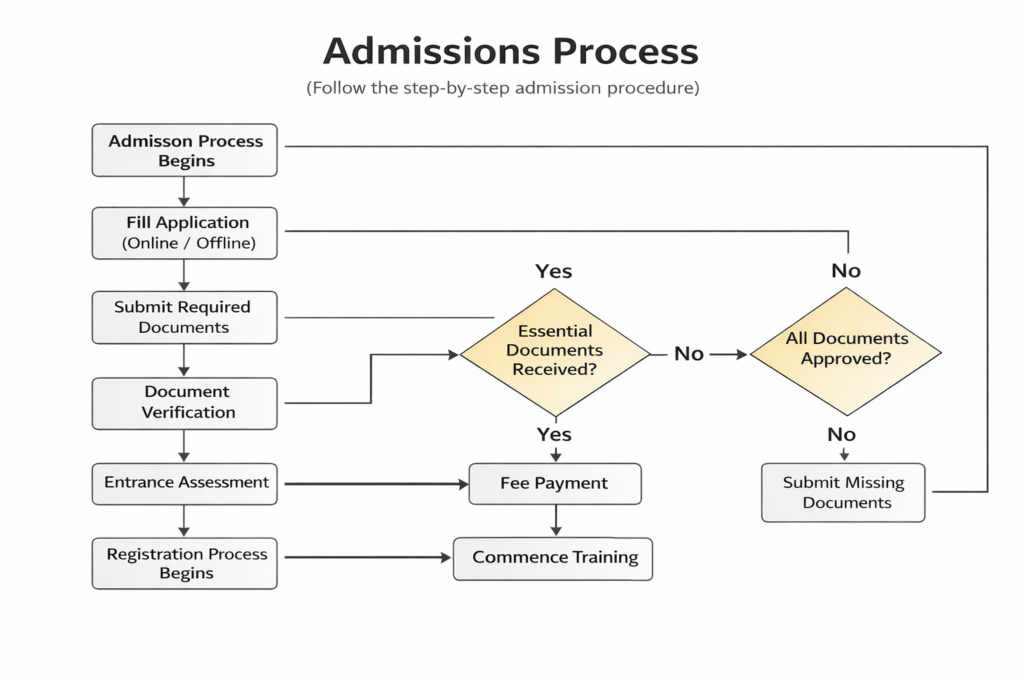
The AME admission process varies slightly by institute but follows a general pattern. Here’s a comprehensive step-by-step guide:
Step 1: Research and Choose DGCA-Approved Institutes
What to Check:
- DGCA approval certificate (most important)
- Infrastructure: Does the institute have actual aircraft, engines, and workshops?
- Faculty: Are instructors DGCA-approved and industry-experienced?
- Placement record: What percentage of students get jobs?
- Location and hostel facilities
Top Institutes for AME Admission:
- School Of Aeronautics (SOACET) soacet.org
- Other DGCA-approved organizations across India
Step 2: Check Eligibility Criteria
Verify you meet:
- Educational qualification (10+2 PCM 50% / B.Sc. / Diploma)
- Age requirement (minimum 16 years)
- Subject requirements (Physics + Mathematics mandatory)
Pro Tip: If you’re borderline on percentage, some institutes offer conditional admission with options to improve scores.
Step 3: Register for Entrance Exam (If Applicable)
Many institutes conduct entrance examinations for AME admission: For SOACET:
- Register at soacet.org
- Fill online application form
- Pay application fee (typically ₹500-1,000)
- Download the admit card before the exam date
Some institutes also offer:
- Direct admission based on 10+2 merit
- Management quota seats
- NRI/foreign national quota
Step 4: Prepare for and Appear in the Entrance Exam
Exam Pattern (Typical):
- Subjects Tested: Physics, Chemistry, Mathematics, English/Aptitude
- Question Type: Multiple Choice Questions (MCQs)
- Duration: 2-3 hours
- Syllabus: Based on 10+2 NCERT curriculum
- Passing Criteria: Institute-specific cut-off marks
Preparation Strategy:
- Revise NCERT textbooks (Class 11-12) thoroughly
- Focus on Physics and Mathematics numericals
- Practice previous year question papers
- Take timed mock tests to build speed
- Strengthen weak areas identified in mock tests
Step 5: Check Results and Attend Counseling
After Entrance Exam:
- Results published on the institute website (typically 2-4 weeks after exam)
- Merit list prepared based on scores
- Qualified candidates are called for counseling
Counseling Process:
- Report to the designated venue with original documents
- Document verification by the admission committee
- Seat allocation based on merit rank and availability
- Stream selection (Mechanical B1 or Avionics B2)
- Fee payment options discussed
Step 6: Document Verification
Original Documents Required:
| Document | Purpose |
| 10th Mark Sheet & Certificate | Age and basic education proof |
| 12th Mark Sheet & Certificate | Eligibility verification |
| Transfer Certificate | From a previous institution |
| Character Certificate | Conduct verification |
| Passport-size Photographs | 6-8 recent color photos |
| Aadhar Card / ID Proof | Identity verification |
| Domicile Certificate | For state quota (if applicable) |
| Caste Certificate | For reservation benefits (if applicable) |
| Migration Certificate | If from a different state/board |
| Income Certificate | For scholarship eligibility |
Important: Carry both originals and photocopies. Originals verified and returned; copies retained.
Step 7: Fee Payment and Admission Confirmation
Fee Payment Options:
- One-time full payment (may include a discount)
- Semester-wise installment plan
- Module-wise payment (for AME programs)
- Education loan (with bank tie-ups)
After Fee Payment:
- Receive provisional admission letter
- Get a student ID card
- Access to the student portal
- Hostel room allocation (if required)
Step 8: Complete Medical Examination
DGCA Class II Medical Certificate:
- Must be done at a DGCA-approved medical center
- List of approved doctors provided by the institute
- Cost: ₹2,000-3,000 approximately
- Validity: Regular renewals required during the course
Medical Tests Include:
- Vision test (distance and near vision)
- Color vision test (Ishihara plates)
- Hearing assessment
- Blood pressure and heart rate
- General physical examination
Step 9: Join Orientation and Start Classes
Orientation Program:
- Introduction to DGCA regulations
- Campus tour and facility explanation
- Faculty introduction
- Course structure overview
- Student handbook distribution
- Hostel rules and regulations
Classes Typically Start:
- July-August for the regular batch
- January-February for mid-year batch (some institutes)
Your AME admission is now complete! You are officially an AME student.
Entrance Exams for AME Admission
Understanding which entrance exams are accepted for AME admission helps you plan your application strategy.
Institute-Specific Entrance Exams
SOACET (School Of Aeronautics Common Entrance Exam):
- Conducted by the School Of Aeronautics
- Application: soacet.org
- Exam Mode: Online/Offline
- Subjects: Physics, Chemistry, Mathematics, English
- Eligibility: 10+2 with PCM (50%)
Other AME Entrance Tests: Various DGCA-approved institutes conduct their own entrance examinations with similar patterns.
AME CET (Aircraft Maintenance Engineering Common Entrance Test)
About AME CET:
- Conducted by a consortium of AME institutes
- Accepted by multiple training organizations
- National-level examination
- Single exam, multiple college options
Key Differences:
Strategy: You can appear for both to maximize admission opportunities.
Direct Admission Without Entrance Exam
Some institutes offer AME admission based on:
- 10+2 merit marks (typically 70%+ in PCM)
- Management quota
- Donation/NRI seats
- Diploma/B.Sc. qualification (lateral entry)
When to Consider Direct Admission:
- If the entrance exam dates clash
- If you have exceptionally strong 10+2 marks
- If you prefer certainty over competitive exams
AME Admission Dates & Timeline 2026
Planning your AME admission requires knowing important dates and deadlines.