

India’s aviation sector is hiring. Airlines are expanding their fleets. MRO companies are scaling up. And the demand for licensed Aircraft Maintenance Engineers has never been stronger. But between your dream of working on aircraft and your first day of training sits one thing that every student must navigate correctly: the admission process.
The AME admission process in India is not complicated, but it is specific. Unlike university admissions guided by JEE counselling or centralised portals, AME admissions are managed individually by each DGCA-approved institute. That means the student who understands the process has a significant advantage over those who are figuring it out as they go.
This guide takes you through every step of the AME admission process 2026, from confirming your eligibility on Day 1 to walking out of enrollment with your institute ID and training schedule in hand. Follow it exactly, and your admission will be smooth, confident, and on time.
What You Will Learn: The complete 8-step AME admission process, 2026 eligibility confirmation, DGCA institute verification, shortlisting, application submission, entrance test, offer letter review, seat confirmation, and enrollment. Plus common mistakes at every stage and how to avoid them.
Read Before: AME Admission 2026: Complete Guide to Aircraft Maintenance Engineering Admission
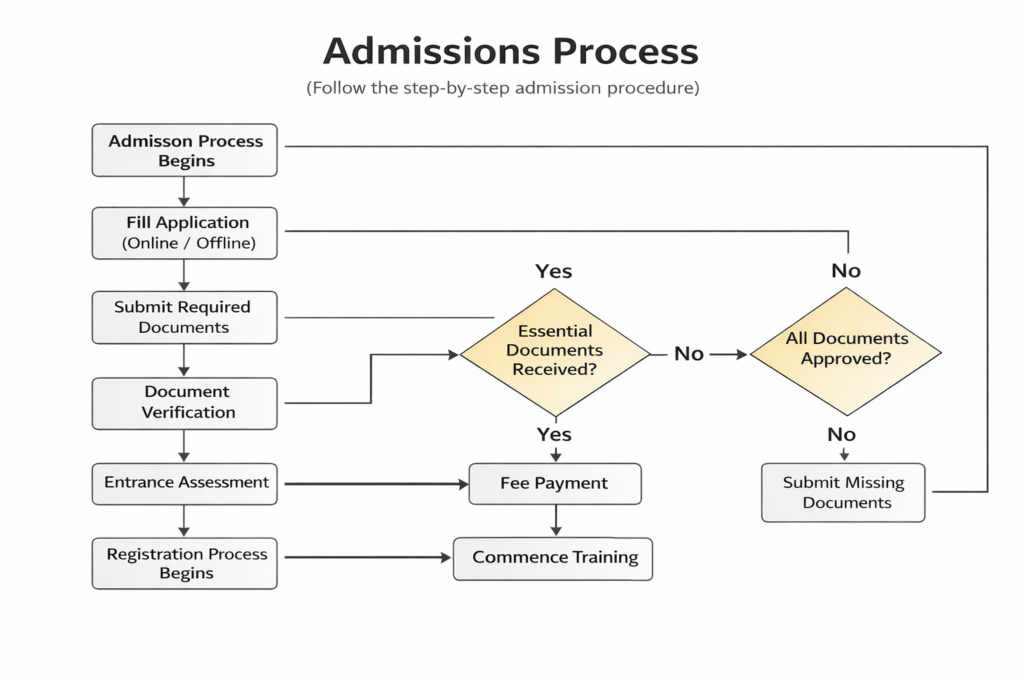
AME Admission Process 2026: Complete Overview at a Glance
Before we walk through each step in detail, here is the complete AME admission process 2026 overview so you know exactly where you stand at any point:
| Step | Stage | Timeline (2026) | Key Action |
| Step 1 | Confirm DGCA Eligibility | December 2025 – January 2026 | Verify PCM marks, age, and board recognition |
| Step 2 | Verify DGCA Institute Approval | January 2026 | Check the dgca.gov.in approved list |
| Step 3 | Research & Shortlist Institutes | January – February 2026 | Evaluate 4–6 institutes on 6 criteria |
| Step 4 | Submit Applications | January – March 2026 | Online/offline forms + application fee |
| Step 5 | Appear for the Entrance Test | March – May 2026 | Physics + Maths written test + interview |
| Step 6 | Receive & Review Offer Letter | April – June 2026 | Verify all terms before signing |
| Step 7 | Confirm Seat and Pay Fees | May – June 2026 | Pay confirmation fee; submit documents |
| Step 8 | Complete Enrollment | June – July 2026 | Attend orientation; collect ID and schedule |
First-Mover Advantage: Quality DGCA-approved AME institutes fill their June 2026 intake seats on a rolling basis, first-come, first-served. Students who begin Step 1 in December and complete applications by February consistently access better institute options, better hostel rooms, and stronger placement batches. There is no centralised waitlist. If a seat is gone, it is gone.
The Complete 8-Step AME Admission Process 2026
STEP 1: Confirm Your DGCA Eligibility Before Anything Else
The AME admission process begins not with an application form but with a document in your hand: your Class 12 mark sheet. DGCA’s eligibility requirements are specific, and confirming you meet every one of them before applying prevents wasted applications, wasted fees, and wasted time.
- Your Class 12 must be from a recognised board, CBSE, ICSE, or any State Board. International board students (IGCSE, IB) need an AIU equivalency certificate. Board recognition:
- Physics AND Mathematics are mandatory. Chemistry is required by all quality institutes. PCM students are fully eligible. Compulsory subjects:
- 50% aggregate in Physics + Mathematics (DGCA minimum). Most institutes set their practical minimum at 50–55% PCM aggregate. 5% relaxation for SC/ST/OBC. Minimum marks:
- Minimum 16 years at admission. No upper age limit. Must be 18+ when applying for DGCA license (after training completion). Age:
- Adequate vision (corrected acceptable for B1.1), normal colour vision for the B2 category, adequate hearing, and general physical fitness. Medical baseline:
PCB Students: Standard DGCA eligibility requires Mathematics at Class 12. PCB students without Mathematics are not eligible under the general rules. Check if your state board records Mathematics as an additional subject on your transcript.
STEP 2: Verify DGCA Approval of Every Institute You Consider
This is the most important step in the entire AME admission process 2026 and the one most commonly skipped. Every year, students pay full course fees to institutes that are not DGCA-approved, complete 2–3 years of training, and discover their certificate has zero legal value. Five minutes of verification prevents this catastrophe.
- dgca.gov.in → Aviation Training Organisations → Approved Basic AME Training Organisation List Go to:
- The exact institute name appears on the current active list. Confirm:
- The approval is current and not expired. Confirm:
- The approval covers your desired category B1.1, B1.3, or B2 Confirm:
- Call DGCA’s regional office directly to confirm approval status. Uncertain?:
Non-Negotiable Rule: If an institute is not on the DGCA-approved list, regardless of what their brochure, website, counsellor, or admission agent claims, do not proceed. An AME certificate from a non-approved institute cannot be used to sit DGCA Module exams or receive a license. This mistake cannot be undone after fees are paid.
Note: Book a FREE counselling session through SOACET to understand the AME admission process clearly.
STEP 3: Research and Shortlist 4–6 DGCA-Approved Institutes
With a verified list of approved institutes in hand, shortlist 4–6 based on the criteria that actually predict your career outcomes, not brochure aesthetics or admission agent recommendations.
- How many operational aircraft does the institute own? Are they airworthy and actively used for student training, or grounded static models? Ask specifically. Aircraft fleet quality:
- Request the last 3-year Module exam pass percentages. Institutes confident in their academics share this proudly. Those who deflect are hiding poor results. DGCA Module exam pass rates:
- Which airlines or MRO companies have formal MOU agreements with this institute for OJT placement? Structured partnerships mean prompt placement after classroom completion. OJT placement partnerships:
- Which companies recruited from this institute’s last 3 batches? Verify on LinkedIn by searching for alumni. Real outcomes are always verifiable. Placement history:
- Hangar quality, avionics labs, engine test benches, workshop facilities. Request a campus visit or verified video tour. Infrastructure:
- Get a full 3-year written fee schedule, tuition, hostel, exam fees, and materials. Compare total cost, not just Year 1 figures. Complete fee transparency:
Campus Visit Advice: For a program you will spend 2–3 years at, a 3-hour campus visit is non-negotiable. You can assess aircraft condition, lab quality, hostel standards, and faculty approachability in ways that no brochure can communicate. Visit your top 2–3 shortlisted institutes before finalising.
STEP 4: Submit Your AME Admission Application
With your shortlist confirmed, submit applications to your top 4–6 DGCA-approved institutes simultaneously, not sequentially. Applying to one at a time wastes months if you are not selected.
- Fill in the institute portal forms carefully. Upload clear, legible scans of the Class 12 mark sheet, Class 10 mark sheet, Aadhaar Card, and 1 passport photo. Errors in name, DOB, or category cause delays. Online application:
- Bring original documents + 3 sets of attested photocopies. Request an acknowledgement receipt for every document submitted. Direct/walk-in application:
- ₹500–₹2,000 (non-refundable, varies by institute). Pay only through the official institute payment channels. Never pay cash without a printed receipt. Application fee:
- Most institutes accept applications from January to March for the June 2026 intake. Some strong institutes close applications as early as February when seats fill. Application deadline:
Application Accuracy Tip: Your name, date of birth, category, and subject details on the application form must match your supporting documents exactly. A discrepancy, even a single letter difference in your name, triggers a verification flag that delays your application by weeks. Double-check before submitting.
STEP 5: Prepare for and Clear the Institute’s Selection Process
Most DGCA-approved AME institutes conduct a selection process before issuing offer letters. Understanding what each component tests and how to prepare for it significantly improves your selection outcome.
Written Entrance Test
The written test covers Physics and Mathematics at the Class 11–12 level. Some institutes add English comprehension and basic logical reasoning. Key topics to revise:
- Mechanics (Newton’s laws, friction, circular motion), Thermodynamics, Electricity and Magnetism, Waves and Optics, all at the Class 12 level.
- Algebra, Trigonometry, Coordinate Geometry, Calculus basics, Statistics, Mathematics:
- 60–100 MCQ questions, 60–90 minutes, negative marking at some institutes. Typical format:
Revision Strategy: Revise Class 11–12 NCERT Physics and Mathematics systematically, do not attempt shortcuts. 2–3 weeks of focused NCERT revision is sufficient preparation for most AME entrance tests. Practice previous year papers from similar institutes if available.
Personal Interview
The personal interview is typically 10–20 minutes and assesses three things: genuine aviation interest, communication clarity, and career awareness. You do not need aerospace engineering expertise you need to demonstrate authentic motivation and basic preparedness:
- Know their fleet, DGCA approval history, and notable alumni. Mentioning specific aircraft types they operate shows genuine interest. Research the institute before your interview:
- Be able to explain the role of an AME in simple, clear terms. “Aircraft Maintenance Engineers inspect, maintain, repair, and certify the airworthiness of aircraft under DGCA authority.” Know what AMEs do:
- Be ready to explain why you chose B1.1 or B2 and what career that leads to. Know your category choice:
- First impressions in aviation are permanent. Formal shirt, trousers, polished shoes. Dress formally:
Merit-Based Selection (Some Institutes)
Some institutes select purely on Class 12 PCM aggregate, no written test required. If your marks are 70%+, these institutes offer faster-track admission. Check the specific selection method of each institute during your research phase.
STEP 6: Receive and Carefully Review Your Offer Letter
An offer letter from a DGCA-approved AME institute is a significant milestone, but review every detail before acting on it. The offer letter is a legally binding document. Confirm every item before paying a single rupee toward seat confirmation:
- Must be explicitly stated. Program name and AME license category (B1.1 / B2):
- Cross-verify against the DGCA website. The approval number on the letter must match the current DGCA-approved list. DGCA approval number:
- No verbal fee promises. Total tuition, hostel fees, and examination fees for all three years must be on the document. Complete 3-year fee schedule in writing:
- Amount stated and whether it adjusts against Year 1 tuition or is forfeited on withdrawal. Seat confirmation fee:
- Confirm you can meet these dates before accepting. Program start date and reporting deadline:
- What are the institute’s formal OJT placement arrangements? This should be in writing. OJT policy:
Offer Letter Red Flags: Be cautious if: (1) DGCA approval number is missing from the offer letter; (2) The fee schedule covers only Year 1 without a 3-year breakdown; (3) OJT arrangements are described vaguely as ‘student’s own arrangement’; (4) The letter requires large upfront payments within 24–48 hours. These are warning signs of either disorganisation or deceptive practices.
STEP 7: Confirm Your Seat and Complete Fee Payment
Once you are satisfied with the offer letter details, confirm your seat:
- Via the official institute payment channel, only NEFT/RTGS, demand draft, or the institute payment portal. Never pay through the personal accounts of agents or counsellors. Pay the seat confirmation fee:
- Written receipt for every payment made. File every receipt; you will need them for loan disbursement, scholarship applications, and fee adjustment at enrollment. Collect payment receipt:
- Typically attested copies of Class 12 mark sheet, Aadhaar, category certificate, and photographs as specified in the offer letter. Submit seat confirmation documents:
- If funding your education through a bank loan, the loan must be sanctioned before seat confirmation. Begin the loan process at least 8 weeks before your intended enrollment date. Education loan timing:
- If you need hostel accommodation, confirm availability and register simultaneously with seat confirmation. Hostel seats at good institutes fill as fast as academic seats. Hostel registration:
STEP 8: Complete Enrollment and Begin Your AME Training Journey
The final step of the AME admission process 2026 is enrollment, the official beginning of your aviation career. Arrive on the reporting date with your complete document folder:
- Every document submitted as a copy during the process is physically verified against originals at enrollment. Originals are verified and returned, not retained permanently. Bring all originals:
- Institute retains verified copies; you keep originals (confirm this policy before handing over any original). Complete original document submission:
- DGCA compliance requirements, institute safety protocols, training schedule, and aviation discipline standards are introduced at orientation. These are professionally important foundations — not optional formalities. Attend orientation mandatorily:
- Student ID, DGCA training file, lab access authorisation, timetable, and library/study material list. Collect your training kit:
- Most quality institutes have an online learning management system for study materials, schedules, and Module exam resources. Register on the LMS / student portal:
- The best AME students begin Module 1 (Mathematics) study from their very first week. This single habit separates students who graduate in 3 years from those who take 4. Start Module exam preparation from Week 1:
5 Costly Mistakes in the AME Admission Process And How to Avoid Every One
Mistake 1 Skipping DGCA Verification
Enrolling at an institute without verifying DGCA approval at dgca.gov.in is the single most catastrophic mistake in the AME admission process. Five minutes of verification eliminates the risk of a 3-year wasted investment. Always verify. No exceptions.
Mistake 2 Applying to Only One Institute
Applying to a single institute and waiting for their response before applying elsewhere loses weeks or months. Apply to 4–6 DGCA-approved institutes simultaneously. More applications mean more options, more negotiating leverage, and a much shorter admission timeline.
Mistake 3 Evaluating Institutes on Fee Alone
The cheapest AME institute is often the cheapest for a reason grounded aircraft fleet, poor Module exam preparation, and weak OJT placement networks. Evaluate quality first: fleet, pass rates, OJT partners, and placement history. Then evaluate fees. The difference between a ₹5 lakh and ₹9 lakh program disappears within 18 months of employment with a good starting salary.
Mistake 4 Starting Too Late
Students who begin the AME admission process in May for a June intake find the best seats already filled. Start in December or January. The early applicant accesses better institute options, better hostel rooms, and better batch compositions. Quality institutes reward preparedness.
Mistake 5 Ignoring the OJT Question
Every student asks about fees, fleet, and facilities. Very few ask about OJT. Ask every shortlisted institute directly: Which airlines and MRO companies are your formal OJT partners? What is your average gap between classroom completion and OJT placement? The answers reveal the institute’s real career delivery capability.
AME Admission Process 2026: Month-by-Month Timeline
| Month | AME Admission Process Activity | Priority Level |
| December 2025 | Class 12 results out (most boards); begin eligibility confirmation; start DGCA research | High |
| January 2026 | DGCA institute verification; campus visits; shortlist finalised | High |
| January – February 2026 | Submit applications to 4–6 institutes; application fees paid | High |
| February – March 2026 | Entrance test preparation; document folder assembled and attested | High |
| March – April 2026 | Written entrance tests and personal interviews at the shortlisted institutes | Critical |
| April – May 2026 | Offer letters received; review terms; begin education loan process if needed | Critical |
| May – June 2026 | Seat confirmation fee paid; hostel registration; scholarship applications (NSP) | Critical |
| June – July 2026 | Enrollment; orientation; DGCA training begins; Module 1 study starts Day 1 | Begin Career |
Frequently Asked Questions: AME Admission Process 2026
Q: What is the AME admission process in India for 2026?
A: The AME admission process 2026 in India involves 8 steps: (1) Confirm DGCA eligibility Class 12 PCM with Physics + Mathematics at minimum 50%; (2) Verify DGCA approval of your chosen institute at dgca.gov.in; (3) Research and shortlist 4–6 institutes based on fleet, Module pass rates, and OJT partnerships; (4) Submit applications (January–March 2026); (5) Appear for written entrance test and personal interview (March–May); (6) Review offer letter terms carefully; (7) Pay seat confirmation fee and submit documents (May–June); (8) Complete enrollment and begin training (June–July 2026). Unlike JEE counselling, there is no centralised portal each DGCA-approved institute manages its own process.
Q: Is JEE required for the AME admission process in India?
A: No JEE Main or Advanced is required at any stage of the AME admission process. AME programs are professional license training programs regulated by DGCA, not university engineering programs requiring JEE. Selection is based on your Class 12 PCM marks and an institute-level entrance test covering Physics and Mathematics at the Class 11–12 level. This makes excellent aviation careers accessible to students who did not qualify through JEE some of India’s finest licensed AMEs never appeared for JEE at all.
Q: How long does the complete AME admission process take from start to enrollment?
A: From beginning Step 1 (eligibility confirmation) to completing Step 8 (enrollment), the AME admission process 2026 typically takes 4–6 months for students who start in December–January. Students who begin in March find the process compressed into 3 months, but with fewer quality institute options available. The admission process itself, from application to offer letter, typically takes 6–10 weeks, depending on the institute. Seat confirmation to enrollment typically takes 4–6 weeks. Starting in January gives you the most time, the most choices, and the most relaxed process.
Q: Can I apply to multiple institutes simultaneously in the AME admission process?
A: Yes, and you absolutely should. The AME admission process in India has no centralised application system like JoSAA or CSAB. Each DGCA-approved institute accepts applications independently. Applying to 4–6 institutes simultaneously is standard good practice. It maximises your options, protects you against rejection at any single institute, and gives you comparison leverage when evaluating offer letters. Pay application fees at multiple institutes; seat confirmation fees are paid only after selecting your preferred offer.
Q: What happens if I miss the AME admission deadline for the June 2026 intake?
A: If you miss the main June 2026 intake deadline at your preferred institutes, some DGCA-approved institutes offer a second intake in October–November 2026. However, not all institutes offer a second batch, and seat availability is significantly lower in the second intake. The more strategic action is to begin the AME admission process in January 2026 for the June intake. Early applicants consistently access better institute options and stronger batch compositions. If you do miss the main intake, use the gap period productively: complete your document preparation, revise Physics and Mathematics, and research OJT quality extensively so you are maximally prepared for the next intake.
Conclusion: The AME Admission Process Is Straightforward If You Start Right
The AME admission process 2026 rewards one quality above all others: preparation. Students who understand every step before they begin, who verify DGCA approval, shortlist on quality criteria, apply early, prepare for their entrance tests, and review offer letters with care consistently secure better institutes, better batches, and better career starts.
India’s fleet is growing. Airports are being built. MRO capacity is expanding. Airlines are hiring licensed AMEs at a rate India has never seen before. The opportunities are real, documented, and waiting. The students who complete the AME admission process correctly in 2026 will be the licensed engineers that airlines are competing to recruit by 2030.
Eight steps. Clear criteria. No JEE required. Follow the process, and your aviation career begins exactly on schedule.
Step 1 starts today. Your aviation career starts here.
Considering Both AME and B.Tech Aeronautical Engineering for 2026?
SOA School of Aeronautics, Neemrana, India’s dedicated aeronautical engineering institution in the Delhi NCR / DMIC aerospace corridor. Our B.Tech Aeronautical Engineering program includes DGCA regulatory framework exposure throughout the curriculum, creating a natural pathway to AME licensing after graduation. Dual specialisation tracks in Aircraft Structures + Aerodynamics and Avionics + UAV Systems. Our admissions team will help you compare the full AME admission process vs. the B.Tech pathway and make the right 2026 decision for your career. https://soacet.org/ | 2026 Admissions Open Talk to Our Team Today