
India’s aviation sector is growing at a pace that makes Aircraft Maintenance Engineering one of the most in-demand professional qualifications available to Class 12 students today. But before you can begin your AME training, there is one step that determines everything: admission.
The AME admission process in India is unlike university admission. There is no centralised portal, no JEE-style counselling, and no statewide seat allotment system. Each DGCA-approved institute runs its own admission independently. That gives motivated students significant advantages, but only if they understand exactly how the process works.
This guide explains the AME admission process in India completely, from initial eligibility confirmation through five admission phases to final enrollment. It includes a comparison across different admission routes, a clear view of what differentiates AME admission from engineering admission, and practical guidance for diploma holders, graduates, and students at every stage.
Before You Continue: The AME admission process in India is legally valid only at DGCA-approved institutes. Before investing time in any admission process, verify the institute’s DGCA approval at dgca.gov.in. Training at an unapproved institute, regardless of how its admission process appears, cannot produce a DGCA AME license.
How the AME Admission Process in India Differs from Engineering Admission
Most students approach the AME admission process with the mental model of engineering admission and immediately encounter confusion. The two processes are fundamentally different in almost every dimension.
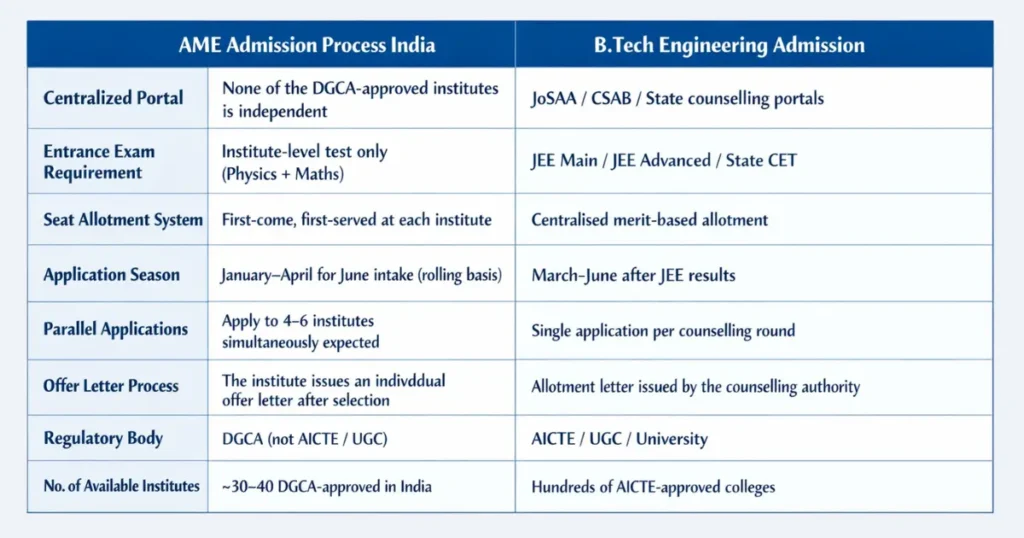
The most important operational difference: the AME admission process in India has no waitlist safety net. A student who secures a seat at one DGCA-approved institute and later discovers a better option cannot simply switch through a counselling process. Thorough research before applying, and applying to multiple institutes in parallel, is an essential strategy, not optional caution.
The 5 Phases of the AME Admission Process in India
The AME admission process in India unfolds across five distinct phases. Understanding each phase, including what happens, what is required, and what decisions you must make, is the difference between a smooth admission and a costly error.
PHASE 1 Pre-Application Preparation | December – January
Before touching an application form, complete three tasks:
- Confirm your DGCA eligibility Class 12 PCM with Physics + Mathematics at minimum 50% aggregate, minimum age 16, recognised board.
- Verify DGCA approval of every institute you are considering at dgca.gov.in.
- Assemble your initial document folder Class 10 mark sheet, Class 12 mark sheet, Aadhaar Card, passport photos. Completing Phase 1 thoroughly eliminates 90% of the problems students encounter later in the process.
PHASE 2 Application Submission | January – March
Submit applications to 4–6 DGCA-approved institutes simultaneously. The AME admission process in India has no limit on parallel applications applying to multiple institutes is standard good practice, not an indication of indecision. Each application requires a filled application form (online or offline), Class 10 and 12 mark sheets, an Aadhaar Card, photographs, and an application fee of ₹500–₹2,000 (non-refundable). Pay only through official institute channels. Errors in name, date of birth, or category on the form create verification delays. Double-check every entry before submitting.
PHASE 3 Selection Process | March – May
The selection stage is where the AME admission process in India has the most variation between institutes. Three selection methods are used:
- Written entrance test in Physics and Mathematics at the Class 11–12 level, typically 60–80 MCQs in 60–90 minutes. Some institutes add English comprehension
- Personal interview, 10–20 minutes, assessing aviation motivation, communication quality, and basic aviation awareness.
- Merit-based selection, direct admission based on Class 12 PCM aggregate, no written test required. Many institutes use a combination of a written test followed by a brief personal interview. Know which method your target institutes use and prepare accordingly.
PHASE 4 Offer Letter and Seat Confirmation | April – June
Shortlisted candidates receive offer letters. This is the most financially consequential phase of the AME admission process in India.
Before paying seat confirmation fees, verify: the DGCA approval number on the offer letter matches the DGCA website, all 3-year fees are stated in writing, OJT arrangements are specified with named partners, and seat confirmation fee amount and forfeiture policy are clearly stated. Pay the seat confirmation fee only through the official institute payment systems.
Simultaneously: apply for an education loan (requires 6–8 weeks processing), apply for NSP scholarships, and register for a hostel if needed.
PHASE 5 Enrollment and Orientation | June July
The final phase of the AME admission process in India is enrollment. Arrive on the reporting date with your complete document folder, all originals for verification (returned after checking) and 5 sets of attested photocopies. Attend orientation fully. DGCA compliance requirements, training schedules, and safety protocols are introduced here. Collect student ID, training file, timetable, and DGCA Module study materials. Register on the institute’s LMS/student portal. Begin DGCA Module 1 (Mathematics) preparation from your very first week.
Note: Book a FREE counselling session through SOACET to understand the AME admission process clearly.
AME Admission Process in India: Route Variations by Student Background
The AME admission process in India is not identical for every student. Your academic background changes both the admission pathway and the DGCA Module exam requirements once you are admitted:
Route 1 Class 12 PCM Students (Standard Route)
The most common entry point into AME training in India. Eligibility: Class 12 with Physics, Chemistry, and Mathematics, with a minimum 50% in Physics + Mathematics combined. Admission process: Phase 1–5 as described above. Program duration: 2–3 years classroom + 1 year OJT minimum. DGCA Module exams required: 13–17, depending on category. This is the standard, well-defined route with the widest range of institute options.
PCM Score Strategy: Scoring 60%+ in PCM gives you access to the best DGCA-approved AME institutes in India with merit scholarship eligibility. Scores between 50–59% meet the minimum threshold, your application is evaluated, but your institute options narrow. If your final Class 12 result is borderline, contact the institutes directly to confirm your specific score’s eligibility before the application window closes.
Route 2 Diploma Holders (Lateral Entry)
Students with a 3-year engineering diploma (especially in Mechanical, Electrical, Electronics, or Aeronautical Engineering) can apply for lateral entry into AME training at some DGCA-approved institutes. Lateral entry typically means entry at a more advanced stage of the classroom curriculum, with credit given for relevant technical subjects already covered in the diploma. Not all institutes offer lateral entry confirm availability and terms before applying.
- 3-year engineering diploma from a recognised polytechnic in a relevant discipline. Eligibility:
- Possible for some modules based on the diploma syllabus overlap to submit the transcript to DGCA for credit assessment. DGCA Module exemptions:
- Potentially shorter classroom training duration and reduced total program cost. Advantage:
- OJT requirement of minimum 12 months remains unchanged regardless of lateral entry status. Caveat:
Route 3 B.Tech Aeronautical Engineering Graduates (Fast-Track)
B.Tech Aeronautical Engineering graduates represent the most advantageous entry point in the entire AME admission process in India. DGCA grants Module exam exemptions to engineering graduates under CAR-66 provisions based on their B.Tech syllabus coverage.
- Typically, 8–12 modules are exempted based on the B.Tech syllabus. Submit the official transcript to the DGCA regional office for credit assessment. DGCA Module exemptions:
- 18–24 months total (classroom + OJT) vs 3–4 years for Class 12 entrants. Effective training duration:
- B.Tech + AME license combination commands 25–40% salary premium over single-qualification engineers or AMEs. Salary impact:
- Same Phase 1–5 as standard route, but with B.Tech qualification presented at Phase 1 eligibility confirmation and DGCA exemption application submitted during Phase 2 Admission process:
SOA Neemrana Note: SOA School of Aeronautics, Neemrana, offers B.Tech Aeronautical Engineering with DGCA regulatory framework exposure throughout the 4-year curriculum, specifically preparing graduates for the fast-track AME licensing pathway. Students who complete B.Tech at SOA Neemrana have the strongest possible preparation for AME admission and module exemption applications. Visit soacet.org for full program details.
Route 4 Career Changers and Mature Students
There is no upper age limit in the AME admission process in India. Adults who have worked in other fields and are transitioning to aviation careers are fully eligible. Some DGCA-approved institutes have experienced batches with students ranging from 18 to 35+ years. Career changers bring workplace discipline, communication skills, and life experience that often compensate for any gap in technical foundation, provided they invest adequately in Class 11–12 Physics and Mathematics revision before their entrance test.
Understanding Selection Methods in the AME Admission Process in India
Since each DGCA-approved institute manages its own selection, the test format and evaluation criteria vary. Here is what to expect across the three common selection approaches:
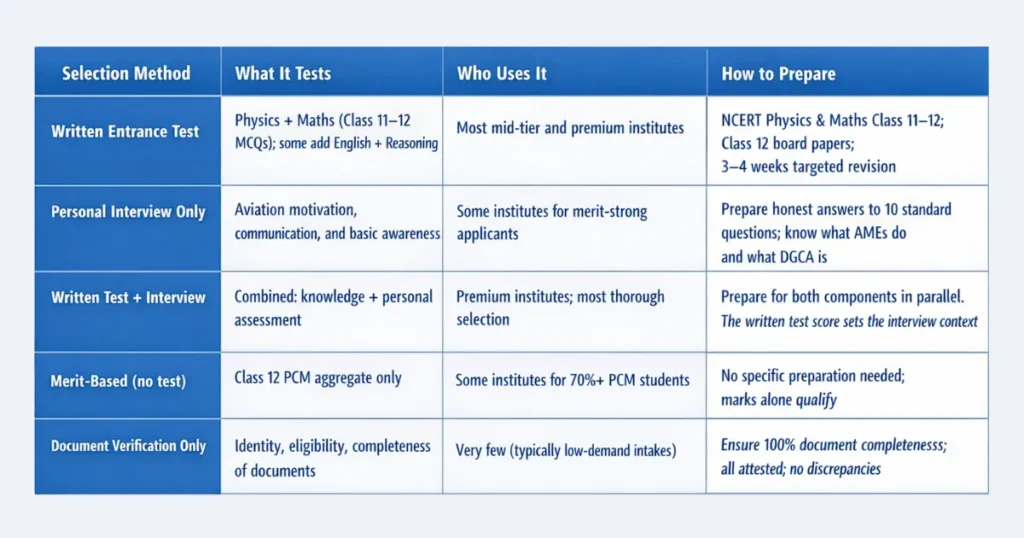
Multiple Shortlists Strategy: Apply to institutes using different selection methods in parallel. If you are strong at entrance tests, prioritise test-based institutes. If your Class 12 PCM score is 70%+, include merit-based institutes in your shortlist for a guaranteed seat while you attempt test-based selections for better institutes. This layered strategy ensures you always have a backup within the AME admission process in India.
Common Pain Points in the AME Admission Process in India And How to Navigate Them
Pain Point 1: No Centralised Information Source
Unlike the JEE engineering admission process, there is no single portal for AME admissions in India. Students must research each DGCA-approved institute individually. Solution: Start with the DGCA-approved ATO list at dgca.gov.in as your master source. From that list, visit each institute’s website, call their admissions office directly, and compare them based on the 8 quality criteria covered in our AME colleges guide. Begin this research in December not after your Class 12 results arrive.
Pain Point 2: Admission Season Overlaps Board Exam Season
The primary AME admission season in India (January–May) overlaps directly with Class 12 board examinations (February–April for most boards). This creates a genuine time management challenge. Solution: Submit applications in January–February using predicted/previous semester marks. Most institutes accept conditional applications pending final results. Convert conditional admissions to confirmed seats as soon as your Class 12 results are published.
Pain Point 3: Unverified Institutes Aggressively Market Themselves
Institutes without DGCA approval or with recently lapsed approval often market more aggressively than established institutes, using colourful brochures, agent networks, and discounted fees. Students who are attracted to impressive marketing without verifying DGCA status are the most vulnerable to wasted investments. Solution: DGCA verification at dgca.gov.in before any application, regardless of how persuasive the marketing appears.
Pain Point 4: OJT Gap After Classroom Completion
Many students complete 2 years of classroom training and then wait 3–9 months before their OJT begins due to weak placement partnerships at their institute. This gap extends the total program duration, adds living costs, and delays licensing. Solution: Ask every shortlisted institute a specific question during the AME admission process: ‘What is your typical gap between classroom completion and OJT commencement, and which airlines or MROs are your named OJT partners?’ Institutes that cannot answer specifically have weak OJT infrastructure.
Pain Point 5: Financial Planning Only for Year 1
A common and avoidable mistake in the AME admission process in India is budgeting only for the first year of fees. Year 2 tuition, hostel for Years 2–3, DGCA exam fees, and OJT administration fees must be planned before enrollment. Solution: Request a complete 3-year written fee schedule from every institute at the offer letter stage. Begin education loan applications 8 weeks before enrollment. Apply for NSP and state scholarships simultaneously with your seat confirmation.
AME Admission Process vs B.Tech Aeronautical Engineering Admission: At a Glance
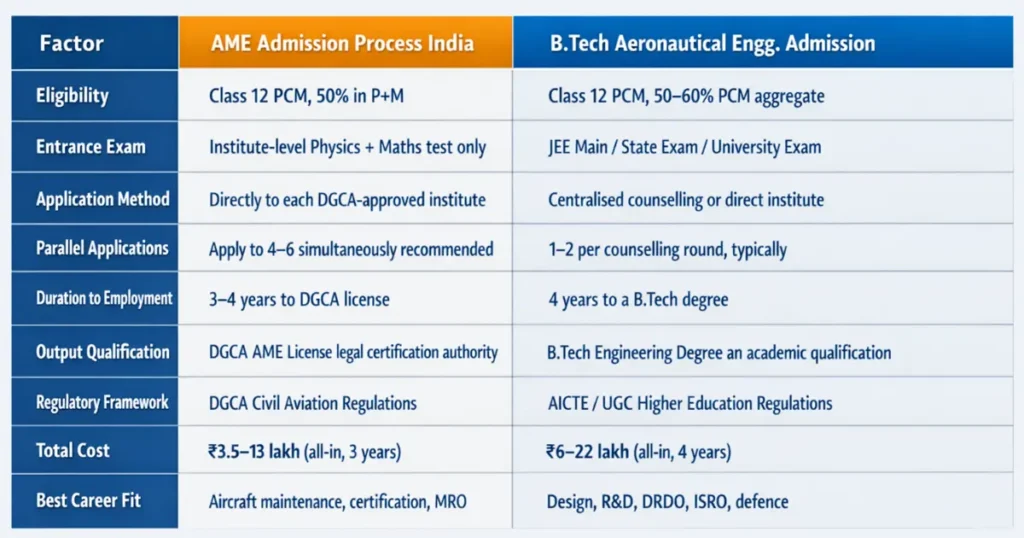
Both pathways are genuinely valuable for different career destinations. The AME admission process in India is designed for students committed to hands-on aircraft maintenance and legal certification authority. The B.Tech route is designed for students targeting design, R&D, and government defence science careers. Students who want both the highest-earning aviation qualification combination in India pursue B.Tech Aeronautical Engineering first, then leverage module exemptions through the fast-track AME admission process after graduation.
Frequently Asked Questions: AME Admission Process in India
Q: What is the AME admission process in India for 2026?
A: The AME admission process in India for 2026 involves five phases: (1) Pre-application preparation confirm DGCA eligibility and verify institute approval at dgca.gov.in; (2) Application submission submit to 4–6 DGCA-approved institutes simultaneously between January and March 2026; (3) Selection process written entrance test in Physics and Mathematics, personal interview, or merit-based selection depending on the institute; (4) Offer letter review and seat confirmation verify 3-year fee schedule and OJT arrangements before paying; (5) Enrollment and orientation June to July 2026 reporting, document submission, and DGCA training commencement. Unlike engineering admission, there is no centralised portal each DGCA-approved institute manages admission independently.
Q: Is JEE required for the AME admission process in India?
A: No JEE Main or JEE Advanced is required for the AME admission process in India. AME is a professional license training program regulated by DGCA, not a university engineering program requiring JEE. Selection for AME admission is based on Class 12 PCM marks and an institute-level entrance test covering Physics and Mathematics at the Class 11–12 level. This makes AME genuinely accessible to students who did not qualify through JEE, and the career outcomes for well-trained licensed AMEs are comparable or superior to those of many JEE-admitted engineering graduates in terms of salary growth and employment stability.
Q: Can diploma holders apply for the AME admission process in India?
A: Yes, diploma holders (3-year engineering diploma in a relevant discipline) can apply for AME training through lateral entry provisions at many DGCA-approved institutes. The process follows the same Phase 1–5 structure as standard admission, with the diploma certificate replacing the Class 12 mark sheet as the primary academic document. Diploma holders may receive credit for some AME training subjects based on their diploma syllabus, potentially shortening classroom training duration. The minimum 12-month OJT requirement applies equally regardless of entry route. Confirm lateral entry terms with each specific institute before applying.
Q: How long does the AME admission process in India take from start to enrollment?
A: For students who begin the AME admission process in December 2025 or January 2026 (recommended), the typical timeline is: 4–6 weeks from application to selection test, 2–4 weeks from test to offer letter, 2–4 weeks from offer letter to seat confirmation, and enrollment in June–July 2026. Total: approximately 5–6 months from initial application to first day of training. Students who begin in March or April face compressed timelines with fewer institute options, as strong institutes fill early. Starting in December or January gives the most time, the most choices, and the most relaxed process.
Q: What makes the AME admission process in India different from other countries?
A: India’s AME admission process is distinctive in several ways: (1) It is regulated by DGCA under a unique Indian adaptation of EASA CAR-66 standards, creating an India-specific qualification framework; (2) There is no centralized application system each DGCA-approved institute manages admission independently, unlike countries with centralized aviation training registries; (3) The module exemption pathway for engineering graduates is a uniquely progressive feature of Indian AME regulation allowing B.Tech Aeronautical Engineering graduates to fast-track AME licensing in 18–24 months; (4) OJT at Indian airlines and MROs gives graduates exposure to one of the world’s fastest-growing aviation markets providing career experience that is highly valued internationally, especially in the Middle East and Southeast Asia.
Conclusion: The AME Admission Process in India Rewards Prepared Students
The AME admission process in India is not complex, but it is specific. It rewards students who verify before applying, research before committing, apply to multiple institutes simultaneously, ask the right questions about OJT and Module pass rates, and plan their finances for all three years before paying a single rupee.
India’s aviation sector is generating licensed AME demand at a rate the country has never seen before. The students who navigate the admission process correctly in 2026 will be the licensed professionals that airlines and MRO companies are actively recruiting by 2030.
Whether you are entering through the standard Class 12 route, the diploma lateral entry, or the B.Tech fast-track pathway, the admission process fundamentals are the same: verify, research, apply strategically, and choose the institute that earns your confidence through evidence, not presentation.
Your aviation career begins with this process. Handle it with the precision it deserves.
Evaluating B.Tech Aeronautical Engineering as Your AME Fast-Track Pathway?
SOA School of Aeronautics, Neemrana, India’s only institution dedicated exclusively to aeronautical engineering, located in the heart of the Delhi NCR / DMIC aerospace corridor. Our B.Tech Aeronautical Engineering program is built with DGCA regulatory framework exposure throughout the curriculum, creating the most direct pathway to accelerated AME licensing after graduation. Our admissions counsellors will walk you through the B.Tech → AME admission process in India, module exemptions, timelines, fees, and career outcomes. Admissions open for 2026.
https://soacet.org/ | 2026 Admissions Get Your Personalised Roadmap Today