Have you ever stood at an airport viewing gallery, watching a 400-ton metal bird defy gravity and disappear into the clouds, and thought, “I want to be the person who understands how that works”? If the answer is yes, you are exactly where you need to be.
Entering an aircraft engineering course is often compared to learning a new language, a language of physics, precision, and high-stakes innovation. As we move into 2026, the aviation landscape is shifting. India is no longer just a participant in global aviation; we are becoming its heartbeat. With hundreds of new airports and thousands of aircraft orders on the horizon, there has never been a better time for a beginner to step into the hangar.
This guide is designed to take you from “curious beginner” to “informed aspirant,” covering everything you need to know about choosing the right aircraft engineering course and launching a career that literally reaches the sky.
Read Before: Aircraft Maintenance Engineering: A Promising Career Path
What is Aircraft Engineering?
Before picking a course, it’s vital to understand what the field actually entails. At its simplest, aircraft engineering is the branch of engineering that deals with the design, construction, and maintenance of machines that fly within the Earth’s atmosphere.
However, for a beginner, the field is usually split into two distinct pathways:
- Aeronautical Engineering (The Design Path): This is for the dreamers who want to sit at a drafting board (or a high-powered computer) to design the next generation of wings, engines, or fuel-efficient fuselages.
- Aircraft Maintenance Engineering (The Practical Path): This is for the doers. These are the licensed professionals who ensure that an aircraft is safe for flight. Without their signature, even the world’s best pilot cannot take off.
Both paths start with a specialised aircraft engineering course, but the daily lives of the two professionals are quite different.
Why Choose an Aircraft Engineering Course in 2026?
You might wonder, “Why now?” The year 2026 is a “Golden Window” for aviation students in India for several reasons:
1. The Domestic Boom
India is currently the third-largest domestic aviation market in the world. With the “Make in India” initiative reaching the aerospace sector, we are seeing the rise of domestic aircraft manufacturing and regional connectivity like never before.
Note: Book a FREE counselling session through SOACET to understand the AME admission process clearly.
2. The Global Shortage of Talent
There is a worldwide shortage of skilled aircraft engineers. From Boeing in the USA to Airbus in Europe, every major player is looking toward India for a fresh, well-trained workforce.
3. Technological Evolution
Courses in 2026 are not what they were ten years ago. Today, a modern aircraft engineering course at an institute like SOACET includes training in drone technology, sustainable aviation fuels (SAF), and digital twin technology.
Types of Aircraft Engineering Courses
For a beginner, the variety of course titles can be confusing. Here is a breakdown of the primary options available:
A. B.Tech in Aeronautical Engineering (4 Years)
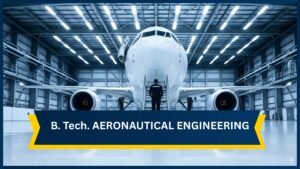
This is a comprehensive university degree affiliated with bodies like Bikaner Technical University (BTU) and approved by AICTE. It focuses on the “Why” and “How” of flight. It involves deep mathematics, fluid dynamics, and structural analysis.
B. Aircraft Maintenance Engineering (AME) (3 Years)
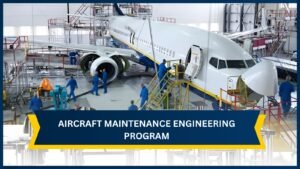
This is a professional licensing program approved by the Directorate General of Civil Aviation (DGCA). It is highly practical and focuses on the “maintenance” and “safety” aspects. It follows the CAR 147 (Basic) standards.
C. Integrated Programs (The Hybrid Path)
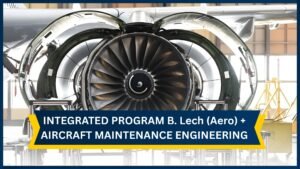
Some premier institutes, including the School of Aeronautics, offer integrated courses. This allows you to work toward your B.Tech degree while simultaneously preparing for your AME license exams. For a beginner, this is the most “future-proof” option.
Eligibility Criteria: Do You Have What It Takes?
Aviation is a field of high responsibility, and therefore, the entry requirements for an aircraft engineering course are strict but fair.
Academic Eligibility (12th Pass)
- Subjects: You must have passed 10+2 with Physics, Chemistry, and Mathematics (PCM).
- Minimum Marks: Most top-tier colleges require at least 50% aggregate in PCM.
- Entrance Exams: You may need to clear the SOACET Entrance Test or have a valid JEE Main score.
Medical Fitness (The Non-Negotiable)
Unlike standard engineering, your physical health matters here:
- Colour Blindness: You must have normal colour vision. In a hangar, mistaking a red wire for a green one can be catastrophic.
- General Health: You need a certificate from a registered medical practitioner proving you are fit for technical work.
What Will You Learn? (The 2026 Curriculum)
A beginner often asks, “Will I just be fixing engines?” The answer is no. A modern aircraft engineering course is incredibly diverse. Here is a glimpse of the modules you will master:
- Aerodynamics: The study of how air interacts with solid objects. You will learn how to shape a wing to create “Lift.”
- Propulsion: The science of jet engines. You will understand how a turbine sucks in air, compresses it, ignites it with fuel, and blasts it out to create “Thrust.”
- Avionics: The electronic “brain” of the aircraft. This includes radar, satellite navigation, and communication systems.
- Material Science: Learning about carbon fibres and honeycomb structures that are lighter than aluminium but stronger than steel.
- Aviation Legislation: Understanding the strict laws that keep the skies safe.
The Career Roadmap
So, you’ve finished your aircraft engineering course. What’s next? The path usually follows these steps:
- The Trainee Phase: You join an airline or an MRO (Maintenance, Repair, and Overhaul) facility as a junior. You are learning the ropes under the watchful eye of a senior.
- The Module Phase: For AME students, you will be clearing your DGCA Module exams. There are 11 to 13 modules in total.
- The Licensed Phase: Once you clear your modules and gain experience, you receive your BAMEL (Basic Aircraft Maintenance Engineer License). Now, you have the authority to sign off on a plane.
- The Type-Rating Phase: You get specialised training on a specific aircraft, like a Boeing 787 or Airbus A320. Now, your value in the global market skyrockets.
Salary and ROI: Is it Worth the Investment?
Aviation is one of the highest-paying technical sectors in the world. While the initial investment in an aircraft engineering course might seem significant, the return on investment (ROI) is impressive.
| Experience Level | Estimated Monthly Salary (2026) |
| Fresh Graduate / Trainee | ₹35,000 – ₹55,000 |
| Licensed Engineer (AME) | ₹1,00,000 – ₹1,80,000 |
| Type-Rated Engineer | ₹2,50,000 – ₹4,50,000 |
| Chief Engineer / Technical Lead | ₹6,00,000+ |
Note: Salaries for Indian engineers in the Middle East (UAE, Qatar) are often double these amounts and are typically tax-free.
Why Choose the School Of Aeronautical Neemrana (SOA, Neemrana) for Your Course?
If you are looking for the best aircraft engineering course in India, the School of Aeronautics (SOACET) has been the industry leader since 1992. Here is why beginners choose us:
1. The Neemrana
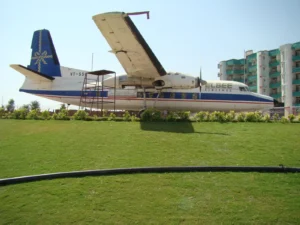
We don’t just teach from books. Our campus in Neemrana features Live Aircraft, including a Fokker F-27 and a Beechcraft. You will be touching real engines and working on real airframes from day one.
2. DGCA and BTU Approvals
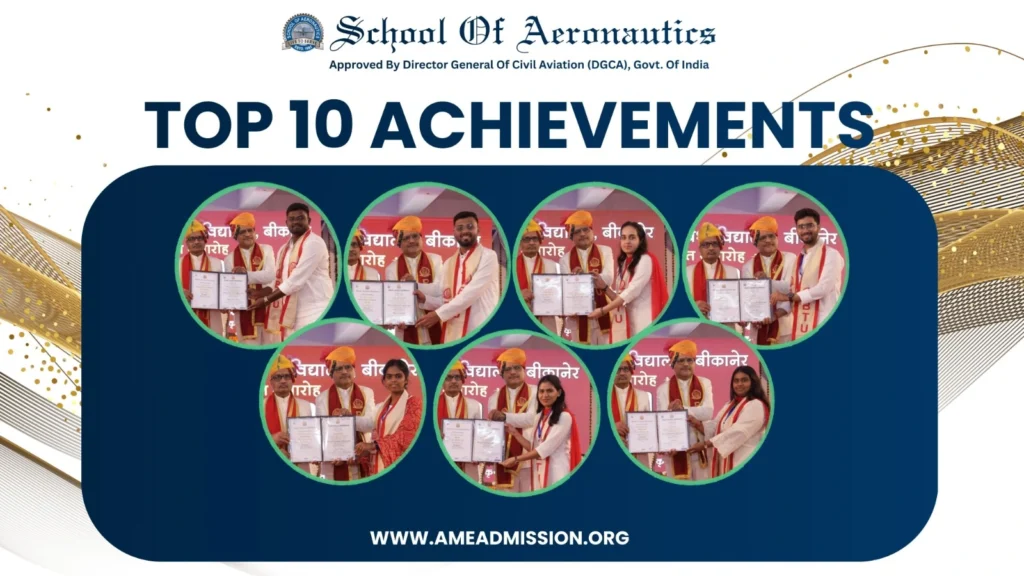
Our courses are fully recognised. Whether you want a B.Tech degree affiliated with Bikaner Technical University (BTU) or a DGCA-approved AME license training, we provide the most legitimate paths.
3. Industry-Expert Faculty
Our instructors aren’t just academics; they are veteran engineers who have worked in the Indian Air Force and major commercial airlines. They teach you the “street smarts” of the hangar.
4. Placement Hub
Our alumni work for Emirates, Indigo, Air India, and NASA. We have an active placement cell that bridges the gap between the classroom and the industry.
Frequently Asked Questions (FAQs)
Q1. Is Aircraft Engineering harder than Mechanical Engineering?
It is more specialised. While Mechanical is broad, Aircraft Engineering goes deep into the physics of flight and safety regulations. If you love machines, you will find it incredibly engaging.
Q2. Can I go abroad after my course in India?
Yes! The Indian DGCA license and B.Tech degrees are based on international standards. Many students move to the USA, UK, or UAE for higher studies or high-paying jobs.
Q3. Are there any scholarships available?
Yes, SOACET offers merit-based scholarships through the Laxmi Narain Verma Memorial (LMVM) Society entrance tests.
Q4. Is the course suitable for girls?
Absolutely. The aviation industry is very inclusive, and we have many female alumni who are now leading technical teams in top airlines.
Conclusion: Take Your First Step Today
An aircraft engineering course is more than just a sequence of exams it is a passport to a global, high-prestige career. It is for those who are not satisfied with a 9-to-5 desk job, those who want to be the reason why a million people fly safely every single day.
As the Indian aviation sector prepares for its biggest decade yet, the question isn’t whether the industry is ready for you, but whether you are ready for the industry.
The sky isn’t the limit; it’s your workplace. Are you ready to start?