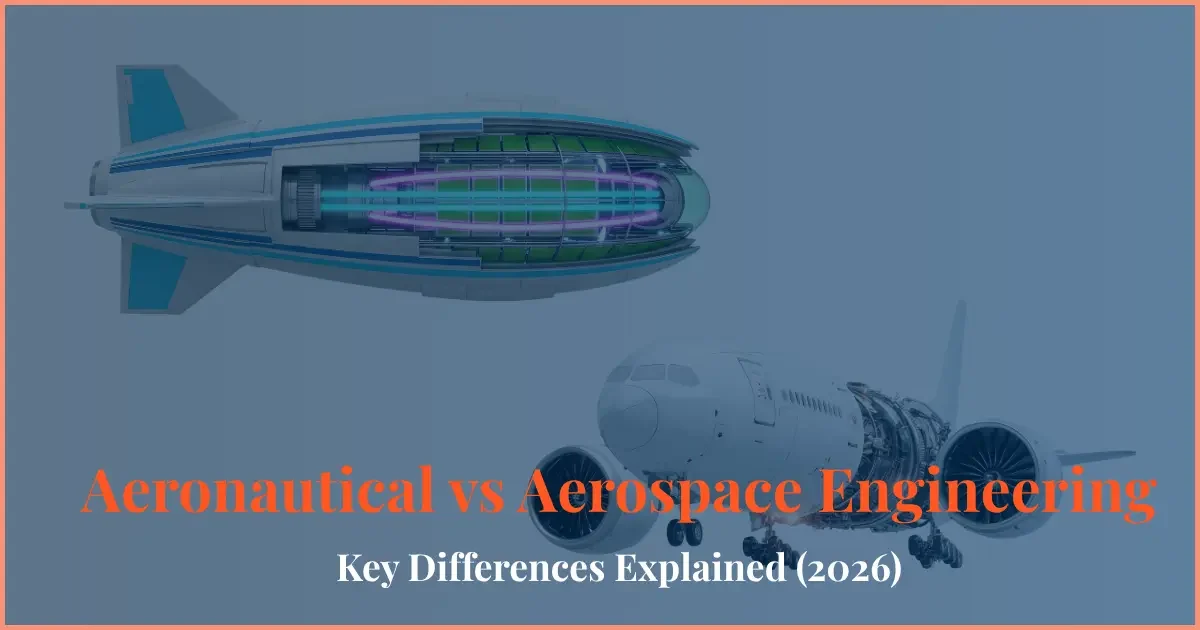
If you’ve ever stared at a jet engine or watched a rocket launch and thought, “I want to build that,” you’ve likely encountered two terms that sound almost identical: Aeronautical vs Aerospace Engineering.
To the average person, they are the same. But to a student planning their future at a premier institution like SOACET, the distinction is vital. Choosing the wrong one could mean the difference between spending your career perfecting the wings of a commercial airliner or calculating the orbital trajectory of a Martian rover.
As we move through 2026, the lines are blurring due to new technologies like space tourism and high-altitude drones. However, the technical foundations remain distinct. This guide will break down everything you need to know to make an informed decision.
Read Before: AERONAUTICAL ENGINEERING AND AIRCRAFT MAINTENANCE ENGINEERING
Defining the Contenders: Atmosphere vs. Space
To understand the core of Aeronautical vs Aerospace Engineering, we first need to look at where these machines operate.
What is Aeronautical Engineering?
Aeronautical engineering is the older, more focused discipline. It is the study of flight within the Earth’s atmosphere. If it stays below the “Karman Line” (the edge of space), it falls under the jurisdiction of an aeronautical engineer. This includes commercial planes, military fighter jets, helicopters, and the rapidly growing world of commercial drones.
What is Aerospace Engineering?
Note: Book a FREE counselling session through SOACET to understand the AME admission process clearly.
Aerospace engineering is the “umbrella” term. It is a broader field that encompasses both aeronautical engineering (flight in the air) and astronautical engineering (flight in the vacuum of space). Aerospace engineers are trained to handle the transition from our thick, oxygen-rich atmosphere into the cold, empty void of space.
Aeronautical vs Aerospace Engineering: The Direct Comparison
For a quick overview, here is how these two branches stack up against each other in 2026.
| Feature | Aeronautical Engineering | Aerospace Engineering |
| Primary Focus | Aircraft within Earth’s atmosphere. | Aircraft AND Spacecraft (Atmosphere + Space). |
| Medium | Air (Fluid Dynamics). | Air and Vacuum (Orbital Mechanics). |
| Common Projects | Passenger planes, Drones, Gliders. | Rockets, Satellites, Space Stations. |
| Physics Focus | Aerodynamics and Lift. | Celestial mechanics and Re-entry heat. |
| Complexity | High (focused on efficiency/safety). | Extremely High (dealing with vacuum/radiation). |
4 Key Differences You Need to Know
While they share a common ancestor, the technical daily life of these two engineers differs significantly.
1. The Medium of Operation
In Aeronautical Engineering, air is your best friend and your worst enemy. You study how air flows over wings to create lift. In Aerospace Engineering, you must design machines that work where there is no air. This means your propulsion systems can’t rely on oxygen from the atmosphere (like a jet engine does); instead, they must carry their own oxidiser (like a rocket).
2. Materials and Heat Management
A commercial plane deals with temperature changes, but an aerospace vehicle (like a rocket) deals with “thermal shock.” During re-entry into Earth’s atmosphere, a spacecraft can reach temperatures of 1,600°C. Aerospace engineers must master advanced ceramics and heat shields that an aeronautical engineer rarely has to consider for a standard aircraft.
3. Propulsion Systems
Aeronautical engineers focus on turbofans, piston engines, and propellers, aiming for fuel efficiency and noise reduction. Aerospace engineers dive into liquid oxygen tanks, solid rocket boosters, and even ion thrusters for deep-space travel.
4. Navigation and Control
A plane navigates using GPS, radar, and air traffic control. A satellite or a deep-space probe uses star trackers and complex orbital manoeuvres like “gravity assists” to reach its destination.
Syllabus and Subjects
If you are looking at the 2026 curriculum at SOACET, you will notice a significant overlap, but the specialisation happens in the final years.
Common Subjects (The Foundation):
- Fluid Mechanics
- Thermodynamics
- Engineering Mathematics
- Materials Science
- Solid Mechanics
Aeronautical Specialisations:
- Advanced Aerodynamics
- Aircraft Structures
- Flight Stability and Control
- Aircraft Maintenance Engineering (AME)
Aerospace Specialisations:
- Space Mechanics (Astronautics)
- Rocket Propulsion
- Space Environment & Spacecraft Design
- Satellite Communication & Navigation
Career Scope and Salary in 2026
When debating Aeronautical vs Aerospace Engineering, the “Scope” is often the deciding factor for students and parents.
The Aeronautical Outlook
The aviation sector is booming. With India becoming a global hub for Aircraft Maintenance, Repair, and Overhaul (MRO), aeronautical engineers are in high demand.
- Top Roles: Design Engineer, Quality Control, Maintenance Engineer, Drone Architect.
- Average Starting Salary: ₹4.5 LPA – ₹7.5 LPA.
The Aerospace Outlook
With the “New Space” era (SpaceX, ISRO, Skyroot), aerospace engineering has become a high-glamour, high-stakes career. It is no longer restricted to government jobs.
- Top Roles: Mission Specialist, Satellite Engineer, Propulsion Researcher, Structural Analyst.
- Average Starting Salary: ₹6 LPA – ₹10 LPA (Higher in specialised private firms).
Which One Should You Choose?
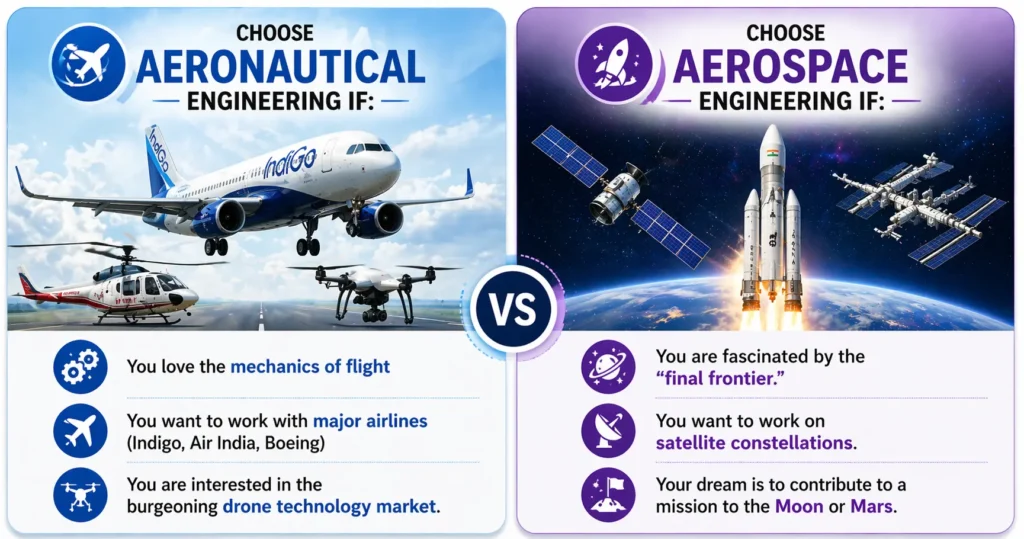
The real question isn’t which is “better,” but which one matches your passion.
- Choose Aeronautical Engineering if: You love the mechanics of flight, you want to work with major airlines (Indigo, Air India, Boeing), or you are interested in the burgeoning drone technology market.
- Choose Aerospace Engineering if: You are fascinated by the “final frontier,” you want to work on satellite constellations, or your dream is to contribute to a mission to the Moon or Mars.
Pro Tip: In many cases, an Aerospace degree allows you to work in Aeronautical roles, but it is much harder for a purely Aeronautical engineer to move into Spacecraft design without further specialisation.
Why Study at the School of Aeronautics (SOACET)?
Whether you choose Aeronautical or Aerospace Engineering, the quality of your training determines your altitude in the industry. SOACET provides the perfect launchpad for both.
- Practical Exposure: Our campus features real aircraft and engines, ensuring that “Aerodynamics” isn’t just a chapter in a book, but a visible reality.
- Modern Tools: We train students on 2026-standard software like CATIA, ANSYS, and MATLAB.
- Industry Integration: Our proximity to major aviation hubs allows for frequent industrial visits and internships that turn students into professionals.
- Legacy of Excellence: Since 1996, we have been the preferred choice for students who are serious about a career in the skies.
Frequently Asked Questions (FAQs)
Q1. Is Aerospace Engineering more difficult than Aeronautical?
Technically, yes. Aerospace covers everything Aeronautical does, plus the complexities of orbital mechanics and vacuum physics. It requires a slightly higher level of mathematical proficiency.
Q2. Can an Aeronautical Engineer work at ISRO?
Absolutely. ISRO needs aeronautical engineers for the atmospheric phase of their rocket launches and for the design of their reusable launch vehicles (RLVs).
Q3. Is there a difference in eligibility?
For both courses, you need 10+2 with Physics, Chemistry, and Mathematics (PCM). High marks in Math are particularly beneficial for both streams.
Q4. Which has a better future in 2026?
Both are on an upward trajectory. Aviation is becoming more sustainable (electric planes), and space is becoming more commercialised. You can’t go wrong with either if you are skilled.
Conclusion: Ready for Takeoff?
The debate of Aeronautical vs Aerospace Engineering ultimately comes down to your vision. Do you see yourself perfecting the way we travel across our planet, or are you looking to help humanity leave it?
Both paths lead to rewarding, high-status careers that contribute to the progress of our species. The first step is getting the right education from a place that understands the industry inside and out.
Start your journey today: Explore Aeronautical & Aerospace Programs at SOACET