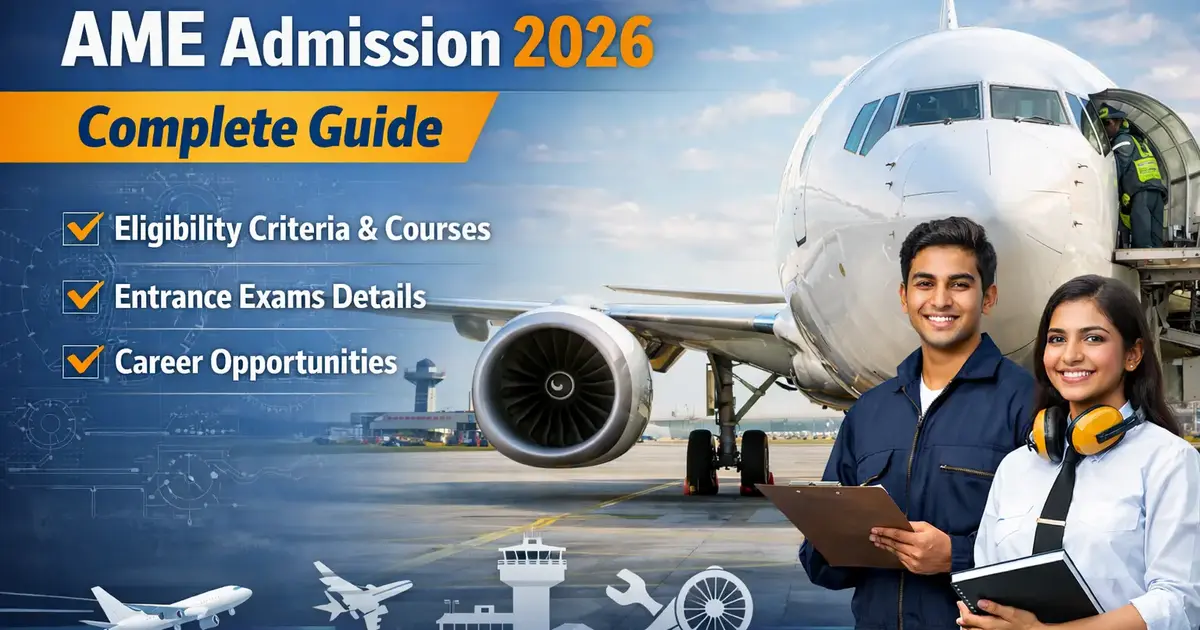
AME Admission 2026 is open, and if you are a Class 12 PCM student serious about building an aviation career, there is no better time to act. Aircraft Maintenance Engineering is one of India’s most stable, most respected, and fastest-growing aviation professions. Every aircraft that takes off from an Indian airport does so because a licensed AME has certified it airworthy. That signature and the career behind it start with the admission decision you make today.
Before diving into the AME Admission 2026 process, let’s make sure you fully understand what you’re entering. This matters because AME is a professional license program not a traditional university engineering degree and that distinction changes everything about how admission, training, and career progression work.
An Aircraft Maintenance Engineer (AME) is a licensed aviation professional authorised by the Directorate General of Civil Aviation (DGCA) to inspect, maintain, repair, and certify the airworthiness of aircraft. Without a valid DGCA-issued AME license, no engineer can legally sign off on an aircraft’s fitness to fly.
This is not a ceremonial responsibility. When an AME signs an airworthiness certificate, they are legally certifying that the aircraft meets every safety requirement. Airlines, MRO companies, and private operators cannot operate without licensed AMEs on staff. This is why AME is one of aviation’s most indispensable and recession-proof careers.
Factor | AME (Aircraft Maintenance Eng.) | Aeronautical Engineering (B.Tech) |
Core Function | Maintain & certify aircraft airworthiness | Design, develop & test aircraft systems |
Qualification Type | DGCA License (B1/B2 category) | University Degree (B.Tech / B.E.) |
Duration | 2–3 years + OJT + DGCA exams | 4 years of undergraduate |
Regulatory Body | DGCA, India | AICTE / UGC + University |
Admission Route | Direct to a DGCA-approved institute | JEE / State Exam / University Exam |
Starting Salary | ₹4–7 LPA (rising fast with endorsements) | ₹4–8 LPA (wide range by employer) |
Work Location | Airports, hangars, runways | Offices, labs, manufacturing plants |
International Scope | Middle East USD 4,000–8,000/month | Global USD 60,000–120,000/year |
India follows the EASA-aligned CAR-66 framework for AME licensing. In AME Admission 2026, you will need to choose your category a decision that shapes your entire career trajectory:
Which Category for 2026? For most students entering AME Admission 2026, B1.1 is the primary choice due to the highest volume of airline job openings. B2 is an excellent addition if your institute supports dual-category training.
There has never been a stronger time to pursue AME in India. The data supports this emphatically, and understanding these drivers will help you commit to your AME Admission 2026 with full confidence.
This is not speculative growth. It is an active, government-backed, contractually committed expansion. Every aircraft on order is a future job for a licensed AME.
AME eligibility for 2026 is governed by DGCA’s Civil Aviation Requirements (CAR) Series C, Part II. Understanding every eligibility parameter before applying prevents wasted applications and costly mistakes.
Eligibility Parameter | DGCA Minimum Requirement | Institute Typical Standard |
Class 12 Board | Any recognised board (CBSE, ICSE, State) | CBSE / ICSE / State Board accepted |
Compulsory Subjects | Physics + Mathematics | Physics + Chemistry + Mathematics (PCM) |
Minimum Marks in P+M | 50% aggregate (Physics + Mathematics) | 50%–55% PCM aggregate |
SC/ST/OBC Relaxation | 5% (most institutes) | 5% relaxation is commonly applied |
Diploma Holders | 3-year Engg. Diploma eligible (lateral) | Check the individual institute policy |
B.Tech Graduates | Fully eligible; Module exam exemptions apply | Fast-track licensing pathway available |
Age Planning Note: Students who start AME training directly after Class 12 typically complete their 2–3 year training and OJT period between ages 19–22, positioning them for license issuance and first airline job at an ideal career entry point.
Medical fitness is a factor in AME career sustainability that many students overlook during AME Admission 2026 planning:
Medical Caution: If you have a known medical condition affecting vision, colour perception, or physical capability to work in aircraft environments, consult a DGCA-approved physician and review CAR medical standards before investing in AME training. Better to know early than after completing the program.
DGCA’s minimum requirement is Physics + Mathematics at Class 12. PCB students who did not take Mathematics cannot apply under standard eligibility. However, students who took Physics, Chemistry, Biology, AND Mathematics (as an additional subject) may be eligible check your state board’s records. Some universities also offer a Mathematics bridge qualification. If you are a PCB student keen on AME, check with your state board and individual institute admissions teams before concluding AME is inaccessible.
Document Authenticity Warning: All documents submitted for AME Admission 2026 are subject to DGCA-standard verification. Submission of forged, tampered, or misrepresented documents is a criminal offence under aviation law and can result in permanent disqualification from any aviation career. Always submit genuine, correctly attested documents.
This is the operational core of this guide. Follow every step in sequence. Rushing or skipping any step is the most common source of problems in AME Admission 2026.
Before a single form is filled, confirm you meet all DGCA eligibility criteria. Download and read DGCA’s CAR Series C, Part II from dgca.gov.in — specifically pages covering eligibility. Confirm your Class 12 board, subjects, marks, and age against DGCA requirements. If you are a PCB student, check your state board records for any Mathematics subject entry.
This is the single most consequential step in AME Admission 2026. Navigate to dgca.gov.in → Aviation Training Organisations → Basic AME Training Organisations List. Only institutes on this list are genuinely DGCA-approved. Verify:
Non-Negotiable Rule: If an institute is not on the DGCA-approved list, regardless of what their brochure, website, or admission agent claims, do not enrol. An AME certificate from an unapproved institute has zero career value. You cannot sit the GCA Module exams and cannot receive a license. This mistake cannot be undone.
With a verified list of approved institutes, shortlist 4–6 based on these six parameters:
Most quality AME institutes in 2026 offer online applications. Some continue to accept direct/walk-in applications:
AME Admission 2026 selection typically involves one or more of these components:
Interview Tip: Research the institute you’re visiting, fleet size, notable alumni, and DGCA approval history. Mentioning specific aircraft types they operate or industries they serve demonstrates the kind of preparation that interviewers remember.
Before paying seat confirmation fees, carefully verify every detail in your offer letter:
Once enrolled in AME Admission 2026, your training unfolds across three phases:
This is the operational core of this guide. Follow every step in sequence. Rushing or skipping any step is the most common source of problems in AME Admission 2026.
Before a single form is filled, confirm you meet all DGCA eligibility criteria. Download and read DGCA’s CAR Series C, Part II from dgca.gov.in specifically pages covering eligibility. Confirm your Class 12 board, subjects, marks, and age against DGCA requirements. If you are a PCB student, check your state board records for any Mathematics subject entry.
This is the single most consequential step in AME Admission 2026. Navigate to dgca.gov.in → Aviation Training Organisations → Basic AME Training Organisations List. Only institutes on this list are genuinely DGCA-approved. Verify:
Non-Negotiable Rule: If an institute is not on the DGCA-approved list regardless of what their brochure, website, or admission agent claims do not enrol. An AME certificate from an unapproved institute has zero career value. You cannot sit the GCA Module exams and cannot receive a license. This mistake cannot be undone.
With a verified list of approved institutes, shortlist 4–6 based on these six parameters:
Most quality AME institutes in 2026 offer online applications. Some continue to accept direct/walk-in applications:
AME Admission 2026 selection typically involves one or more of these components:
Interview Tip: Research the institute you’re visiting fleet size, notable alumni, DGCA approval history. Mentioning specific aircraft types they operate or industries they serve demonstrates the kind of preparation that interviewers remember.
Before paying seat confirmation fees, carefully verify every detail in your offer letter:
Once enrolled in AME Admission 2026, your training unfolds across three phases:
AME admissions in India do not follow a single centralised calendar like JEE or NEET. Each DGCA-approved institute manages its own intake schedule. Here is the general 2026 pattern most institutes follow:
Admission Activity | Typical 2026 Timeline | Notes |
Applications Open (Main Batch) | January–March 2026 | Apply early for the best seat availability |
Written Entrance Tests | March–May 2026 | Varies by institute — confirm directly |
Offer Letters Issued | April–June 2026 | Rolling basis after tests |
Main Batch Reporting | June–July 2026 | Most common start month |
Seat Confirmation Deadline | May–June 2026 | Typically, 15–30 days afterthe offer letter |
Second Batch (where available) | October–November 2026 | Not all institutes offer a second intake |
Scholarship Application Window | Concurrent with admission | Apply to the NSP portal simultaneously |
Deadline Warning: AME institutes operate a first-come, first-served seat allocation in most cases. Unlike JEE counselling, there is no centralised waitlist. Once an institute’s seats fill, they do not hold seats speculatively. Begin your AME Admission 2026 research in January and aim to have applications submitted by March for the June intake.
The DGCA Module examinations are the intellectual backbone of the AME pathway. Understanding them from Day 1 of AME Admission 2026 planning allows you to build an effective study strategy throughout your training.
DGCA Module exams are written examinations that test your theoretical knowledge across all required aviation subjects under CAR-66. They are conducted at DGCA-designated examination centres across India. You can appear for Module exams during your training — you do not need to wait until training completion.
Module No. | Subject Name | Status for B1.1 |
Module 1 | Mathematics | Mandatory |
Module 2 | Physics | Mandatory |
Module 3 | Electrical Fundamentals | Mandatory |
Module 5 | Digital Techniques & Systems | Mandatory |
Module 6 | Materials & Hardware | Mandatory |
Module 7A | Maintenance Practices | Mandatory |
Module 8 | Basic Aerodynamics | Mandatory |
Module 9A | Human Factors in Aviation | Mandatory |
Module 10 | Aviation Legislation (DGCA CAR) | Mandatory |
Module 11A | Turbine Aeroplane Aerodynamics | Mandatory |
Module 13 | Aircraft Aerodynamics & Structures | Mandatory |
Module 15 | Gas Turbine Engine | Mandatory |
Module 17A | Propeller (Turboprop aircraft) | Mandatory |
Study Strategy for 2026: Begin DGCA Module preparation from Week 1 of training — not just before exam dates. Treat each Module as a professional certification, not a university subject. Students who consistently dedicate 90–120 minutes of independent study daily to Module subjects alongside classroom attendance consistently outperform those who cram.
Financial transparency is essential for making a sound decision about AME Admission 2026. Here is what AME training genuinely costs across different institution types:
Fee Component | Govt./Low-cost Institutes | Mid-tier Private Institutes | Premium Private Institutes |
Annual Tuition (Yr 1) | ₹60K – ₹1.2L | ₹1.2L – ₹1.8L | ₹1.8L – ₹2.5L |
Annual Tuition (Yr 2) | ₹60K – ₹1.2L | ₹1.2L – ₹1.8L | ₹1.8L – ₹2.5L |
OJT Year (Yr 3) | ₹30K – ₹60K | ₹50K – ₹1L | ₹80K – ₹1.5L |
DGCA Module Fees | ₹15K – ₹20K | ₹15K – ₹25K | ₹15K – ₹25K |
Hostel + Mess/yr | ₹60K – ₹90K | ₹80K – ₹1.3L | ₹1L – ₹1.8L |
Books & Materials | ₹10K – ₹18K | ₹15K – ₹25K | ₹20K – ₹30K |
TOTAL (3 yrs, all-in) | ₹3.5L – ₹6L | ₹5.5L – ₹9L | ₹8L – ₹14L |
AME remains one of aviation’s best value qualifications. Compare: Pilot training costs ₹35–80 lakh; B.Tech at private engineering colleges costs ₹12–22 lakh; AME costs ₹4–10 lakh all-in. For a middle-class family, AME offers access to aviation careers at a fraction of the cost of other aviation pathways.
This is a carefully curated list of well-regarded DGCA-approved institutes evaluated on faculty depth, aircraft fleet, Module pass rates, and placement outcomes. Always independently verify the current DGCA approval status at dgca.gov.in before enrolling.
For students in Rajasthan and the Delhi NCR corridor, SOA School of Aeronautics in Neemrana (Rajasthan) offers B.Tech Aeronautical Engineering with embedded AME-pathway awareness through its regulatory framework curriculum. For students weighing B.Tech Engineering vs. AME, Neemrana’s location in the Delhi-Mumbai Industrial Corridor gives access to aerospace and defence manufacturing companies ideal for both pathways. Visit soacet.org for program details.
AME Admission 2026 is not just an academic decision it is a career investment. Here is what that investment returns:
Career Stage | Experience | India Salary | International Salary |
Junior AME (B1.1, newly licensed) | 0–2 years | ₹4 – ₹7 LPA | USD 2,000–3,500/mo |
AME with type endorsements | 2–5 years | ₹7 – ₹12 LPA | USD 3,500–5,500/mo |
Senior AME / Lead Technician | 5–10 years | ₹12 – ₹22 LPA | USD 5,000–8,000/mo (tax-free) |
CAME / Quality Manager | 10+ years | ₹22 – ₹38 LPA | USD 7,000–12,000/mo |
Base Maintenance Manager | 12–15 years | ₹35 – ₹55 LPA | USD 10,000–15,000/mo |
DGCA Inspector / Aviation Authority | 15+ years | ₹40 – ₹65 LPA | Senior government scale |
The real salary multiplier for AMEs is aircraft type endorsements. Each additional aircraft type (A320, B737, ATR 72, etc.) you are qualified on adds a direct salary premium. Career-focused AMEs accumulate type endorsements systematically through their airline or MRO career, turning their DGCA license into a continuously appreciating professional asset.
Middle East Opportunity: Indian AMEs with 3+ years of experience and 1–2 type endorsements are actively recruited by the UAE, Qatar, and Saudi Arabia aviation sectors. Tax-free salaries of USD 4,000–8,000 per month, combined with the ability to accumulate multiple type endorsements on wide-body fleets, make international AME careers one of the highest-returning early-career moves in Indian aviation.
This is one of the most common questions students ask during AME Admission 2026 planning. Here’s a genuinely honest, structured comparison to help you decide:
Decision Factor | AME License Pathway | B.Tech Aeronautical Engineering |
Duration to Employment | 2–3 years training + OJT | 4 years + placement |
JEE Required | No institute entrance only | Yes (for govt.) / University exam (private) |
Total Education Cost | ₹4L – ₹13L all-in | ₹6L – ₹22L (govt to private) |
Work Type | Hands-on aircraft maintenance | Design, R&D, analysis |
DRDO / ISRO Eligibility | Not directly applicable | Primary recruitment source |
Airline Engineering Jobs | Primary pathway (license required) | Quality assurance, planning roles |
International Earning | USD 4,000–8,000/month tax-free (ME) | USD 60,000–120,000/year globally |
Best Personality Fit | Hands-on, detail-oriented, procedural | Analytical, creative, research-minded |
Further Education | CAME, MBA Aviation (later) | GATE → M.Tech, MBA, PhD |
There is no universally “better” choice. AME is better for students who want faster employment, aviation hands-on work, and practical career entry without requiring JEE success. B.Tech Aeronautical Engineering is better for students who want to design aircraft systems, work in R&D, access DRDO/ISRO/HAL engineering roles, or pursue research pathways.
Some students pursue both completing B.Tech and then fast-tracking to an AME license using their engineering degree module exemptions. This dual qualification is extraordinarily powerful in the job market.
A: There is no single national last date for AME Admission 2026 each DGCA-approved institute sets its own admission deadlines. Most institutes begin accepting applications in January–March 2026 for a June–July intake. A second batch (where available) typically has an October–November application window. Contact each institute directly for their specific 2026 deadline. The safest approach: complete your applications by March 2026 for the main June batch.
A: No. JEE Main or Advanced is not required for AME Admission 2026. AME programs are professional license training regulated by DGCA, not university engineering programs requiring JEE. Selection for AME Admission 2026 is based on Class 12 PCM marks and/or an institute-level entrance test covering Physics and Mathematics. This makes AME accessible to students who do not qualify through JEE, yet still enables an outstanding aviation career.
A: Visit the official DGCA website at dgca.gov.in → Aviation Training Organisations → Approved Basic AME Training Organisation List. This is the only authoritative verification source. Confirm the institute name is listed, the approval is current (not expired), and the approval covers your desired category (B1.1 / B2). If uncertain, call DGCA's regional office directly. Never rely solely on an institute's own claims of DGCA approval.
A: DGCA's minimum requirement is 50% aggregate in Physics and Mathematics at Class 12. Most quality DGCA-approved institutes set their practical minimum at 50–55% PCM (Physics, Chemistry, Mathematics) aggregate. SC/ST/OBC students typically receive 5% relaxation. Scoring 60%+ in PCM at Class 12 gives you comfortable access to all quality AME programs for 2026.
A: Yes, absolutely. AME Admission 2026 does not require a JEE qualification of any kind. If you meet the Class 12 PCM eligibility criteria (50%+ in Physics and Mathematics), you can directly apply to DGCA-approved AME institutes without any JEE score. Many outstanding AME engineers never appeared for JEE at all. Your Class 12 marks and institute entrance test performance are all that matter for AME Admission 2026.
A: Total AME course fees for 2026 vary by institution: Government-affiliated and lower-cost institutes: ₹3.5 lakh to ₹6 lakh all-in (3 years including accommodation and DGCA exam fees). Mid-tier private DGCA-approved institutes: ₹5.5 lakh to ₹9 lakh all-in. Premium private institutes: ₹8 lakh to ₹14 lakh all-in. Education loans from SBI, PNB, and Canara Bank cover DGCA-approved AME training, including accommodation and exam fees, witha moratorium during the training period.
A: Starting salary for a newly licensed AME (B1.1) with an Indian airline or MRO in 2026 is typically ₹4–7 LPA. With 2–3 years of experience and type endorsements, this rises to ₹7–12 LPA domestically. Indian AMEs working in the Middle East with 3+ years of experience earn USD 4,000–8,000 per month tax-free, making AME one of the highest-earning short-duration professional qualifications in Indian aviation. Senior AMEs with 10+ years and multiple type endorsements regularly earn ₹22–38 LPA in India.
A: Yes, and it is an extremely powerful combination. B.Tech Aeronautical Engineering graduates are fully eligible for DGCA AME training. Importantly, engineering graduates receive Module exam exemptions for subjects already covered in their B.Tech curriculum, meaning they require fewer DGCA Module exams to achieve their AME license. The B.Tech + AME license combination is one of the most sought-after profiles in India's MRO sector and airline engineering departments.
A: The complete timeline from AME Admission 2026 to receiving your DGCA AME license is typically 3–4 years: 2–3 years of approved training (classroom theory + practical labs); plus minimum 1 year of supervised OJT on operational aircraft; plus time to pass all required DGCA Module exams (which can be attempted during training, reducing post-training wait time). Students who begin Module exam preparation from their first week of training and pass modules progressively can reduce post-training waiting time significantly.
AME Admission 2026 is more than an academic enrollment it is the first professional decision of a career that will touch the lives of millions of passengers who fly on aircraft you maintain and certify. That is not a small responsibility. And it is not a small career.
India’s aviation sector is ordering aircraft at historic rates, building new airports across Tier 2 and Tier 3 cities, expanding MRO capacity domestically, and creating a wave of AME demand that will last for the next 20 years. The licensed AMEs who enter the profession in 2026 will be the senior engineers, quality managers, and base maintenance directors of 2036 and beyond.
Use this guide as your reference. Verify every institute at dgca.gov.in before applying. Organise your documents now. Research your shortlist thoroughly. Visit campuses. And make your AME Admission 2026 decision with complete information and genuine confidence.
SOACET 2026 (School of Aeronautics Common Entrance Test) is a National Level AME Entrance Exam 2026 organized every year by the LNVM Society. The examination is conducted for admission and scholarship into aviation programs at the prestigious School of Aeronautics, Neemrana.
CORPORATE OFFICE
H 974, PALAM EXTENSION, PART 1, SEC 7,
DWARKA, NEW DELHI 110077
I 04, DELHI – JAIPUR EXPY, RIICO INDUSTRIAL AREA,
NEEMRANA, RAJASTHAN 301705