You just finished Class 12. Or you’re about to. And somewhere between your board exam results and decisions about “what next”, you discovered Aircraft Maintenance Engineering and suddenly, aviation feels like the direction you want to go.
If you’re reading this with no prior knowledge of AME admission after 12th, how it works, whether you qualify, what it costs, where to apply, and what your future actually looks like, this guide is written specifically for you.
We start from zero. No jargon, no assumed knowledge. Just everything a Class 12 student needs to understand to make a confident, informed decision about pursuing AME after 12th and to take their first real steps toward an aviation career.
What is AME in One Paragraph: An Aircraft Maintenance Engineer (AME) is a licensed aviation professional, certified by India’s aviation authority (DGCA), who inspects, maintains, repairs, and certifies that aircraft are safe to fly. Every commercial aircraft in India, IndiGo, Air India, SpiceJet, can only take off after a licensed AME certifies it airworthy. That signature is AME’s professional authority. No pilot flies, no passenger boards, without that certification. AME is not a certificate course. It is a professional license like a doctor’s registration or a lawyer’s bar admission, but for aircraft.
Read Before: What qualifications do you need to be an Aeronautical Engineer?
Are You Eligible for AME Admission After 12th? Confirm These 4 Things
Before anything else, confirm your eligibility for AME admission after 12th. DGCA India’s aviation authority sets these four non-negotiable criteria:
1. Your Class 12 Board Is Recognized
Your Class 12 must be from a recognised board, CBSE, ICSE, any state board, or NIOS. If you studied abroad (IGCSE or IB curriculum), you need an equivalency certificate from the Association of Indian Universities (AIU) before applying. Most students in India are automatically eligible here.
2. You Studied Physics AND Mathematics in Class 12
This is the most important eligibility requirement for AME admission after 12th. DGCA mandates both Physics AND Mathematics at the Class 12 level. Chemistry is required by all quality institutes as well. PCM students (Physics + Chemistry + Mathematics) are fully eligible.
- Fully eligible for the widest range of AME institute options for PCM students:
- Not eligible under standard rules. If you took PCB + Mathematics as an additional subject, check your transcript you may qualify. PCB students (Biology instead of Maths):
- Not eligible for standard AME admission after 12th. Commerce or Arts students:
Check Your Marksheet Now: Before reading further, open your Class 12 mark sheet and confirm both Physics AND Mathematics appear as subjects with marks, not just enrolled subjects. This single check saves weeks of confusion later.
3. Your Marks Meet the Minimum
DGCA’s minimum is 50% aggregate in Physics and Mathematics combined. Most quality DGCA-approved institutes set their own minimum at 50–55% PCM aggregate. SC/ST/OBC candidates typically receive 5% relaxation. Scoring 60%+ in PCM gives you comfortable access to quality programs.
4. Your Age Is 16 or Above
Minimum age for AME training admission is 16 years. You must be at least 18 years old when you apply for your DGCA license (after completing training). For most Class 12 students at 17–18, age is not a barrier.
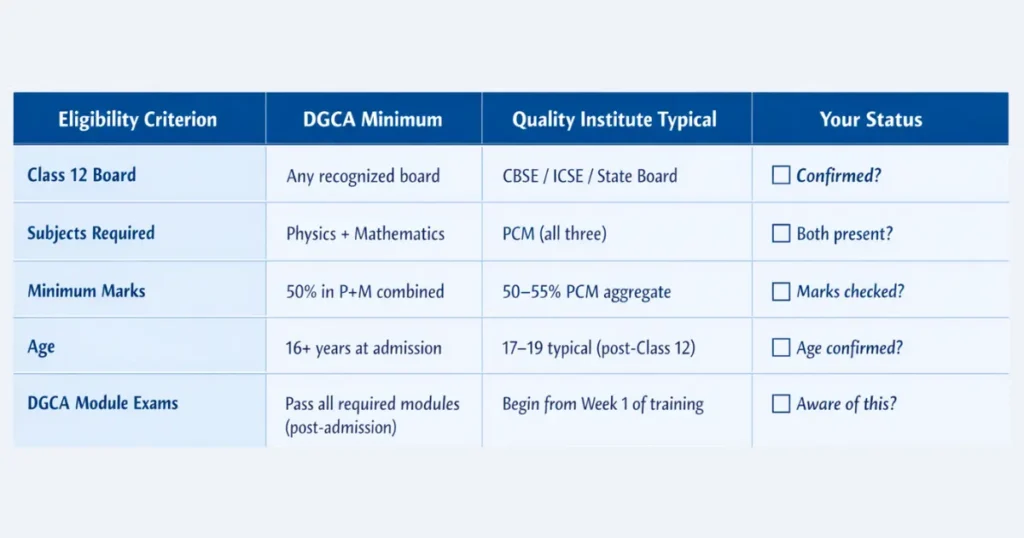
Use This as Your Pre-Checklist: Print or save this table. Tick each box before moving to the application stage. Students who confirm all four eligibility criteria before applying avoid 90% of the common AME admission after 12th complications.
What AME Training After 12th Actually Looks Like: A Beginner’s Overview
Many students considering AME admission after 12th don’t have a clear picture of what the training involves. Here is what your AME journey realistically looks like from Day 1 to licensed professional:
Year 1–2: Classroom Theory + Practical Labs (At Your DGCA-Approved Institute)
For the first 12–18 months, you attend structured classroom sessions at your DGCA-approved AME institute. The subjects are technical but directly relevant to aircraft: Aviation Mathematics, Physics, Electrical Systems, Aerodynamics, Aircraft Materials, Gas Turbine Engines, Hydraulics, DGCA Aviation Law, and Human Factors in Aviation.
Alongside classroom theory, you spend significant time in the institute’s hangar and workshops physically working on aircraft components, engines, hydraulic systems, and avionics. This is where AME training becomes unlike any classroom degree: you are hands-on with the machines you are learning to maintain.
During this same period, you begin appearing for DGCA Module examinations, written tests set by DGCA that certify your knowledge in each subject area. These are the exams that count toward your actual license. Start preparing for them from Week 1, not after training ends.
Note: Book a FREE counselling session through SOACET to understand the AME admission process clearly.
Year 2–3: On-the-Job Training (OJT) at an Airline or MRO
After completing your classroom training, you move into OJT, On-the-Job Training. DGCA requires a minimum of 12 months of supervised practical training on operational aircraft at an approved airline, MRO company, or maintenance facility.
During OJT, you work under the supervision of licensed AMEs, performing real maintenance tasks, completing real maintenance documentation, and building the practical competence that classroom training cannot fully provide. The aircraft type you train on during OJT often becomes your first type endorsement, a critical salary multiplier in your career.
License Application and Career Launch
Once all DGCA Module exams are passed and OJT is completed, you submit your AME license application to DGCA. Processing takes 4–12 weeks. When your license arrives with your name, license number, and approved category (B1.1 or B2), your professional aviation career officially begins.
Total time from Class 12 to licensed AME: 3–4 years. At 21–22 years old, you will hold a professionally recognised aviation license that legally authorises you to certify aircraft airworthiness. The same authority keeps every commercial passenger in India safe every time they fly.
7 Action Steps to Get AME Admission After 12th: Your Complete Roadmap
Here is your complete, beginner-friendly action plan for AME admission after 12th. Follow these steps in order:
01 Confirm Your Eligibility Right Now
Open your Class 12 mark sheet. Confirm: PCM subjects present, Physics + Mathematics marks noted, total PCM aggregate calculated. If your results are not yet published, use your pre-board or mock test marks as a provisional check. Students who confirm eligibility before doing anything else avoid the most common AME after 12th confusion.
02 Choose Your AME License Category
Decide between B1.1 (Aeroplane Turbine airframe and engines) and B2 (Avionics electrical and electronic systems). B1.1 has the most airline job openings; B2 carries a salary premium due to lower supply. If your target institute offers dual B1.1+B2 training, that is the highest-value option but takes longer. Making this choice before applying determines which institutions are appropriate for you.
03 Verify DGCA Approval of Every Institute You Consider
This step cannot be skipped or delegated.
- Go to dgca.gov.in → Aviation Training Organisations → Approved Basic AME Training Organisation List.
- Confirm the exact name of every institute you are considering. Confirm their approval is current.
- Confirm it covers your desired category.
- Non-DGCA-approved institutes produce certificates that have zero value for getting a DGCA license.
- Five minutes of verification protects 3 years of investment.
04 Research and Shortlist 4–6 DGCA-Approved Institutes
For each verified institute, investigate:
- How many operational aircraft do they have?
- Which airlines or MRO companies are their OJT partners?
- What is their DGCA Module exam pass rate?
- Where have their last 2–3 batches been placed?
- What is the complete 3-year fee? Apply to 4–6 simultaneously, the AME admission after 12th process has no centralised portal, so parallel applications are expected and smart.
05 Prepare Your Documents and Application
Gather: Class 10 mark sheet + certificate, Class 12 mark sheet + certificate, Transfer Certificate, Aadhaar Card, 10–12 passport photos, character certificate from school. Fill each institute’s application form carefully. Name and date of birth must match Aadhaar exactly. Pay application fees (₹500–₹2,000 per institute) only through official channels. Apply January–March for the June 2026 intake.
06 Prepare for the Entrance Test and Interview
Most DGCA-approved AME institutes conduct a written entrance test in Physics and Mathematics at the Class 11–12 level, 60–80 MCQs in 60–90 minutes. Revise NCERT Physics and Mathematics for 3–4 weeks. Focus on: Mechanics, Current Electricity, Thermodynamics, Fluid Mechanics, Trigonometry, Calculus, and Coordinate Geometry. For the personal interview: know what AMEs do, why you want this career, and basic facts about the institute you’re visiting. Dress formally.
07 Review Your Offer Letter Carefully Before Paying
When you receive an offer letter, verify: DGCA approval number appears on the letter; 3-year fee schedule is written in full; OJT arrangements name specific partners; seat confirmation fee and refund policy are clearly stated. Only after confirming all these details should you pay the seat confirmation fee and proceed to enrollment. Begin education loan applications at least 8 weeks before the enrollment date if needed.
AME After 12th vs Other Aviation Career Options: What Suits You Best?
When considering AME admission after 12th, most students are simultaneously evaluating other options. Here is the honest, side-by-side comparison:
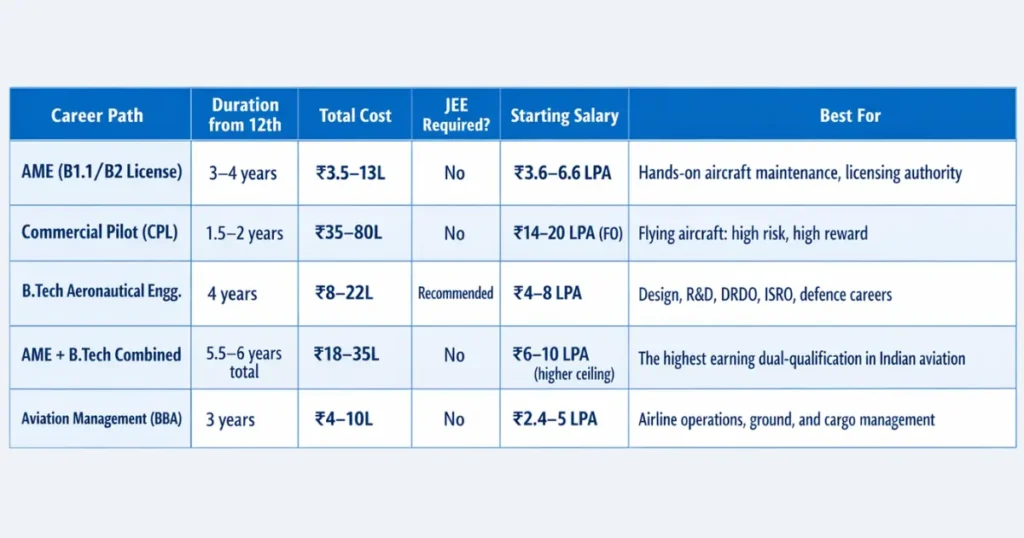
For most PCM students committed to aviation but without the budget for pilot training or the JEE results for top engineering colleges, AME admission after 12th is the clearest, most accessible, and highest-return aviation career pathway available. The combination of no JEE requirement, lower fees than either pilot training or private B.Tech, and a professional license as the direct outcome is simply not matched by any other aviation pathway at this entry level.
What Your Life Looks Like After AME Admission After 12th: 5-Year Career Snapshot
For a beginner considering this path, the most motivating thing is seeing where the journey actually leads. Here is a realistic 5-year career snapshot for a student who takes AME admission after 12th in 2026:
Year 1–2 (2026–2028): Training at DGCA-Approved Institute
You are studying Aviation Physics, Aerodynamics, Electrical Systems, Gas Turbine Engines, and DGCA regulations. You are in the hangar three times a week, working on actual aircraft. You are appearing for DGCA Module exams one by one, targeting a 75%+ pass in each. Your schedule is full, the work is technical, and the sense of purpose is clear.
Year 3 (2028–2029): On-the-Job Training at an airline or MRO
You are working under licensed AMEs at a commercial airline or MRO facility. You are performing real maintenance tasks on real operational aircraft. Every day you are learning in ways no classroom can replicate. The shift work, the hangar environment, the direct safety responsibility, this is the professional world you chose. By the end of OJT, you have your first aircraft type in your training log.
Year 4 (2029–2030): First Job as Licensed AME
Your DGCA license arrives. You apply to your target airline or MRO. You are interviewed, selected, and joining at ₹40,000–₹65,000 per month. You are 22–23 years old and hold a professional aviation license that 99% of your peer group does not. You are on the payroll of India’s aviation sector, one of the country’s fastest-growing industries.
Year 5 (2030–2031): First Type Endorsement and Salary Jump
Within 12–18 months of your first job, you earn your first aircraft type endorsement, A320, B737, or ATR72. Your monthly salary jumps from ₹50,000 to ₹75,000–₹95,000. Airlines are actively retaining you with incremental offers. Your license, combined with your endorsement, makes you a professional with genuine market value. The journey from Class 12 to a ₹10 LPA+ aviation career took exactly 5 years and approximately ₹6–9 lakh a career return on investment that few professional qualifications in India can match.
International Potential: After 3–5 years of licensed experience and 2+ type endorsements, Indian AMEs regularly secure positions in the Middle East, UAE, Qatar, Saudi Arabia, earning USD 4,000–8,000 per month, completely tax-free. For an Indian professional, this earning level at 26–28 years of age represents one of the fastest paths to financial independence available through any vocational qualification.
Frequently Asked Questions: AME Admission After 12th
Q: What subjects are required for AME admission after 12th?
A: DGCA requires Physics and Mathematics at the Class 12 level as minimum subjects for AME admission after 12th. Chemistry is required by virtually all quality DGCA-approved institutes as well, making PCM (Physics, Chemistry, Mathematics) the standard subject combination for AME eligibility. PCB students (Biology instead of Mathematics) are not eligible under standard rules, unless Mathematics was also taken as an additional subject. Students who took PCM with at least 50% aggregate in Physics and Mathematics meet DGCA’s minimum eligibility for AME admission after 12th.
Q: Can I do AME after 12th without JEE?
A: Yes, completely. JEE is not required for AME admission after 12th at any stage. AME is a professional license training program regulated by DGCA, not a university engineering program requiring JEE Main or Advanced. Selection for AME admission after 12th is based on Class 12 PCM marks and an institute-level entrance test in Physics and Mathematics, both of which are within the ability of any dedicated PCM student. Many licensed AMEs in India’s aviation sector, including engineers at IndiGo, Air India, and major MRO companies, never appeared for JEE. The AME pathway is genuinely accessible without a JEE qualification.
Q: What is the minimum percentage for AME admission after 12th?
A: The DGCA minimum for AME admission after 12th is 50% aggregate in Physics and Mathematics combined (not PCM overall, specifically P+M). Most quality DGCA-approved institutes set their practical minimum at 50–55% PCM aggregate. Some premier institutes prefer 60%+ PCM. SC/ST/OBC students typically receive a 5% relaxation from the minimum. Scoring 60% or above in PCM at Class 12 gives you comfortable access to the best DGCA-approved AME institutes in India without any borderline eligibility concerns.
Q: How much does AME cost after 12th, and is it affordable?
A: Total AME course cost after 12th in India, including tuition, hostel, DGCA exam fees, study materials, and all living costs over 3 years, ranges from ₹3.5 lakh at budget DGCA-approved institutes to ₹13 lakh at premium private institutes. The middle range of ₹5–9 lakh covers most quality programs. This is significantly more affordable than pilot training (₹35–80 lakh) and comparable to B.Tech at government or state colleges. Education loans from SBI, PNB, and Canara Bank specifically cover DGCA-approved AME training, with a moratorium during the training period, meaning no EMI while you are studying.
Q: What is the scope of AME after 12th in India in 2026?
A: The scope of AME after 12th in India in 2026 is exceptionally strong and backed by hard data. Indian airlines have placed orders for over 1,200 new aircraft. 100+ new airports are being built. The government is actively growing India’s MRO sector to reduce ₹20,000+ crore in annual foreign maintenance spending. Every new aircraft requires 3–5 licensed AMEs. Every new airport hub needs certified maintenance engineers. The demand for licensed AMEs in India far outpaces the current supply, and this gap is projected to persist for at least 10–15 years. Students who take AME admission after 12th in 2026 are entering a profession with a structural hiring surplus, not a competitive talent pool fighting for scarce jobs.
Conclusion: AME After 12th The Aviation Career That Starts Sooner Than Any Other
If you are a Class 12 PCM student with aviation in your heart and a practical approach to your career, AME admission after 12th gives you something no other aviation pathway offers at this entry level: a genuine professional license, achieved without JEE, at a fraction of pilot training costs, in just 3–4 years.
You will work on the aircraft that carries millions of passengers. Your signature will certify their airworthiness. Your career will grow with every type of endorsement, every year of experience, and every strategic move you make in one of India’s most expansion-phase industries.
The 7 action steps are clear. The eligibility criteria are specific. The investment is defined. The career return is well-documented. What remains is simply your decision and your first step.
After 12th, the sky is not the limit. It is the beginning.
Want to Explore Both AME and B.Tech Aeronautical Engineering After 12th?
SOA School of Aeronautics, Neemrana, India’s only institution dedicated exclusively to aeronautical engineering, in the heart of the Delhi NCR / DMIC aerospace corridor. Our B.Tech Aeronautical Engineering program includes the DGCA regulatory framework throughout the curriculum, creating the ideal foundation for students who want to pursue AME licensing after graduation, with significant Module exam exemptions. Not sure whether AME or B.Tech Aeronautical Engineering right for you? Our counsellors will help you compare both pathways’ eligibility, costs, duration, and career outcomes so you can make the best decision for your future.
https://soacet.org/ | 2026 Admissions Open Get Your Career Roadmap Today