

Here is the uncomfortable truth that most AME guidance articles skip: the quality of the AME college in India you choose is the single biggest factor shaping your career more than your marks, more than your preparation, and more than the effort you put into studying. A student with average Class 12 scores who selects a genuinely quality AME college consistently outperforms a high-scorer who chooses poorly.
Why? Because an AME license is only as valuable as the training that backs it. A DGCA Module exam pass certificate from a well-trained engineer who has spent 2 years on operational aircraft is worth 10x more in the job market than the same certificate from someone who trained on static mockups and grounded aircraft.
This guide gives you a complete, honest framework for evaluating AME colleges in India 8 weighted criteria, a region-wise institute overview, a campus visit checklist, and the specific red flags that should make you walk away regardless of brochure quality. Use this before applying anywhere.
Note on Rankings: There is no official government ranking of AME colleges in India. This guide uses outcome-based evaluation criteria, such as DGCA approval status, fleet quality, Module exam pass rates, OJT placements, and alumni employment data, which are far more predictive of your career outcomes than any promotional ranking system.
Read Before: Choosing the Best College for Aeronautical Engineering in India
The One Non-Negotiable Before Evaluating Any AME College in India
Before comparing any two AME colleges in India on any criterion, such as fees, location, infrastructure, or placements, confirm one thing. Confirm it personally. Confirm it before visiting. Confirm it before paying any fee.
Every AME college in India must appear on the DGCA’s Approved Basic AME Training Organisation List. This is the only credential that legally qualifies an institute to train AME candidates in India. Without it, every other quality metric is irrelevant because training at an unapproved institute cannot lead to a DGCA AME license.
- Go to dgca.gov.in → Aviation Training Organisations → Approved Basic AME Training Organisation List. How to verify:
- The institute name is listed; approval is current (not expired) approval covers your desired category (B1.1, B1.3, or B2). Confirm three things:
- Call DGCA’s regional office directly their number is on the DGCA website. If uncertain:
Zero Tolerance Rule: If an institute is not on the DGCA-approved list, do not proceed regardless of what their brochure, website, testimonials, or admission agent claims. A non-approved AME college in India cannot produce a licensable AME. This verification takes 5 minutes and protects 3 years of your life.
The 8-Criterion Framework for Evaluating AME Colleges in India
Once DGCA approval is confirmed, evaluate every AME college in India on these 8 criteria listed in order of career impact:
Criterion 1: Aircraft Fleet Quality and Quantity [Weight: Critical 25%] How many operational aircraft does the institute have? Are they airworthy and actively used for student training? Ask specifically: Can students perform maintenance tasks, not just observe? Institutes with 3+ operational aircraft across multiple types deliver categorically better training than those with 1–2 static display models.
Criterion 2: OJT Placement Partnership Quality [Weight: Critical 20%] Which airlines or MRO companies have formal MOU agreements with this AME college in India? Structured partnerships mean students are placed for OJT within weeks of classroom completion. Vague ‘assistance’ language means students wait 3–9 months after training before OJT begins, extending total program duration by up to a year.
Criterion 3: DGCA Module Exam Pass Rate [Weight: High 15%] Request the last 3-year DGCA Module exam pass percentage per module. Institutes delivering 80%+ pass rates are preparing students academically. Those who refuse to share this data are hiding poor outcomes. A 65% module pass rate means roughly 1 in 3 students is re-attempting exams, extending their licensing timeline.
Criterion 4: Alumni Placement Track Record [Weight: High 15%] Which companies hired graduates from the last 3 batches? At what salary levels? In what roles? Ask for this in writing. Verify it independently: search the institute’s name on LinkedIn and find actual alumni profiles. Real employment outcomes are always verifiable by a motivated student.
Criterion 5: Faculty Depth and Industry Experience [Weight: Medium 10%] How many faculty members hold active DGCA AME licenses? How many have current or recent industry experience at airlines or MRO companies? Theory taught by practising or recently practising professionals is qualitatively different from theory delivered by career academics.
Criterion 6: Infrastructure Labs, Hangar, Avionics Workshop [Weight: Medium 10%] Avionics labs (for B2 aspirants), engine test benches, component workshops, and actual aircraft bays are essential. DGCA specifies minimum infrastructure requirements, but minimum compliance produces minimum outcomes. Look for labs that are actively used during student training, not showrooms opened during inspection visits.
Note: Book a FREE counselling session through SOACET to understand the AME admission process clearly.
Criterion 7: Total Fee Transparency and Value [Weight: Medium 5%] A reputable AME college in India will provide a complete 3-year written fee schedule without prompting. Institutes that quote only Year 1 tuition and become vague about subsequent years, hostel costs, and exam fees are either disorganised or deliberately obscuring the true cost. Transparency about fees is a proxy for transparency about the program overall.
Criterion 8: Location and Airport/MRO Proximity [Weight: Lower 5%] Proximity to active airports, MRO companies, and aerospace industries provides organic internship access, better OJT options, and easier transition to first employment. AME colleges in India near Delhi NCR, Mumbai, Bengaluru, or major MRO hubs have structural advantages over isolated locations.
How to Use This Framework: Visit each shortlisted AME college in India with this 8-criterion list printed. Ask specific questions for each criterion. Score each institute out of 10 per criterion. Weight by the percentages shown. The highest weighted score is your best choice, not the most attractive brochure or the most persuasive counsellor.
AME Colleges in India: Region-Wise Overview for 2026
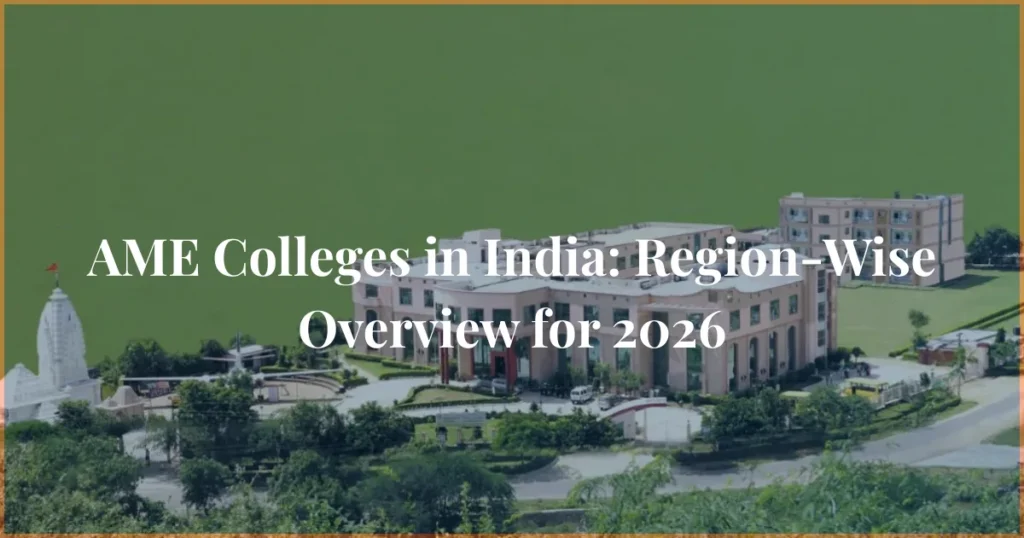
Here is a practical, honest region-by-region overview of the landscape of AME colleges in India, not a promotional list, but a genuine guide to where quality programs exist:
North India AME Colleges (Delhi NCR, UP, Rajasthan)
Choosing the right institute is one of the most important decisions for an Aircraft Maintenance Engineering (AME) career. Below are some well-known AME institutes in India, along with their strengths and important notes.
NIAE (National Institute of Aeronautical Engineering) – Bareilly, Uttar Pradesh
NIAE is one of the oldest AME institutes in India with a strong legacy in aviation education. It is government-affiliated and has a solid track record of producing skilled aircraft maintenance engineers over the years.
IGIA (Indira Gandhi Institute of Aeronautics) – Chandigarh
IGIA is a well-established private institute known for its experienced faculty and strong placement presence in North India. It offers good regional exposure and has built a reputation in the aviation training sector.
Rajiv Gandhi Aero Training Academy – Delhi NCR
Located in the capital region, this institute benefits from strong industry connections and proximity to major aviation hubs. However, students should always verify the current DGCA approval status before taking admission.
SOA School of Aeronautics – Neemrana, Rajasthan
SOA offers a unique pathway by combining B.Tech Aeronautical Engineering with AME exposure. Located in the Delhi-Mumbai Industrial Corridor (DMIC), it is considered one of the few dedicated aeronautical institutions in the NCR region.
For North India students, SOA School of Aeronautics in Neemrana (Rajasthan) offers a strategically distinctive option not as a standalone AME institute, but as India’s only dedicated aeronautical engineering institution in the Delhi NCR / DMIC aerospace corridor. Students who want the strongest possible foundation for an AME career or want to evaluate B.Tech Aeronautical Engineering followed by AME licensing (the highest-earning combination in Indian aviation) should visit soacet.org for full program details.
South India AME Colleges (Bengaluru, Chennai, Hyderabad)
Apart from the top institutes, there are several other AME colleges in India that offer good training, specialisation, and industry exposure. Here are some notable options:
Hindustan Aviation Academy (HAA) – Bengaluru
HAA has played a significant role in building South India’s aviation training reputation. It is known for its strong industry connections and exposure to airline operations. The institute is well-regarded, but students should verify the current DGCA approval status before admission.
Rajiv Gandhi Aviation Academy – Secunderabad
This institute is DGCA-approved and is known for its experienced faculty. Located in Secunderabad, it benefits from Hyderabad’s growing aerospace ecosystem, offering good learning and career opportunities.
Blue Wings Aviation – Chennai
Blue Wings Aviation is gaining recognition for its strong focus on the B2 Avionics specialisation track. It is a good choice for students interested in aircraft electronics and avionics systems, with a steadily growing track record in the field.
Orient Flights Aviation Academy – Puducherry
This institute focuses heavily on the DGCA module exam preparation. It conducts multiple batches throughout the year, making it flexible for students. However, candidates should verify the available aircraft fleet and practical exposure before enrolling.
West India AME Colleges (Mumbai, Pune)
In addition to well-known institutes, some emerging AME colleges in India are gaining attention due to their location advantage and growing industry connections. These institutes can offer good exposure if chosen carefully.
ATI (Aeronautical Training Institute) – Mumbai
ATI benefits from its proximity to Mumbai Airport, one of India’s busiest aviation hubs. This provides students with strong access to active MRO (Maintenance, Repair, and Overhaul) operations and real-world exposure, making it a good choice for practical learning.
Ambedkar Institute of Aeronautics – Pune
Located in Pune, this institute benefits from the city’s rapidly growing aerospace and engineering ecosystem. It offers a good environment for technical learning, but students should verify the current DGCA approval status and available aircraft fleet before taking admission.
Gujarat Institute of Aeronautics – Ahmedabad
This institute is developing alongside the expanding aviation sector in Ahmedabad. With improved infrastructure and facilities, it has potential for future growth. However, candidates should carefully check the quality of OJT (On-Job Training) opportunities before enrolling.
East India AME Colleges (Bhubaneswar, Kolkata)
East India also has some well-established AME institutes that provide good regional exposure and career opportunities in aviation.
IGIAT (Indira Gandhi Institute of Aviation Technology) – Bhubaneswar
IGIAT is one of the most established AME institutes in East India. It has built a strong regional reputation over the years and is known for offering structured training programs in aircraft maintenance engineering.
Bengal Aeronautical Institute – Kolkata
Located in Kolkata, this institute benefits from its city-based aviation environment and regional placement opportunities. However, students should verify the current DGCA approval status and available aircraft fleet before taking admission.
Region-wise caveat: This region-wise overview reflects established reputation as of 2026. DGCA approval status, fleet quality, and OJT placement performance can change. Always verify current DGCA approval at dgca.gov.in and independently verify placement outcomes through LinkedIn alumni research before finalising any AME college in India.
Campus Visit Checklist: What to Verify at Every AME College in India
A campus visit is non-negotiable for a program where you will spend 2–3 years. Here is exactly what to verify during your visit:
Aircraft and Hangar See the Fleet in Person
- How many? What types? Are they current-generation (A320, B737, ATR72) or older models? Count the aircraft:
- Are the aircraft operational (engines running, hydraulics active) or grounded static displays? Ask to see a recent maintenance log. Airworthiness status:
- Are students actively working on aircraft during your visit, or is the hangar empty? Visit on a regular weekday, not a specially organised open day. Student access:
- Can the hangar accommodate the number of students enrolled? Overcrowded hangars mean limited hands-on time per student. Hangar capacity:
Labs and Workshops Beyond the Photographs
- Active test equipment, working aircraft electrical panels, communication system trainers, not just diagrams on walls. Avionics lab:
- Actual gas turbine engine components available for student disassembly and reassembly, not just photographs. Engine workshop:
- Hydraulic system trainers, fuel system models, and landing gear trainers are in active use. Component workshop:
- DGCA Module exam practice software, CAD access, maintenance documentation software (AMM, CMM access), Computer lab:
Faculty Ask Direct Questions
- How many faculty hold active DGCA AME licenses?
- What is the average industry experience of faculty members?
- Who specifically teaches Gas Turbine Engine theory, and what is their MRO or airline background?
- What is the student-to-faculty ratio for practical lab sessions?
Student Welfare Hostel, Mess, and Safety
- Ask to see a typical occupied double or triple sharing room. Visit hostel rooms unannounced, do not show rooms
- Food quality directly affects student health and study performance. Eat one meal in the mess during your visit
- Is there a campus doctor or nurse? What is the nearest hospital? Ask about medical facilities:
- Is the campus adequately secured? What are the visitor and student access protocols? Security:
The Surprise Visit Principle: Visit on an ordinary Tuesday or Wednesday, not during an organised open day, not during the admission season peak. What you see on a regular day is what you will experience for 2–3 years. Impressive presentations during scheduled visits reveal very little about the daily operational reality.
Red Flags at AME Colleges in India: 7 Warning Signs to Never Ignore
Red Flag 1 DGCA Approval Not Immediately Verifiable
Any AME college in India that cannot instantly produce its current DGCA approval certificate, or whose name does not appear on the active DGCA-approved list, walk away. No exceptions, no ‘our approval is pending renewal’ explanations.
Red Flag 2 No Aircraft on Campus, Only ‘Arrangements’
Institutes that promise aircraft access ‘at a nearby airport’ or ‘through partnerships’ without having operational aircraft physically on campus cannot deliver consistent, structured practical training. Quality AME colleges in India own their fleet. They do not outsource it.
Red Flag 3 Refusal to Share Module Exam Pass Rates
This is one of the most reliable quality indicators available. Institutes with strong academic preparation are proud of their Module pass rates and share them without prompting. Institutes that refuse, deflect, or give vague assurances are concealing weak outcomes. A 65% average Module pass rate means 35% of students face expensive re-attempts and extended licensing timelines.
Red Flag 4 Vague OJT ‘Assistance’ Without Named Partners
‘We help students find OJT’ is not an OJT program. A genuine OJT commitment from quality AME colleges in India specifies named airline or MRO partners, a target placement timeline after classroom completion, and a documented OJT log process. Vague assistance language is a strong predictor of a 6–12 month OJT gap after training, silently extending your program by a year.
Red Flag 5 Pressure to Pay Large Fees Before the Offer Letter
Legitimate AME colleges in India issue a detailed, written offer letter before requesting seat confirmation fees. Institutes that pressure students to pay ₹25,000–₹50,000 or more during an initial campus visit or within 24–48 hours of inquiry are either badly organised or deliberately exploiting admission pressure. Never pay significant fees without a written, detailed offer letter in hand.
Red Flag 6 Alumni Nowhere to Be Found Online
A genuine AME college in India with 5–10 years of operation will have dozens of verifiable alumni on LinkedIn working in aviation roles. Search the institute’s name on LinkedIn. If no alumni appear or if alumni profiles show unrelated careers, the institute’s placement outcomes are either very poor or entirely fabricated.
Red Flag 7 Admissions Through Unverified Third-Party Agents Only
Quality AME colleges in India have their own admissions process with direct contact between the student and the institute. Institutes whose admissions are handled exclusively through third-party agents who may be earning commissions on fee collection introduce a layer of misrepresentation that protects neither the student’s interests nor the institute’s reputation. Always verify directly with the institute.
Frequently Asked Questions: AME Colleges in India
Q: How do I verify if an AME college in India is genuinely DGCA-approved?
A: Go directly to the official DGCA website at dgca.gov.in → Aviation Training Organisations → Approved Basic AME Training Organisation List. This is the only authoritative verification source. Confirm that the exact institute name appears on the current list, the approval is active and not expired, and the approval covers your specific category (B1.1, B1.3, or B2). If uncertain, call DGCA’s regional office their contact numbers are on the DGCA website. Never rely solely on the institute’s own claims, brochures, or website statements about DGCA approval. This 5-minute verification is the most important due diligence you can do.
Q: What is the best AME college in India for B1.1 license training?
A: There is no single universally ‘best’ AME college in India the best choice depends on your location, budget, and career priorities. However, the strongest B1.1 AME colleges in India consistently share these characteristics: 3+ operational airworthy aircraft on campus, formal MOU-based OJT partnerships with commercial airlines or type-rated MRO companies, 80%+ DGCA Module exam pass rates over the last 3 years, and verifiable airline/MRO placement for the majority of graduates. Among well-regarded institutions, NIAE Bareilly (North India), HAA Bengaluru (South India), and ATI Mumbai (West India) have established reputations. Always verify independently before enrolling.
Q: Does the location of an AME college in India affect placement and salary?
A: Yes, significantly. AME colleges in India located in major aviation hubs (Delhi NCR, Mumbai, Bengaluru, Chennai, Hyderabad) have structural advantages: proximity to airline technical bases for OJT placement, easier access to type endorsement training on current fleet aircraft, and natural industry networking during the training period. Students from AME colleges in India near Delhi NCR consistently report 15–25% higher first-job salaries than peers from Tier 2 city institutes, partly due to direct airport proximity and partly due to the quality of airlines that partner for OJT in these hubs.
Q: Can I attend an AME college in India after completing B.Tech Aeronautical Engineering?
A: Yes, and this is one of the most powerful career moves available to aeronautical engineering graduates in India. B.Tech Aeronautical Engineering graduates who attend AME colleges in India for DGCA licensing receive Module exam exemptions under CAR-66, significantly reducing their licensing timeline from 3–4 years to approximately 18–24 months. The B.Tech + AME license combination is among the most sought-after qualification profiles in India’s aviation MRO and airline engineering sectors, commanding salaries 25–40% above single-qualification peers. Institutions like the SOA School of Aeronautics in Neemrana specifically design their B.Tech Aeronautical Engineering curriculum with DGCA regulatory framework exposure, creating a seamless pathway to post-graduation AME licensing.
Q: How many DGCA-approved AME colleges are there in India in 2026?
A: The number of DGCA-approved AME colleges in India changes as approvals are granted, renewed, or expired, making the official DGCA website the only reliable source for a current count. As of recent data, approximately 30–40 institutes across India hold active DGCA approval for basic AME training across B1.1, B1.3, and B2 categories. The distribution is uneven: concentration is highest in North India (especially Delhi NCR and UP), followed by South India (Bengaluru, Chennai, Hyderabad) and West India (Mumbai, Pune). East India has fewer approved institutes. Always verify the current list directly at dgca.gov.in before making any admission decision.
Conclusion: Choose Your AME College in India With Evidence, Not Impressions
The AME colleges in India landscape are wide, and the quality variation within them is enormous. A well-chosen institute sets you up for a licensed, employed, and earning aviation career within 3–4 years. A poorly chosen one can cost you the same 3–4 years in a program that produces a certificate worth far less than the investment.
Use the 8-criterion framework. Visit campuses. Verify DGCA approval directly. Ask the hard questions about OJT partnerships and Module pass rates. Research alumni on LinkedIn. And walk away from any institute that displays any of the 7 red flags, no matter how impressive their presentation.
The best AME college in India for you is the one that gives you the strongest aircraft access, the most structured OJT path, and the most honest answers to your hardest questions. That institute exists. Find it with evidence not with enthusiasm.
Verify. Visit. Ask. Decide. Your aviation career is worth that level of care.
Exploring the B.Tech Aeronautical Engineering + AME Pathway?
SOA School of Aeronautics, Neemrana, is India’s only institution dedicated exclusively to aeronautical engineering — located in the heart of the Delhi NCR / DMIC aerospace corridor. Our B.Tech Aeronautical Engineering program builds DGCA regulatory framework understanding throughout the curriculum, creating the strongest possible foundation for students who plan to pursue AME licensing after graduation. Visit our campus in Neemrana. Meet our faculty. See our labs. Make your 2026 admission decision with complete, verified information. https://soacet.org/ | Schedule a Campus Visit 2026 Admissions Open