“How much does the AME course actually cost?” It sounds like a simple question. But the answer most students get from college websites, from admission agents, and even from well-meaning counsellors is almost always incomplete.
They quote the first-year tuition fee. They skip the hostel. They don’t mention DGCA exam fees. They certainly don’t tell you about the hidden Year 3 costs. And they rarely answer the question that actually matters: given the total AME course fees you will spend, is this investment genuinely worth it?
This guide changes that. Here is the complete, honest, nothing-hidden breakdown of AME course fees in India, every cost component, every tier, government versus private, scholarship options, and most importantly, a transparent return-on-investment analysis that tells you exactly what your AME investment will return over your career.
Read This First: AME course fees vary significantly based on institution type, location, and whether you are comparing the total all-in cost or just tuition. This guide uses the total all-in cost, including tuition, hostel, DGCA exam fees, study materials, and incidentals, because that is the amount that actually leaves your family’s account over 3 years.
Read Before: SOA CET 2025: Scholarship and Admission for Aeronautics Students
AME Course Fees in India: Complete Component-by-Component Breakdown
The first thing every family must understand about AME course fees in India is that the total cost has multiple components, and quoting only tuition gives a dangerously incomplete picture. Here is every cost component you must budget for:
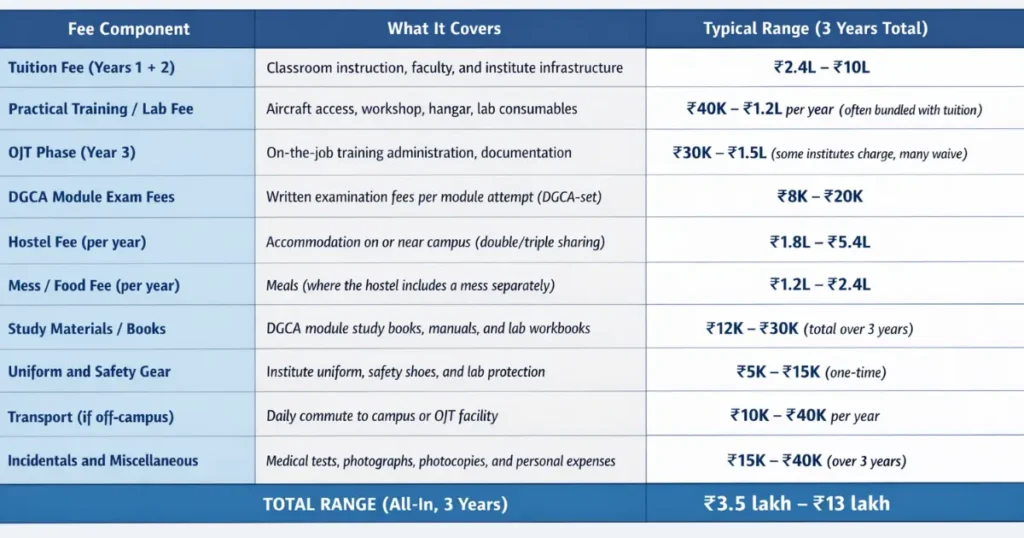
Fee Transparency Red Flag: If an AME institute quotes you a total fee that is below ₹3.5 lakh for a complete 3-year program, including hostel, scrutinise their DGCA approval status, aircraft fleet condition, and OJT placement quality very carefully. Suspiciously low fees almost always reflect quality cuts somewhere in the program that will affect your career outcomes.
AME Course Fees in India by Institution Tier: What Each Tier Delivers
Not all AME course fees are equal, and neither are the outcomes they produce. Here is the honest tier-by-tier breakdown:
Tier 1 Government and Lower-Cost DGCA-Approved Institutes
| Cost Item | Annual Amount | 3-Year Total |
| Tuition Fee | ₹60,000 – ₹1,20,000 | ₹1.2L – ₹2.4L |
| Hostel + Mess | ₹80,000 – ₹1,20,000 | ₹2.4L – ₹3.6L |
| DGCA Exam Fees | Spread across 3 years | ₹10K – ₹18K |
| Books + Materials | ₹5,000 – ₹8,000 | ₹15K – ₹25K |
| TOTAL ALL-IN | ₹3.5 lakh – ₹6.5 lakh |
Government-affiliated and lower-cost DGCA-approved institutes offer the most affordable AME course fees in India. Trade-off considerations: the aircraft fleet may be older or smaller, hostel infrastructure may be basic, and OJT placement networks may be limited. Best suited for: students from economically constrained families who supplement formal training with intensive self-study for DGCA Module exams.
Tier 2 Mid-Tier Private DGCA-Approved Institutes
| Cost Item | Annual Amount | 3-Year Total |
| Tuition Fee | ₹1,20,000 – ₹1,80,000 | ₹2.4L – ₹3.6L |
| Hostel + Mess | ₹1,00,000 – ₹1,50,000 | ₹3L – ₹4.5L |
| DGCA Exam Fees | Spread across 3 years | ₹12K – ₹20K |
| Books + Materials | ₹6,000 – ₹10,000 | ₹18K – ₹30K |
| OJT Fee (if charged) | ₹30K – ₹80K (Year 3) | ₹30K – ₹80K |
| TOTAL ALL-IN | ₹5.5 lakh – ₹9 lakh |
Mid-tier private institutes represent the largest segment of AME training in India. Quality varies significantly within this tier some deliver excellent aircraft access, strong Module pass rates, and structured OJT placement; others are mid-fee with mid-quality outcomes. This tier requires the most careful research before commitment.
Tier 3 Premium Private DGCA-Approved Institutes
| Cost Item | Annual Amount | 3-Year Total |
| Tuition Fee | ₹1,80,000 – ₹2,80,000 | ₹3.6L – ₹5.6L |
| Hostel + Mess | ₹1,20,000 – ₹2,00,000 | ₹3.6L – ₹6L |
| DGCA Exam Fees | Spread across 3 years | ₹15K – ₹22K |
| Books + Materials | ₹8,000 – ₹12,000 | ₹24K – ₹36K |
| OJT Administration Fee | ₹80K – ₹1.5L (Year 3) | ₹80K – ₹1.5L |
| TOTAL ALL-IN | ₹8 lakh – ₹14 lakh |
Premium institutes justify higher AME course fees with larger operational aircraft fleets, stronger airline and MRO OJT partnerships, better-equipped avionics labs, superior Module exam preparation records, and stronger placement support. The additional ₹3–7 lakh over mid-tier fees often repays itself within 18–24 months of employment through better first-job salaries and faster type endorsement access.
The Right Question: Don’t ask ‘Which institute is cheapest?’ Ask ‘Which institute gives the best career return for its fees?’ An AME who spends ₹9 lakh at a premium institute with strong OJT and gets a ₹60,000/month first job earns back the fee differential in 8–10 months compared to an AME who spent ₹5 lakh but earns ₹35,000/month at a weak-placement institute.
Note: Book a FREE counselling session through SOACET to understand the AME admission process clearly.
Hidden AME Course Fees Nobody Tells You About
Beyond the stated tuition and hostel fees, several AME course fees are consistently omitted from college brochures. Budget for every one of these before enrolling:
- Each Module exam re-attempt costs ₹500–₹1,000. Underprepared students can spend ₹8,000–₹25,000 extra on re-attempts. Strong preparation from Day 1 is not just an academic investment, it is a direct financial saving. DGCA Module re-attempt fees:
- Aircraft type endorsement training at an airline or approved training organisation costs ₹50,000–₹3,00,000 per type, depending on aircraft complexity. Most first-employer airlines cover this for their own fleet, but if you pursue endorsements independently, budget accordingly. Type training/endorsement fee (post-license):
- Most DGCA-approved institutes charge a refundable security deposit of ₹10,000–₹50,000 at enrollment. This is returned on completion but ties up capital for 3 years. Hostel deposit:
- DGCA-approved aviation medical examination at the license application stage: ₹2,000–₹8,000. Not a large amount, but an unbudgeted cost that surprises students at the end of training. Medical examination fee (at license stage):
- Administrative fee for submitting your AME license application to DGCA. Check the current fee schedule at dgca.gov.in, approximately ₹1,000–₹3,000. License application fee to DGCA:
- If OJT placement is delayed by 3–6 months after classroom completion, you continue to incur living expenses without the structure of a hostel. Budget ₹8,000–₹15,000/month for this potential gap period. Year 3 gap living costs:
- If not already held, ₹1,500–₹3,500 (normal) or ₹3,500–₹7,000 (Tatkaal). Essential for AME career; budget it from Day 1. Passport application:
AME Course Fees vs Career Returns: The Real ROI Analysis
This section answers the question this blog is actually about: given the AME course fees you will invest, is this career financially worth it? Here is the transparent, numbers-based answer.
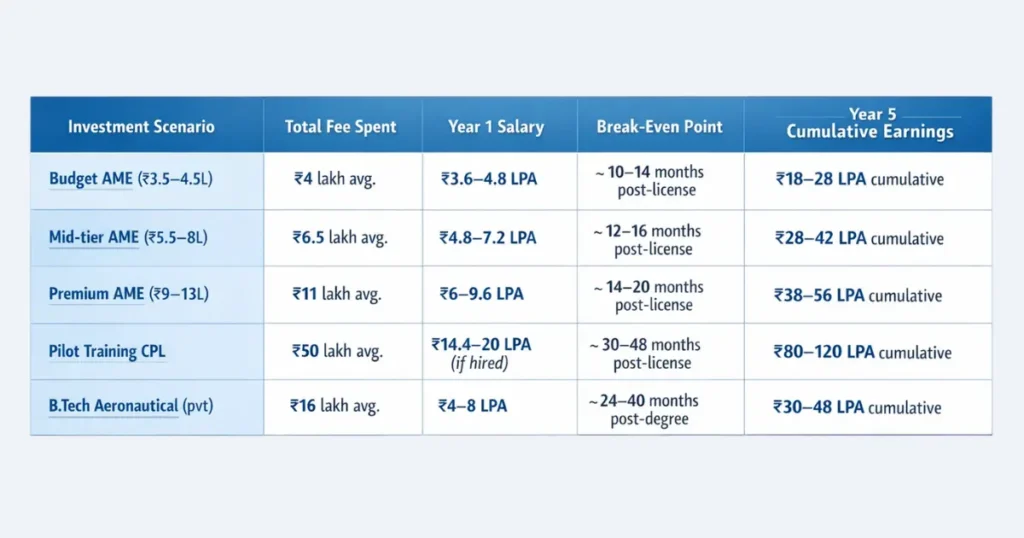
The ROI picture is unambiguous: AME course fees represent the best investment return per rupee spent in Indian aviation education. A student who spends ₹6.5 lakh on a quality mid-tier AME program and earns ₹6 LPA in Year 1 achieves break-even in 13 months. By Year 5, with type endorsements, they are earning ₹12–18 LPA. The investment-to-return ratio is simply not matched by any comparable aviation qualification.
The 10-Year Number: An AME who invests ₹8 lakh in their training, earns ₹5 LPA in Year 1, and reaches ₹22 LPA by Year 7 (through endorsements) will have earned approximately ₹1.2–1.5 crore in cumulative salary over 10 years of employment. Against an investment of ₹8 lakh, this represents an ROI of 1,400–1,800%. Very few professional qualifications in India approach this return.
How to Reduce Your AME Course Fees Without Reducing Your Career Quality
Paying less in AME course fees does not have to mean accepting a weaker program if you are strategic about how you reduce costs:
Scholarships: Free Money That Most Students Don’t Apply For
- Central government scholarships for aviation sector training are available under the Ministry of Civil Aviation skill development schemes. Most eligible students never apply because they do not know they exist. Register on NSP immediately after enrollment, before the application window closes each July–September. National Scholarship Portal (scholarships.gov.in):
- Many states offer merit and means-based scholarships for students pursuing professional training outside traditional engineering degrees. Check your state education department website specifically for ‘professional training scholarships’ or ‘skill development scholarships.’ State Government Scholarships:
- Most quality DGCA-approved AME institutes offer a 20–40% tuition fee reduction for students with Class 12 PCM scores above 70–80%. Ask specifically about merit scholarship criteria at each shortlisted institute during the application process, not after enrollment. Institute Merit Scholarships:
- Check eligibility for AICTE-administered scholarships some AME programs with affiliated technical institutions qualify. ₹50,000 per year available for qualifying candidates. AICTE PRAGATI and SAKSHAM Schemes:
Education Loans: Cover All 3 Years Before You Start
Education loans from nationalised banks specifically support AME training at DGCA-approved institutes. Key loan details every student must know:
- SBI Scholar Loan, PNB Saraswati, Canara Bank Vidya Turant, Union Bank Education Loan, Bank of Baroda Baroda Education Loan. Eligible banks:
- Tuition + hostel + DGCA exam fees + study materials + laptop (if applicable) all covered under education loan Coverage:
- Most education loans for professional training offer a full moratorium during the training period + 6 months after course completion. No EMI during training. Moratorium period:
- 4–10.5% per annum, depending on bank, loan amount, and collateral (government schemes offer subsidised rates for income-below-₹4.5L families). Interest rate:
- Up to ₹7.5 lakh without collateral; ₹7.5L–₹30L with collateral (property, FD, LIC policy). Loan amount:
Loan Timeline: Begin education loan application 8–10 weeks before your enrollment date. Banks require the institute’s fee schedule letter, admission offer letter, and income documents. Get these from the institute early. Loan processing takes 4–6 weeks minimum. Students who start the process on enrollment day face delays that can affect their fee payment and seat security.
Fee Negotiation: Honest and Effective
Negotiating AME course fees is standard and expected, especially at private institutes during the June/July enrollment period. Legitimate negotiation strategies:
- If you hold offer letters from two DGCA-approved institutes at different fee points, many institutes will match or partially match the competitor’s fee for a qualified candidate. Present competing offer letters:
- If your Class 12 marks are strong (70%+), formally request the merit scholarship in your enrollment meeting. Many institutes apply it only when specifically requested. Request a merit scholarship in writing:
- Institutes with strong alumni communities sometimes offer a 5–15% fee reduction for siblings of enrolled graduates. Ask about sibling/alumni discounts:
AME Course Fees vs Other Aviation and Engineering Qualifications
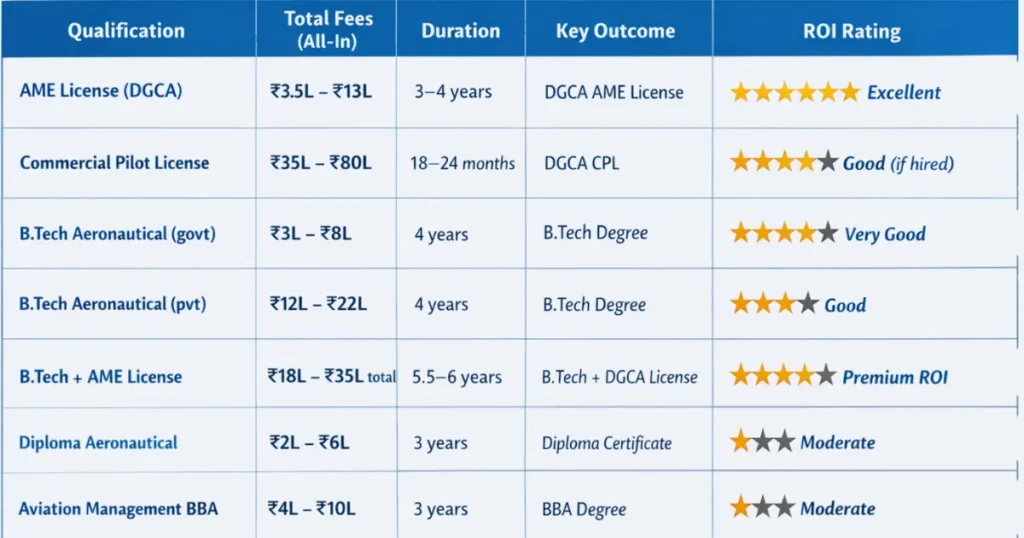
| Qualification | Total Fees (All-In) | Duration | Key Outcome | ROI Rating |
| AME License (DGCA) | ₹3.5L – ₹13L | 3–4 years | DGCA AME License | ⭐⭐⭐⭐⭐ Excellent |
| Commercial Pilot License | ₹35L – ₹80L | 18–24 months | DGCA CPL | ⭐⭐⭐ Good (if hired) |
| B.Tech Aeronautical (govt) | ₹3L – ₹8L | 4 years | B.Tech Degree | ⭐⭐⭐⭐ Very Good |
| B.Tech Aeronautical (pvt) | ₹12L – ₹22L | 4 years | B.Tech Degree | ⭐⭐⭐ Good |
| B.Tech + AME License | ₹18L – ₹35L total | 5.5–6 years | B.Tech + DGCA License | ⭐⭐⭐⭐⭐ Premium ROI |
| Diploma Aeronautical | ₹2L – ₹6L | 3 years | Diploma Certificate | ⭐⭐ Moderate |
| Aviation Management BBA | ₹4L – ₹10L | 3 years | BBA Degree | ⭐⭐ Moderate |
The standout finding from this comparison: AME course fees are lower than pilot training by 6–8x, comparable to B.Tech engineering at government rates, and deliver a professional license (not just a degree) as the output. The dual B.Tech + AME license pathway costs more upfront but delivers a salary premium that repays the investment within 3–5 years of employment.
Frequently Asked Questions: AME Course Fees
Q: What is the total AME course fee in India for 3 years?
A: The total AME course fee in India over 3 years ranges from ₹3.5 lakh to ₹13 lakh all-in, depending on the institution tier. Budget tier DGCA-approved institutes: ₹3.5–6.5 lakh total (tuition + hostel + DGCA exam fees + study materials). Mid-tier private institutes: ₹5.5–9 lakh total. Premium private institutes: ₹8–13 lakh total. These figures include all major cost components tuition, accommodation, food, DGCA module examination fees, and study materials. Always request a written 3-year fee schedule from your institute before paying any enrollment fee.
Q: Are there scholarships available to reduce AME course fees?
A: Yes, and most eligible students never apply for them. Available scholarships for AME course fees in India include: National Scholarship Portal (NSP) central government schemes for aviation sector training (scholarships.gov.in — register immediately after enrollment, before July–September window closes); state government skill development scholarships (check your state education department); institute merit scholarships of 20–40% for students with 70–80%+ Class 12 PCM scores (ask specifically during admission counselling); and AICTE PRAGATI/SAKSHAM schemes where applicable. Applying for all available scholarships simultaneously can reduce your net AME course fees by ₹40,000–₹2,50,000 over the 3-year program.
Q: Can I get an education loan for AME course fees in India?
A: Yes. Education loans covering AME course fees in India are available from SBI (Scholar Loan), PNB (Saraswati scheme), Canara Bank (Vidya Turant), Union Bank, and Bank of Baroda. Loans cover tuition, hostel, DGCA exam fees, and study materials. Up to ₹7.5 lakh is available without collateral; ₹7.5–30 lakh with collateral. Most loans carry a full moratorium during training, plus 6 months post-completion, meaning no EMI while you are studying. Interest rates range from 4–10.5% depending on the bank and income. Begin the loan application 8–10 weeks before enrollment: banks require the institute’s fee schedule letter and admission offer letter to process the application.
Q: Is the AME course fee worth it compared to a B.Tech engineering degree?
A: For a student whose goal is hands-on aircraft maintenance and a DGCA license AME course fees represent a better value than a comparable private B.Tech engineering degree on every metric: lower total cost (₹4–9 lakh vs ₹12–22 lakh for private B.Tech), shorter time to first employment (3–4 years vs 4–5 years), and a professional license as the output rather than just an academic degree. For students targeting design, R&D, and DRDO/ISRO/HAL engineering careers, B.Tech is the appropriate path. For students committed to aviation maintenance and certification, AME offers superior ROI on every comparable metric. The strongest combination is B.Tech Aeronautical Engineering, followed by AME licensing higher upfront investment but the highest career earnings ceiling in Indian aviation.
Q: What is the AME course fee at government colleges in India?
A: Government-affiliated and subsidised DGCA-approved AME training institutes in India charge tuition fees of approximately ₹60,000–₹1,20,000 per year, significantly below private institute rates. The total 3-year all-in cost at government-affiliated programmes (including hostel and DGCA exam fees) typically ranges from ₹3.5 to ₹6.5 lakh. Notable institutes include the National Institute of Aeronautical Engineering (NIAE) in Bareilly and government-affiliated regional aviation training centres. Seats at government-affiliated programs are limited and often fill early — applications should be submitted January–March for the June intake.
Conclusion: AME Course Fees Are Not a Cost, They Are India’s Best Aviation Career Investment
After examining every component of AME course fees in India, the tuition, the hostel, the hidden costs, and the return on every rupee invested, the answer to the question this blog asked is clear.
Yes. AME is worth it.
For a middle-class Indian family investing ₹5–9 lakh in a quality DGCA-approved AME program, the career return is extraordinary: a legally mandated professional license, first-year employment within weeks of licensing, salary growth of 4–5x within 7 years, and international earning potential that looks modest in retrospect.
The only condition: the quality of the institute you choose must match the investment you make. Verify DGCA approval. Evaluate OJT partnerships. Check Module exam pass rates. Request a written 3-year AME course fees schedule before signing anything.
Invest wisely. Choose the right institute. And let the career return prove every rupee was worth it.
Comparing AME vs B.Tech Aeronautical Engineering Investment for 2026?
SOA School of Aeronautics, Neemrana, India’s dedicated aeronautical engineering institution in the Delhi NCR / DMIC aerospace corridor. Our B.Tech Aeronautical Engineering program offers DGCA regulatory framework curriculum, dual specialisation tracks, and a natural fast-track pathway to AME licensing after graduation — giving students the dual qualification that commands India’s highest aviation career ROI. Our admissions team will give you a complete, transparent comparison of AME course fees vs B.Tech investment and career returns. No pressure. Just complete the information. https://soacet.org/ | 2026 Admissions Get a Complete Fee & ROI Comparison