
What if you could earn both your undergraduate and postgraduate qualifications in aeronautical engineering in five years instead of six, at a lower total cost, with no gap year, and no second admission process? That is exactly what a B.Tech Aeronautical Engineering integrated program delivers.
India’s aviation and aerospace sector is expanding at a pace the country has never seen before. Airlines are ordering over 1,200 new aircraft. DRDO, ISRO, and HAL are scaling engineering headcount. The indigenous drone sector is creating entirely new career categories. And across all of this growth, employers are not just looking for engineers, they are looking for specialists. Professionals with depth.
A B.Tech Aeronautical Engineering integrated program is designed to create exactly that kind of professional. This guide explains everything: what integrated programs are, why they exist, who qualifies, which institutions genuinely deliver them, what careers they unlock, and what salaries you can realistically expect. Read this before making your admission decision.
Read Before: Integrated B. Tech Aeronautical + AME: A Dual Advantage
What Is a B.Tech Aeronautical Engineering Integrated Program?
A B.Tech Aeronautical Engineering integrated program combines undergraduate (B.Tech) and postgraduate (M.Tech) qualifications into a single, continuous academic journey without the gap, re-admission, or repetition of the traditional sequential route.
The standard path 4-year B.Tech, then separately applying for a 2-year M.Tech takes 6 years minimum, costs more in total fees and living expenses, and breaks your academic momentum with entrance exams and transition periods. The integrated program compresses this to 5 years: one cohort, one institution, one deliberately designed curriculum where every year builds directly on the last.
Three Integrated Format Types You Will Encounter in India
- Two separate degrees are awarded upon completion. The most academically prestigious and career-powerful format. Particularly strong at IITs where Dual Degree programs are well-established. 5-Year B.Tech + M.Tech Integrated:
- A single B.Tech degree with two embedded specialisation tracks built into the curriculum, for example, Aircraft Structures + Aerodynamics, or Avionics + UAV Systems. Both specialisations are reflected on the degree certificate. 4-Year B.Tech with Dual Specialisation:
- Combines aeronautical engineering depth with aviation business management, ideal for students targeting airline operations, MRO management, aviation consulting, and supply chain leadership roles. 5-Year B.Tech + MBA Integrated:
Key Point: In the context of dedicated aeronautical engineering institutions like SOA School of Aeronautics, Neemrana, the ‘integrated program’ most commonly refers to a B.Tech with dual specialisation tracks embedded across the full 4-year curriculum, providing the depth benefits of integration without requiring an additional fifth year.
Why Choose a B.Tech Aeronautical Engineering Integrated Program Over a Standard B.Tech?
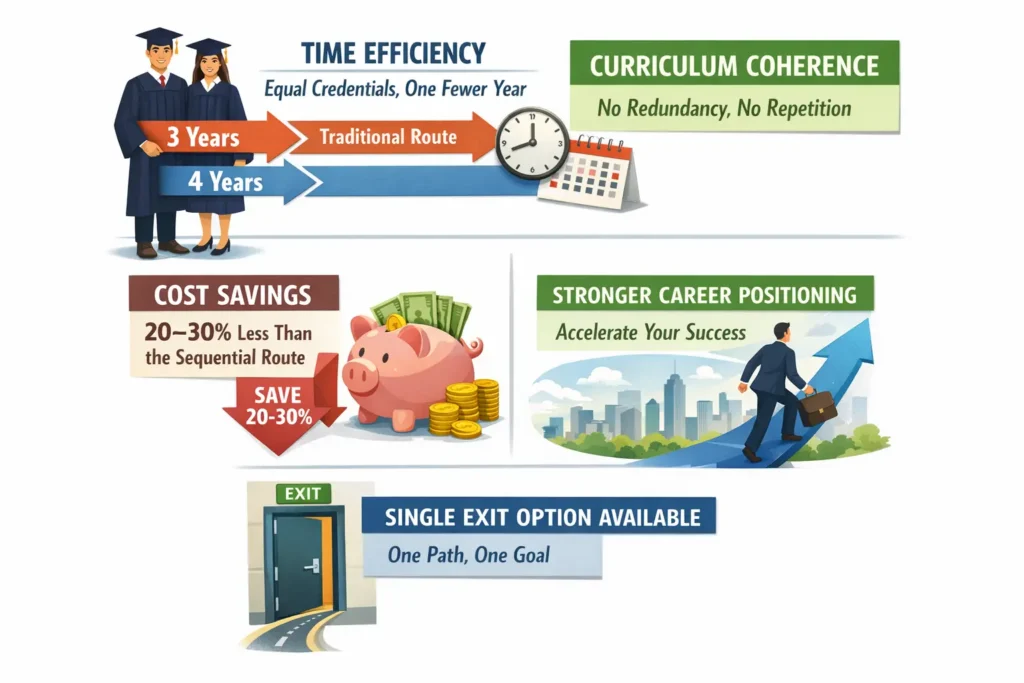
This is the central question, and it deserves a direct, evidence-based answer. Here are the five concrete advantages that integrated aeronautical engineering programs deliver:
Advantage 1
Time Efficiency: Equal Credentials, One Fewer Year
A standalone B.Tech (4 years) + standalone M.Tech application, entrance exam, and program (2 years) = minimum 6 years. An integrated B.Tech + M.Tech = 5 years. You arrive at the same destination, both credentials in hand, one full year earlier. In career terms: one additional year of salary, one additional year of professional experience, and one fewer year of tuition and living costs.
Advantage 2
Curriculum Coherence: No Redundancy, No Repetition
When B.Tech and M.Tech programs are designed by separate institutions or faculty teams, students frequently repeat foundational content in postgraduate study that they already covered in undergraduate studies. Integrated programs are designed as a unified journey. Year 1 mathematics builds Year 3 aerodynamics, which builds Year 5 advanced computational fluid dynamics research. Every year serves a purpose. Nothing is repeated; everything compounds.
Note: Book a FREE counseling session through SOACET to understand the AME admission process clearly.
Advantage 3
Cost Savings: 20–30% Less Than the Sequential Route
The total fee of an integrated program is typically 20–30% less than pursuing B.Tech and M.Tech separately, because you eliminate one set of admission fees, one hostel deposit, one set of study material costs, and one year of living expenses. For most middle-class Indian families, this saving is ₹2–5 lakh across the program meaningful amount of money without any reduction in the final qualification received.
Advantage 4
Stronger Career Positioning
When DRDO, HAL, ISRO, Boeing India, or Airbus India review applications, a candidate with a B.Tech Aeronautical Engineering integrated program credential demonstrates depth of commitment, specialisation, and research capability. Particularly for PSU recruitment, M.Tech holders enter at higher grade levels, Scientist B at DRDO and Scientist SC at ISRO, than B.Tech-only candidates. This starting grade difference compounds into permanently higher salary trajectories over a 30-year career.
Advantage 5
Single Exit Option Available
Most well-structured integrated programs (especially at IITs and quality private institutions) allow students to exit at Year 4 with their full B. Tech degree if circumstances require it. This option means you take on essentially zero additional risk, you commit to 5 years, but retain the safety net of a complete undergraduate credential at Year 4. It is an asymmetric bet in your favour.
Eligibility for B.Tech Aeronautical Engineering Integrated Program: Who Can Apply?
Eligibility for a B.Tech Aeronautical Engineering integrated program is governed by AICTE guidelines and individual institution policies. Here is the complete, stream-by-stream breakdown:
| Eligibility Factor | Standard Requirement | Notes for Integrated Programs |
| Qualification | Class 12 from a recognised board | CBSE / ICSE / State Board accepted |
| Compulsory Subjects | Physics + Chemistry + Mathematics (PCM) | All three are mandatory for engineering admission |
| Minimum Marks | 50%–60% PCM aggregate | IIT Dual Degree: 75%+ effective via JEE Advanced rank |
| Entrance Exam | JEE Main / State Exam / University Exam | Private universities: own exam (SOAET, SRMJEE, VITEEE) |
| Age | 17–23 years at admission | Varies by institution and state regulation |
| Relaxation | 5% for SC/ST/OBC | Standard at all AICTE-approved institutions |
| Diploma Lateral Entry | 3-year Engg. Diploma: lateral to Year 2 only | Not available for 5-year integrated programs |
Can PCB Students Apply?
PCB (Physics, Chemistry, Biology) students cannot apply for a B.Tech Aeronautical Engineering integrated program under standard eligibility. However, students who took PCB + Mathematics as an additional subject at Class 12 may be eligible to check with their state board. Some private universities also accept a Mathematics bridge qualification. For PCB students committed to aviation, aviation management programs (BBA + MBA Aviation) are an accessible alternative pathway.
Top Colleges Offering B.Tech Aeronautical Engineering Integrated Programs in India
Not every institution that uses the word ‘integrated’ in its brochure delivers a genuinely integrated program experience. Here is an honest, tiered assessment of where quality B.Tech Aeronautical Engineering integrated programs genuinely exist:
Tier 1 IITs (Highest Prestige, Most Competitive)
- 5-year integrated. JEE Advanced top 2,000–5,000 ranks. World-class wind tunnels, CFD labs, and research infrastructure. IIT Bombay B.Tech + M.Tech Dual Degree, Aerospace Engineering:
- Strong research output in flight mechanics and propulsion. JEE Advanced required. IIT Madras B.Tech + M.Tech Aerospace Engineering:
- Dual degree with specialisation options in avionics and structures. JEE Advanced required. IIT Kharagpur B.Tech + M.Tech Aerospace:
- Known for computational aerodynamics specialisation. JEE Advanced required. IIT Kanpur Integrated Aerospace Engineering:
IIT Reality Check: IIT dual-degree seats typically require JEE Advanced ranks in the top 3,000–5,000 (varies by IIT and year). These are outstanding programs for those who qualify. Still, the vast majority of students access integrated aeronautical engineering programs through quality private institutions, which deliver strong outcomes through a different route.
Tier 2 Quality Private Universities
- B.Tech + M.Tech Aerospace Engineering integrated good industry partnerships and active placement support. SRM Institute of Science and Technology, Chennai:
- B.Tech Aerospace with dual specialisation tracks a large campus, a strong research ecosystem and student volume. VIT, Vellore:
- Structured aerospace program with international elective integration and a good alumni network. Manipal Academy of Higher Education:
- Aeronautical engineering with dual specialisation options and an avionics focus. Hindustan Institute of Technology and Science (HITS), Chennai:
Tier 3 Dedicated Aviation Institutions
SOA School of Aeronautics, Neemrana (Rajasthan). This is India’s only institution dedicated exclusively to aeronautical engineering, located in the heart of the Delhi NCR / Delhi-Mumbai Industrial Corridor (DMIC). What distinguishes SOA Neemrana for a B.Tech Aeronautical Engineering integrated program:
- Unlike every other institution on this list, SOA Neemrana is not a multi-disciplinary campus where aeronautical engineering is one of 30 programs competing for faculty attention and lab investment. Every resource, faculty, lab, industry partnerships, and career services are concentrated exclusively on aeronautical engineering. Singular Aeronautical Focus:
- Two embedded specialisation tracks across the full B.Tech curriculum: (1) Aircraft Structures + Aerodynamics, the classical design and analysis pathway for DRDO/HAL/aerospace MNC roles; (2) Avionics + UAV Systems, the digital aviation pathway for avionics careers and India’s booming drone sector. Dual Specialisation Built In:
- Aviation regulatory content is woven throughout the curriculum, preparing students for DGCA compliance roles and creating a natural pathway to AME licensing after graduation. DGCA Regulatory Framework Exposure:
- Neemrana sits in India’s most active aerospace and defence manufacturing zone, surrounded by defence supply chain companies in Bhiwadi, aerospace component manufacturers near Manesar, and the aviation industry clusters of Delhi NCR. Students access real internships and industry projects throughout their degree. Location Advantage DMIC Corridor:
- Annual tuition ₹1.8–3 lakh; total 4-year all-in cost ₹12–22 lakh, significantly below IIT and comparable to quality private universities, but with exclusively focused aviation education. Competitive Fee Structure:
Visit for 2026 Admission Details: Full program details, dual specialisation options, fee structure, and the 2026 admission process at https://soacet.org/
Career Scope After a B.Tech Aeronautical Engineering Integrated Program in India

Graduates of a B.Tech Aeronautical Engineering integrated program enter a wider range of career options at higher grade levels than standard B.Tech graduates. Here is where they are being hired in 2026:
Government Sector Prestige, Security, Nation-Building
- Design and development of fighter aircraft, UAVs, missiles, and hypersonic vehicles. M.Tech integrated graduates enter at Scientist B, one full grade above the B.Tech-only Scientist C entry. DRDO (Scientist B):
- Spacecraft structures, launch vehicle propulsion, satellite aerodynamics. M.Tech credential unlocks SC-level entry directly. ISRO (Scientist/Engineer SC):
- Senior Design Engineer roles in TEJAS, Advanced Light Helicopter, and AMCA indigenous aircraft programs. HAL (Hindustan Aeronautics Limited):
- Engineering officer roles managing aircraft systems, airworthiness, and maintenance planning across the IAF fleet. Indian Air Force Technical Branch:
Private Aerospace Sector Innovation and Global Exposure
- Aerodynamics, structural analysis, and systems design at India R&D centres. M.Tech preferred for specialist roles. Boeing India, Airbus India:
- Indigenous defence manufacturing fastest-growing aerospace private employer in India. Tata Advanced Systems (TASL), Mahindra Aerospace:
- Jet engine design, avionics development, and systems integration roles. GE Aviation India, Safran, Honeywell Aerospace:
- India’s drone sector needs aeronautical engineers with both structures and avionics backgrounds, perfectly served by dual specialisation. UAV / Drone Startups:
- Graduates who additionally pursue DGCA AME licensing after their integrated program have access to senior quality assurance and airworthiness management roles at Air Works, AIESL, and GMR Aero Technic. MRO Companies (AME Pathway):
International Careers
- Integrated B.Tech + M.Tech graduates from strong institutions are competitive for M.S. programs at MIT, Delft, Cranfield, and RMIT. M.S. abroad:
- Rolls-Royce, Safran globally, MBDA, Boeing Commercial all recruit Indian aeronautical engineers with integrated degrees and strong CGPA. Global aerospace companies:
Salary After B.Tech Aeronautical Engineering Integrated Program: 2026 Numbers
Here are the actual salary ranges employers are paying aeronautical engineering graduates in 2026, stratified by qualification type and experience level:
| Experience Level | B.Tech Only | B.Tech + M.Tech Integrated | Govt. PSU (DRDO/ISRO/HAL) |
| Entry (0–2 years) | ₹4 – ₹7 LPA | ₹6 – ₹11 LPA | ₹7 – ₹10 LPA (M.Tech grade) |
| Mid-Level (3–7 years) | ₹9 – ₹16 LPA | ₹14 – ₹26 LPA | ₹12 – ₹20 LPA |
| Senior (8–12 years) | ₹18 – ₹30 LPA | ₹26 – ₹50 LPA | ₹20 – ₹35 LPA |
| Principal/Lead (12+ yrs) | ₹28 – ₹45 LPA | ₹40 – ₹70+ LPA | ₹35 – ₹55 LPA |
| International (Abroad) | USD 60K – 85K/yr | USD 80K – 120K/yr | Not the primary route |
The salary premium for integrated graduates is real, permanent, and compounding. At mid-career, a B.Tech + M.Tech Aeronautical Engineering graduate earns ₹5–10 lakh more annually than a B.Tech-only peer, a gap that widens with seniority.
Highest Earning Path: B.Tech Aeronautical Engineering integrated program + DGCA AME license + 2 aircraft type endorsements + 7–10 years experience = ₹35–55 LPA domestic | USD 8,000–15,000/month international. This combination is the most powerful qualification profile in Indian aviation.
How to Choose the Right B.Tech Aeronautical Engineering Integrated Program: 5-Point Framework
- Confirm your career direction first. Government R&D (DRDO/ISRO/HAL) → prioritise 5-year B.Tech + M.Tech integrated at IIT or quality government institution. Private aerospace/airline / MRO → B.Tech with dual specialisation from a strong private or specialised institution. International career → B.Tech with a strong research record and GATE/GRE preparation.
- Verify the specialisation tracks match your target. Avionics dual specialisation for airline and defence electronics roles. Structures + Aerodynamics for aircraft design. UAV Systems for the drone sector. Confirm the tracks offered by each institution before applying, not all ‘aeronautical engineering’ programs cover all specialisations.
- Examine placement data specifically for aeronautical graduates. General placement statistics dilute the picture. Push for data on aeronautical engineering graduate placement, specifically: which companies, at what salary bands, in what roles. Institutions with genuine aeronautical engineering placement success are proud to share this data in detail.
- Assess lab quality and industry access in person. Visit before you commit. See the CFD labs, the avionics workshops, the CAD software licenses, and the industry project portfolios. For integrated programs with AME pathway exposure, verify actual aircraft presence. A 3-hour campus visit reveals what months of website browsing cannot.
- Calculate the total financial picture for all 4–5 years. Include tuition, hostel, living costs, exam fees, and materials. Compare total program cost to expected first-year salary. For most quality integrated aeronautical programs, the debt-to-salary ratio achieves break-even within 2–3 years of employment a sound investment.
Frequently Asked Questions: B.Tech Aeronautical Engineering Integrated Program
Q: What is the difference between a B.Tech Aeronautical Engineering integrated program and a regular B.Tech?
A: A regular B.Tech Aeronautical Engineering is a 4-year undergraduate degree covering core aeronautical subjects. A B.Tech Aeronautical Engineering integrated program either (a) combines B.Tech + M.Tech into a continuous 5-year program awarding both degrees, or (b) embeds dual specialisation tracks into the 4-year B.Tech, providing postgraduate-level depth within the undergraduate program. Both integrated formats deliver deeper specialisation, stronger career positioning, and better salary outcomes than a standard single-specialisation B.Tech.
Q: Is JEE required for a B.Tech Aeronautical Engineering integrated program?
A: JEE Advanced is required for IIT integrated/dual degree programs. JEE Main is required for NIT-level programs. Many quality private universities and specialised aviation institutions offer B.Tech Aeronautical Engineering integrated programs through their own entrance exams (SOAET, SRMJEE, VITEEE) or JEE Main scores, without requiring JEE Advanced. State engineering colleges admit through state-level exams. Excellent integrated aeronautical engineering programs are accessible at multiple competitive tiers.
Q: What salary can I expect after a B.Tech Aeronautical Engineering integrated program?
A: Entry-level (0–2 years): ₹6–11 LPA for private aerospace companies; ₹7–10 LPA at DRDO/ISRO/HAL at M.Tech entry grade. Mid-level (3–7 years): ₹14–26 LPA. Senior level (8+ years): ₹26–50+ LPA. Internationally, integrated graduates earn USD 80,000–120,000 per year in global aerospace roles. The key salary multipliers beyond the base qualification are aircraft-type endorsements (for the AME pathway) and research publications or patent contributions (for design and R&D roles).
Q: Can I do an AME license after completing a B.Tech Aeronautical Engineering integrated program?
A: Yes, and it is one of the strongest career moves available to aeronautical engineering graduates. DGCA grants Module exam exemptions to B.Tech Aeronautical Engineering graduates under the CAR-66 framework, based on their engineering syllabus coverage. This means engineering graduates can achieve full AME licensure significantly faster than students entering AME training straight after Class 12. The B.Tech Aeronautical Engineering integrated program + AME license combination is among the most sought-after qualification profiles in India’s airline and MRO sector.
Q: Why is the SOA School of Aeronautics, Neemrana, a strong choice for integrated aeronautical engineering?
A: SOA School of Aeronautics in Neemrana is India’s only institution dedicated exclusively to aeronautical engineering, providing focused faculty attention, concentrated lab investment, and exclusive industry partnerships that multi-disciplinary campuses cannot match. Its B.Tech program features dual specialisation tracks (Aircraft Structures + Aerodynamics / Avionics + UAV Systems), DGCA regulatory framework exposure throughout the curriculum, and a location in the Neemrana / Delhi NCR aerospace industrial corridor that provides organic industry access for internships, projects, and placement. It is a particularly strong choice for North India students who want aeronautical engineering depth without the generalist dilution of a large multi-disciplinary campus.
Conclusion: Integration Is Not Just a Format, It Is a Career Strategy
A B.Tech Aeronautical Engineering integrated program is not simply a longer degree or a marketing phrase on a college brochure. At its best, it is a deliberately engineered academic journey that builds genuine specialisation, delivers better credentials in less time, and positions graduates for careers that standard B.Tech-only engineers simply cannot access.
India’s aviation and aerospace sector will need qualified, deeply specialised aeronautical engineers for the next 20 years to design the aircraft on order, maintain the fleets being built, develop the UAVs transforming defence and logistics, and lead the MRO industry India is building to replace foreign dependency.
The students who enter the right B.Tech Aeronautical Engineering integrated program in 2026 will be the principal engineers, research leads, and aviation directors of 2036. Make your admission decision with full information, complete verification, and genuine confidence in where you want to go.
Depth is your advantage. Integration is your strategy. Aviation is your destination.
Ready to Explore India’s Most Focused Aeronautical Engineering Program?
SOA School of Aeronautics, Neemrana the only institution in India dedicated exclusively to aeronautical engineering. Dual specialisation tracks. DGCA framework curriculum. Located in the Delhi NCR / DMIC aerospace corridor. Admissions open for the 2026 batch. https://soacet.org/ | Apply for 2026 Intake