
There is a question that every aspiring Aircraft Maintenance Engineer must answer before spending ₹5–13 lakh and 3 years of their life in training: Is my chosen AME college genuinely DGCA-approved?
Not claimed to be approved. Not ‘in the process of approval.’ Not approved by some state aviation body. Genuinely, currently, verifiably approved by the Directorate General of Civil Aviation, India’s aviation regulatory authority, under the specific standards of CAR Series C, Part II.
The distinction between a genuine DGCA AME college and one that merely claims approval is the difference between a career and a wasted education. This guide tells you exactly what DGCA approval for AME colleges means, how it works, how to verify it, what it requires from the institute, and how to choose the best college from among genuinely approved institutions.
What Makes This Guide Different: Most AME guides tell you to ‘check DGCA approval’ without explaining what that means, what DGCA actually looks for, or why approval quality varies between colleges. This guide delves into the regulatory framework, approval standards, and what they mean for your training and career.
Read Before: Top Aeronautics Courses in India: Apply through SOACET
What DGCA Approval for AME Colleges Actually Means
When we say a college is a “DGCA AME college” what does that mean in legal and practical terms?
The Directorate General of Civil Aviation approves Basic AME Training Organisations (ATOs) under Civil Aviation Requirements (CAR) Series C, Part II. This approval is not a registration, recognition, or affiliation it is a formal regulatory authorisation that permits the organisation to deliver approved AME training under DGCA oversight.
What DGCA Physically Inspects Before Granting Approval
Before any college is placed on the DGCA-approved AME colleges list, DGCA inspectors physically verify compliance with minimum standards across these areas:
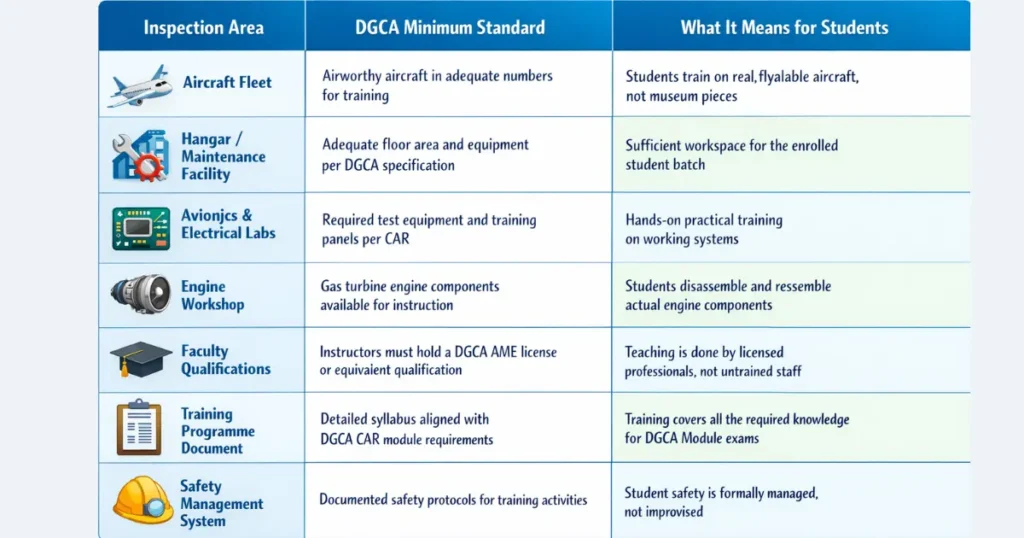
Key Legal Point: DGCA approval is specific to a physical location and specific to approved categories (B1.1, B1.3, B2). An institute approved for B1.1 training is not automatically approved for B2 training. When verifying a DGCA AME college, confirm the approval covers both the location where training occurs AND your desired license category.
CAR-66 and CAR Series C: The Regulatory Framework Behind DGCA AME Colleges
Understanding the regulatory framework that governs DGCA AME colleges gives you the ability to evaluate institutions at a deeper level than surface-level marketing claims.
CAR Series C, Part II The Training Standard
CAR Series C, Part II, defines the requirements for Basic AME Training Organisations in India. It specifies: minimum classroom contact hours per subject module; minimum practical training hours on aircraft and systems; qualification requirements for instructors; record-keeping and documentation standards; and the examination and assessment process that feeds into DGCA Module exams.
Compliance with CAR Series C, Part II, is what separates a DGCA AME college from any other institution that teaches aviation-adjacent content. Without this compliance, there is no pathway to DGCA Module exams and no pathway to a DGCA AME license.
Note: Book a FREE counselling session through SOACET to understand the AME admission process clearly.
CAR-66 The Licensing Standard That Determines Curriculum
CAR-66 is India’s adaptation of the EASA CAR-66 aircraft maintenance licensing standard. It defines the knowledge, experience, and examination requirements for DGCA AME license issuance across all categories (B1.1, B1.3, B2).
Why this matters for college selection: A DGCA AME college that structures its curriculum strictly around CAR-66 module requirements produces students who are genuinely prepared for DGCA Module examinations. Colleges that teach “aviation content” without rigorously aligning to CAR-66 produce students who are knowledgeable but not examination-ready, adding months to their licensing timeline.
| CAR-66 Module | Subject | Relevant for | DGCA Exam Required? |
| Module 1 | Mathematics | All categories | Yes mandatory |
| Module 2 | Physics | All categories | Yes mandatory |
| Module 3 | Electrical Fundamentals | All categories | Yes mandatory |
| Module 5 | Digital Techniques | All categories | Yes mandatory |
| Module 7A | Maintenance Practices | B1 categories | Yes mandatory |
| Module 8 | Aerodynamics | All categories | Yes mandatory |
| Module 9A | Human Factors | All categories | Yes mandatory |
| Module 10 | Aviation Legislation | All categories | Yes mandatory |
| Module 11A | Turbine Aeroplane Systems | B1.1 only | Yes mandatory for B1.1 |
| Module 13 | Aircraft Aerodynamics | B1 categories | Yes mandatory |
| Module 15 | Gas Turbine Engine | B1.1 only | Yes mandatory for B1.1 |
| Module 11B/11C | Helicopter Systems | B1.3 only | Yes mandatory for B1.3 |
CAR-66 Alignment Check: During your campus visit to any DGCA AME college, ask: ‘Can you show me how your curriculum maps to CAR-66 Module requirements?’ A college with a genuine CAR-66 curriculum alignment can show you a written module-by-module syllabus map. Colleges that struggle to answer this question are not as preparation-focused as they claim.
How DGCA Grants and Renews AME College Approval: What Students Must Know
Understanding how DGCA AME college approval is granted and maintained reveals critical information about the current approval status.
The DGCA Approval Process for AME Colleges
- Application submission: The institute submits a formal application to DGCA, including training programme documentation, facility description, aircraft list, and faculty credentials.
- Document review: DGCA’s Training Standards Division reviews the submitted training programme against CAR Series C, Part II requirements.
- Physical inspection: DGCA inspectors visit the institute to physically verify the aircraft fleet, hangar, labs, workshop, and training facilities against approved specifications.
- Approval granted: If all requirements are met, DGCA issues an Approval Certificate with a specific approval number, category (B1.1 / B1.3 / B2), and validity period.
- Surveillance inspections: DGCA conducts periodic surveillance inspections of approved institutes, unannounced or scheduled, to verify continued compliance.
- Renewal: Approval must be renewed periodically. Institutes that fail surveillance inspections or do not renew on time lose active approval status.
Why Approval Status Can Change And Why You Must Check Actively
This is the aspect most students never consider: DGCA AME college approval is not permanent. Approvals expire, get suspended, or get withdrawn when institutes fail to maintain compliance standards. An institute approved in 2020 may not be approved in 2026 or may hold approval for B1.1 but not B2.
Critical Warning: Several AME colleges in India have had their DGCA approval lapse or be withdrawn in recent years due to aircraft becoming unairworthy, faculty departures, or failure to renew. Some of these institutes continue marketing themselves and enrolling students despite lapsed approval. The only protection against this is personally verifying the current DGCA-approved list at dgca.gov.in, not relying on the institute’s own claims, certificates displayed on their premises, or admission agent assurances.
6-Step Process to Verify Any DGCA AME College: Do This Before Applying
Here is the complete, actionable verification process every student must follow before submitting any application to any DGCA AME college in India:
STEP 1: Access the Official DGCA Website
Go directly to www.dgca.gov.in, India’s official civil aviation regulatory authority website. Do not use any third-party ‘DGCA-approved college lists’ from education portals, coaching websites, or social media groups. These lists may be outdated, inaccurate, or financially motivated. The only authoritative source is the DGCA website itself.
STEP 2: Navigate to the Approved ATOs List
From the DGCA homepage: Click ‘Aviation Training Organisations’ in the top navigation menu → Select ‘Approved Basic AME Training Organisations.’ This page contains the current official list of DGCA-approved AME colleges in India, with their approval numbers, approved categories, and location details.
STEP 3: Search for the Exact Institute Name
Search for the exact name of the institute you are considering. Note: Use the exact legal name of the institute, not a shortened trade name. If you are uncertain of the legal name, obtain it from the institute’s DGCA approval certificate before searching. Partial name matches may not indicate the correct institute.
STEP 4: Verify All Three Approval Parameters
For any DGCA AME college you find on the list, confirm three things:
(1) The institute name matches exactly, not approximately.
(2) The approval is marked as ACTIVE, not expired, suspended, or pending renewal.
(3) The approval specifically covers your desired category B1.1, B1.3, or B2. An active approval for B1.1 does not authorise B2 training.
STEP 5: Cross-Verify the Approval Number
Note the DGCA approval number from the official list. When you visit the institute, ask to see their original DGCA Approval Certificate. The approval number, institute name, approved categories, and validity period on the physical certificate must exactly match what appears on the DGCA website.
Any discrepancy, however small, must be clarified directly with DGCA before proceeding.
STEP 6: Confirm Directly With DGCA if Any Doubt Remains
If you have any uncertainty after completing Steps 1–5 if the name does not quite match, if the approval looks recent but the institute claims a longer history, or if anything feels inconsistent, call DGCA’s regional office directly. Their contact numbers are on the DGCA website. A 5-minute phone call with DGCA is the most authoritative verification possible and costs nothing.
Category-Wise: What to Look for in DGCA AME Colleges for B1.1 vs B2
Once DGCA approval is verified, the evaluation criteria for DGCA AME colleges differ based on your license category. Here is what matters most for each:
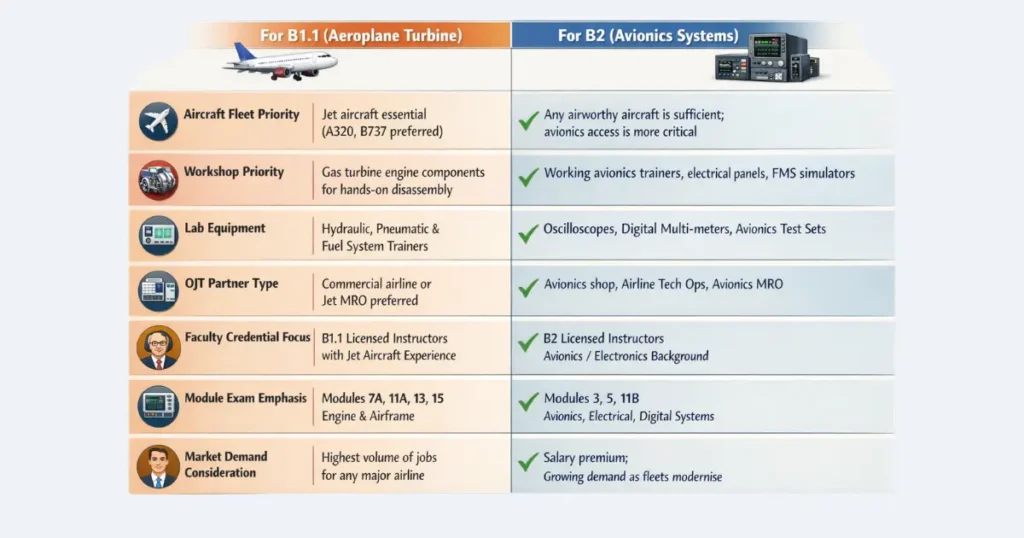
Dual Category Opportunity: Some DGCA AME colleges in India are approved for both B1.1 and B2 training, and some offer dual-category training to students who qualify. A B1.1 + B2 dual license is one of the highest-value AME qualification combinations in Indian aviation, commanding a 25–40% salary premium. Ask any DGCA AME college you visit whether they offer or facilitate dual-category training.
What Separates the Best DGCA AME Colleges from Average Ones
All DGCA AME colleges meet the minimum CAR standards, which is what gets them approved. The best ones go beyond minimum compliance. Here is what genuine quality looks like above the DGCA floor:
Above-Minimum Aircraft Fleet
DGCA minimum aircraft requirements are intentionally conservatively designed as a floor, not an ideal. The best DGCA AME colleges maintain fleets of 3–6 operational aircraft across multiple types, ensuring every student gets adequate hands-on time throughout the training period. Institutes at the minimum threshold with 1–2 aircraft spread across a batch of 30+ students deliver significantly less individual practical time per student.
CAR-66 Module Pass Rate Above 80% Consistently
DGCA specifies minimum passing standards for Module exams (75% per module). The best DGCA AME colleges achieve first-attempt Module exam pass rates of 80–90%+ consistently across their batches. This is the clearest available indicator of teaching quality that goes beyond regulatory compliance. Ask for this data, and strong institutions share it willingly.
Proactive OJT Placement, Not Reactive Assistance
DGCA requires AME training to include supervised practical experience, but does not prescribe exact OJT placement mechanisms. The best DGCA AME colleges have formal airline and MRO OJT placement agreements with named partners, defined timelines, and structured OJT programs. Average colleges offer ‘assistance’ that translates to students independently managing their own OJT search after training completion.
Faculty With Current Industry Experience
DGCA requires instructors to hold appropriate qualifications, but does not require current active employment in the industry. The best DGCA AME colleges ensure their faculty have recent or current engagement with airlines, MRO companies, or DGCA regulatory processes. An instructor who last worked on commercial aircraft 15 years ago and has only taught since then delivers qualitatively different preparation than one who regularly consults with or works at operational aviation facilities.
Transparent DGCA Approval Documentation Available to Students
The best DGCA AME colleges display their current DGCA Approval Certificate prominently, include the approval number in all student communication, and proactively offer to walk prospective students through the DGCA verification process. This transparency signals institutional confidence. Colleges that are evasive about their approval details are not confident for good reason.
Frequently Asked Questions: DGCA AME Colleges
Q: What is the difference between a DGCA-approved AME college and a non-approved AME college?
A: A DGCA-approved AME college has been formally inspected and authorised by the Directorate General of Civil Aviation under CAR Series C, Part II to deliver Basic AME Training. Students at DGCA-approved colleges are eligible to appear for official DGCA Module examinations, and after passing all required modules and completing a minimum of OJT, can apply for a DGCA AME license. A non-approved AME college may teach aviation content, but cannot produce any of these outcomes: its training does not qualify students for DGCA Module exams, and no DGCA AME license can be issued based on that training. The financial and time cost of training at a non-approved college is entirely wasted students must restart at a DGCA-approved college from the beginning.
Q: How do I find the official list of DGCA-approved AME colleges in India?
A: The official and only authoritative source is the DGCA website at dgca.gov.in → Aviation Training Organisations → Approved Basic AME Training Organisations. This list is maintained by DGCA and updated when approvals are granted, renewed, or withdrawn. Do not rely on any third-party websites, education portals, or social media groups for this information they may be outdated or commercially motivated. Access the DGCA website directly, search for the exact institute name, and confirm the approval is active and covers your specific license category (B1.1, B1.3, or B2).
Q: Can a DGCA-approved AME college lose its approval?
A: Yes, and this happens more often than students realise. DGCA approval for AME colleges must be renewed periodically, and DGCA conducts surveillance inspections to verify ongoing compliance with CAR Series C, Part II standards. Institutes can lose approval for several reasons: aircraft becoming unairworthy and not replaced, failure to renew approval on time, faculty qualification lapses, facility deterioration below minimum standards, or failure to maintain the required training programme documentation. Some institutes that lost approval continue marketing themselves and enrolling students despite their lapsed status. Always verify the current approval status at dgca.gov.in immediately before submitting any application, not based on information from a college visit 3 months earlier.
Q: Are all DGCA-approved AME colleges equally good?
A: No DGCA approval establishes a minimum compliance floor, not a quality standard. All DGCA-approved AME colleges meet the regulatory minimum requirements, but there is enormous quality variation above that floor. The best DGCA-approved AME colleges have 3–6 airworthy aircraft, consistent 80%+ Module exam pass rates, formal airline or MRO OJT placement agreements, CAR-66 aligned curriculum, and faculty with active industry experience. Average approved colleges meet minimum requirements exactly sufficient for regulatory compliance, but deliver less practical preparation meaningfully. DGCA approval is necessary but not sufficient as an evaluation criterion; use the 6 additional quality markers described in this guide to distinguish the best from the merely compliant.
Q: Does SOA School of Aeronautics Neemrana offer DGCA AME pathway exposure?
A: SOA School of Aeronautics in Neemrana offers B.Tech Aeronautical Engineering, not standalone AME training. However, SOA Neemrana specifically designs its B.Tech curriculum with DGCA regulatory framework exposure throughout all four years. This gives graduates a comprehensive understanding of DGCA CAR standards, aviation legislation, and maintenance documentation requirements, creating a seamless and accelerated pathway to DGCA AME licensing after graduation. B.Tech Aeronautical Engineering graduates entering AME training receive DGCA Module exam exemptions under CAR-66 provisions, reducing their total time to full AME licensing to approximately 18–24 months. For students who want both an engineering degree and an AME license, the highest-earning aviation qualification combination in India, visiting soacet.org is the logical starting point.
Conclusion: DGCA Approval Is the Starting Point, Not the Finish Line
Choosing from among DGCA AME colleges in India is a two-stage decision. Stage one: verify that the college is genuinely, currently, and correctly DGCA approved under CAR Series C, Part II for your desired category. This verification must be done personally, at dgca.gov.in, and within weeks of your application date.
Stage two: among verified DGCA-approved colleges, distinguish the genuinely excellent from the merely compliant. Ask for the module exam pass rates. Verify OJT placement partnerships by name. Examine the aircraft fleet in person. Assess faculty credentials. The CAR minimum standards are a floor the best DGCA AME colleges are far above that floor, and the difference shapes your entire career.
Do both stages correctly, and you will graduate from a DGCA AME college with a license that is recognised, respected, and backed by genuine aircraft maintenance competence. That is the foundation every licensed AME career deserves.
Verify first. Evaluate deeply. Choose the college that earns your trust and your investment.
Interested in B.Tech Aeronautical Engineering With DGCA AME Pathway Support?
SOA School of Aeronautics, Neemrana, India’s only institution dedicated exclusively to aeronautical engineering, located in the heart of the Delhi NCR / DMIC aerospace corridor. Our B.Tech curriculum is built around DGCA regulatory frameworks and aviation maintenance standards, giving graduates the strongest possible platform for accelerated AME licensing after their degree. Our admissions team will walk you through the B.Tech → AME licensing pathway in detail: module exemptions, timeline, and career outcomes. https://soacet.org/ | 2026 Admissions Schedule Your Consultation Today