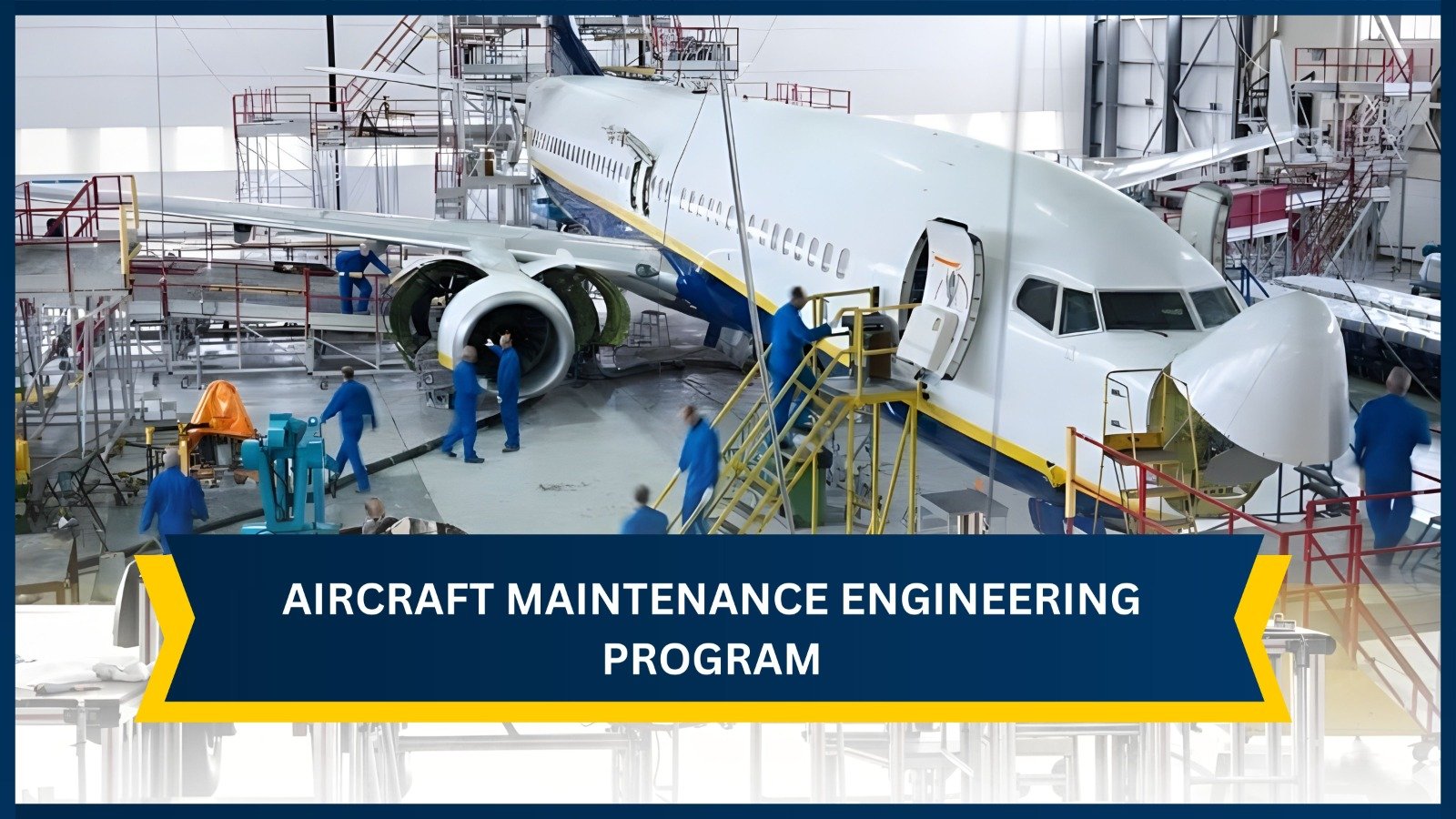
Every aircraft that soars through the sky relies on the expertise of Aircraft Maintenance Engineers (AMEs) to ensure safe, efficient, and reliable operations. In the rapidly expanding aviation industry, AMEs are the unsung heroes who inspect, repair, maintain, and certify aircraft for flight. This critical role combines technical expertise, regulatory knowledge, and hands-on skills to keep passengers and crew safe while maintaining the multi-million dollar assets that are modern aircraft.
The Aircraft Maintenance Engineering Program at the School of Applied Engineering and Technology (SOACET) prepares aspiring aviation professionals for rewarding careers in this essential field. With India’s aviation sector experiencing exponential growth, certified AMEs are in high demand across airlines, MRO (Maintenance, Repair, and Overhaul) facilities, aircraft manufacturers, and aviation regulatory bodies.
Whether you dream of working on commercial airliners, military aircraft, helicopters, or business jets, SOACET’s comprehensive Aircraft Maintenance Engineering Program provides the knowledge, skills, and certifications needed to launch your successful aviation career.
Aircraft Maintenance Engineering is a specialized technical program that trains students to become licensed Aircraft Maintenance Engineers. Unlike traditional engineering degrees, AME training focuses specifically on aircraft systems, maintenance procedures, regulatory requirements, and hands-on practical skills essential for maintaining airworthiness.
AMEs perform critical functions in aviation safety and operations:
The DGCA issues AME licenses in different categories:
SOACET’s program prepares students for Category B licenses in mechanical and avionics streams, with pathways to advance to higher categories through experience and additional training.
Understanding that students come from diverse educational backgrounds, SOACET offers flexible admission options for the Aircraft Maintenance Engineering Program.
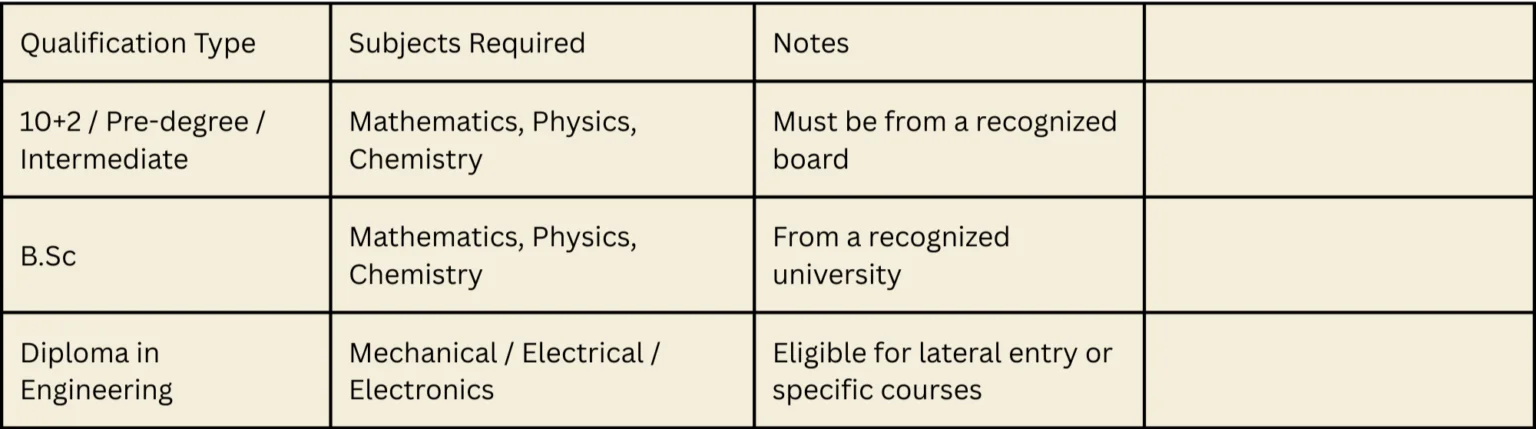
This pathway is ideal for students who have completed their higher secondary education and want to pursue a specialized career in aircraft maintenance directly without spending four years on a traditional engineering degree.
B.Sc. graduates bring strong theoretical foundations in sciences, which enhances their understanding of aircraft systems physics, chemistry of materials and fuels, and mathematical principles underlying aerodynamics and mechanics.
Diploma holders in mechanical, electrical, or electronics engineering possess valuable technical knowledge and practical skills that complement aircraft maintenance training.
SOA’s Aircraft Maintenance Engineering Program follows the syllabus prescribed by the Directorate General of Civil Aviation (DGCA), ensuring training meets national and international aviation standards.
The AME program typically spans 2.5 to 3 years, divided into:
| Module | Subjects / Topics Covered |
|---|---|
| Module 1: Mathematics |
Arithmetic, Algebra, Geometry Trigonometry & Applications Statistics & Probability Calculus Fundamentals |
| Module 2: Physics |
Matter & Mechanics Thermodynamics & Heat Transfer Light, Sound & Wave Motion Electricity & Magnetism |
| Module 3: Electrical Fundamentals |
DC & AC Theory Resistors, Capacitors & Inductors Electrical Circuits & Networks Batteries & Power Generation |
| Module 4: Electronic Fundamentals |
Semiconductor Devices Digital Electronics & Logic Circuits Microprocessors & Computers Electronic Instruments & Testing |
| Module 5: Digital Techniques / Electronic Instrument Systems |
Number Systems & Data Conversion Boolean Algebra & Logic Gates Microcomputer Technology Display Systems & Instruments |
| Module 6: Materials & Hardware |
Aircraft Materials & Properties Corrosion & Prevention Fasteners, Bearings & Hardware Welding, Bonding & Assembly Techniques |
| Module 7: Maintenance Practices |
Safety Procedures & Precautions Workshop Tools & Equipment Usage Aircraft Handling & Servicing Inspection & Non-Destructive Testing Maintenance Documentation & Records |
| Module 8: Basic Aerodynamics |
Principles of Flight Airfoil Theory & Wing Design Aircraft Stability & Control High-Speed Flight Characteristics |
| Module 9: Human Factors |
Aviation Psychology & Performance Error Management & Safety Culture Communication & Teamwork Stress, Fatigue & Health Factors |
| Module 10: Aviation Legislation |
DGCA Regulations & Requirements Aircraft Maintenance Standards Airworthiness Directives & Compliance Documentation & Certification Procedures |
| Module 11: Turbine Aeroplane Aerodynamics, Structures & Systems |
Aircraft Structures & Materials Hydraulic & Pneumatic Systems Landing Gear, Brakes & Wheels Flight Controls & Autopilot Systems Fuel, Oil, Cooling & Environmental Systems |
| Module 12: Helicopter Aerodynamics, Structures & Systems |
Rotor Aerodynamics & Theory Helicopter Structures & Components Transmission & Drive Systems Helicopter-Specific Systems |
| Module 13: Aircraft Aerodynamics, Structures & Systems |
Airframe Structures & Stress Analysis Primary & Secondary Flight Controls Environmental & Pressurization Systems Ice & Rain Protection Systems |
| Module 14: Propulsion |
Gas Turbine Engines (Turbojet, Turbofan, Turboprop) Piston Engines & Propellers Fuel Systems & Controls Engine Monitoring Systems |
| Module 15: Gas Turbine Engine |
Engine Construction & Operation Performance & Testing Maintenance & Troubleshooting Accessories & Systems |
| Module 16: Piston Engine |
Piston Engine Principles Fuel & Ignition Systems Engine Management & Monitoring Propeller Theory & Operation |
| Module 17: Propeller |
Propeller Aerodynamics Constant Speed & Variable Pitch Propellers Synchronization & Synchrophasing Maintenance & Balancing |
SOA provides a comprehensive infrastructure to support high-quality aircraft maintenance training:
Aircraft Maintenance Engineers enjoy diverse career opportunities across the aviation ecosystem with excellent job security and growth potential.
| Step | Description |
|---|---|
| Step 1 | Complete DGCA-Approved Training by successfully finishing both theoretical and practical training at SOA, a DGCA-approved AME training organization. |
| Step 2 | Pass DGCA Module Examinations by clearing written exams for all required modules. Each module can be attempted separately with multiple attempts allowed. |
| Step 3 | Complete On-the-Job Training (OJT) by finishing the required number of OJT hours (varies by category) under supervision at an approved maintenance organization. |
| Step 4 | Obtain Medical Fitness by securing a Class II Medical Certificate from a DGCA-approved medical examiner. |
| Step 5 | Apply for AME License by submitting the application to DGCA along with all certificates, training records, and required documents. |
| Step 6 | Receive AME License after DGCA verification and approval. Upon successful review, DGCA issues the Aircraft Maintenance Engineer License. |
After obtaining your basic license, you can add type ratings for specific aircraft like:
Type ratings significantly enhance employability and earning potential.
Job Creation: Estimated requirement of 15,000+ AMEs in India over the next 5-7 years to support fleet expansion.
Career Implications: AMEs need to continuously upgrade skills to work on next-generation aircraft with advanced systems.
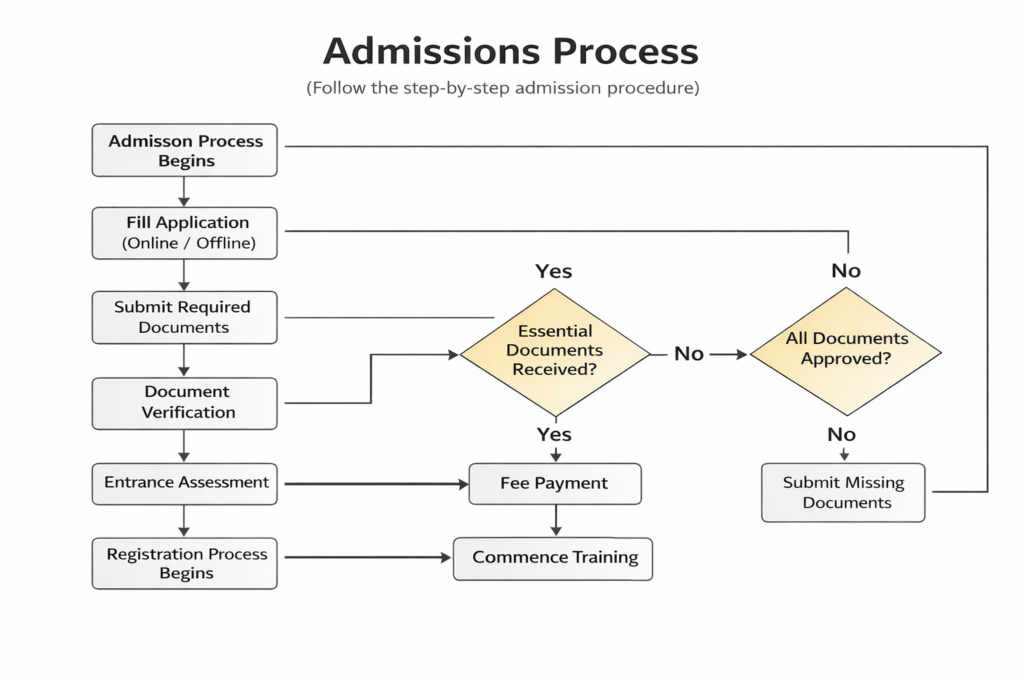
Step 1: Check Eligibility Verify you meet qualification requirements (10+2/B.Sc./Diploma with required subjects)
Step 2: Submit Application
Step 3: Document Verification
Step 4: Entrance Assessment Some institutions conduct aptitude tests or interviews to assess:
Step 5: Fee Payment Complete admission by paying required fees as per schedule
Step 6: Medical Examination Undergo DGCA Class II Medical examination from approved medical examiner
Step 7: Commence Training Join orientation program and begin your AME journey
Visit https://SOA.org/courses/ for:
The Aircraft Maintenance Engineering Program at SOA offers you the opportunity to enter one of the most exciting, challenging, and rewarding careers in aviation. With flexible admission options accommodating students from 10+2, B.Sc., and Diploma backgrounds, comprehensive DGCA-approved training, modern facilities, and strong industry connections, SOA prepares you for success in the dynamic aviation industry.
India’s aviation sector is booming, creating unprecedented demand for skilled AMEs. Airlines are expanding fleets, MRO facilities are growing, and new opportunities emerge constantly. The combination of job security, excellent salaries, career growth potential, and the satisfaction of contributing to aviation safety makes Aircraft Maintenance Engineering an outstanding career choice.
Whether you envision yourself maintaining commercial airliners at major airports, specializing in business jet maintenance, working with military aircraft, or pursuing international opportunities with global airlines, your journey begins with quality training.
Visit https://SOA.org/courses/aircraft-maintenance-engineering-program/ to:
Join SOA’s Aircraft Maintenance Engineering Program and transform your passion for aviation into a rewarding professional career. The sky truly is the limit!
AME is a specialized certification focused on aircraft maintenance, inspection, and certification, leading to a DGCA license.
Aeronautical Engineering is a B.Tech degree focused on aircraft design, manufacturing, and aerospace systems.
AMEs maintain and certify aircraft, while aeronautical engineers design and develop them.
No. To certify aircraft for flight in India, you must hold a valid DGCA AME license.
However, students can work as technicians under supervision while completing training and DGCA modules.
On average, 3–4 years:
2.5–3 years: Theoretical + basic practical training
6–12 months: On-the-job training (OJT) + DGCA module exams
Minimum age: 16 years
Maximum age: No upper limit
Most students typically join between 17–25 years.
Absolutely.
Aircraft maintenance is increasingly welcoming women professionals.
Airlines and MROs actively encourage gender diversity, and women AMEs enjoy equal career growth and opportunities.
After completing training and DGCA modules:
You undergo on-the-job training at an airline or MRO
Complete required OJT hours
Apply for the DGCA AME License
Once licensed, you can work with airlines, MROs, or aviation organizations in India and abroad.
SOACET 2026 (School of Aeronautics Common Entrance Test) is a National Level AME Entrance Exam 2026 organized every year by the LNVM Society. The examination is conducted for admission and scholarship into aviation programs at the prestigious School of Aeronautics, Neemrana.
CORPORATE OFFICE
H 974, PALAM EXTENSION, PART 1, SEC 7,
DWARKA, NEW DELHI 110077
I 04, DELHI – JAIPUR EXPY, RIICO INDUSTRIAL AREA,
NEEMRANA, RAJASTHAN 301705
Thank you very much for your time, we have noted your request and our concerned team will call you soon !!