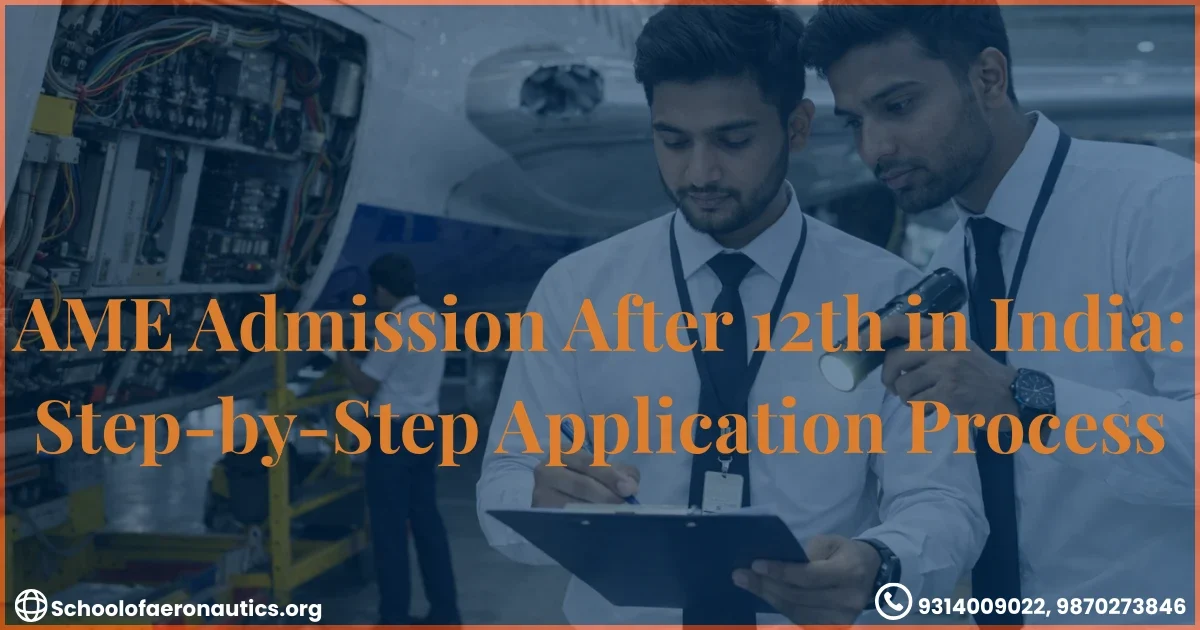
Every flight you have ever taken was possible because of an Aircraft Maintenance Engineer. Before the pilot walked to the cockpit, before a single passenger boarded, a licensed AME verified that every system on that aircraft was airworthy, every component was within tolerance, and every safety protocol was met. Without AMEs, commercial aviation does not function.
If that kind of responsibility and that kind of career appeals to you, then you’re in the right place. This guide is your complete, honest, step-by-step resource for AME admission after 12th in India. We will cover everything: what AME actually is, whether you’re eligible, exactly what the application process involves, which documents you need, how to choose the right DGCA-approved institute, and what your career and salary will look like on the other side.
No fluff. No vague generalities. Just the precise, reliable information you need to make the best decision for your aviation career.
Read Before: How to Become an Aeronautical Engineer After 12th: A Complete Beginner’s Roadmap
What Is Aircraft Maintenance Engineering (AME)? Understanding the Career Before Admission
Before you decide where and how to apply, you should fully understand what you’re applying for. Many students confuse AME with aeronautical engineering they are related but meaningfully different careers.
AME vs. Aeronautical Engineering: The Critical Difference
An AME is not an engineering degree in the traditional sense it is a professional license issued by the DGCA after completing an approved training program and passing a series of written and practical examinations. This distinction matters enormously for your admission planning, because AME admissions follow DGCA rules, not university entrance exam norms.
| Factor | Aircraft Maintenance Eng. (AME) |
| Primary Role | Inspect, maintain, repair, and certify aircraft airworthiness |
| Degree Type | DGCA-approved course + license (not a university degree) |
| Duration | 2–3 years course + OJT + DGCA exams |
| Regulatory Body | DGCA (India) Directorate General of Civil Aviation |
| Work Environment | Airports, hangars, maintenance bays, runways |
| Key Outcome | DGCA Aircraft Maintenance Engineer License (B1/B2) |
| Entry Salary | ₹4–7 LPA (rising sharply with endorsements) |
| Career Ceiling | ₹20–35 LPA (India) | USD 4,000–8,000/month (abroad) |
An AME is not an engineering degree in the traditional sense it is a professional license issued by the DGCA after completing an approved training program and passing a series of written and practical examinations. This distinction matters enormously for your admission planning, because AME admissions follow DGCA rules, not university entrance exam norms.
What Do AMEs Actually Do?
Understanding the daily reality of an AME career helps confirm it’s the right path for you:
- Conduct pre-flight and post-flight aircraft inspections
- Diagnose and repair mechanical, electrical, and avionics faults
- Perform scheduled maintenance checks (A, B, C, D checks for airlines)
- Signing off on aircraft airworthiness certificates is a legal responsibility
- Maintain detailed maintenance logs and documentation
- Work with DGCA-specified Component Maintenance Manuals (CMMs) and Aircraft Maintenance Manuals (AMMs)
- Liaise with pilots, operations teams, and regulatory auditors
AMEs work in high-stakes, precision environments. The best AMEs are methodical, detail-obsessed, technically sharp, and comfortable with legal responsibility because when they sign off on an aircraft, they are certifying it is safe to carry passengers.
AME License Categories in India (DGCA)
India follows CAR-66 (Civil Aviation Requirements, Series C, Part II) for AME licensing. The two primary license categories relevant to admission after 12th are:
| Category | Specialization | Scope of Work |
| B1.1 | Aeroplane Turbine (Airframe & Engine) | Maintenance of turbine-powered commercial aircraft the most common category for airline AMEs |
| B1.3 | Helicopter Turbine | Maintenance of turbine-powered helicopters for defence, offshore, and VIP aviation |
| B2 | Avionics Systems | Maintenance of aircraft electrical, electronic, and avionics systems — growing demand with digital aviation |
| B1.2 | Aeroplane Piston | Smaller piston-powered aircraft maintenance for general aviation, flying clubs |
Which Category Should You Choose? For most students targeting airline careers in India, B1.1 (Aeroplane Turbine) is the most direct route. Airlines like IndiGo, Air India, SpiceJet, and Vistara primarily need B1.1-licensed engineers. B2 (Avionics) is increasingly valuable as aircraft systems become more digital, and B2 engineers typically command a salary premium. Some training institutes allow students to pursue B1.1 + B2 dual licensing.
AME Course Eligibility After 12th: Do You Qualify?
This is the question every student asks first, and it deserves a precise, complete answer. AME eligibility is governed by DGCA’s Civil Aviation Requirements (CAR) Series C, Part II, and it differs slightly from standard engineering program eligibility.
Academic Eligibility Criteria
- Class 12 (or equivalent) passed from a recognised board, CBSE, ICSE, State Boards
- Compulsory subjects: Physics and Mathematics at Class 12 level (Chemistry is required by most institutes as a third subject, though DGCA mandates only Physics + Maths)
- Minimum aggregate marks in Physics and Mathematics: 50% combined (as per DGCA CAR guidelines)
- Some institutes require 50% aggregate in PCM (Physics, Chemistry, Mathematics) overall
- SC/ST/OBC candidates: 5% relaxation in minimum marks at most DGCA-approved institutes
Note: DGCA rules stipulate Physics and Mathematics as the core minimum. However, most quality DGCA-approved institutes require PCM (Physics, Chemistry, Mathematics) at the 12th level, as Chemistry is essential for understanding aircraft materials, fuels, and corrosion processes in the curriculum.
Age Requirement
- Minimum age: 16 years at the time of admission to the AME training program
- For DGCA AME license issuance: You must be at least 18 years of age
- There is no formal upper age limit for AME course admission, though most students enrol between 17 and 22
Practical Note on Age: Since AME training takes 2–3 years and you must be 18 to receive the DGCA license, students who begin AME training at 16 (after Class 10) complete their training at a natural age for licensure. Students starting after Class 12 (typically 17–18 years old) usually complete training and reach licensing age at an optimal point in their career timeline.
Medical Fitness Requirement
This is a requirement many students overlook, and it can be a critical factor:
- AME candidates must be medically fit as per DGCA medical standards
- While not as stringent as pilot medical requirements, AMEs must have adequate vision (corrected vision is acceptable at most categories), hearing capability, and general physical fitness to perform maintenance tasks
- Candidates with serious colour blindness may face restrictions in certain AME categories, particularly avionics (B2)
- A medical evaluation is typically conducted during the AME licensing process, not at admission. However, students with known medical conditions should check DGCA medical requirements proactively before investing in training.
Stream Requirement: PCB (Biology) Students
Important clarification for PCB students: DGCA requires Physics and Mathematics at Class 12 for AME admission. Biology alone does not meet the requirement. However, some state boards allow students to add Mathematics as an additional subject if your class 12 transcript shows Physics, Chemistry, Biology, AND Mathematics, you may be eligible. Verify this possibility with your state board before concluding that AME is inaccessible.
Documents Required for AME Admission After 12th: The Complete Checklist
Getting your documents organised before you begin applications saves enormous time and prevents last-minute stress. Here is the complete document checklist for AME admission after 12th in India:
Academic Documents
- Class 10 Mark Sheet (Secondary School Certificate)
- Class 10 Pass Certificate / Board Certificate
- Class 12 Mark Sheet (Higher Secondary Certificate), original and attested copies
- Class 12 Pass Certificate / Board Certificate, original and attested copies
- School / College Transfer Certificate (TC)
- School / College Migration Certificate (if applying outside your home state)
- Character Certificate from the last institution attended
Identity and Address Documents
- Aadhar Card (mandatory for Indian nationals, both original and photocopy)
- Valid Passport (highly recommended, DGCA processes and some international AME pathways require it)
- PAN Card (for fee payment and financial processes)
- Domicile Certificate (required by some state-quota institutes)
- Category Certificate SC/ST/OBC/EWS certificate, if applicable, issued by the competent authority
Photographs and Physical Documents
- Recent passport-size photographs, minimum 10 (colour, white background, formal attire)
- Medical fitness certificate from a registered MBBS doctor (some institutes require this at admission; all require it before license application)
- Blood group certificate
Financial Documents
- Fee payment proof (demand draft or online payment receipt upon admission)
- Bank account details for scholarship applications
- Income certificate (if applying for fee concession or government scholarship)
- Education loan sanction letter (if applicable required before seat confirmation at many institutes)
For NRI / Foreign National Students
- Valid Passport with an appropriate student visa
- Equivalency certificate from the Association of Indian Universities (AIU) for foreign Class 12 boards
- FRRO (Foreigners Regional Registration Office) registration
Document Attestation Warning: For AME admission, all academic documents must be attested (self-attested copies are usually accepted for initial application, but original verification is mandatory before final enrollment). DGCA-approved institutes are required to verify original documents. Never submit forged or tampered documents. DGCA takes document fraud extremely seriously, and violations can permanently bar you from aviation careers.
Step-by-Step AME Admission Process After 12th: The Complete Application Guide

This is the core section of this guide. Follow these steps in order skipping or rushing any step can result in admission to a substandard institute or, worse, a non-DGCA-approved program that has zero value for your career.
Step 1: Verify Your Eligibility (Week 1)
Before researching institutes or filling forms, confirm you meet all basic eligibility criteria:
- Confirm you have passed Class 12 with Physics and Mathematics (minimum 50% in these two subjects combined)
- Confirm your age is 16+ at the time of admission
- If you have any medical conditions affecting vision, hearing, or physical mobility, consult a physician and review DGCA medical standards proactively
- If you are a PCB student, check whether your state board allows a Mathematics bridge certificate
Action Item: Download and read DGCA’s Civil Aviation Requirements (CAR) Series C Part II from the official DGCA website (dgca.gov.in). Pages 1–15 cover all eligibility requirements. This document is the source of truth, not any institute’s marketing brochure.
Step 2: Research and Shortlist DGCA-Approved Institutes Only (Weeks 1–2)
This is the most critical step in the entire AME admission process. There are hundreds of institutes in India that claim to offer AME courses. A significant number are NOT DGCA-approved, and a certificate from an unapproved institute is completely worthless for career purposes.
Here’s how to verify DGCA approval correctly:
- Visit the official DGCA website: Go to dgca.gov.in → Aviation Training Organisations → Approved Basic AME Training Organisation List. This is the only authoritative list. If an institute does not appear here, it is not approved.
- Verify the specific category approval: An institute may be approved for B1.1 but not B2, or vice versa. Confirm that the institute is approved for the specific category (B1.1, B1.3, B2) you want to pursue.
- Check approval validity date: DGCA approvals are renewed periodically. Confirm that the institute’s approval is current and not expired.
- Call DGCA directly if uncertain: DGCA’s regional offices can confirm institute approval status. Their contact details are on the official website.
Red Flag Warning: If an institute’s name does NOT appear on the DGCA-approved list, but they claim approval, do not enrol. No exceptions. The financial loss from an unapproved AME course is total your certificate will not be recognised, you will not be able to sit DGCA Module exams, and you will need to restart your AME training entirely from scratch at an approved institute.
Step 3: Compare Your Shortlisted Institutes on 6 Key Parameters (Week 2)
Once you have a list of verified DGCA-approved institutes, evaluate each on these six parameters:
- Aircraft fleet available for OJT (On-the-Job Training): AME training requires hands-on work on real aircraft. Ask each institute: How many aircraft do you have? What types? Are they operational or static (grounded)? Institutes with diverse operational aircraft provide significantly better training.
- DGCA Module exam pass rates: Ask for the last 3 years of DGCA Module exam pass percentages for their students. Top institutes typically have 80–95% pass rates. Institutes that refuse to share this data are hiding poor outcomes.
- Hangar and workshop facilities: Visit in person or ask for verified photos and video tours. AME training requires proper hangars, avionics labs, engine test benches, and component workshops. A classroom-only AME program produces engineers who cannot do the job.
- Industry connections and placement support: Which airlines and MRO companies have recruited from this institute? Ask for specific names and contact former students on LinkedIn. Real placement success is verifiable.
- Total fee structure all-in transparency: Get a complete, written fee breakout: tuition by year, examination fees, uniform costs, accommodation, and any other charges. Compare this to industry norms. Unusually cheap institutes often have poor facilities; unusually expensive ones are not necessarily better.
- Hostel and campus quality: You will live here for 2–3 years. Visit. Assess hostel conditions, mess quality, security, and transport connectivity to the nearest airport (essential for OJT).
Step 4: Obtain and Complete Application Forms (Week 2–3)
Application procedures vary by institute, but typically follow one of three formats:
- Online application: Most quality institutes now have online application portals. Fill the form carefully errors in name spelling, date of birth, or academic details cause significant delays later. Upload clear, legible scanned copies of all required documents.
- Direct visit/walk-in application: Some institutes, particularly those in smaller cities, accept direct admissions. Bring all original documents plus 5–10 sets of attested photocopies.
- Through admission agents: Some institutes use authorised admission agents in specific regions. If using an agent, verify their authorisation directly with the institute and never pay fees to an agent in cash without a receipt.
Key details to fill accurately on every application form:
- Full name exactly as on Class 12 certificate, no spelling variations
- Date of birth exactly as on the birth certificate and the Class 10 certificate
- Father’s / Guardian’s name exactly as on official documents
- Permanent address with correct PIN code
- Preferred AME license category (B1.1 / B1.3 / B2 / combined)
Step 5: Pay the Application Fee (Week 3)
Most DGCA-approved institutes charge a non-refundable application processing fee ranging from ₹500 to ₹2,000. Payment modes vary:
- Online payment via the institute portal (credit card, debit card, net banking, UPI)
- Demand draft in favour of the institute (confirm DD details payable at the city and favouring name before preparing)
- Direct fee payment at the institute’s admissions office
Payment Caution: Never pay the full course fee at the application stage. Application fees are typically ₹500–₹2,000. If any institute asks for ₹50,000 or more before you have formally visited the campus and signed an offer letter, treat this as a serious red flag. Confirm all fee structures in writing before any payment.
Step 6: Appear for the Institute Selection Process (Week 3–4)
Unlike B.Tech admissions, which are entirely based on JEE or state exam scores, many DGCA-approved AME institutes conduct their own selection process:
- Written entrance test: Usually covers Physics and Mathematics at the Class 11–12 level. Some institutes add basic English comprehension. Prepare by revising your Class 12 Physics (particularly mechanics, electricity, and thermodynamics) and Mathematics thoroughly.
- Personal interview: Institutes often conduct a short interview to assess communication skills, aviation interest, and career motivation. Be honest about why you want an AME career. Show genuine knowledge of what AMEs do.
- Document verification: Original documents are verified in person. Bring complete sets of originals and attested photocopies.
- Merit-based selection (some institutes): Many institutes select purely on Class 12 marks (PCM aggregate) without a written test.
Interview Preparation Tip: Research the institute you’re visiting, know their history, fleet size, and notable alumni. Walk around the hangar if permitted before the interview. Being able to reference specific details about the institute demonstrates genuine interest and typically impresses interviewers significantly.
Step 7: Receive Offer Letter and Confirm Seat (Week 4–5)
If selected, you will receive an official offer letter or admission letter. Before paying the seat confirmation amount:
- Read the offer letter carefully, confirm the program name, category (B1.1/B2), duration, and total fee structure
- Verify the institute’s DGCA approval number matches what you found on the DGCA website
- Confirm the seat confirmation fee (typically ₹25,000 to ₹1 lakh) and whether it is adjustable against the first-year tuition or non-refundable
- Get the complete fee schedule for all 3 years in writing prevent fee surprises later
- Confirm hostel availability and hostel fee structure if you plan to stay on campus
- Confirm the program start date and reporting date
Note: Book a FREE counseling session to understand the AME admission process clearly.
Step 8: Complete Fee Payment and Enrollment (Week 5–6)
Upon seat confirmation:
- Pay the first instalment of tuition fees as per the payment schedule
- Submit all original documents for institutional verification (originals returned after verification)
- Obtain your student ID, program schedule, and library/lab access cards
- Collect your hostel allotment letter if applicable
- Register with the institute’s student management system / online portal
- Attend mandatory orientation sessions, which typically include DGCA compliance briefings, safety protocols, and institute rules that are legally important for aviation training environments
Education Loan Timeline Tip: If you are applying for an education loan, begin the bank application process at least 6–8 weeks before your reporting date. Most bank education loans for DGCA-approved institutes are straightforward, but processing takes time. Get the loan sanction letter before committing to seat confirmation, if possible.
Step 9: Begin Training What to Expect in Your First Year
Once enrolled, here’s what your AME training journey looks like:
- Year 1 Theoretical Foundation: Aviation Mathematics, Physics of Flight, Aircraft Materials, Basic Electricity and Electronics, Aircraft General Knowledge (AGK), Human Factors in Aviation, DGCA CAR regulations. This year is an intense classroom-based study. Your DGCA Module 1 and Module 2 examinations happen during this phase.
- Year 2 Technical Specialisation: Depending on your category, for B1.1 Piston Engine Systems, Gas Turbine Engines, Aircraft Airframe Structures, Fuel Systems, Hydraulics, and Landing Gear Systems. For B2 Aircraft Electrical Wiring, Avionics Systems, Navigation Systems, Communication Systems, and Flight Instruments. DGCA Module exams continue through Year 2.
- Year 3 / OJT Phase On-the-Job Training: Minimum 1 year of supervised practical training on operational aircraft at an approved airline, MRO, or maintenance base. This is where theory becomes practice. Strong institutes have MOU agreements with airlines and MRO companies for structured OJT placement.
Understanding DGCA Module Exams: The Path from Training to Licensed AME
The DGCA Module examinations are the intellectual backbone of the AME pathway. Understanding them before you begin training helps you plan your study strategy from Day 1.
What Are DGCA Module Exams?
DGCA Module exams are written examinations conducted by the Directorate General of Civil Aviation that test your theoretical knowledge across all required aviation subjects. There are 17 modules in total under the EASA Part-66 / Indian CAR-66 framework, though the specific modules required depend on your license category.
Module Exam Structure Key Details
| Module | Subject | Required For | Question Format |
| Module 1 | Mathematics | B1.1, B1.3, B2 | Multiple Choice |
| Module 2 | Physics | B1.1, B1.3, B2 | Multiple Choice |
| Module 3 | Electrical Fundamentals | B1.1, B1.3, B2 | Multiple Choice |
| Module 4 | Electronic Fundamentals | B2 (B1 lighter version) | Multiple Choice |
| Module 5 | Digital Techniques & Systems | B1.1, B2 | Multiple Choice |
| Module 6 | Materials & Hardware | B1.1, B1.3, B2 | Multiple Choice |
| Module 7A/B | Maintenance Practices | All categories | Multiple Choice |
| Module 8 | Basic Aerodynamics | All categories | Multiple Choice |
| Module 9A | Human Factors | All categories | Multiple Choice |
| Module 10 | Aviation Legislation (CAR) | All categories | Multiple Choice |
| Module 11A/B | Turbine Aeroplane Aerodynamics | B1.1 / B1.3 | Multiple Choice |
| Module 13 | Aircraft Aerodynamics (Structures) | B1.1, B1.3 | Multiple Choice |
| Module 15 | Gas Turbine Engine | B1.1, B1.3 | Multiple Choice |
| Module 17A | Propeller Systems | B1.1 | Multiple Choice |
Passing Criteria and Exam Logistics
- Minimum passing score: 75% in each Module exam
- Examinations are conducted at DGCA-designated examination centres across India
- Students can appear for Module exams during training, not just after completion
- Failed modules can be re-attempted. There is no cap on the number of attempts, but fees apply per attempt
- Module exam fees: ₹1,000 per module (subject to DGCA revision)
Study Strategy: The best AME students begin studying for DGCA Modules from the very first week of training, not just before exams. Treat each Module exam as a professional certification exam (not a university exam) and allocate serious, independent study time beyond classroom hours. Students who prepare continuously throughout training consistently outperform those who cram.
Top DGCA-Approved AME Institutes in India for Admission After 12th
This is a curated list of well-regarded DGCA-approved institutes based on faculty quality, aircraft fleet, Module exam pass rates, and placement outcomes. Always verify the current DGCA approval status before applying.
North India
- National Institute of Aeronautical Engineering (NIAE), Bareilly, Uttar Pradesh One of India’s oldest and most established AME training institutes
- Indira Gandhi Institute of Aeronautics (IGIA), Chandigarh, Strong faculty and regional industry connections
- Rajiv Gandhi Aero Training Academy, Delhi / NCR region
- Orient Flights Aviation Academy, multiple campus locations
For students in Rajasthan and the Delhi NCR region, SOA School of Aeronautics in Neemrana is also worth noting. While primarily known for its B.Tech Aeronautical Engineering program, its location in the heart of the Neemrana industrial corridor, surrounded by aerospace and defence manufacturing companies, provides aviation students with organic industry exposure that complements AME pathway considerations. Students interested in pursuing both aeronautical engineering and understanding aircraft maintenance regulatory frameworks benefit from Neemrana’s unique industrial ecosystem.
South India
- Hindustan Aviation Academy (HAA), Bengaluru Well-established with strong airline placement connections in South India
- Rajiv Gandhi Aviation Academy, Secunderabad, DGCA-approved, with reasonable faculty depth
- Orient Flights Aviation Academy, Puducherry
- Blue Wings Aviation, Chennai Avionics specialisation track
West India
- Aeronautical Training Institute (ATI), Mumbai
- Ambedkar Institute of Aeronautics, Pune
- Gujarat Institute of Aeronautics is growing program with improving facilities
East India
- Indira Gandhi Institute of Aviation Technology, Bhubaneswar
- Bengal Aeronautical Institute, Kolkata
Verification Reminder: Do not rely on this list alone. Always re-verify every institute’s current DGCA approval status at dgca.gov.in before applying. Approvals change, expire, or get suspended. Checking takes 5 minutes and can save years of wasted investment.
AME Course Fees After 12th in India: Transparent Cost Breakdown
One of the most important practical decisions in AME admission is financial. Here’s a complete, honest cost breakdown:
Typical AME Course Fee Structure (DGCA-Approved Institutes)
| Cost Component | Typical Range | Notes |
| Annual Tuition (Year 1) | ₹1.2L – ₹2.5L | Varies by institute tier |
| Annual Tuition (Year 2) | ₹1.2L – ₹2.5L | Same rate as Year 1, typically |
| Annual Tuition (Year 3/OJT) | ₹50K – ₹1.2L | Lower during the OJT phase |
| Total Tuition (3 years) | ₹3.5L – ₹7L | Full program range |
| DGCA Module Exam Fees | ₹15K – ₹25K | Across all required modules |
| Hostel + Mess (per year) | ₹80K – ₹1.5L | If on-campus accommodation |
| Books + Study Material | ₹15K – ₹30K | Over full program |
| Uniform + PPE | ₹5K – ₹15K | One-time, Year 1 |
| TOTAL (All-In, 3 years) | ₹6L – ₹13L | Including accommodation |
AME training is significantly more affordable than engineering degrees at private universities (which cost ₹12–22 lakh). It is also considerably less expensive than pilot training (₹35–80 lakh). For students from middle-income families seeking a strong aviation career path without massive debt, AME offers exceptional value.
Scholarship and Financial Aid Options
- National Scholarship Portal (scholarships.gov.in): Central government scholarships for merit and means-based students, check the Ministry of Civil Aviation-specific schemes
- State government scholarships: Many states have aviation sector skill development schemes. Check your state’s education department website
- Education loans: Nationalised banks (SBI, PNB, Canara Bank, Union Bank) provide education loans for DGCA-approved AME courses. Loan coverage typically includes tuition + accommodation + exam fees
- Institute-specific scholarships: Several institutes offer merit scholarships for students scoring 85%+ in PCM at Class 12, ask admissions teams directly
- AICTE-PRAGATI and AICTE-SAKSHAM scholarships: Check eligibility for AICTE scholarship schemes that extend to aviation training programs
Career Prospects and Salary After AME: What You’re Working Toward
Every difficult step in the AME admission process becomes easier when you have a clear, exciting picture of what awaits on the other side. Here’s what AME graduates in India are achieving:
Employers Who Hire Licensed AMEs in India
- Commercial Airlines: IndiGo, Air India, SpiceJet, Vistara, Akasa Air, ongoing demand for licensed B1.1 engineers as India’s fleet expands
- MRO Companies: Air Works, Air India Engineering Services (AIESL), GMR Aero Technic, ST Engineering (India), Lufthansa Technik India
- Government Aviation: Indian Air Force (technical entry), Indian Coast Guard, Border Security Force Air Wing, Helicopter Corporation of India
- Helicopter Operators: Global Vectra Helicorp, Pawan Hans, Offshore operators have a strong demand for B1.3 licensed engineers
- Defence / DPSU: HAL (Hindustan Aeronautics Limited) AME-qualified engineers in manufacturing quality and maintenance roles
- International: Middle East airlines (Emirates, Etihad, Qatar), Singapore Airlines Engineering Company, Lufthansa Technik globally
Salary Progression for Licensed AMEs in India
| Career Stage | Experience | Typical Salary Range |
| Junior Licensed AME (B1.1) | 0–2 years | ₹4 – ₹7 LPA |
| AME with endorsements | 2–5 years | ₹7 – ₹12 LPA |
| Senior AME / CAME | 5–10 years | ₹12 – ₹22 LPA |
| Quality Manager / Base Maint. Mgr | 10+ years | ₹22 – ₹38 LPA |
| International (Middle East / SE Asia) | 3–5 years | USD 4,000 – USD 8,000/month (tax-free) |
| Inspector / DGCA-level role | 15+ years | ₹30 – ₹50+ LPA |
The real salary accelerator for AMEs is aircraft type endorsements. Each aircraft type you are trained and licensed on adds a meaningful premium to your package. An AME endorsed on A320, B737, and ATR 72 commands significantly more than one endorsed only on a single type. Career-driven AMEs accumulate endorsements systematically.
Middle East Advantage: Many Indian AMEs spend 5–8 years working in the UAE, Qatar, or Saudi Arabia, earning USD 4,000–8,000 per month tax-free, accumulating multiple aircraft type endorsements, and returning to India with substantial savings and elite credentials. This international stint is a well-established and genuinely lucrative pathway for motivated AME graduates.
7 Critical Mistakes to Avoid in Your AME Admission Process
- Not verifying DGCA approval before applying. This is the single most costly mistake in AME education. Every year, students pay full fees to non-DGCA-approved institutes and discover their certificates are worthless only after completing the program. Always verify at dgca.gov.in before paying a single rupee.
- Choosing an institute purely based on low fees. An AME course that costs ₹2 lakh total sounds attractive until you discover the institute has 2 grounded aircraft, no avionics lab, and a Module exam pass rate of 30%. The cheapest AME program often produces the most expensive outcome years of wasted time and a career that never launches.
- Ignoring the OJT facility quality. The hands-on training component of AME is where engineers actually develop competence. An institute with only classroom-based training and no real aircraft produces licensed engineers who cannot confidently perform the job. Ask specifically: How many operational aircraft do you have? Where will I do my OJT? Which airlines / MROs are your OJT partners?
- Not researching the Module exam pass rates. DGCA Module exams are genuinely challenging they require consistent, serious study. Institutes with poor teaching, inadequate study materials, or insufficient exam preparation support will show low Module pass rates. This data is available by asking current students and reading alumni feedback online.
- Rushing the admission decision under deadline pressure. Some institutes create artificial urgency (‘Last 3 seats! Apply today!’). Good institutes don’t need to pressure-sell. Take the time to verify approval, visit the campus, and speak to current students. Making a rushed decision for a 3-year program is a disproportionate risk.
- Not understanding the difference between AME training completion and AME license issuance. Completing your AME course is not the same as receiving your DGCA license. The license requires passing all required Module exams, completing the OJT hours AND submitting the license application to DGCA. Understand this timeline fully your license may come 6–12 months after completing classroom training, depending on Module exam scheduling and OJT completion.
- Applying without a financial plan for all 3 years. Many students secure Year 1 fees but don’t plan for Years 2–3. If you run out of funding mid-program, you cannot pause AME training and resume later without losing significant progress. Have a complete 3-year financial plan, including a contingency buffer, before enrolling.
Frequently Asked Questions (FAQs): AME Admission After 12th
Q: Can I get AME admission after 12th without Physics and Mathematics?
A: No. DGCA regulations under CAR Series C, Part II specifically require Physics and Mathematics at the Class 12 level as minimum eligibility for AME training. These subjects are non-negotiable because they form the technical foundation of aircraft maintenance, fluid mechanics, thermodynamics, electrical systems, and structural analysis all of which depend on this foundation. Students with PCB who did not take Mathematics in 12th should check if their state board allows a Mathematics bridge certification before concluding AME is inaccessible.
Q: Is JEE required for AME admission after 12th?
A: No JEE (Main or Advanced) is not required for AME admission. AME programs are professional license training courses regulated by DGCA, not university engineering programs regulated by AICTE or UGC. Most DGCA-approved AME institutes conduct their own entrance test (covering Physics and Mathematics at Class 12 level) and/or select on merit based on Class 12 PCM marks. This is one of the significant advantages of AME over aeronautical engineering degrees you can pursue an excellent aviation career without needing to clear a highly competitive national entrance exam.
Q: How long does the complete AME admission process take from application to enrollment?
A: The complete process from initial application to enrollment typically takes 4–8 weeks. DGCA approval verification and institute research take 1–2 weeks. Application submission and the written test take 1–2 weeks. Receiving the offer letter, financial planning, fee payment, and document verification take 2–3 weeks. Some institutes have faster processes, particularly those with rolling admissions throughout the year. Allow 6–8 weeks of buffer to avoid rushing critical steps.
Q: What is the best AME category to choose, B1.1 or B2?
A: The best category depends on your career goals. B1.1 (Aeroplane Turbine Airframe & Engine) offers the highest volume of job opportunities in India all major commercial airlines primarily recruit B1.1 licensed engineers, making this the safest and most employment-dense choice. B2 (Avionics) is a growing specialisation with salary premiums as aircraft systems become increasingly digital, airlines need B2 engineers too, and their relative scarcity creates a market advantage. Many ambitious students pursue training at institutes that offer a B1.1 + B2 combined pathway, which maximises both employability and earning potential.
Q: Can I do an AME course while simultaneously pursuing a B.Tech degree?
A: In practice, very few students successfully pursue both simultaneously due to the intensive nature of both programs. However, students who complete a B.Tech in Aeronautical Engineering from an AICTE-approved institution may receive credit exemptions for certain DGCA Module exams, reducing the total number of exams required for an AME license. This means an aeronautical engineering graduate can often achieve AME licensure faster than someone starting from scratch. Some institutions structure their aeronautical engineering curriculum to provide exposure to DGCA regulatory frameworks throughout the program, making the B.Tech to AME license pathway more seamless.
Q: How is the AME admission process different from the B.Tech admission process?
A: The differences are significant. B.Tech admissions are primarily exam-based (JEE Main/state exams/university exams) with centralised counselling (JoSAA for NITs/IITs). AME admissions are institute-specific, based on Class 12 marks or institute entrance tests, with direct application to individual DGCA-approved institutes. There is no centralised AME counselling process that you apply separately to each institute you’re interested in. This means AME admissions are more personal but also require more individual research and due diligence. The DGCA approval verification step has no equivalent in B.Tech admissions it is unique to AME and critically important.
Q: What marks are required in Class 12 for AME admission?
A: DGCA’s minimum requirement is 50% aggregate in Physics and Mathematics combined at Class 12. In practice, quality DGCA-approved institutes set their own cutoffs, which are typically: 50–55% PCM aggregate for general category students, 45–50% for SC/ST/OBC with reservation benefits. Some highly sought-after institutes (particularly in major metros with many applicants) may set de facto cutoffs higher based on the applicant pool in a given year. Scoring 60%+ in PCM gives you comfortable access to all quality AME programs.
Q: Is AME admission open throughout the year or only in specific months?
A: Most DGCA-approved AME institutes admit students in batches aligned with academic cycles typically June–July for the main batch, with some institutes also running an October–November batch. However, many institutes accept admissions on a rolling basis throughout the year, particularly for students who have recently completed Class 12 exams in October–November (CBSE and state board supplementary results). Contact each institute directly for their specific admission schedule for 2026.
Conclusion: Your AME Admission Journey Starts with One Right Decision
Aircraft Maintenance Engineering is one of India’s most essential, secure, and rewarding aviation careers, and it remains dramatically underappreciated by students who don’t know enough about it. You now know enough.
The AME admission process after 12th is straightforward when you follow the right steps: verify your eligibility, shortlist only DGCA-approved institutes, gather your documents, apply with care, and choose the institute that offers genuine hands-on training, strong Module exam preparation, and proven placement outcomes. Nothing about this process is mysterious it just requires the discipline to do each step correctly.
The career that awaits maintaining the aircraft that carry millions of passengers safely every day, earning competitive salaries that rise steeply with experience, and having the option to build an international career in the Middle East or Southeast Asia, is built on exactly the foundation you begin with your AME admission after 12th.
Don’t let confusion delay the decision. Verify. Research. Apply. And begin.
Exploring Aviation Engineering Careers in India?
SOA School of Aeronautics, Neemrana (Rajasthan), offers B.Tech Aeronautical Engineering with integrated aviation regulatory frameworks and industry exposure in India’s premier aerospace manufacturing corridor, the Delhi NCR / DMIC belt. For students weighing their options between AME and aeronautical engineering, our admissions team can guide you toward the path that best fits your goals. https://soacet.org/ | Admissions Open 2026 Batch