


Here is a number that most AME institutes will never tell you: a significant percentage of the students who sit the AME entrance exam every year are not underprepared. They have studied. They know their Physics. They can solve Mathematics problems. But they still underperform and lose their seat at a quality DGCA-approved institute because of specific, avoidable mistakes that no one warned them about.
This blog is that warning. Written from the patterns that repeat across thousands of AME entrance exam attempts, this guide covers the 10 most damaging mistakes students make in preparation, in the exam hall, and in the interview room and gives you the precise fix for every single one.
Read this before your AME entrance exam. The difference between a top rank and a borderline result is almost always one of these ten mistakes.
Important Context: This guide applies to entrance tests conducted by all DGCA-approved AME institutes across India. While specific question counts and marking schemes vary by institute, the preparation and exam-day mistakes covered here are universal they appear in every AME entrance exam setting, every year, without exception.
Note: Common Mistakes to Avoid During the SOACET 2025 Admission Process
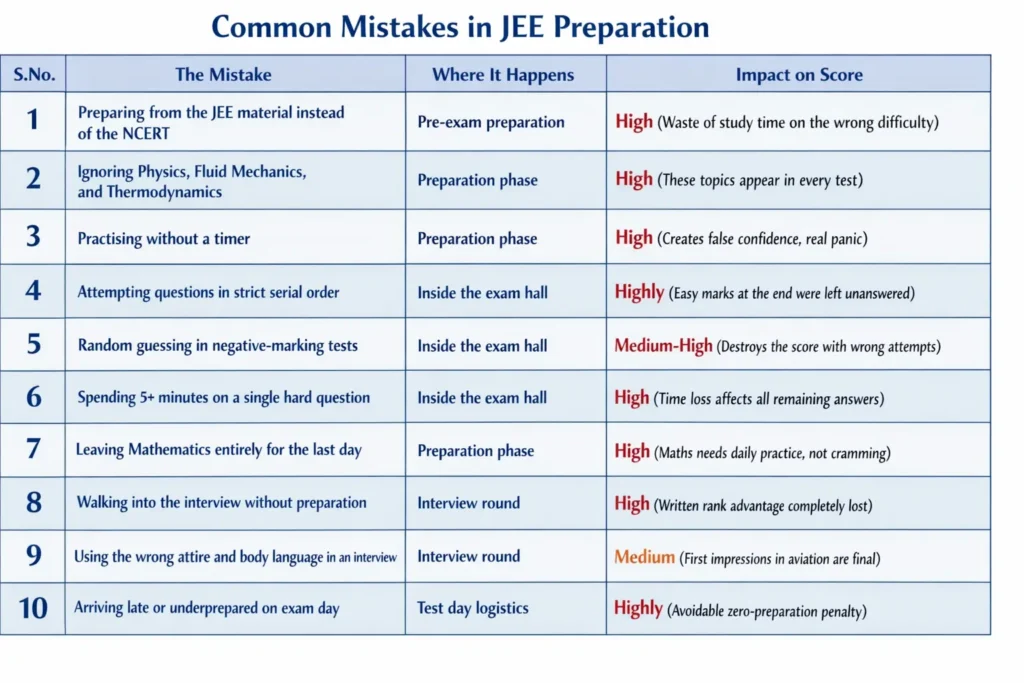
The 10 AME Entrance Exam Mistakes at a Glance
Before we break down each mistake and its fix in detail, here is the complete overview of every AME entrance exam mistake this guide addresses:
Each Mistake And Its Exact Fix
MISTAKE #1: Preparing From JEE Coaching Material Instead of NCERT
This is by far the most common preparation mistake in the AME entrance exam. Students reach for their JEE coaching notes, Arihant publications, or DC Pandey problems and spend weeks solving problems that are 2–3 difficulty levels above what any AME entrance test actually asks. The result: exhausted, over-complicated preparation that leaves the actual NCERT-level concepts unreliable under pressure.
THE FIX: Go back to NCERT. Completely.
Every AME entrance exam question across every DGCA-approved institute in India can be traced to an NCERT Class 11 or Class 12 concept. Solve NCERT examples first. Then the NCERT exercises. Then NCERT exemplar problems. Only after mastering NCERT should you attempt any additional sources, and even then, Class 12 board papers are more relevant than JEE coaching material. Depth in NCERT beats breadth across advanced sources, every single time.
MISTAKE #2: Skipping Fluid Mechanics and Thermodynamics in Physics
Students preparing for the AME entrance exam often treat Fluid Mechanics (Class 11) and Thermodynamics (Class 12) as ‘optional’ topics either because they’re perceived as difficult, or because they weren’t emphasised in school. This is a critical strategic error. These two topics appear in virtually every AME entrance exam across India deliberately. Examiners choose them because they are directly relevant to aircraft maintenance: hydraulic systems, pneumatics, and gas turbine engine principles all draw on these exact foundations.
THE FIX: Make Fluid Mechanics and Thermodynamics non-negotiable.
Dedicate 2 focused study sessions specifically to each topic in your preparation plan. For Fluid Mechanics: master pressure, Pascal’s law, Bernoulli’s equation, continuity equation, and viscosity. For Thermodynamics: master all four laws, heat engine cycles, efficiency calculations, and entropy basics. These are not difficult topics at the NCERT level they simply require deliberate attention that most students avoid giving them.
MISTAKE #3: Practising Problems Without Timing Yourself
This mistake produces the most common AME entrance exam horror story: the student who knows all the material, sits down in a 90-minute test, and suddenly cannot finish in time. They panic. They rush. Their accuracy collapses. They leave a test feeling like they failed a paper they had fully prepared for. This is not a knowledge failure. It is a training failure. They practised under comfortable, untimed conditions and never built the retrieval speed that timed conditions demand.
THE FIX: Introduce a stopwatch from Week 2 of your preparation, never remove it.
From the moment you begin timed practice, every problem-solving session must have a clock running. Target: 90 seconds maximum per MCQ in the AME entrance exam. Build this discipline through daily practice: 20 problems in 30 minutes to start, scaling to 60 problems in 70 minutes by Week 3. Students who train under time pressure consistently score 15–25% higher in the actual AME entrance exam than equally knowledgeable students who only practised untimed.
MISTAKE #4: Answering Questions in Strict Serial Order
Most students sit down, start at Question 1, and work through sequentially, even when they hit a difficult question they cannot solve. The result: 8 minutes spent on Question 12, while Questions 60–80 (which may be straightforward and easy) remain unattempted when time runs out. In the AME entrance exam, there is no law requiring serial-order answering. Examiners do not reward students who attempted Question 1 over those who skipped it.
THE FIX: Always scan the full paper first, then attempt in difficulty order.
Use the first 3–4 minutes of the AME entrance exam to scan all questions and mark them: Easy (attempt first), Medium (attempt second), Hard (attempt last or skip if time is tight). This single strategy consistently adds 8–15 marks for well-prepared students because it ensures easy marks are never left on the table due to time running out on hard problems. Practise this approach in every mock test from Week 2 onwards.
MISTAKE #5: Randomly Guessing Every Unanswered Question
In AME entrance exams with negative marking, random guessing is mathematically self-destructive. With four options per question and −0.25 negative marking, a random guess has a 25% chance of earning +1 and a 75% chance of losing −0.25. The expected value is exactly zero, meaning random guessing adds nothing on average, but introduces variance that regularly destroys borderline scores. Students who guess blindly on 20 questions often lose 3–5 marks they could have simply retained by leaving those questions blank.
THE FIX: Apply the elimination rule, never guess completely randomly.
Note: Book a FREE counselling session through SOACET to understand the AME admission process clearly.
The fix is simple and must be applied consistently in every AME entrance exam. Never guess on a question where you cannot eliminate at least two of the four options. If you can confidently eliminate two options, your probability of being correct rises to 50%, attempting mathematically positive even with negative marking. If you have no directional idea at all, leave the question blank. This disciplined approach consistently produces higher scores than the ‘attempt everything’ strategy in negative-marking tests.
MISTAKE #6: Spending More Than 90 Seconds on Any Single Question
This mistake costs more marks than any other in-hall behaviour. A student who spends 5 minutes on a single difficult question they cannot solve has lost the time needed to correctly answer 3–4 easier questions elsewhere in the paper. The net result: 1 difficult question attempted (likely incorrectly, sometimes with negative marking) and 3–4 easy questions not attempted at all. The AME entrance exam does not award bonus marks for attempting hard questions. All marks are equal.
THE FIX: Set a 90-second hard rule skip and move on, always.
Train this behaviour in every mock test: if 90 seconds pass on a question without a clear answer, mark it and move to the next question immediately. Return to marked questions only after completing the rest of the paper. Students who practise this consistently report attempting 15–20 more questions per test than peers who get stuck, with no reduction in accuracy on the questions they do answer.
MISTAKE #7: Leaving Mathematics Preparation Until the Last Week
Mathematics is the subject that students most commonly plan to revise later, and it is the subject that requires daily practice most urgently. Unlike Physics, which can tolerate concept-by-concept batch revision, Mathematics skills are perishable: trigonometric identities, calculus steps, and coordinate geometry techniques degrade without regular use. Students who leave Mathematics for the final week before their AME entrance exam consistently underperform relative to their actual capability because the cognitive pathways are not warmed up.
THE FIX: Mathematics must be touched every single day, from Day 1 of preparation.
Even on Physics-heavy revision days, solve a minimum of 10 Mathematics problems, 5 from your strongest topic (to maintain fluency) and 5 from your weakest (to build it). Daily Mathematics contact keeps every topic warm, accessible, and accurate under pressure. Students who follow this approach consistently score 10–15% higher in the Mathematics section of the AME entrance exam compared to those who study Mathematics in batches.
MISTAKE #8: Walking Into the AME Entrance Exam Interview Completely Unprepared
This mistake is devastatingly common. A student earns a strong written test score, feels confident, walks into the interview, and immediately loses their advantage because they cannot clearly explain what an AME does, why they want to pursue aviation, or what DGCA is. Interviewers at DGCA-approved AME institutes are experienced aviation professionals. They identify genuine interest versus vague enthusiasm within 60 seconds. A well-prepared 5-minute interview can elevate a borderline written score into a confident offer letter. An unprepared interview can eliminate a top-written ranker.
THE FIX: Dedicate at least one full day to interview preparation, not 20 minutes the night before.
Prepare specific, honest answers to these core questions every AME entrance exam candidate should expect: Why do you want to become an AME? What does an AME do? (Inspect, maintain, repair, and certify aircraft airworthiness under DGCA authority.) Which category, B1.1 or B2, and why? What do you know about this institute? (Name their fleet, DGCA approval year, and specific program.) What are your Class 12 marks? (State them confidently; no apology.) Practise these answers aloud with a family member or in front of a mirror at least 3 times. Speaking an answer is different from knowing it.
MISTAKE #9: Wearing Casual Clothes to the AME Entrance Exam Interview
This mistake seems minor. It is not. Aviation is one of the most professionally regulated industries in the world, and everyone who works in it understands that professional appearance reflects professional awareness. An AME who maintains aircraft must project discipline, precision, and reliability. An interviewer who sees a candidate in jeans and a casual t-shirt is receiving a signal, whether the candidate intends it or not, that this person does not yet understand professional standards. Candidates who dress formally consistently receive higher interview evaluation scores, even when their verbal answers are identical to those of casually dressed peers. This is a documented bias in professional hiring contexts globally.
THE FIX: Dress as if the interview is your first day at an airline because symbolically, it is.
Formal full-sleeve shirt (white, light blue, or formal colour, no prints or slogans), formal trousers (not jeans, not cargo), polished formal shoes (not sneakers), clean-shaven or neatly groomed, hair properly set. Bring a pen and notebook. Posture: sit upright, maintain eye contact, do not fold arms. These details are not about looking impressive, they are about signalling that you understand what professional aviation culture requires from Day 1.
MISTAKE #10: Poor Exam-Day Logistics Arriving Late, Bringing Wrong Items
This final mistake sounds embarrassingly basic. Yet every AME entrance exam across India sees students who arrive late (some barred from entry after the hall is locked), who bring the wrong ID document, who forget their admit card, or who show up at the wrong venue because they didn’t reconfirm the address. An AME is a professional who signs airworthiness certificates, a responsibility that requires systematic preparation and zero procedural carelessness. Interestingly, how a student handles exam-day logistics is sometimes considered a proxy signal for their likely professional reliability.
THE FIX: Build a pre-exam checklist and complete it the evening before, not the morning of.
Complete this the night before your AME entrance exam: Confirm the venue address (look it up on Google Maps do not rely on memory), plan travel route and leave 45 minutes earlier than you think you need to, prepare your document envelope: Aadhaar Card + Admit Card + 2 photographs + 2 blue/black ballpoint pens, set two alarms for the morning, eat a light dinner and sleep by 10 pm. On exam day: light breakfast (not heavy post-meal drowsiness affects concentration), arrive 30 minutes before the hall opens, sit near the front, read every question fully before answering.
What These AME Entrance Exam Mistakes Actually Cost You: Score Impact Analysis
To make the impact concrete, here is how each mistake affects your final AME entrance exam score in a typical 80-question, 80-mark paper:
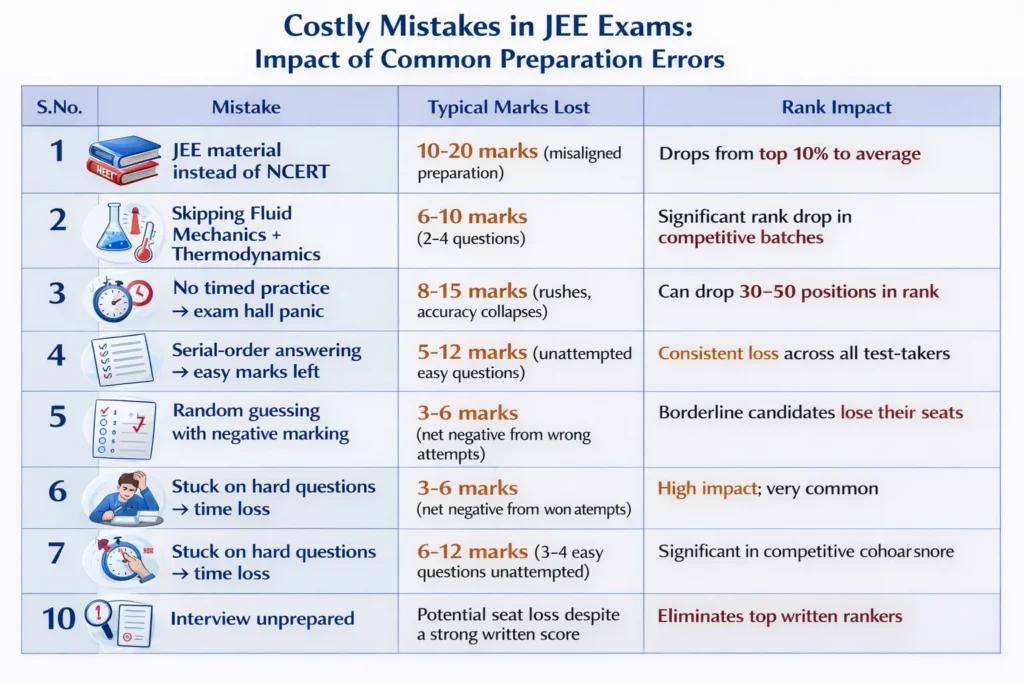
Total Avoidable Loss: A student who makes all 8 preparation and exam-hall mistakes listed above can lose 40–70 marks, more than half a paper, through entirely avoidable errors. A student who avoids every mistake on this list and prepares for 4 focused weeks consistently finishes in the top 100 of any AME entrance exam in India. These are not talent differences. There are preparation and strategy differences.
Bonus: 5 AME Entrance Exam Interview Mistakes Nobody Warns You About
Beyond the core mistakes above, here are five AME entrance exam interview errors that almost nobody warns students about, but which cost candidates their selection every year:
Interview Mistake 1 Saying ‘I Don’t Know’ and Stopping There
When an interviewer asks a question you cannot answer, the worst response is a flat ‘I don’t know’ followed by silence. The better response: ‘I don’t know the answer to that yet, but I understand it involves [related concept I do know], and I plan to study it during my training.’ Honest acknowledgement of a gap, combined with a forward-looking attitude, scores higher than a fabricated wrong answer.
Interview Mistake 2 Giving Generic Answers to ‘Why AME?’
‘I love aviation’ and ‘aircraft always fascinated me’ are answers that every single candidate gives. They communicate nothing specific. A memorable answer connects a specific experience or observation to the AME role: ‘I saw an AME pre-flight check at [airport] and realised that aviation safety depends on this professional’s signature I want to be that professional.’ Specific answers are remembered. Generic answers are forgotten within seconds.
Interview Mistake 3 Asking No Questions When Invited To
Almost every AME entrance exam interview ends with ‘Do you have any questions for us?’ Saying ‘No, I think you’ve covered everything’ signals passive disengagement. Prepare one intelligent question: ‘What aircraft types do students work on during OJT?’ or ‘What is your DGCA Module exam pass rate over the last three years?’ These questions demonstrate that you have researched the institute and take your career seriously.
Interview Mistake 4 Over-Explaining Simple Answers
Interviewers ask simple, direct questions. They expect simple, direct answers. When asked ‘What is DGCA?’ answer in one confident sentence: ‘DGCA is the Directorate General of Civil Aviation, India’s aviation regulatory authority under the Ministry of Civil Aviation.’ Do not narrate the history of Indian aviation regulation. Precision is a professional virtue in aviation demonstrate it in your interview.
Interview Mistake 5 Visibly Checking Your Phone Before Entry
Students who are seen checking their phones in the waiting area immediately before their interview convey anxiety, distraction, and poor professional composure. In the 10–15 minutes before your interview begins, sit calmly, breathe steadily, and mentally review your prepared answers. The discipline of controlled composure in a high-stakes moment is exactly the quality an AME must demonstrate daily on the job.
Frequently Asked Questions: AME Entrance Exam Mistakes
Q: Why do students who know Physics and Maths still fail the AME entrance exam?
A: The most common reason well-prepared students underperform in the AME entrance exam is not a knowledge deficit it is a performance-under-pressure deficit. Students who practise untimed, skip timed mock tests, and rely on passive reading feel confident in preparation but cannot execute that knowledge at the speed the exam requires. Additionally, poor time management strategies (serial-order answering, getting stuck on hard questions) consistently cost 10–20 marks regardless of preparation quality. The fix is systematic: timed practice from Week 2, scanning all questions before attempting, and hard 90-second question time limits that are practised until automatic.
Q: What is the most damaging mistake in the AME entrance exam interview?
A: Walking into the interview completely unprepared is the single most damaging mistake because it eliminates the advantage earned by a strong written test score. The second most damaging interview mistake is casual attire: aviation interviewers consistently rate formally dressed candidates higher on professionalism and career seriousness metrics. The combination of preparation (specific answers to expected questions) and presentation (formal dress, confident posture, eye contact) consistently produces interview outcomes that match or exceed written test performance for well-prepared candidates.
Q: Does negative marking really matter in AME entrance exams?
A: Yes significantly, for borderline candidates. In a competitive AME entrance exam batch where the difference between a seat and rejection is 3–5 marks, random guessing on 15–20 questions (which is common among undisciplined test-takers) creates a net expected loss of 0–4 marks compared to leaving those questions blank. For students near the cutoff, this is the difference between admission and another year of waiting. The elimination rule only attempts questions where you can confidently eliminate at least two of four options consistently produces higher scores than blind guessing in all negative-marking AME entrance exams.
Q: How much does exam-day preparation (logistics) actually affect the AME entrance exam score?
A: More than most students realise. Students who arrive late (even 5–10 minutes after starting time) at many institutes are barred from the hall, losing all marks regardless of preparation quality. Students who arrive flustered and rushed after transport problems take 10–15 minutes to settle, during which time their accuracy is significantly below their actual capability. The 45-minute early arrival recommendation is not excessive caution it is professional-grade preparation. An AME maintains aircraft on a schedule; the discipline of being ready before the scheduled time starts on Day 1 of the admission process.
Q: Can preparation mistakes be corrected after a failed AME entrance exam attempt?
A: Absolutely, and many of the students who eventually rank in the top 100 are doing so on a second attempt after learning from a first. The key is a structured post-attempt review: (1) Identify which specific topics lost you marks, was it Fluid Mechanics? Calculus? Time management collapse? (2) Target those specific areas in the preparation for your re-attempt. (3) Add systematic timed practice tests that you did not do before. (4) Prepare the interview component properly if it contributed to your first rejection. Most students who make these specific corrections in their re-attempts improve their score by 20–40%, because now they are correcting known gaps rather than preparing blindly.
Conclusion: The AME Entrance Exam Is Honest It Rewards Preparation and Punishes Avoidable Errors
Every mistake on this list has one thing in common: it is completely avoidable. Not with talent. Not with coaching. With awareness and a disciplined correction applied before your AME entrance exam date.
The students who rank in the top 100 of every AME entrance exam batch are not extraordinary. They are disciplined, targeted, and strategic. They study from NCERT, practise under time pressure, manage their exam-hall decisions intelligently, and walk into interviews prepared to perform rather than hoping to survive.
You now know every mistake. You now know every fix. The only question is whether you apply what you have read, or read it and go back to the same habits that produce average results.
Avoid the mistakes. Execute the fixes. Take your seat at the top.
Thinking Beyond the Entrance Exam? Explore the Complete Aviation Career Path.
SOA School of Aeronautics, Neemrana, India’s dedicated aeronautical engineering institution in the Delhi NCR / DMIC aerospace corridor. Our B.Tech Aeronautical Engineering program includes DGCA regulatory framework exposure throughout the curriculum, creating a natural and accelerated pathway to AME licensing after graduation. Dual specialisation tracks in Aircraft Structures + Aerodynamics and Avionics + UAV Systems. Admissions open for 2026. Our counsellors will help you evaluate the right aviation career path for your goals.
https://soacet.org/ | 2026 Admissions Open Get Guidance Today