

If you search for “AME course duration” online, you will find answers ranging from 18 months to 5 years, sometimes on the same page. This inconsistency is not random. It reflects a genuine confusion about what is and is not counted when institutes describe their program length.
Some institutes say 2 years, counting only classroom training. Others say 3 years including the mandatory OJT (On-the-Job Training) that DGCA requires. A few honest ones say 3–4 years, acknowledging the time it takes to pass all DGCA Module exams and complete the license application process. All three can be technically true. But only one gives you the complete picture.
This guide cuts through every layer of confusion about AME course duration. We address the myths that mislead students, explain exactly what each year contains, answer the questions students actually search for, and give you the honest timeline from Class 12 enrollment to DGCA license in hand.
The One-Line Answer: The total AME course duration from Class 12 enrollment to obtaining a DGCA AME license is 3 to 4 years for most students. Institutes describing a ‘2-year AME course’ are counting only the classroom phase and excluding mandatory OJT. Both are required before you can get your license. Plan for 3 years minimum.
Read Before: What is the Syllabus and Modules for Aircraft Maintenance Engineering (AME)?
Why AME Course Duration Seems Confusing: Understanding the Terminology
The AME course duration confusion exists because different stakeholders measure different things, and almost nobody explains which measurement they are using.
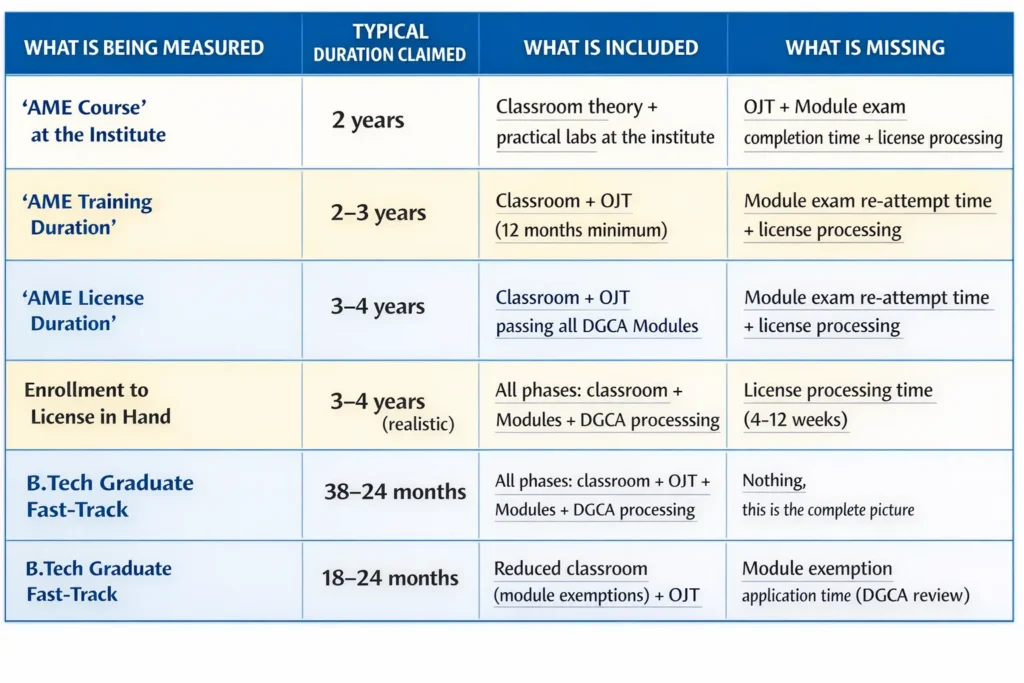
The lesson from this table: always ask a shortlisted institute the same specific question, ‘What does your stated AME course duration include, and does it include OJT?’ The answer immediately tells you whether they are quoting the institute’s training period or the complete path to your DGCA license.
AME Course Duration: 6 Myths Students Believe (and the Facts That Replace Them)
These are the six most widespread myths about AME course duration in India and the accurate facts that replace each one.
MYTH: AME is a 2-year course
FACT: The institute-based training phase is approximately 12–18 months of classroom and practical lab work. But DGCA additionally requires a minimum of 12 months of OJT on operational aircraft before your license can be applied for. Total: 3–4 years from enrollment to license. Institutes that advertise a ‘2-year AME course’ are counting only the classroom phase.
MYTH: You get your DGCA license as soon as classroom training ends
FACT: Classroom completion is not license issuance. Before DGCA issues your AME license, you must:
- Pass all required DGCA Module exams (13–17 modules, 75% each)
- Complete a minimum of 12 months of OJT on operational aircraft
- Submit a complete license application to DGCA
- Wait 4–12 weeks for DGCA processing.
Each step takes time. Classroom completion is roughly the halfway point of your total AME course duration.
MYTH: The faster the course, the better the institute
FACT: A shorter-than-average AME course duration is sometimes a red flag, not a selling point. DGCA’s CAR Series C, Part II specifies minimum classroom contact hours for each Module subject. Institutes that compress classroom training below 12 months cannot legally meet these minimum requirements. If an AME institute claims a course duration significantly shorter than the 12–18 month classroom standard, ask specifically how they meet DGCA’s minimum contact hour requirements. Rushed training produces under-prepared students who struggle with Module exams and OJT.
MYTH: OJT is optional or can be done later
FACT: OJT (On-the-Job Training) of a minimum of 12 months on approved operational aircraft is a mandatory DGCA requirement, not optional, not deferrable, not reducible. You cannot apply for a DGCA AME license without a completed OJT log signed by a licensed supervising AME at an approved facility. There are no exceptions. OJT is an integral component of the AME course duration, not a post-course extra.
MYTH: All DGCA Module exams are taken at the end of training
FACT: DGCA Module exams can and should be attempted progressively throughout the training period, not only after completion. Students who begin attempting Module 1 (Mathematics) and Module 2 (Physics) from their 3rd–4th month of training and continue sitting exams as they complete relevant classroom subjects can have all modules cleared before OJT even starts. This is the single most effective strategy for reducing total AME course duration within the legal DGCA framework.
MYTH: AME course duration is the same at every DGCA-approved institute
FACT: DGCA sets minimum requirements, but the total calendar time varies significantly between institutes. The single biggest variable is the gap between classroom completion and OJT placement commencement. Institutes with formal airline or MRO OJT partnerships typically place students within 4–8 weeks of classroom completion. Institutes without structured OJT arrangements can leave students waiting 3–9 months. This gap alone can turn a 3-year AME journey into a 4–5 year one without any regulatory delay, just a poor institutional choice.
AME Course Duration Broken Down: What Each Component Actually Takes
Here is the honest, phase-by-phase AME course duration breakdown with realistic minimum and typical timelines for each component:
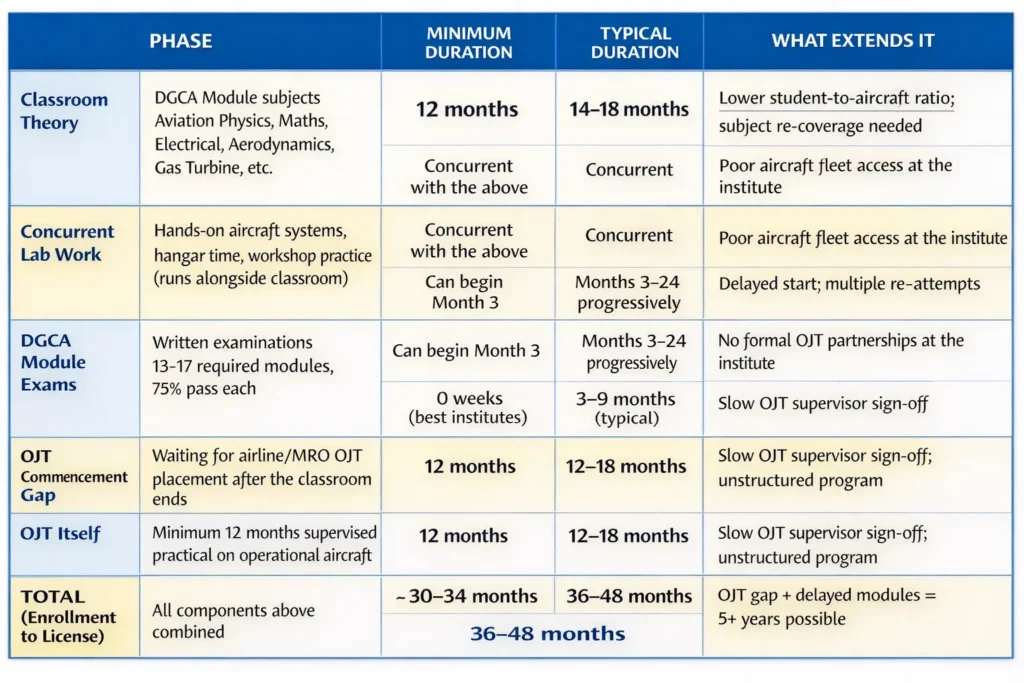
The Key Number: 30–34 months is the realistic floor for total AME course duration when everything goes optimally, modules are started early, the institute has immediate OJT placement, OJT is structured and well-supervised, and the license application is submitted immediately on OJT completion. 36–48 months is the standard experience. 48–60 months is what happens when OJT is delayed, and modules are left until the end.
The ‘2-Year vs 3-Year AME Course’ Debate: Settled Once and For All
This is the most-searched question about the AME course duration in India. Here is the definitive, no-ambiguity answer.
The AME course is advertised as 2 years by many institutes. This refers to the institute-based training phase, approximately 12–18 months of classroom theory and concurrent practical lab work at the DGCA-approved training centre. This is the phase where fees are paid, where you attend classes, and where the institute is directly involved.
But here is what that ‘2-year’ description leaves out and why it matters:
Note: Book a FREE counselling session through SOACET to understand the AME admission process clearly.
- You must pass 13–17 written Module exams (depending on your B1.1 or B2 category) with a minimum 75% score in each. These happen throughout and sometimes after classroom training and are not fully completed by the time the classroom ends for most students. DGCA Module exams
- DGCA requires a minimum of 12 months of supervised practical training on operational aircraft at an approved airline or MRO. This is not part of the 2-year institute training it is an additional mandatory requirement. No OJT completion = no license application possible. OJT (On-the-Job Training)
- The time between when your institute-based training ends and when your OJT begins. At institutes without formal OJT partnerships, this gap can be 3–9 months. OJT placement gap
- After submitting your complete application, DGCA takes 4–12 weeks to process and issue the license. DGCA license processing
Add it all up: 2-year institute course + 12-month mandatory OJT + any OJT gap + module completion time + license processing = 3 to 4 years minimum. The ‘2-year AME course’ is not wrong, it is just incomplete. And the missing year is the most variable, most career-impactful year of your entire training.
The Right Question to Ask: Don’t ask ‘How long is your AME course?’ Ask: ‘What is your total timeline from enrollment to DGCA license issuance, including OJT placement time?’ An institute that answers this question specifically and confidently has students who graduate on time. An institute that hedges or redirects to the ‘2-year course’ talking point does not.
AME Course Duration Varies by Your Background: What Each Profile Can Expect
Your academic background directly affects your AME course duration, because DGCA’s module exemption provisions under CAR-66 significantly reduce the classroom and exam burden for engineering graduates.
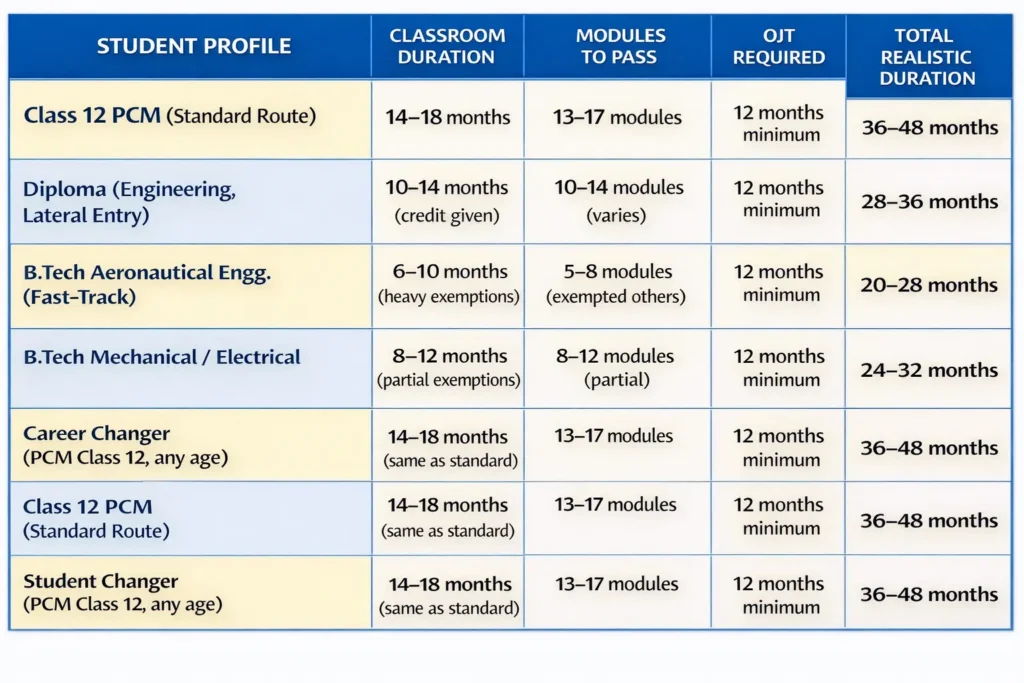
| Student Profile | Classroom Duration | Modules to Pass | OJT Required | Total Realistic Duration |
| Class 12 PCM (Standard Route) | 14–18 months | 13–17 modules | 12 months minimum | 36–48 months |
| Diploma (Engineering, Lateral Entry) | 10–14 months (credit given) | 10–14 modules (varies) | 12 months minimum | 28–36 months |
| B.Tech Aeronautical Engg. (Fast-Track) | 6–10 months (heavy exemptions) | 5–8 modules (exempted others) | 12 months minimum | 20–28 months |
| B.Tech Mechanical / Electrical | 8–12 months (partial exemptions) | 8–12 modules (partial) | 12 months minimum | 24–32 months |
| Career Changer (PCM Class 12, any age) | 14–18 months (same as standard) | 13–17 modules | 12 months minimum | 36–48 months |
The table makes a compelling case that pursuing B.Tech Aeronautical Engineering before AME training is the most time-efficient route to holding both an engineering degree and a DGCA AME license. Total time: 4 years B.Tech + approximately 2 years AME fast-track = 6 years. But you exit with the most powerful aviation qualification combination in India, a formal engineering degree and a DGCA AME license, rather than just one or the other.
SOA Neemrana Advantage: SOA School of Aeronautics in Neemrana specifically designs its B.Tech Aeronautical Engineering curriculum with the DGCA regulatory framework throughout, maximising the Module exam exemptions available to graduates entering the AME fast-track route. SOA Neemrana graduates can typically reduce their total AME course duration post-graduation to 18–22 months. See soacet.org for full program details.
How to Know If Your AME Course Duration Is on Track: 4 Progress Checkpoints
If you are already enrolled in AME training, here are the four checkpoints that tell you whether your AME course duration is on track for a 3-year completion or drifting toward 4–5 years:
Checkpoint 1 End of Month 4: Module 1 Attempted
If you have not attempted your first DGCA Module exam (Mathematics Module 1) by the end of your fourth month of training, you are already behind the optimal module progression schedule. The fastest AME graduates have passed Module 1 and Module 2 (Physics) by Month 4. Action: begin Module 1 preparation immediately and schedule your attempt at the next available DGCA exam date.
Checkpoint 2 End of Month 18: At Least 8 Modules Cleared
Students on track for a 3-year AME course duration typically have 8–10 modules cleared by the end of their 18th month. Students who have cleared fewer than 6 at this stage are likely facing a 4–5 year total timeline because remaining modules will extend into or beyond the OJT period, delaying license application. Action: identify which modules are outstanding and commit to a progressive exam schedule regardless of OJT status.
Checkpoint 3 OJT Placement Within 8 Weeks of Classroom Completion
If your classroom training ended more than 8 weeks ago and you do not yet have a confirmed OJT placement start date at a named airline or MRO, your institute’s OJT system is not working for you. Action: contact the admissions/placement office, ask specifically for the named OJT partner and start date, and escalate if no specific answer is given. If the institute cannot provide a concrete OJT placement within 8–12 weeks of classroom completion, begin independently identifying approved OJT facilities.
Checkpoint 4 License Application Submitted Within 2 Weeks of OJT Completion
Students who delay license application after OJT completion, to prepare more, or simply through inertia, add months to their AME course duration with no benefit. The moment your OJT log is complete, your modules are all passed, and your training completion certificate is issued, assemble your DGCA license application package and submit it. There is nothing to be gained from delay. Every week of delay is a week without your license and without the salary that comes with it.
Frequently Asked Questions: AME Course Duration
Q: Is AME a 2-year course or a 3-year course in India?
A: Both answers you will find online are technically correct, but for different components. The institute-based training phase (classroom theory + practical labs at the DGCA-approved institute) is typically 12–18 months, which is why many institutes describe AME as a ‘2-year course.’ However, DGCA additionally requires a minimum of 12 months of OJT (On-the-Job Training) on operational aircraft before a license can be applied for, and this is mandatory, not optional. When you add classroom training + OJT + DGCA Module exam completion + license processing, the realistic total AME course duration from Class 12 enrollment to DGCA license issuance is 3 to 4 years. Plan for 3 years minimum.
Q: Does the AME course duration include OJT, or is OJT separate?
A: When DGCA describes the total requirements for an AME license, OJT is an integral part it is not separate or optional. However, when individual institutes describe their ‘AME course duration,’ they often mean only the institute-based training phase (classroom + labs). OJT typically takes place at a partner airline or MRO facility, not at the training institute, which is why some institutes exclude it from their course duration description. For your career planning purposes, always include OJT when calculating total AME course duration because you cannot apply for your DGCA license without completing it.
Q: Can the AME course duration be completed in less than 2 years?
A: AME training cannot be legally completed in under 2 years in India because DGCA’s CAR Series C, Part II specifies minimum classroom contact hours for each Module subject that collectively require approximately 12–18 months to complete at any approved institute. Any institute claiming a complete AME program (including all Module subjects) in under 12 months should be pressed specifically on how they meet DGCA’s minimum contact hour requirements. Additionally, DGCA requires a minimum of 12 months of OJT beyond classroom training, making a total duration under 24 months impossible for the complete path from enrollment to license.
Q: How does the AME course duration compare with the B.Tech Aeronautical Engineering?
A: Standard B.Tech Aeronautical Engineering takes 4 years and does not include a DGCA AME license. Standard AME training from Class 12 takes 3–4 years and produces a DGCA license, but not a formal degree. Both take approximately the same total calendar time from Class 12, but the outcomes differ: B.Tech produces an engineering degree for design/R&D roles; AME produces a legal certification authority for maintenance roles. The most strategically complete path is B.Tech Aeronautical Engineering (4 years), followed by fast-track AME licensing (18–24 months with DGCA Module exemptions) = approximately 6 years total, producing India’s highest-earning aviation qualification combination.
Q: Why do some students take 5 years to complete AME when the course is supposed to be 3 years?
A: Students who take 5+ years to complete AME almost always face one or more of these specific delays: (1) Delayed Module exam starts beginning exams only after classroom completion rather than progressively throughout training, adding 6–12 months; (2) OJT placement gap enrolling at an institute without formal airline or MRO partnerships, leading to 3–9 months of waiting after classroom ends; (3) Multiple Module exam re-attempts inadequate study preparation leading to failed exams, each re-attempt adding 4–12 weeks; (4) Personal circumstances financial difficulties, health issues, or family obligations requiring training breaks. The first two factors are entirely preventable through institute selection and Module exam strategy. They account for the vast majority of extended AME course durations.
Conclusion: AME Course Duration Is 3–4 Years, And Every Month of It Has a Purpose
The AME course duration question has a clear answer once the myths are stripped away: 3 to 4 years from Class 12 enrollment to DGCA license in hand, for a student who chooses the right institute, starts Module exams from Day 1, and secures prompt OJT placement.
Those 3–4 years are not empty. Year 1 builds your technical foundation. Year 2 deepens your specialisation and Module exam preparation. Year 3 is OJT, where you work on real aircraft, supervised by licensed professionals, building the competence that turns your theoretical knowledge into genuine aircraft maintenance authority.
By the time you receive your DGCA license, you will not be a student who has completed a course. You are a licensed professional who has been tested to a government standard, trained on operational aircraft, and authorised by law to certify their airworthiness. Three to four years for that credential in India’s fastest-growing sector is genuinely good value.
3 years. Every month, building toward something that matters.
Thinking About B.Tech Aeronautical Engineering Before AME Fast-Track?
SOA School of Aeronautics, Neemrana, India’s only institution dedicated exclusively to aeronautical engineering, in the Delhi NCR / DMIC aerospace corridor. Our B.Tech Aeronautical Engineering program includes the DGCA regulatory framework throughout, maximising the Module exam exemptions that reduce AME course duration for graduates pursuing DGCA licensing. Counselors available to compare the standard AME route vs B.Tech + fast-track AME for your specific timeline and career goals. https://soacet.org/ | 2026 Admissions Open Plan Your Aviation Timeline