
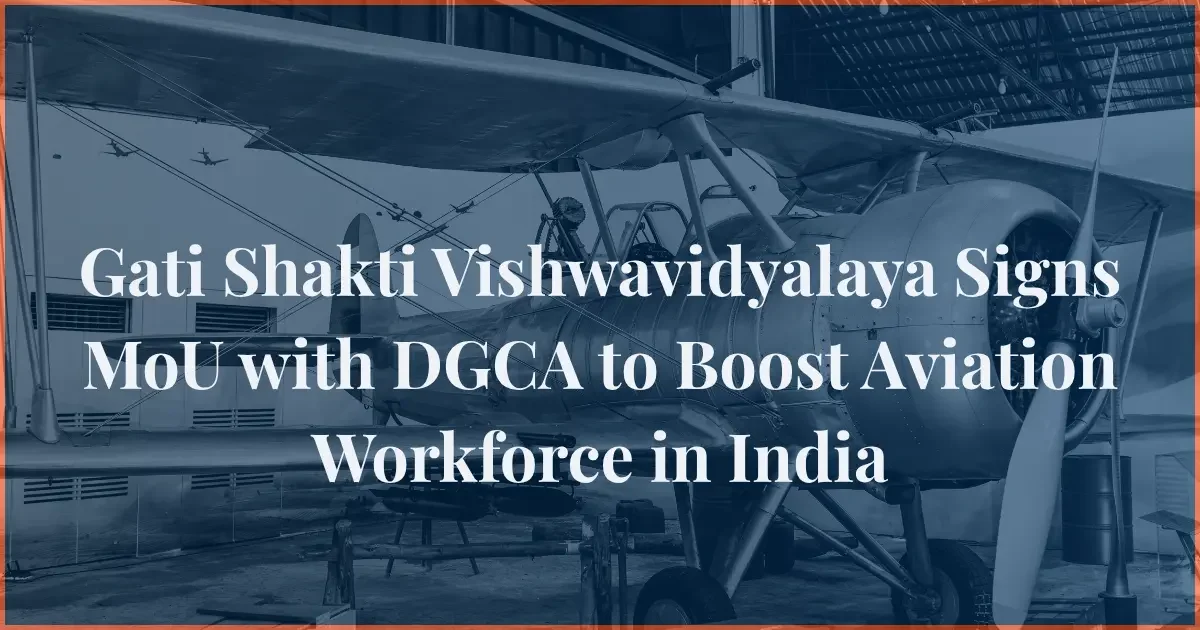
In a significant step for India’s aviation sector, Gati Shakti Vishwavidyalaya signed a Memorandum of Understanding (MoU) with the Directorate General of Civil Aviation (DGCA) on March 30, 2026, in New Delhi.
The Gati Shakti Vishwavidyalaya DGCA MoU was signed in the presence of two senior Union Ministers, Ashwini Vaishnaw (Railways and Information Technology) and Ram Mohan Naidu (Civil Aviation), signalling the highest level of government attention to a problem that has quietly constrained India’s aviation ambitions for years: the absence of formal degree recognition for Aircraft Maintenance Engineers.
This is not a routine institutional agreement. It is a policy-level acknowledgement that India’s aviation workforce needs structural reform and that the gap between on-the-ground skills and formal academic qualifications can no longer be allowed to limit the careers of the professionals keeping Indian aircraft airworthy.
What You Need to Know: Gati Shakti Vishwavidyalaya (GSV) is a central government university established under the Ministry of Railways to support multi-modal connectivity and transport sector education. This MoU with DGCA extends GSV’s mandate into civil aviation, specifically to provide curriculum frameworks and degree credentials to Aircraft Maintenance Engineers currently trained only through DGCA-approved institutes without formal university degree recognition.
The Core Problem This Gati Shakti Vishwavidyalaya DGCA MoU Addresses
To understand why this Gati Shakti Vishwavidyalaya DGCA MoU matters so deeply, you need to understand a fundamental structural issue in India’s AME ecosystem.
India has thousands of licensed Aircraft Maintenance Engineers. These are professionals who have completed 2–3 years of rigorous technical training at DGCA-approved institutes, passed all required DGCA Module examinations (a demanding series of 13–17 written tests), completed a minimum of 12 months of supervised On-the-Job Training on operational aircraft, and been issued a DGCA AME license a legally binding professional certification authorizing them to inspect, maintain, repair, and certify aircraft airworthiness.
They are, by any professional measure, highly skilled. Airlines and MRO companies depend on them completely. Every aircraft that carries passengers in India does so because a licensed AME certified it as airworthy.
But here is the problem that the MoU addresses head-on: these engineers do not hold a formal university degree. Their DGCA license, which carries far more regulatory authority than a standard engineering degree, is not recognised within the traditional academic qualification framework that governs career progression in government organisations, public sector undertakings, and many regulatory bodies.
The result: AMEs with years of high-skill aviation experience, carrying legal certification authority, are denied career advancement opportunities that their qualification should rightfully earn because a checkbox asks for a ‘degree’, and a DGCA license does not fit.
“The major feedback that we got from these AMEs who are getting trained through the approved organisations is that they do not have any specific degree, even though they have one of the best skills to handle the aircraft, to handle the maintenance, to handle the repair of the aircraft.”
Source: YouTube | Jagran Mon, 30 Mar 2026 08:39 PM (IST)
Ram Mohan Naidu, Union Minister of Civil Aviation
This MoU is the government’s formal response to that feedback. Gati Shakti Vishwavidyalaya will provide curriculum frameworks and degree certificates to qualifying AME professionals, giving them the formal academic credentials that their professional license alone could not.
Key Details of the Gati Shakti Vishwavidyalaya DGCA MoU: What Was Agreed
| MoU Element | Detail |
| Parties to the Agreement | Gati Shakti Vishwavidyalaya (GSV) and Directorate General of Civil Aviation (DGCA) |
| Signing Date | March 30, 2026 |
| Witnessed by | Union Ministers Ashwini Vaishnaw and Ram Mohan Naidu |
| Primary Objective | Address the workforce requirements of India’s rapidly expanding aviation sector |
| Specific Focus | Providing formal curriculum and degree credentials to Aircraft Maintenance Engineers (AMEs) |
| Problem Being Solved | AMEs possess high technical skills but lack formal degree recognition, hindering career progression |
| Mechanism | GSV will provide curriculum structure and award degree certificates to qualifying AME professionals |
| Broader Context | Part of the government’s Atmanirbhar focus on domestic MRO, manufacturing, and aviation workforce development |
| Pilot Demand Signal | The government revealed 10,000–12,000 additional pilots needed over the next decade, alongside AME requirements |
Why This MoU Comes Now: India’s Aviation Sector in Full Expansion
The timing of the Gati Shakti Vishwavidyalaya DGCA MoU is not coincidental. It is a direct response to the scale and pace of India’s aviation expansion, which has created a workforce urgency that the existing training infrastructure, without formal degree recognition, cannot fully address.
The Fleet Expansion Reality: 1,700 Aircraft on Order
Minister Naidu revealed at the MoU signing that India currently has 1,700 aircraft on order, double the size of the existing operational fleet. Every new aircraft that enters service requires a team of licensed AMEs to maintain and certify it. The scale of this expansion translates directly into a structural shortage of qualified, licensed maintenance professionals.
Industry estimates suggest that each operational aircraft requires 3–5 licensed AMEs for routine maintenance operations. With 1,700 aircraft on order, India’s aviation sector will require between 5,000 and 8,500 additional AME-equivalent professionals to staff the expanded fleet. This is before accounting for natural attrition and international recruitment of existing Indian AMEs.
The Airport Infrastructure Surge: UDAN Scheme and Regional Connectivity
The Union Cabinet recently approved an additional Rs 28,000 crore for the UDAN (Ude Desh Ka Aam Nagrik) regional connectivity scheme. This funding will catalyse the development and activation of regional airports across India’s Tier 2 and Tier 3 cities, expanding helicopter operations and regional air connectivity, all of which require ground-level maintenance engineering professionals.
Each new operational regional airport hub creates demand for local AME presence. The cumulative effect of UDAN expansion is a distributed, nationwide demand for maintenance professionals that cannot be met by concentrating AME talent only in India’s major aviation hubs.
The Pilot Demand Signal
Alongside the AME workforce discussion, Minister Naidu disclosed that India will require 10,000 to 12,000 additional pilots over the next decade. This figure underscores the full scale of India’s aviation ambition and contextualises why the government is investing at this level in workforce development across every aviation professional category, not just AMEs.
The Atmanirbhar MRO Imperative
One of the most significant statements at the MoU signing was Minister Naidu’s focus on Maintenance, Repair, and Overhaul (MRO). He noted that many Indian aircraft are currently sent abroad for engine and component maintenance, a situation that represents both an economic loss (foreign exchange outflow in the tens of thousands of crores annually) and a strategic vulnerability.
“The most important part in the aviation sector is how well you can create this aviation manufacturing ecosystem in the country. We are putting full focus on the full throttle to expand this ecosystem.”
Ram Mohan Naidu, Union Minister of Civil Aviation
Building a domestic MRO sector capable of retaining this maintenance work requires not just licensed AMEs but AMEs with the professional standing and formal qualifications to lead MRO enterprises, manage quality systems, and represent Indian maintenance capabilities credibly to international aviation standards bodies. This is precisely where the degree recognition gap bites hardest.
What the Gati Shakti Vishwavidyalaya DGCA MoU Means for AME Students and Aviation Aspirants
For students currently evaluating AME as a career path and for professionals already in the AME field, the Gati Shakti Vishwavidyalaya DGCA MoU has implications that extend well beyond the immediate degree-granting mechanism.
For Current AME Professionals: A Career Progression Unblocker
The most immediate beneficiaries of this MoU are licensed AMEs currently working in India’s aviation sector who have been unable to progress into management, PSU positions, or regulatory roles because formal degree criteria blocked them. The degree recognition pathway through Gati Shakti Vishwavidyalaya directly addresses this career ceiling, allowing professionals with a DGCA AME license and demonstrated competence to receive formal academic recognition commensurate with their actual skills.
For AME Aspirants in 2026: Enhanced Career Value of AME Training
Students considering AME admission in 2026 can now see a clearer, more complete career trajectory. The MoU signals that the government views AME training as a career-defining qualification deserving of formal academic recognition, not just a vocational certificate. This policy direction strengthens the long-term career value of AME training as a professional pathway, beyond the immediate employment certainty it already provides.
For Aviation Sector Employers: A Larger, More Credentialled Talent Pool
MRO companies, airline engineering departments, and DGCA-related regulatory bodies have long had access to highly skilled AMEs but faced formal qualification barriers when elevating these professionals into management and leadership roles. The degree recognition pathway expands the pool of formally credentialled aviation maintenance professionals available for senior positions directly supporting India’s goal of building a world-class domestic MRO industry.
The Broader Policy Signal for Aviation Education
This MoU is also a signal about the direction of Indian aviation education policy. It demonstrates that the government is willing to create new institutional linkages between technical certification bodies like DGCA and formal academic institutions like GSV to address structural gaps in professional recognition. Students and institutions operating in the aviation education space should read this as a policy environment that is actively innovating to support the sector’s workforce needs.
India’s Aviation Workforce Challenge: Key Numbers at a Glance
| Metric | Current Status | Projected Need | Policy Response |
| Operational Aircraft (India) | ~700+ aircraft in service | 2,400+ by 2035 (1,700 on order) | MoU: AME degree recognition |
| AME Professionals Required | Existing workforce | 5,000–8,500 additional (fleet-based estimate) | GSV curriculum + degrees |
| Pilots Required | Existing pilot force | 10,000–12,000 additional (next decade) | Train in India mandate |
| Operational Airports | ~150 operational airports | Expanding under the UDAN scheme | Rs 28,000 cr UDAN funding |
| MRO Work Retained Domestically | ~15% of total maintenance value | Target: 50%+ domestic MRO | Atmanirbhar MRO ecosystem |
| AME Degree Status (Pre-MoU) | DGCA license only; no formal degree | Degree credentials via GSV | Gati Shakti DGCA MoU |
| AME Career Progression (Pre-MoU) | Blocked at the management level in PSUs/Govt. | Full career pathway available post-degree | MoU removes structural barrier |
Aeronautical Engineering + AME: The Qualification Combination This MoU Validates
The Gati Shakti Vishwavidyalaya DGCA MoU powerfully validates a career strategy that aviation education institutions like SOA School of Aeronautics, Neemrana, have been building toward: the combination of formal aeronautical engineering education and DGCA AME licensing as the highest-value aviation career qualification profile in India.
Here is why that matters in the context of this MoU:
- The government is actively creating pathways for AME professionals to receive formal degree credentials. Students who begin their aviation career with a B.Tech Aeronautical Engineering degree are already ahead of this curve, they hold both formal academic credentials and the foundation for fast-track AME licensing via DGCA Module exam exemptions. Formal degree recognition is now a policy priority:
- Minister Naidu’s emphasis on building a domestic MRO ecosystem requires professionals who can bridge technical maintenance authority (AME license) and formal management credentials (degree). B.Tech Aeronautical Engineering graduates who additionally acquire DGCA AME licensing are precisely this profile. The MRO sector needs dual-credential professionals:
- Every aircraft on order is a career opportunity for licensed AME professionals. The government’s acknowledgement of this scale and the policy investment to build the workforce is the clearest market signal possible for students evaluating aeronautical engineering and AME career paths. 1,700 aircraft on order means sustained career growth:
- The Prime Minister’s emphasis on training and educating aviation professionals in India is a direct investment in the value of Indian aviation qualifications. Students who complete quality aeronautical engineering programs in India and pursue AME licensing are positioned as the exact talent profile this national strategy requires. Atmanirbhar MRO demands Indian-trained talent:
For Students at SOA School of Aeronautics, Neemrana: SOA Neemrana’s B.Tech Aeronautical Engineering program is built with the DGCA regulatory framework throughout the curriculum, preparing graduates not just for engineering careers but specifically for the fast-track AME licensing pathway. In the context of the Gati Shakti DGCA MoU, SOA Neemrana graduates will be among the best-positioned professionals in India’s aviation workforce development landscape. Visit soacet.org for 2026 admission details.
What Comes Next: Expected Implementation and Industry Implications
While the Gati Shakti Vishwavidyalaya DGCA MoU establishes the framework and intent, several implementation steps will determine how rapidly the aviation workforce benefits are realised:
Curriculum Development and Alignment
GSV and DGCA will need to develop a curriculum that is academically rigorous enough to justify formal degree conferral while being practically aligned with the realities of AME training. This curriculum development phase will be critical if it is designed well, it will produce the most technically credible aviation maintenance qualification framework in India’s history. If it is rushed or misaligned with DGCA’s CAR standards, it may create degrees that do not translate into meaningful career advancement.
Recognition by Government Employers and PSUs
For the degree to fully resolve the career bottleneck, it must be recognised by government aviation employers, AIESL (Air India Engineering Services), HAL, DGCA regulatory roles, and defence aviation entities. The involvement of senior Union Ministers in the MoU signing suggests strong political will for this recognition, but formal notification through relevant employment rules will be the actual implementation milestone to watch.
Implications for AME Admission in 2026
For students considering AME admission in 2026, this MoU is an additional positive signal it demonstrates that the government is actively investing in the long-term career pathway of AME professionals, not just the immediate licensing mechanism. Students who begin AME training in 2026 are entering a professional environment where formal degree recognition is being actively developed for their qualification category.
Frequently Asked Questions: Gati Shakti Vishwavidyalaya DGCA MoU
Q: What is the Gati Shakti Vishwavidyalaya DGCA MoU about?
A: The Gati Shakti Vishwavidyalaya DGCA MoU, signed on March 30, 2026, is an agreement between Gati Shakti Vishwavidyalaya (a central government university under the Ministry of Railways) and the Directorate General of Civil Aviation (DGCA), India’s aviation regulatory authority. The MoU aims to provide formal curriculum structures and degree credentials to Aircraft Maintenance Engineers (AMEs) who are currently trained through DGCA-approved institutes but do not receive formal university degrees. It was signed in the presence of Union Ministers Ashwini Vaishnaw and Ram Mohan Naidu to address the growing aviation workforce requirements of India’s rapidly expanding aviation sector.
Q: Why don’t AMEs have formal degrees in India?
A: AME (Aircraft Maintenance Engineering) training in India is regulated by DGCA under Civil Aviation Requirements (CAR) Series C, Part II, not by AICTE or UGC, which govern university engineering programs. Completing AME training and passing DGCA Module examinations earns a professional DGCA AME license — a legally binding certification authorising the holder to certify aircraft airworthiness. However, this license is not classified as a formal university degree under India’s academic qualification framework. This creates a career bottleneck: AMEs with high-level skills and legal certification authority are blocked from certain management, PSU, and regulatory positions that require a formal ‘degree’ qualification. The Gati Shakti Vishwavidyalaya DGCA MoU directly addresses this gap.
Q: Will this MoU affect AME admission and training in India?
A: The MoU does not change the admission or training requirements for AME programs currently run by DGCA-approved institutes. The DGCA Module exam structure, OJT requirements, and licensing framework remain unchanged. What the MoU introduces is a pathway for qualifying AMEs to receive formal degree credentials from Gati Shakti Vishwavidyalaya on top of their DGCA license, resolving the career progression bottleneck without disrupting the existing training system. For students considering AME admission in 2026, this is a positive development: it signals government commitment to the long-term professional recognition of AME qualifications and strengthens the overall career value of AME training.
Q: How does this development affect aeronautical engineering students?
A: For aeronautical engineering students, particularly those considering the B.Tech Aeronautical Engineering + AME licensing combination, this MoU is a strong positive signal. It validates the government’s view that AME certification is a career-defining qualification worthy of formal academic recognition. B.Tech Aeronautical Engineering graduates who pursue DGCA AME licensing after graduation will ultimately hold both a formal engineering degree (B.Tech) and a DGCA AME license, a combination that is positioned as the most complete aviation maintenance and engineering qualification profile in India. In the context of Minister Naidu’s emphasis on domestic MRO development and the Atmanirbhar aviation ecosystem, this dual qualification is precisely what India’s expanding aviation maintenance industry needs.
Q: What is Gati Shakti Vishwavidyalaya, and why is it involved in aviation?
A: Gati Shakti Vishwavidyalaya (GSV) is a central government university established under the Ministry of Railways, primarily to support education and research in multi-modal connectivity, transport infrastructure, and logistics. Its mandate includes supporting the National Master Plan for Multi-modal Connectivity (PM Gati Shakti initiative), which covers not just railways and highways but also airports, ports, and inland waterways. The DGCA MoU extends GSV’s scope into civil aviation, specifically addressing the AME workforce credential gap within the broader national connectivity and transport sector education mandate. GSV is the institutional mechanism the government has chosen to bridge the gap between DGCA’s technical licensing framework and India’s formal academic qualification system.
Conclusion: A Milestone for India’s Aviation Workforce And for Students Entering Aviation Today
The Gati Shakti Vishwavidyalaya DGCA MoU signed on March 30, 2026, is a milestone that aviation education observers have been anticipating for years. It acknowledges, at the highest governmental level, that India’s aviation workforce development cannot be complete while its most technically qualified maintenance professionals are denied the formal credential recognition that their skills deserve.
For students entering aviation education in 2026, whether through AME admission or B.Tech Aeronautical Engineering, this policy development sends a clear message: the government is building the institutional architecture to make aviation careers as formally recognised and professionally complete as possible.
India’s aviation sector has 1,700 aircraft on order. UDAN is expanding regional connectivity. The Atmanirbhar MRO ecosystem is being built. The Prime Minister has directed that training and education must happen in India. Against this backdrop, every student who enters quality aviation training in 2026 is not just starting a career, they are stepping into a national development priority that the government is actively resourcing and formally recognising.
The sky is no longer the limit. It is the beginning of a formally recognised, government-backed Indian aviation career.
Inspired by India’s Aviation Growth Story? Begin Your Journey at SOA Neemrana.
SOA School of Aeronautics, Neemrana, India’s only institution dedicated exclusively to aeronautical engineering, is positioned in the heart of the Delhi NCR / DMIC aerospace corridor. Our B.Tech Aeronautical Engineering program includes the DGCA regulatory framework throughout the curriculum, building the foundation for both engineering careers and fast-track AME licensing. In the context of India’s aviation expansion and the Gati Shakti DGCA MoU, SOA Neemrana graduates are positioned at the centre of India’s aviation workforce development story. Admissions open for 2026. https://soacet.org/ | 2026 Admissions Be Part of India’s Aviation Future