
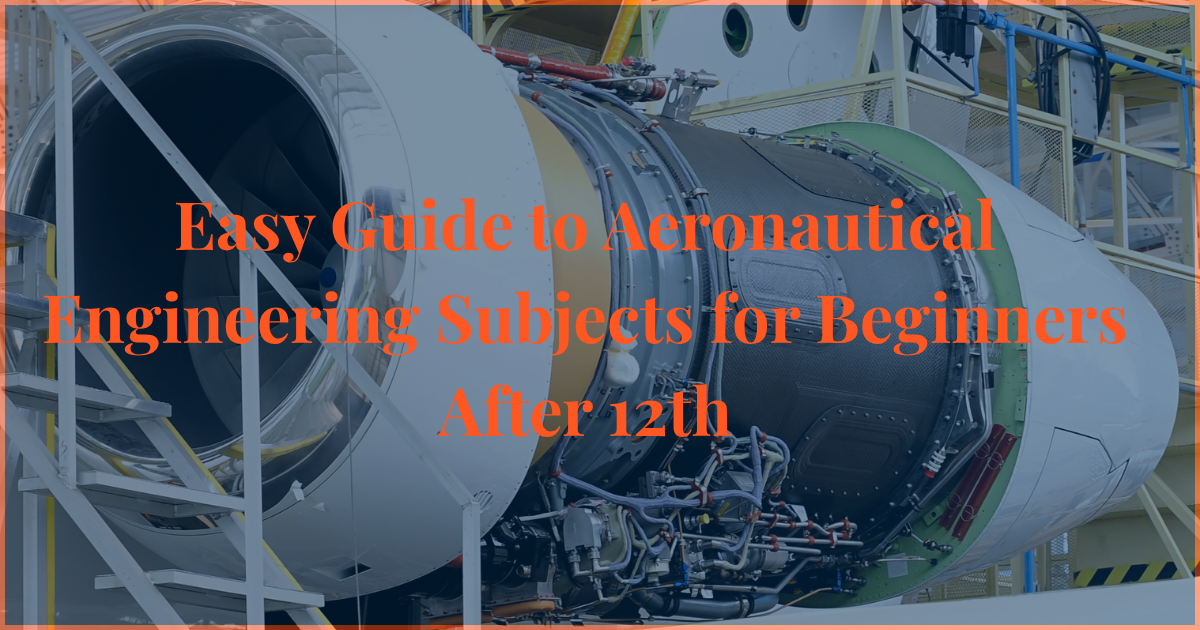
Passing your 12th-grade board exams is a massive milestone. If you spent your high school years fascinated by physics, solving complex calculus problems, and staring at the sky wondering how massive objects conquer gravity, you are likely considering an aviation career. But as you look at university brochures, the academic terminology can feel incredibly overwhelming. What does a freshman actually study? What are the core aeronautical engineering subjects you need to master to build a career in this high-tech field?
Transitioning from school-level physics to designing supersonic wings or calibrating jet engines is a step-by-step journey. You do not start building rockets on day one. Instead, you build a steady foundation of basic sciences before diving into advanced aerodynamics and propulsion.
Read Before: Common Mistakes Students Make in the AME Entrance Exam (And How to Avoid Them)
The Academic Structure: From 12th Class to Flight Mechanics
A B.Tech in Aeronautical Engineering is a 4-year undergraduate program divided into 8 semesters. The curriculum is carefully designed by academic bodies and universities like Bikaner Technical University (BTU) to take a student who only knows high school science and turn them into an industry-ready professional.
The program generally follows a structured trajectory:
- Year 1 (Semesters 1 & 2): Foundation and transition from 12th-grade PCM.
- Year 2 (Semesters 3 & 4): Introduction to fluid behavior, thermodynamic cycles, and materials.
- Year 3 (Semesters 5 & 6): Core aeronautical engineering specialization (propulsion, avionics, and structures).
- Year 4 (Semesters 7 & 8): Electives, advanced computational simulations, major projects, and industrial internships.
Let us explore these phases in detail to demystify the subjects you will encounter.
Year 1: Building the Mathematical and Scientific Foundation
Many freshmen walk into college expecting to start working on aircraft wings immediately. However, the first year is dedicated to aligning students from various boards (CBSE, ICSE, State Boards) onto a common scientific platform.
1. Engineering Mathematics (Semesters 1 & 2)
Aviation runs on numbers. You cannot calculate the trajectory of a missile or the stress on a wing spar without advanced mathematics.
- What you study: Linear algebra, vector calculus, ordinary and partial differential equations, and infinite series.
- Why it matters: You will use differential equations to model how air flows over a wing. If your mathematical foundation is weak, advanced fluid dynamics will feel like a foreign language.
2. Engineering Physics
This subject bridges the gap between high school physics and engineering applications.
- What you study: Wave optics, electromagnetism, quantum mechanics, and basic relativity.
- Why it matters: Understanding wave behavior helps you grasp how shockwaves form when an aircraft approaches supersonic speeds. (M>1.0)
Note: Book a FREE counselling session through SOACET to understand the AME admission process clearly.
3. Engineering Drawing and CAD (Computer-Aided Design)
Before a machine is built, it must be drawn with absolute geometric precision.
- What you study: Orthographic projections, isometric views, and basic drafting software like AutoCAD.
- Why it matters: Blueprints are the universal language of engineers. You must be able to read and create technical drawings to communicate with manufacturing teams.
4. Basic Workshop Practices
A fantastic introduction to the physical tools of the trade.
- What you study: Practical hands-on training in fitting, carpentry, welding, and machine shops.
- Why it matters: An engineer who only understands computer designs but has never held a wrench is of little use in a hangar. This subject builds respect for physical craftsmanship.
Year 2: The Core Engineering Transition
By the third semester, the general engineering subjects fade away, and you begin studying how physical laws apply specifically to fluids, heat, and structures. This is where the core aeronautical engineering subjects make their entrance.
1. Fluid Mechanics
Before you study how air flows around a plane, you must study how any fluid behaves under pressure and motion.
- What you study: Hydrostatics, Bernoulli’s equation, viscosity, boundary layer theory, and laminar vs. turbulent flows.
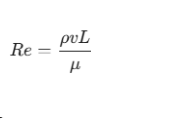
- Key Concept: You will learn how to calculate the Reynolds Number (RE), which determines fluid behavior:

where (P) is fluid density (V), is velocity, (L) is characteristic length, and (U) is dynamic viscosity.
2. Engineering Thermodynamics
Aircraft engines are heat engines. They convert chemical energy from fuel into heat and then into kinetic thrust.
- What you study: Laws of thermodynamics, gas power cycles (like the Brayton Cycle used in gas turbines), and entropy.
- Why it matters: This subject helps you calculate how much fuel an engine needs to burn to produce a specific amount of force.
3. Strength of Materials
An aircraft must be light enough to fly, but strong enough to withstand immense forces during turbulence.
- What you study: Stress, strain, shear force, bending moments, and torque.
- Why it matters: You learn how to select materials that will not bend or break when subjected to high gravitational forces (G-forces).
4. Introduction to Aerodynamics
This is the moment you have been waiting for. You finally study the science of flight.
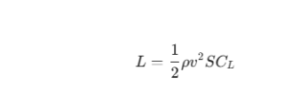
- What you study: How lift and drag are generated. You will master the Lift Equation:
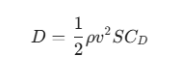
 and the Drag Equation:
where (S) is the wing surface area, and (CL) and (CD) are the coefficients of lift and drag.
Year 3: Advanced Specializations and Engine Design
The third year contains the most challenging and highly rewarding aeronautical engineering subjects. Here, you focus on the mechanical and electronic systems that keep a plane operating safely.
1. Propulsion (Jet Engines and Rockets)
If aerodynamics is the wing, propulsion is the heart of the aircraft.
- What you study: Gas turbine engines, ramjets, scramjets, turbofans, turboprops, and chemical rocket propulsion.
- Why it matters: You learn how to analyze the thermal efficiency of a jet engine and design combustion chambers that can handle temperatures exceeding. 1,500 °C
2. Aircraft Structures
Building on the “Strength of Materials” subject, this focuses specifically on the unique geometry of flight vehicles.
- What you study: Thin-walled beam analysis, column buckling, fuselage bending, and wing torsion.
- Why it matters: You learn how to place internal ribs and spars inside a wing to prevent it from twisting off during a high-speed dive.
3. Avionics and Aircraft Systems
Modern planes are essentially flying computers. Avionics (Aviation Electronics) is the brain of the vehicle.
- What you study: Radar systems, satellite navigation (GPS), autopilot loops, flight control computers, and communication benches.
- Why it matters: You learn how the pilot’s inputs at the controls are converted into electronic signals that move the hydraulic actuators on the wings.
4. Flight Mechanics and Performance
How does a plane behave when it is actually in the sky?
- What you study: Take-off and landing distances, gliding flight, range, endurance, and static/dynamic stability.
- Why it matters: You learn how to design an aircraft that naturally returns to a straight-and-level flight path if it is disturbed by a gust of wind.
Year 4: Electives, Simulations, and Industry Integration
In your final year, you transition from a student solving textbook problems to an associate engineer working on complex systems. The curriculum becomes highly customizable through elective subjects.
1. Computational Fluid Dynamics (CFD)
Building physical prototypes and testing them in wind tunnels is incredibly expensive. CFD allows engineers to simulate flight on supercomputers.
- What you study: Numerical methods, grid generation, and simulation software like ANSYS Fluent or MATLAB.
- Why it matters: You learn how to visualize shockwaves and air turbulence on a computer screen, allowing for rapid design changes.
2. Key Elective Subjects
Students can choose to specialize in emerging 2026-2030 aviation trends:
- Unmanned Aerial Vehicles (UAVs): Designing and programming commercial and military drones.
- Composite Materials: Working with carbon fiber and Kevlar structures used in next-gen planes.
- Spacecraft Dynamics: For those wanting to transition into astronautics and rocket trajectory planning.
3. Major Project and Internship
You spend a significant portion of your final semesters working in teams to design, build, and test a model aircraft or drone. You also undergo a mandatory internship at an active MRO (Maintenance, Repair, and Overhaul) facility or manufacturing plant.
How Difficult are the Aeronautical Engineering Subjects? (Tips for Beginners)
A common concern among 12th-pass students is: “Is the syllabus too hard for me?”
Aeronautical engineering is indeed highly rigorous. It requires a high level of mathematical intuition and a strong grasp of physics concepts. However, the subjects are not abstract. Unlike pure coding or abstract mathematics, everything you study in aeronautics has a physical, visible manifestation. If you calculate lift, you can see the wing rise. If you calculate thrust, you can hear the engine roar.
Tips to Succeed:
- Do Not Rote Learn: You cannot pass these subjects by memorizing answers. Focus on the physical meaning behind every equation.
- Master the Basics: If you do not understand Fluid Mechanics in Semester 3, you will struggle with Aerodynamics in Semester 5. Treat each subject as a building block.
- Learn Software Early: Get comfortable with MATLAB, Python, and CAD software by your second year. It will make your projects much easier.
Why Study These Subjects at the School of Aeronautics (SOACET)?
The quality of your education is directly proportional to how your aeronautical engineering subjects are taught. At SOACET Neemrana, we believe that flight mechanics cannot be learned solely from a blackboard.
The Fokker F-27 Advantage
When we teach you about aircraft systems or landing gear retraction, we don’t just show you a slide. We take you to our on-campus hangar housing a Fokker F-27 and a Beechcraft. Students get to inspect real hydraulic lines, touch actual turbine blades, and see the structures they study in class implemented in real, heavy-weight aircraft.
AICTE Approved and BTU Affiliated
Our academic curriculum is aligned with the latest guidelines of Bikaner Technical University (BTU). This ensures that the degrees you earn are globally valid for higher studies (MS/M.Tech) and prestigious government jobs with organizations like ISRO and DRDO.
Frequently Asked Questions (FAQs)
Q1. Do I need to learn coding to study aeronautical engineering subjects?
Yes. Modern engineering relies heavily on simulation. You will use coding (primarily MATLAB or Python) to solve complex aerodynamic equations and model flight dynamics.
Q2. Is there a lot of chemistry involved in this course?
Chemistry is primarily limited to your first year (General Chemistry) and specific propulsion modules, where you study fuel combustion and propellants. The course is heavily dominated by Physics and Mathematics.
Q3. Can I get a job immediately after B.Tech with these subjects?
Absolutely. Graduates are highly sought-after by commercial airlines, drone startups, MRO facilities, and research organizations like HAL and DRDO.
Q4. Are there separate subjects for Aircraft Maintenance?
If you choose the Aircraft Maintenance Engineering (AME) license path instead of B.Tech, your subjects will focus heavily on maintenance legislation, practical workshop practices, and system inspections as per DGCA norms.
Conclusion: Take the First Step Today
Studying aeronautical engineering subjects is a deeply rewarding challenge. It is an academic pathway designed for those who want to push the boundaries of technology and play a role in how humanity travels across the planet and explores the universe.
From the foundational mathematics of your first year to the complex computational designs of your final projects, each subject is a step toward your professional takeoff. By choosing an institution like SOACET that balances rigorous academic theory with unparalleled practical hands-on experience, you ensure that your career launches with maximum thrust.
Are you ready to design the future of flight? Your countdown starts today.