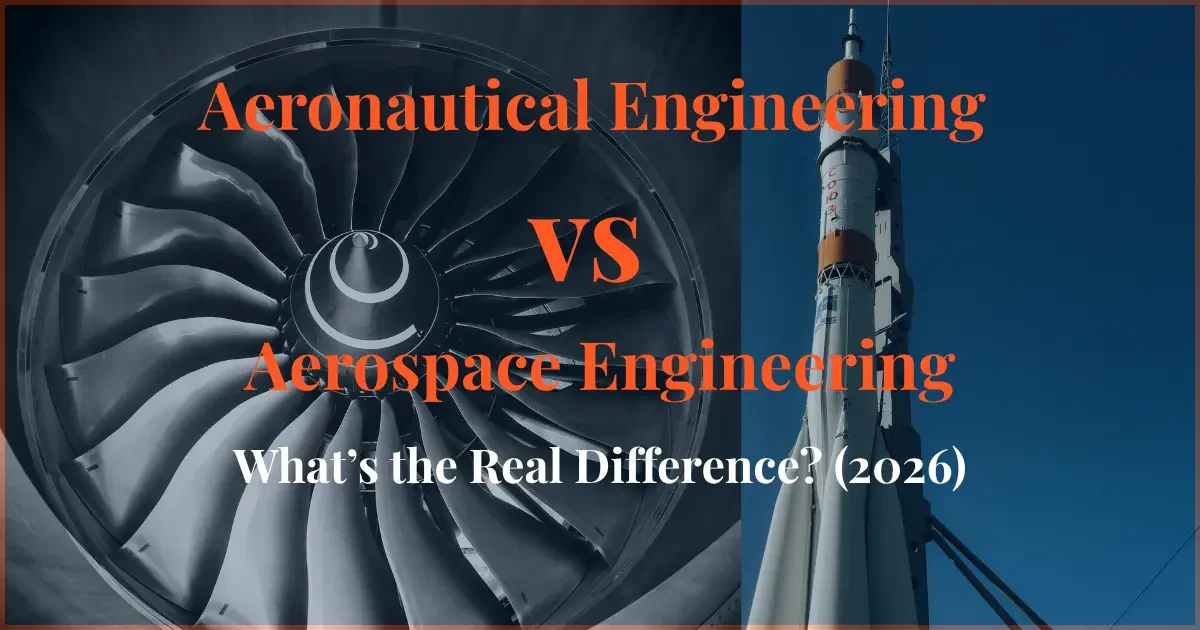
Every time you watch a heavy metal tube glide effortlessly through the air, or witness a rocket punch its way through the clouds to reach orbit, you are seeing the pinnacle of human ingenuity. But behind these technical marvels lie two highly prestigious academic fields that are often grouped: aeronautical engineering and aerospace engineering.
To a high school graduate looking to build a career in the skies, these terms can feel incredibly confusing. Are they the same thing? Does choosing one over the other restrict you to working only on planes or only on spacecraft?
As we move through 2026, the lines between these disciplines are shifting. Private space travel, sustainable aviation, and autonomous drone networks are forcing both fields to evolve.
1. Defining the Core Fields
To truly understand how these fields differ, we have to look at the boundaries of flight. The dividing line between our sky and outer space is an imaginary boundary known as the Karman Line, located roughly 100 kilometers (62 miles) above sea level.
What is Aeronautical Engineering?
At its core, aeronautical engineering is the study, design, and manufacture of flight-capable machines that operate within the Earth’s atmosphere. This is the older, highly focused discipline of flight. If a vehicle relies on air to generate lift and burn fuel, it falls squarely under this branch.
Aeronautical engineers are the minds behind:
- Commercial airliners (like the Airbus A320 and Boeing 787).
- Military fighter jets and strategic bombers.
- Helicopters, gliders, and hot air balloons.
- Modern civilian and tactical military drones.
What is Aerospace Engineering?
Aerospace engineering is the broader, “umbrella” term that encompasses all flight, both inside and outside Earth’s atmosphere. It is essentially made up of two major fields: aeronautical engineering (which handles atmospheric flight) and astronautical engineering (which handles space flight in the vacuum of space).
Aerospace engineers design systems that can transition from our thick, oxygen-rich air into the cold, empty void of space. They work on:
- Reusable rockets (like SpaceX’s Falcon 9).
- Interplanetary probes and Martian rovers.
- Communication and weather satellites.
- Space stations and lunar landers.
2. Technical Comparison: Air vs. Vacuum
While both fields share a common ancestor in classical mechanics, their daily design challenges are shaped by the environments their vehicles inhabit.
| Feature | Aeronautical Engineering | Aerospace Engineering |
| Operating Medium | Earth’s Atmosphere (Dense Air) | Atmosphere + Space (Vacuum of Space) |
| Primary Force | Lift and Aerodynamic Drag | Gravity, Orbital Trajectories, and Solar Radiation |
| Propulsion Type | Air-breathing engines (Turbofans, Turboprops) | Rocket motors (Solid/Liquid chemical, Ion thrusters) |
| Material Stresses | Wind shear, flutter, fatigue over thousands of flight hours | Thermal shock (re-entry heat up to 1,600°C), micro-meteoroids |
| Control Systems | Aerodynamic surfaces (Ailerons, flaps, rudders) | Reaction control thrusters, gimballed rocket nozzles |
The Aerodynamics Challenge
In aeronautical engineering, air is your primary medium. You spend years studying fluid dynamics to understand how air flows over wings to create lift while minimizing drag.
In aerospace engineering, you must design for an environment where there is no air. A satellite orbiting Earth does not use wings to stay up; it uses orbital velocity. Its control systems cannot use rudders or flaps to turn; instead, it must fire tiny cold-gas thrusters or use reaction wheels to change its orientation.
The Thermal Shock Challenge
An aircraft flying at high altitudes experiences freezing temperatures (around -55°C), but those temperatures remain relatively stable during the cruise.
A rocket or a spacecraft, however, experiences extreme thermal shock. During launch and re-entry, a spacecraft’s skin can reach temperatures over 1,600°C due to atmospheric compression. Designing thermal protection shields, advanced ceramic tiles, and structures capable of handling rapid temperature transitions is a core task for aerospace specialists.
Note: Book a FREE counselling session through SOACET to understand the AME admission process clearly.
3. Academic Breakdown: What Will You Study?
If you choose to pursue either course at a premier aviation institute like the School of Aeronautics (SOACET), the first two years of your curriculum will look remarkably similar. You will study fundamental physics, advanced calculus, materials science, and thermodynamic cycles.
However, in the third and fourth years, the academic paths split into highly specialized streams.
Aeronautical Specializations
The curriculum for aeronautical engineering focuses deeply on the mechanics of atmospheric flight. Key subjects include:
- Advanced Aerodynamics: The study of subsonic, transonic, and supersonic airflows.
- Aircraft Design: The art of balancing structural weight, passenger capacity, fuel volume, and aerodynamic efficiency.
- Propulsion Systems: Deep dive into internal combustion engines, gas turbines, turboprops, and turbofans.
- Flight Stability and Control: Designing autopilot systems and mechanical control linkages to keep planes stable in turbulent air.
Aerospace Specializations
The aerospace curriculum expands into the realm of outer space. Key subjects include:
- Astrodynamics (Orbital Mechanics): Calculating satellite orbits, escape velocities, and interplanetary transfer trajectories (like Hohmann transfers).
- Space Environment: Studying how cosmic radiation, solar winds, and extreme vacuums affect electronic components and materials.
- Rocket Propulsion: The chemistry and physics of liquid fuel, solid fuel, and electric propulsion systems.
- Spacecraft Design: Designing life-support systems, power arrays (solar panels), and communication systems for long-duration deep-space missions.
4. Career Scope and Job Roles in 2026
The commercial landscape of 2026 has opened up incredible opportunities for graduates of both disciplines. The decision of which to study should be guided by where you want your daily workspace to be.
Opportunities in Aeronautical Engineering
India is currently undergoing a massive civil aviation boom. With domestic carriers ordering over 1,200 new aircraft and the government setting up domestic manufacturing plants under the “Make in India” initiative, the scope for aeronautical engineering is exceptionally high.
Common job roles include:
- Aircraft Design Engineer: Designing wings, fuselages, or landing gear assemblies for manufacturers like HAL or private players like Tata Aerospace.
- Flight Test Engineer: Working on the runway and in test flights to analyze real-world telemetry data from new aircraft designs.
- Systems Engineer: Ensuring that the complex hydraulic, electrical, and fuel systems inside a commercial jet work together safely.
- Drone Architect: Designing Unmanned Aerial Vehicles (UAVs) for agriculture, logistics, and defense surveillance.
Opportunities in Aerospace Engineering
With the rise of the “New Space” economy, space is no longer the exclusive domain of government agencies. Private space startups like Skyroot Aerospace and Agnikul Cosmos, alongside global giants like SpaceX, have created a competitive job market.
Common job roles include:
- Mission Specialist / Flight Controller: Working in control rooms to monitor satellite health, launch sequences, and orbital maneuvers.
- Propulsion Engineer: Designing and testing rocket engines, combustion chambers, and fuel delivery systems.
- Satellite Systems Engineer: Building payloads, communication arrays, and thermal control systems for low-Earth orbit (LEO) constellations.
- Structural Analyst: Using advanced simulation software (like ANSYS or CATIA) to ensure rockets can survive the violent vibrations of a launch.
5. Salary Expectations: India vs. Abroad
Because of the highly specialized nature of these fields, salaries are significantly higher than standard engineering disciplines. Below is an estimated salary projection for 2026:
| Career Stage | Aeronautical Engineering (INR per annum) | Aerospace Engineering (INR per annum) |
| Fresher (Entry-Level) | ₹4.5 Lakhs – ₹8 Lakhs | ₹5.5 Lakhs – ₹9 Lakhs |
| Mid-Level (5-9 Years) | ₹12 Lakhs – ₹22 Lakhs | ₹14 Lakhs – ₹26 Lakhs |
| Senior Specialist (10+ Years) | ₹25 Lakhs – ₹45 Lakhs | ₹30 Lakhs – ₹60 Lakhs+ |
Note: In international markets like the USA and the Middle East, entry-level salaries for both disciplines range between $85,000 and $115,000 per annum, though security clearance requirements (such as ITAR in the US) can sometimes restrict space-sector jobs to local citizens.
6. How to Choose: Diagnostic Questions for Students
Still undecided? Ask yourself these four simple questions to find your true path:
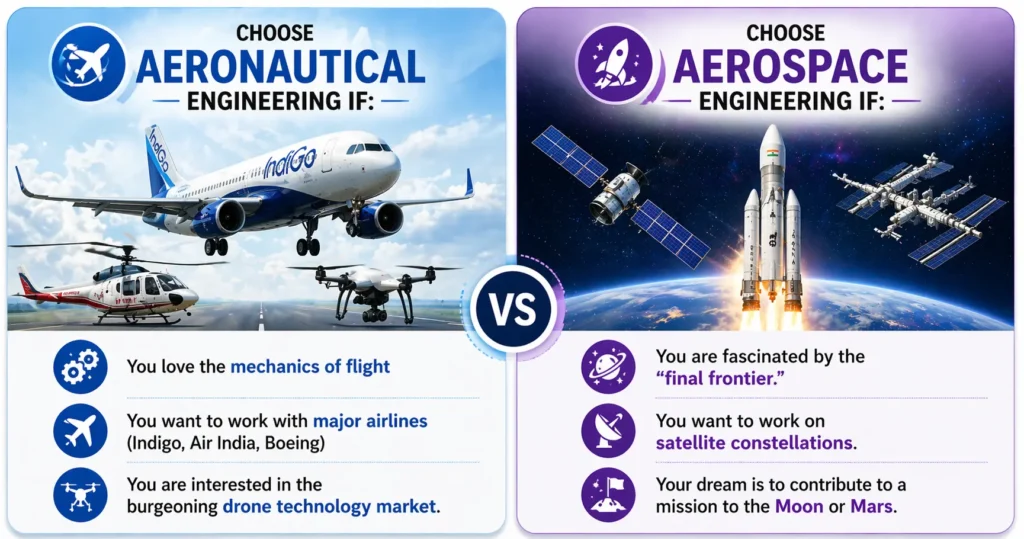
- Are you fascinated by the mechanical beauty of planes, or do you dream of the stars? If commercial flight, military fighters, and helicopters excite you, go for aeronautical engineering. If you are obsessed with the moon, Mars, and deep-space travel, choose aerospace.
- How do you feel about complex mathematics? While both fields require math, aerospace engineering involves higher levels of abstract math for calculating celestial coordinates, orbital trajectories, and space-time physics.
- Where do you want to work? If you want a wide range of job opportunities in civilian sectors (airlines, manufacturing, drone startups), aeronautical offers a larger immediate job market in India. If you are aiming for high-stakes, research-heavy roles (ISRO, DRDO, space startups), aerospace is your calling.
Why Study at the School of Aeronautics (SOACET)?
Choosing the right educational institution is the most critical decision of your professional journey. Since 1992, the School of Aeronautics (SOACET) has been the preferred destination for students serious about a career in the skies.
World-Class Practical Infrastructure
We don’t believe in teaching flight mechanics solely from blackboards. Our Neemrana campus features a dedicated hangar with actual “Live” aircraft, including a heavy-duty Fokker F-27 and a Beechcraft. Students get to touch real engines, inspect actual airframes, and troubleshoot functional hydraulic systems.
Global Industry Alignment
Our curriculum, approved by the AICTE and affiliated with Bikaner Technical University (BTU), is designed to meet 2026 global industry standards. We integrate modern software training, including CATIA, ANSYS, and MATLAB, ensuring our graduates are “job-ready” from day one.
Unparalleled Placements
With an active alumni network spanning commercial airlines, defense labs, and space research organizations across the globe, SOACET provides a direct pipeline to your dream career.
Frequently Asked Questions (FAQs)
Q1. Can an aeronautical engineer work on spaceships?
Yes, but they may need additional training in orbital mechanics and vacuum physics. The structural and thermodynamic principles learned in aeronautical engineering are highly transferable to spacecraft design.
Q2. Is Aerospace Engineering harder than Aeronautical?
Generally, yes. Aerospace covers everything that Aeronautical does, plus the unique challenges of space flight, rocket science, and celestial mechanics, making the academic workload slightly heavier.
Q3. Does SOACET offer integrated programs?
Yes, SOACET offers unique integrated paths where you can pursue your B.Tech in Aeronautical Engineering alongside your Aircraft Maintenance Engineering (AME) license training, giving you a dual professional advantage.
Q4. Are there jobs in the government sector for these graduates?
Absolutely. In India, public sector undertakings like HAL, defense labs like DRDO, and space research organizations like ISRO are among the largest recruiters of aeronautical and aerospace talent.
Conclusion: Elevate Your Ambitions
At the end of the day, the debate between aeronautical engineering and aerospace engineering isn’t about which is “better”—it is about where your passion lies. One keeps its focus on mastering the skies of our home planet, while the other looks beyond the horizon to conquer the final frontier.
Both pathways lead to highly respected, intellectually challenging, and financially rewarding careers. The key to success is building a strong foundation of practical grit and technical precision.
The sky is waiting, and the stars are calling. Your countdown starts today.
Ready to take flight? Explore our specialized programs at SOACET