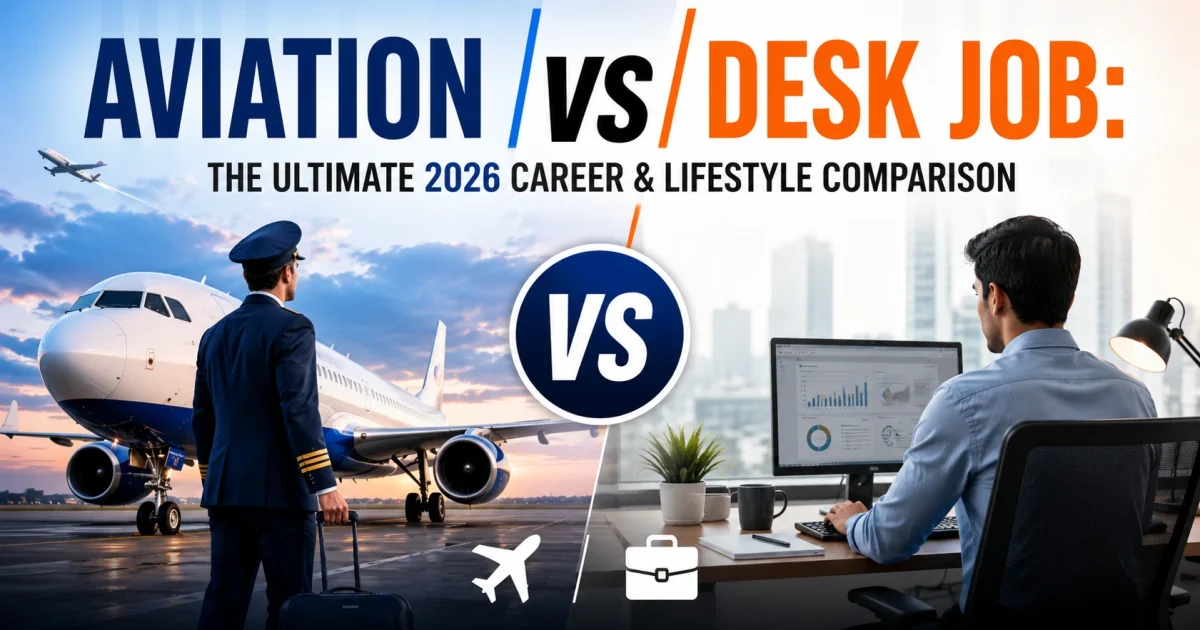
For decades, the “dream career” was sold to us as a sleek, air-conditioned corporate office in a soaring glass high-rise. We were taught that professional success meant sitting in an ergonomic chair, working on a dual-monitor setup, and attending weekly sync meetings. This was the promised land of stability, safety, and steady promotion.
However, as we progress through 2026, the cracks in the corporate office dream have widened into chasms. Sitting in a chair for nine hours a day is now clinically linked to chronic lifestyle diseases, remote work has blurred the boundaries between personal and professional spaces, and generative AI has made many white-collar desk jobs highly vulnerable to automated corporate restructuring.
This has brought students and young professionals to a massive career crossroads: aviation vs desk job.
1. Defining the Lifestyles: Active Tarmac vs. Sedentary Cubicle
To truly evaluate the choice of an aviation vs desk job, we must look beyond the starting salary and analyze the physical and psychological demands of your daily work. The fundamental difference lies in your relationship with your environment.
Aviation Tarmac Lifestyle (Dynamic):
Active Hangar Floor —> Hands-on Engineering —> Flight Safety Clearance —> High Impact
Corporate Desk Job Lifestyle (Sedentary):
Dual-Monitor Cubicle —> Continuous Staring —> Digital Deliverables —> Abstract Impact
The Active Aviation Lifestyle
In aviation, your workspace is a living, breathing ecosystem of heavy machinery, physical forces, and immediate real-world outcomes. Whether you operate as a commercial pilot or an Aircraft Maintenance Engineer (AME), your environment is the active hangar floor, the maintenance line, and the open tarmac.
- The Core Experience: You are constantly on your feet, interacting with massive aerospace structures, running diagnostics on actual turbofan engines, and utilizing precision calibration tools.
- The Environment: You are exposed to the elements the roar of taxiing jetliners, the smell of aviation-grade turbine fuel, and the physical space of open hangars. Your office is the runway and the sky.
- The Psychological Reward: Immediate and high-impact. When you successfully troubleshoot a snag on a Boeing 737 MAX or sign the Flight Release Certificate, you see the direct result of your work as that massive aircraft takes off safely into the sky.
The Sedentary Desk Job Lifestyle
In a corporate or IT desk job, your workspace is abstract, controlled, and digital. Your environment is defined by indoor tech parks, air-conditioned cubicles, and digital communication platforms like Slack or Microsoft Teams.
- The Core Experience: Your entire professional value is delivered through your fingers to a keyboard. You spend your day analyzing spreadsheets, writing software code, or coordinating digital marketing campaigns.
- The Environment: Predictable, static, and indoor. While this offers protection from weather elements, it traps you in a cycle of artificial lighting and prolonged screen time.
- The Psychological Reward: Abstract and delayed. Your deliverables are often small cogs in massive, invisible enterprise machines. You may write code for a database that you will never physically see, or build slides for a strategy that feels distant from physical reality.
2. AME Lifestyle vs. Corporate Job: Day-to-Day Realities
To understand the core differences between hands-on technical aviation roles and general corporate careers, let us compare the ame lifestyle vs corporate job day-to-day routines.
A Day in the Life of an AME (Aircraft Maintenance Engineer)
An AME does not have a “routine” day; they have shift objectives shaped by flight schedules.
- 07:00 AM – Hangar Briefing: You arrive at the airport MRO (Maintenance, Repair, and Overhaul) facility. Your team reviews the incoming aircraft logbooks to note any pilot-reported snags.
- 09:00 AM – On-the-Job Diagnostics: You walk out to the line. Today, you are running a borescope inspection on the turbine blades of an Airbus A321neo’s engine. You are active, using your hands, and interpreting high-definition live feeds of the internal turbine stages.
- 12:00 PM – Structural Analysis: You work with physical forces. Calculating the safety factor () of an airframe component under aerodynamic strain relies on direct mechanical stress limits:
- 03:00 PM – The Certification: The diagnostic is complete, and the repair is certified. You sign the Certificate of Release to Service (CRS). As the aircraft taxis out toward the runway, your day’s work is visibly validated. You head home with a clear boundary between your shift and your personal life.
Note: Book a FREE counselling session through SOACET to understand the AME admission process clearly.
A Day in the Life of a Corporate Desk Specialist
A corporate professional’s day is defined by continuous digital connectivity.
- 09:00 AM – The Morning Login: You arrive at your desk or open your laptop at home. You are greeted by 45 unread emails and 12 Slack notifications, setting off an immediate cognitive load.
- 11:00 AM – Staring & Splicing: You are analyzing data, writing software code, or managing digital ad campaigns. Your eyes are fixed on a monitor, and your spine is compressed in a seated position.
- 02:00 PM – The Corporate Sync: You sit in a 2-hour Zoom meeting discussing abstract software metrics. You feel a sense of fatigue that is purely cognitive rather than physical.
- 06:00 PM – The Blur: You close your laptop, but your phone continues to ping with work-related notifications. The boundary between your workspace and your home is fluid, keeping your stress levels elevated long into the night.
3. The Biomechanical & Physical Reality of Your Workspace
Many students automatically lean toward desk jobs because they seem comfortable. However, when choosing between an aviation vs desk job, you must consider the biological impact of sitting for decades.
The Biological Toll of the Desk Job
Human biology is structurally engineered for movement. Prolonged sitting often termed the “sitting disease” has severe systemic consequences on the human body.
- Spinal Compression: Sitting forces your lumbar spine to carry up to of the load compared to standing. Over a 10-year desk career, this leads to chronic lower back pain and herniated discs.
- Metabolic Stagnation: When sitting, your body’s caloric burning rate drops, insulin effectiveness drops, and your risk of cardiovascular disease increases.
- Cognitive Fatigue: Lack of physical circulation reduces oxygen delivery to the brain, leading to “brain fog” and high rates of corporate burnout.
The Physical Balance of Aviation
Aviation roles require dynamic physical engagement. As an AME on the active hangar floor, you are constantly walking, lifting, reaching, and balancing.
- Mechanical Work Done: In physics, the work () done by your body during active movement is modeled as:
Where is the force applied by your muscles, and what is your physical displacement? This constant physical output keeps your metabolism highly active, your circulation strong, and your posture aligned. - Natural Fatigue: Unlike the cognitive, anxiety-driven fatigue of corporate desks, the fatigue of an aviation engineer is physical. This leads to healthier sleep cycles and a natural release of stress-reducing endorphins.
4. Addressing the Counter-Argument: Why Choose an IT Career Over Aviation?
To maintain absolute objectivity, we must ask: why choose an IT career over aviation? What are the traditional arguments that draw hundreds of thousands of graduates toward software code and office desks, and how do they hold up in 2026?
Aviation Sector (2026):
Dynamic Environment —> Physical Skill Deficit —> AI-Proof Security —> High Direct Impact
IT/Corporate Sector (2026):
Static Desk —> White-Collar Saturation —> High AI Automation —> Abstract Digital Output
The Traditional Arguments for IT
- Work from Home (WFH) & Flexibility: The ability to work from your living room, coordinate projects from a coffee shop, and avoid long daily commutes is a major attraction.
- Immediate Comfort: Working in an air-conditioned office with zero exposure to high noise, grease, weather elements, or heavy physical tools.
- Low Barrier to Entry: To write software, all you need is a laptop and an internet connection. There are no strict physical fitness tests or color-blindness restrictions like those found in civil aviation.
The 2026 Reality Check
While these comfort-driven benefits remain, the trade-offs in 2026 are severe. The “work from home” model has isolated many corporate freshers, leaving them with minimal mentoring.
Furthermore, because the barrier to entry for coding is low, the market is highly saturated. IT freshers are facing immense downward pressure on salaries, while aviation technical professionals are experiencing a historic seller’s market due to a massive, physical skill shortage.
5. Job Security in the Age of Generative AI: Virtual vs. Physical Safety
If you are comparing aviation vs desk job, you must look at how artificial intelligence is changing the nature of work.
The Cubicle is Vulnerable to Automation
In the corporate world, if your job involves taking digital inputs, processing them behind a screen, and delivering digital outputs, your role is highly vulnerable to AI automation.
In 2026, generative AI models can write clean code, compile financial spreadsheets, design landing pages, and handle database administration in seconds. This has led to flat or shrinking headcounts across many tech companies.
A corporate desk worker must constantly upskill and specialize deeply just to outrun automated scripts.
The Runway is AI-Proof
You cannot run an AI script to physically replace a damaged compressor blade inside a jet engine. You cannot use a digital chatbot to physically climb onto a wing, inspect a fuel valve, or safety-wire a titanium engine mount on an active hangar floor.
Aviation is a highly regulated, physical field that requires:
- Tactile Sensing: Human sight, human touch, and physical grit.
- Absolute Legal Accountability: Under civil aviation laws, an AI cannot sign a Certificate of Release to Service (CRS) and take legal responsibility for passenger lives. Only a licensed human Aircraft Maintenance Engineer can hold that power.
This makes hands-on aviation careers completely insulated from the white-collar AI layoffs affecting desk-bound professionals.
6. Financial Trajectory Comparison (Aviation vs. Corporate Desk Job)
How do these paths compare financially over a 15-year career horizon? Let’s look at a realistic projection based on 2026 industrial salary standards:
| Career Phase | Aviation Technical Track (e.g., Licensed AME) | Traditional Corporate Track (e.g., IT Consultant / HR) |
| Entry Level (Years 1–2) | ₹3.5 Lakhs – ₹5.5 Lakhs per annum (Trainee Technician / Junior Cadet) | ₹4.0 Lakhs – ₹7.5 Lakhs per annum (Associate Software Developer / Analyst) |
| Mid-Career (Years 3–7) | ₹12 Lakhs – ₹20 Lakhs per annum (Licensed Certifying Engineer / First Officer) | ₹8 Lakhs – ₹15 Lakhs per annum (Senior Developer / Project Coordinator) |
| Senior Specialist (Years 10+) | ₹24 Lakhs – ₹50 Lakhs per annum (Type-Rated Certifying Engineer / Captain) | ₹18 Lakhs – ₹32 Lakhs per annum (Technical Architect / Delivery Manager) |
| Global Opportunities | ₹60 Lakhs – ₹1.2 Crore per annum (Tax-free salaries in major Middle East/Southeast Asian hubs) | ₹35 Lakhs – ₹65 Lakhs per annum (Global corporate roles requiring relocation) |
7. Analyzing the Return on Investment (ROI) and Payback Period
To make a smart financial decision, we can use a basic economic mathematical model to calculate the Educational Payback Period (). This measures how quickly you can recover your total educational and training costs once you enter the job market:
Let’s model the ROI for both paths based on standard 2026 data:
Case A: Specialized Aviation Track (AME Course at SOACET)
- Total Educational Cost (): ~₹6,00,000 (Average fees for a 3-year DGCA-approved CAR 147 program).
- Average Initial Salary as Licensed Basic AME (): ~₹12,00,000 per annum (reached rapidly within 3 years of completing training).
Using our formula:
This indicates an accelerated payback period of just 6 months once licensing is achieved.
Case B: Standard Business/IT Desk Job Track (Private BBA / MBA)
- Total Educational Cost (): ~₹10,50,000 (Combined fees for standard college graduation and initial technical training, including residential charges).
- Average Initial Salary as Corporate Associate (): ~₹4,50,000 per annum.
Using our formula:
This indicates a significantly longer payback period of approximately 2.3 years to recover your initial capital investment.
8. Diagnostic Matrix: Which Path is Your True Calling?
Still feeling torn? Ask yourself these four simple diagnostic questions to identify your natural technical path:
- Do you prefer tangible, mechanical machinery or abstract logic blocks? If you love physical mechanisms, holding precision tools, and troubleshooting aircraft systems, choose aviation. If you prefer sitting at a computer workstation, writing logical scripts, and debugging software databases, choose a desk job.
- How do you feel about physical confinement? If the thought of sitting in the same chair, staring at the same monitor, under the same fluorescent lights for 250 days a year makes you feel anxious, choose aviation. If you value indoor comfort and a highly controlled environment, a desk job is more suitable.
- What is your tolerance for safety responsibility? As a licensed AME or commercial pilot, you carry the legal and psychological responsibility of thousands of passengers’ lives; if you sign off on a faulty plane, you are legally accountable. If you prefer a lower-stakes corporate environment, a desk job is the natural choice.
- Are you ready for continuous, strict regulatory exams? Aviation is a highly regulated, license-based career where you must pass tough regulatory exams (like the DGCA modules with a passing score of ). If you prefer traditional college semester grading systems, a corporate desk job path is the standard choice.
Why Study Aviation at the School of Aeronautics (SOACET)?
Since 1992, the School of Aeronautics (SOACET) has served as India’s premier launchpad for aviation leaders. Whether you choose AME or B.Tech in Aeronautical Engineering, SOACET provides an educational platform that balances academic depth with unparalleled physical grit.
1. The Neemrana “Live Hangar” Advantage
You cannot learn flight safety or turbine mechanics solely from textbooks. Our Neemrana campus features an active hangar housing actual, heavyweight operational aircraft, including a Fokker F-27 and a Beechcraft. Our students trace working hydraulic lines, test structural wings, inspect turbofan blades, and conduct live engine runs.
2. Strategic Civil and University Approvals
At SOACET, you don’t have to choose between a university degree and a technical license. We offer integrated programs where you can work toward your AICTE-approved B.Tech in Aeronautical Engineering from a recognized university like Bikaner Technical University (BTU) while simultaneously undergoing DGCA-approved CAR 147 basic AME training.
3. Dedicated Exam Support Cell
Clearing competitive university exams and rigorous DGCA module papers requires expert mentorship. SOACET maintains a dedicated Exam Support Cell providing specialized coaching, module mock tests, and a vast international technical library, resulting in one of the highest clearance rates in the country.
Frequently Asked Questions (FAQs)
Q1. Is an aviation career more stressful than a corporate desk job?
They involve different types of stress. Aviation stress is operational and temporal (ensuring the plane departs safely and on time). Once your shift is over and the plane takes off, your work is done.
Corporate stress is cognitive and chronic (long-term projects, constant emails, and blurred work-life boundaries), which can sometimes lead to higher rates of mental burnout.
Q2. Can an AME transition into a corporate desk job later in life?
Yes. Many senior AMEs who choose to step away from the active tarmac transition into high-paying corporate roles such as Aviation Safety Auditors, Fleet Managers, Quality Assurance Consultants, or Maintenance Directors, working primarily in office environments.
Q3. How has the AI boom of 2026 affected aviation job security?
The AI boom has actually highlighted the stability of aviation. While many junior coding, writing, and administrative desk jobs have been automated, the demand for hands-on, safety-certified aviation professionals remains exceptionally high and completely insulated from automated replacement.
Q4. Are education loans available for aviation courses at SOACET?
Yes. Because SOACET is a highly recognized, DGCA-approved, and BTU-affiliated institution, all major public and private banks provide structured educational loans to cover the costs of tuition, practical labs, and hostel fees.
Conclusion: Take the Leap Toward Takeoff
When evaluating aviation vs desk job, the debate isn’t about which path is universally superior; it is about finding the environment that matches your natural talents, biological preferences, and long-term career expectations.
One path puts you at the keyboard of digital innovation, managing database architectures and building the virtual platforms of tomorrow from a corporate desk. The other puts you on the active tarmac and hangar floors of daily aviation operations, ensuring that the heavy machines keeping humanity connected remain absolutely safe and airworthy. Both pathways lead to highly respected, intellectually challenging, and financially rewarding careers.
If you are someone who finds beauty in physical machines, values active movement over sedentary confinement, and wants a future-proof career that cannot be automated by software scripts, it’s time to step away from the desk.
The runway is clear, and the skies are waiting. Are you ready for takeoff?