
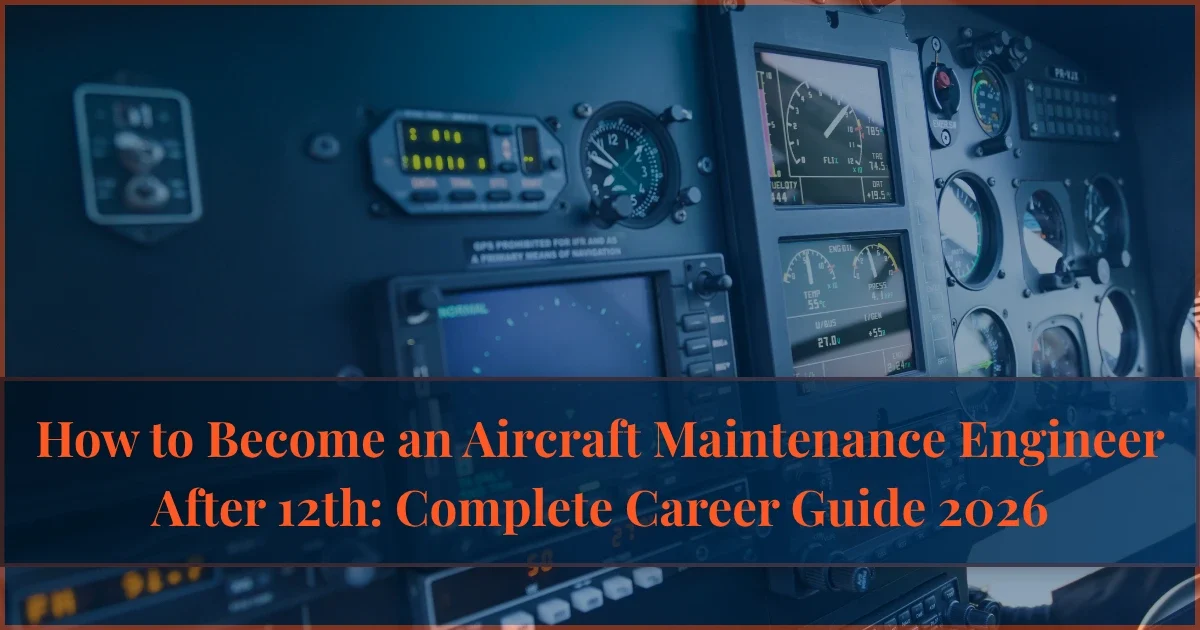
Every time a commercial aircraft pushes back from the boarding gate, taxiway lines guide it toward the runway. Inside the cockpit, the flight crew runs through a comprehensive electronic checklist, checking hydraulic pressures, flight control responses, and engine instruments. However, the ultimate authorization that allows that multi-million-dollar machine to lift off into the skies does not come from the pilots, nor does it come from air traffic control. It rests entirely on a single signature in the aircraft’s logbook, placed by a licensed professional who has certified the plane’s airworthiness.
If you are a high school science student looking for a technical career that combines hands-on engineering, regulatory authority, and exceptional global mobility, learning how to become an aircraft maintenance engineer after 12th is the first step toward a prestigious profession. This is not a standard office desk job; it is a highly specialized pathway where you hold direct responsibility for passenger safety and aircraft performance.
In this comprehensive 2026 guide, we will outline the licensing requirements, training streams, eligibility criteria, and practical phases required to build a highly successful career as a certified aircraft maintenance engineer (AME).
Read Before: How to Choose the Right Aviation Course After 12th in India (Expert Guide)
1. What Does an Aircraft Maintenance Engineer Actually Do?
To understand this profession, you must look beyond the standard engineering stereotypes. A conventional mechanical or aeronautical engineer focuses primarily on the theoretical design, wind-tunnel simulation, and manufacturing of aircraft structures. Once the design leaves the manufacturing plant, the designer’s direct interaction with the physical aircraft typically ends.
This is where the AME steps in. The day-to-day operations of an active aircraft are governed by strict safety regulations. Over time, aircraft systems experience natural wear and tear due to high-altitude pressure changes, temperature variations, and structural stress. An AME is the specialized professional authorized to inspect, troubleshoot, repair, and certify these complex machines.
Your responsibilities as an active AME include:
- Pre-Flight Inspections: Conducting rapid, highly focused visual and diagnostic checks on the ramp during short layovers to ensure the aircraft is safe for its next flight leg.
- Base Maintenance: Performing deep-level, structural teardowns inside major hangars, inspecting turbine components, checking landing gear assemblies, and testing flight safety systems.
- System Diagnostics: Using advanced electronic test equipment to troubleshoot complex avionics networks, communication suites, and fly-by-wire controls.
- Airworthiness Certification: Signing the official Flight Release Certificate (FRC), declaring that all systems are functioning perfectly and the aircraft is legally permitted to fly.
2. Deciphering the Legal Regulatory Framework: CAR 147 & CAR 66
You cannot become an AME by simply obtaining a standard university degree. Because civil aviation is a highly regulated global sector, the entire training, testing, and licensing system is strictly monitored by national civil aviation authorities.
In India, this regulatory body is the Directorate General of Civil Aviation (DGCA), operating under the Ministry of Civil Aviation. The training frameworks are aligned with international standards:
[DGCA Civil Aviation Regulations]
┌────────────────────────┴────────────────────────┐
▼ ▼
[CAR 147 Approved Institutes] [CAR 66 Licensing Rules]
Govern the physical facilities, Define the module examinations,
live aircraft hangars, and the practical hours, and logging
syllabus of the training college. requirements for students.
When you enroll in an approved program, your education is structured around these two regulatory frameworks. The college handles your CAR 147 basic training, preparing you to sit for the CAR 66 module examinations. This legal alignment ensures that your technical qualifications are recognized by airlines and maintenance organizations worldwide.
3. Academic and Medical Gateways: Can You Apply?
Before registering for an entrance exam or choosing an academy, you must verify that you meet the strict academic and physical standards set by civil aviation authorities.
How to Become an Aircraft Maintenance Engineer After 12th PCM
To qualify for admission into a DGCA-approved CAR 147 training program, you must fulfill the following requirements:
- Academic Stream: You must have completed your high school education under the science stream, specializing in Physics, Chemistry, and Mathematics (PCM).
- Minimum Marks: Most premier institutes require a minimum aggregate of fifty percent marks in your PCM subjects.
- The Diploma Route: If you pursued a three-year state-board-approved diploma in Mechanical, Electrical, Electronics, or Aeronautical engineering instead of standard high school, you are also fully eligible to apply.
Medical Fitness Parameters
Because the work of an AME directly impacts safety, candidates must pass a medical examination conducted by a registered medical practitioner.
- Color Vision: You must have normal color vision. Any form of color blindness is a disqualification, as engineers must be able to instantly identify color-coded electrical lines, warning lights, and hydraulic fluid indicators.
- General Health: You must have normal hearing and be free from any chronic physical ailments that could restrict your ability to work safely in active hangar environments or on the ramp.
- Corrected Vision: If you wear corrective glasses, your corrected vision must meet the standard six-by-six parameter.
4. B1.1 Mechanical vs. B2 Avionics: Choosing Your Specialization
When you initiate your training, you must select one of two primary technical streams. This choice defines the systems you will work on throughout your professional career.
Category B1.1 (Mechanical – Aeroplanes Turbine)
This stream is tailored for students who have a passion for heavy machinery, structural assembly, and thermodynamics.
- Primary Focus: Jet propulsion systems, turboprop engines, fuselage structures, landing gear retracting mechanisms, cabin pressurization systems, and fuel distribution networks.
- Daily Work Realities: You will work on the physical and mechanical components of the aircraft. This involves disassembling assemblies, inspecting turbine blades for wear, checking structural rivets, and monitoring hydraulic seals.
Category B2 (Avionics)
This stream is ideal for students who prefer electronics, digital circuits, and computer programming logic.
- Primary Focus: Flight management computers, radar systems, satellite navigation arrays, autopilot systems, instrument displays, and cockpit warning systems.
- Daily Work Realities: Your tasks will center on diagnostic testing, software calibration, wiring harness repairs, and electronic system overhauls. With modern aircraft relying heavily on computer-controlled systems, Avionics engineers are highly sought-after.
5. The Step-by-Step Roadmap to Becoming an AME
Securing your license requires a structured, step-by-step approach. Here is the actual professional pathway you will follow from high school graduation to becoming a fully certified certifying engineer:
[Academic Foundation (PCM)]
│
▼
[CAR 147 Approved Training] ─ (Clear DGCA Module Exams)
│
▼
[Practical Experience (MRO)] ─ (Log Hangar Maintenance Hours)
│
▼
[Basic AME License (BAMEL)] ─ (Obtain Aircraft Type Rating)
│
▼
[Full Certifying Authority]
Phase 1: Institutional Training (Academic + Practical)
You will spend your initial years inside a CAR 147-approved academy. Your time is split evenly between classroom lectures and hands-on laboratory workshops. You will study aerodynamics, electrical engineering, materials science, maintenance practices, and aviation law.
Phase 2: Clearing the DGCA Module Examinations
While undergoing training, you must clear the official technical modules conducted by the DGCA. These exams are computer-based and test your understanding of aircraft mechanics, materials, and safety regulations. Clearing these modules is a mandatory step to qualify for your basic license.
Phase 3: Accumulating Hangar Logbook Hours
After completing your institutional training, you will join an active airline, cargo operator, or MRO facility as a trainee technician. During this phase, you will perform actual maintenance tasks on operational aircraft under the direct supervision of licensed engineers, logging every task in your official technical logbook.
Phase 4: Obtaining the Basic License (BAMEL)
Once you have cleared your modules and logged the required practical hours, the DGCA will award you your Basic Aircraft Maintenance Engineer License (BAMEL). This license confirms your technical competency but does not yet give you full signing authority on commercial aircraft.
Phase 5: Type-Rating and Full Certifying Authority
To sign off on a specific aircraft, such as an Airbus A320 or Boeing 737, you must undergo specialized “Type-Rating” training. Once you complete this training and pass the practical check, your license is endorsed for that aircraft type, granting you full certifying authority.
6. Real-World Challenges and How to Overcome Them
While the career path is highly rewarding, it requires dedication, technical precision, and a proactive mindset. Understanding potential challenges early on will help you navigate your training successfully.
- The Module Exam Hurdle: The DGCA module examinations are rigorous and demand a thorough understanding of the syllabus. To succeed, look for academies that offer dedicated module coaching, structured preparation schedules, and mock testing facilities.
- Developing Practical Skills: Theoretical knowledge is only half the battle. You must build strong practical skills. Training on live, operational aircraft rather than simple desktop models is essential to build the confidence needed for real hangar operations.
- The Transition from Trainee to Licensed Engineer: The time it takes to transition from a trainee to a licensed engineer depends on how quickly you log your practical hours. Joining an institute with strong industry connections and established placement pathways can significantly speed up this transition.
7. The Power Move: The Integrated B.Tech Aeronautics + AME Pathway
Many students face a difficult choice after high school: should they pursue a standard university degree or enroll in a professional licensing program?
To address this challenge, leading aviation colleges have developed a powerful solution: the Integrated B.Tech Aeronautics + AME program.
This integrated pathway offers several key advantages:
- Dual Qualifications: You work toward a recognized B.Tech university degree and a professional licensing track concurrently, saving you up to two years of study compared to pursuing them separately.
- Expanded Career Options: You qualify for both design engineering roles at major aerospace manufacturers and hands-on certifying roles at commercial airlines.
- Global Academic Portability: If you plan to pursue higher studies (such as an MS or PhD in Europe or the US) later in your career, having an AICTE-approved B.Tech degree provides the necessary academic credentials.
8. What to Look For When Selecting an AME Training Institute
The quality of your training facility has a direct impact on your early career opportunities. When evaluating options, keep these critical criteria in mind:
1. Presence of Live, Heavy Aircraft
Avoid institutes that rely solely on scaled-down engines or simple visual mockups. The best training environments feature fully equipped hangars with real, operational heavy aircraft. Learning to perform diagnostics, engine run-ups, and landing gear checks on actual airframes is essential to developing true professional capability.
2. Comprehensive Regulatory Approvals
Verify that the technical degree program is affiliated with a recognized state technical university and approved by the AICTE, and that the maintenance program is fully aligned with CAR 147 regulatory requirements.
3. Active Placement Cell and Industry Links
An institute’s value is reflected in its placement record. Look for colleges with dedicated training and placement cells that maintain active relationships with major airlines, prominent MRO hubs, and global aerospace manufacturers.
9. Why the School of Aeronautics (SOACET) is North India’s Leading Institute
Established in 1992, the School of Aeronautics (SOACET) in Neemrana, Rajasthan, has spent over three decades building a reputation as a pioneer in aviation education in India.
Our Live Hangar Infrastructure
Our campus features a fully operational technical hangar housing a Fokker F-27 twin-engine turboprop airliner and a Beechcraft aircraft. This physical infrastructure ensures that our students gain valuable hands-on experience running turbine engines, tracing hydraulic architectures, and diagnosing avionics systems on real, operational aircraft.
Expert Faculty and Dedicated Coaching
Our instructors are experienced, safety-certified industry veterans who bring years of practical hangar experience to the classroom. Our structured training schedules, technical library, and dedicated module coaching labs have consistently helped our students achieve outstanding success in their licensing exams.
Industry-Proven Placements
We build direct pathways into the aviation industry. Our active training and placement cell works closely with top domestic airlines, international cargo operators, and major defense manufacturing organizations. Our alumni are currently working in key roles at companies like IndiGo, Air India, Emirates, Tata Advanced Systems, and Hindustan Aeronautics Limited (HAL).
10. Frequently Asked Questions (FAQs)
Q1. Can a student with a commerce or arts background become an AME?
No. Because the training involves complex aerodynamics, electrical systems, and structural mechanics, having a strong foundation in Physics, Chemistry, and Mathematics (PCM) at the $10+2$ level is a strict regulatory requirement.
Q2. Is there an age limit to apply for AME admission in 2026?
Yes. Candidates applying for the 2026 intake should generally be between 14 and 24 years of age at the time of admission.
Q3. How does the B.Tech + AME integrated program save time?
Pursuing a B.Tech degree typically takes four years, while completing AME licensing training can take an additional three years. By choosing the integrated program at SOACET, you complete both programs concurrently over five years, saving you two years of study and reducing your overall educational expenses.
Q4. Are education loans available for this program?
Yes, absolutely. Because the School of Aeronautics is a recognized, AICTE-approved, and state technical university-affiliated institution, all major public and private sector banks provide comprehensive educational loans covering tuition, training, and hostel fees.
Conclusion: Start Your Journey Today
Understanding how to become an aircraft maintenance engineer after 12th is the first step toward a prestigious, rewarding, and globally recognized technical career. As the aviation infrastructure continues to expand rapidly to support massive fleet developments and new regional airports, the industry has an urgent need for skilled technical minds to maintain and certify the future of flight.
By choosing an institution with a three-decade legacy of technical excellence, premium live aircraft hangar facilities, and dual-track academic options like the School of Aeronautics (SOACET), you build your career on a solid foundation.
The runway is clear, and the future of aviation is waiting. Take the first step toward your destination today.