

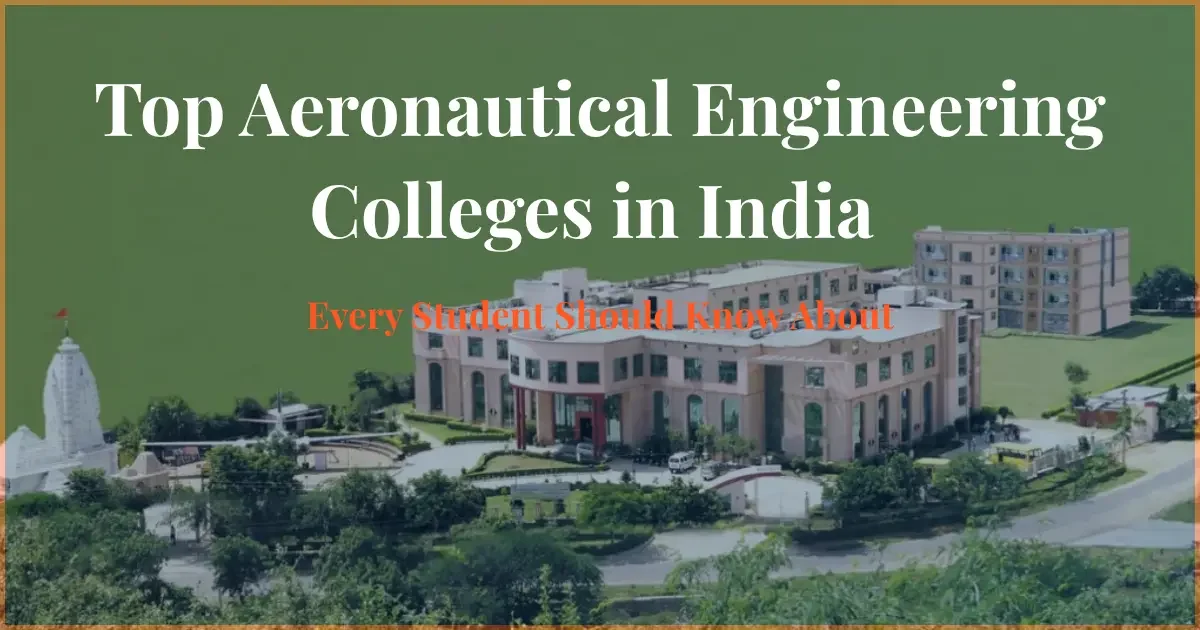
Have you ever stood on the tarmac, looked at a massive commercial jet, and felt a burning desire to understand the physics that keeps it in the air? If your dream is to design, manufacture, and perfect machines that conquer the skies, you are standing at the threshold of one of the most exciting technical careers of our time.
As we progress through 2026, the Indian aviation sector is going through a massive transformation. With domestic airlines ordering thousands of new-generation narrow-body and wide-body aircraft, and the government pushing heavily for indigenous defense production, the demand for highly skilled aeronautical engineers is at an all-time high.
However, your success in this high-responsibility industry is entirely dependent on the quality of your education. Choosing from the top aeronautical engineering colleges in india is your very first step toward a prestigious and high-paying career.
Read Before: Top 10 DGCA Approved AME Colleges in India – 2026 Ultimate Guide
What is Aeronautical Engineering? (Understanding the Core)
Before you select a college, it is essential to understand what you will actually be studying. Aeronautical engineering is a specialized branch of engineering that deals with the design, development, construction, testing, and science of flight-capable machines operating within the Earth’s atmosphere.
While many use the terms “aeronautical” and “aerospace” interchangeably, aeronautical engineering focuses specifically on vehicles that operate in dense air (like commercial planes, helicopters, military fighter jets, and tactical drones). If a vehicle is designed to go beyond our atmosphere into the vacuum of space, it enters the realm of aerospace or astronautical engineering.
Because aeronautical systems are highly complex and safety-critical, the training required is incredibly rigorous. It demands a perfect blend of theoretical physics, advanced mathematics, and deep hands-on mechanical training.
How to Evaluate the Top Aeronautical Engineering Colleges in India?
When searching for the top aeronautical engineering colleges in india, you shouldn’t just rely on flashy brochures. You need to look at specific parameters that directly impact your career. Use this evaluation checklist:
1. Affiliations and Approvals
For a B.Tech program, the college must be approved by the All India Council for Technical Education (AICTE). Furthermore, the affiliation with a recognized technical university is crucial. For instance, the B.Tech programs at premier institutes like the School of Aeronautics (SOACET) are affiliated with Bikaner Technical University (BTU), ensuring global recognition of your degree.
2. Live Hangar and Practical Facilities
You cannot learn flight mechanics solely from blackboards. The presence of a “Live” aircraft hangar—where students can work on operational systems, test control surfaces, and perform engine ground runs—is what separates mediocre institutes from top-tier colleges.
3. Faculty Experience
Aviation is a field of precision. The best colleges hire instructors who aren’t just career academics but are veteran engineers from the Indian Air Force (IAF), Hindustan Aeronautics Limited (HAL), or major commercial airlines.
4. Placement Records and MRO Tie-ups
Note: Book a FREE counselling session through SOACET to understand the AME admission process clearly.
A college’s direct relationship with the aviation industry is critical. Look for institutes that facilitate internships at leading Maintenance, Repair, and Overhaul (MRO) facilities, giving you a head start on your resume.
Detailed Profiles of the Top Aeronautical Engineering Colleges in India
Based on academic excellence, infrastructure quality, practical learning facilities, and placement feedback, here are the top institutions every student should know about.
1. School of Aeronautics (SOACET), Neemrana & Delhi
Topping our list of the top aeronautical engineering colleges in india is the School of Aeronautics (SOACET). Established in 1992, SOACET has redefined how aviation education is delivered in the country.
- The Neemrana Advantage: The Neemrana campus features a dedicated hangar housing actual, operational aircraft, including a heavy-weight Fokker F-27 and a Beechcraft. Students get hands-on experience troubleshooting functional hydraulic, pneumatic, and electrical systems on real planes.
- Integrated Learning: SOACET offers unique integrated programs where you can work toward your B.Tech in Aeronautical Engineering (affiliated with BTU) while simultaneously undergoing Aircraft Maintenance Engineering (AME) license training.
- Industry Alignment: With 30+ high-tech labs (including Aerodynamics, Propulsion, Avionics, and NDT labs), the institute ensures its graduates are “job-ready” from day one.
2. Indian Institute of Technology (IIT), Bombay & Madras
The aerospace departments of the premier IITs are world-renowned for their research-oriented approach.
- IIT Madras: MIT and IIT Madras boast some of the finest research labs in Computational Fluid Dynamics (CFD) and structural testing. It is a dream destination for students who want to focus heavily on theoretical design, aerodynamics research, and higher studies abroad.
- IIT Bombay: Known for its state-of-the-art propulsion research labs, IIT Bombay provides exceptional exposure to students looking to work with defense research organizations or global giants like Boeing and Airbus.
3. Indian Institute of Space Science and Technology (IIST), Thiruvananthapuram
Established by the Department of Space, Government of India, IIST is directly linked to the Indian Space Research Organisation (ISRO).
- The Specialty: While IIST focuses heavily on space-bound systems, its aeronautical and aerospace programs are highly prestigious. Students who maintain exceptional academic performance are directly absorbed into ISRO centers as scientists or engineers.
4. Madras Institute of Technology (MIT), Chennai
One of the oldest and most respected names in Indian aviation education, MIT Chennai has a rich legacy.
- The Legacy: MIT is the alma mater of India’s Missile Man, Dr. A.P.J. Abdul Kalam. The institute has a dedicated department for aeronautical engineering with strong ties to defense labs and HAL manufacturing plants.
5. Indian Institute of Engineering Science and Technology (IIEST), Shibpur
IIEST Shibpur has a historical legacy of engineering education. Its aerospace and aeronautical department offers a robust academic framework, focusing heavily on structural analysis, metallurgy, and traditional fluid dynamics.
6. PEC University of Technology, Chandigarh
PEC is highly respected in North India for its technical programs. The aeronautical engineering department offers excellent laboratory facilities and maintains a strong alumni network that is active across both the defense sector and commercial airlines.
7. Manipal Institute of Technology, Manipal
A premier private university, Manipal offers world-class campus facilities and modern software training tools like CATIA, ANSYS, and MATLAB. It is a fantastic choice for students looking for global campus exposure and structured industrial internships.
8. Dayananda Sagar College of Engineering, Bengaluru
Located in the tech capital of India, Dayananda Sagar benefits heavily from its geographical location. The proximity to major aviation hubs like HAL, NAL, and private aerospace startups in Bengaluru provides students with frequent industrial visits and local placement opportunities.
9. Sathyabama Institute of Science and Technology, Chennai
Sathyabama offers highly modernized course streams with a strong focus on satellite integration and drone technology. Their propulsion and composite material labs are well-regarded in South India.
10. Acharya Institute of Technology, Bengaluru
Acharya is another prominent Bengaluru-based college that offers extensive practical training in aeronautics. Their collaboration with local aviation firms ensures that students get excellent opportunities for project work and technical internships.
Eligibility Criteria for B.Tech in Aeronautical Engineering
To secure a seat in one of the top aeronautical engineering colleges in india, you must meet specific academic and medical benchmarks.
- Academic Qualification: You must have passed your 10+2 (Higher Secondary) or equivalent exam from a recognized board.
- Subject Requirements: Physics, Chemistry, and Mathematics (PCM) are compulsory subjects at the 10+2 level.
- Minimum Marks: Most premier institutes require a minimum of 50% aggregate in PCM, though IITs and NITs require a qualifying standard JEE thresholds.
- Entrance Exams: Selection is primarily based on national-level exams like JEE Main / Advanced or institute-specific exams like the SOACET Entrance Test.
Detailed Fee Structure Breakdown (2026 Projections)
Understanding the financial commitment is vital for every family. While fee structures vary significantly between government and private colleges, here is a general breakdown:
| Institution Type | Annual Tuition Fee Range | Estimated Hostel & Mess Cost |
| Government Institutes (IITs/IIST) | ₹1,50,000 – ₹2,50,000 | ₹40,000 – ₹60,000 per year |
| Premier Private Colleges (e.g., SOACET) | ₹1,20,000 – ₹2,20,000 | ₹60,000 – ₹90,000 per year |
| Boutique Aviation Academies | ₹2,50,000 – ₹4,50,000 | ₹80,000 – ₹1,20,000 per year |
Note: Many colleges offer merit-cum-means scholarships. For example, the Laxmi Narain Verma Memorial (LMVM) Society at SOACET offers extensive scholarship benefits to students based on entrance exam scores.
Career Scope and Placement Opportunities in 2026
Graduating from one of the top aeronautical engineering colleges in india is your gateway to a highly lucrative, global industry. The year 2026 is presenting unique career avenues:
1. The Drone Revolution (UAVs)
With the Indian government striving to make the country a global drone hub by 2030, aeronautical engineers are in immense demand to design, test, and program agricultural, logistics, and surveillance drones.
2. Maintenance, Repair, and Overhaul (MRO)
India is rapidly developing major MRO hubs in Jewar (Noida) and Navi Mumbai. Previously, airlines sent planes abroad for heavy checks; now, these massive facilities are creating thousands of high-paying jobs on home soil.
3. Sustainable and Green Aviation
The global mandate to reduce carbon footprints has opened up new research areas in Sustainable Aviation Fuel (SAF) engine modifications and electric aircraft systems.
Salary Outlook:
- Freshers (B.Tech Graduate): ₹5.0 LPA – ₹8.5 LPA.
- Mid-Level Professionals (5-8 Years): ₹12 LPA – ₹22 LPA.
- Senior Specialists / Licensed Engineers: ₹25 LPA – ₹50+ LPA.
Why School of Aeronautics (SOACET) is Your Best Flight Path
When comparing the top aeronautical engineering colleges in india, SOACET stands out for its unique blend of academic pedigree and practical grit.
- A Legacy of 30+ Years: Since 1992, we have produced technical leaders who now head departments in global airlines, Indian defense wings, and space research organizations.
- Unmatched Hangar Practice: Learning thermodynamics is one thing; feeling the heat of a live turbine ground run on our Fokker F-27 is another. We ensure our students cross the bridge from theory to reality.
- BTU and AICTE Approvals: Our courses are fully recognized globally, allowing for seamless transition to Master’s programs (MS/M.Tech) in the US, Europe, or Australia.
Frequently Asked Questions (FAQs)
Q1. Is Aeronautical Engineering harder than other engineering branches?
It is highly specialized and requires great mathematical and physics skills. However, for students who love mechanics, fluid dynamics, and flight systems, it is incredibly engaging and far less abstract than fields like pure coding.
Q2. Can I transition into the space sector with an Aeronautical Engineering degree?
Absolutely. The fundamental mechanics of structure, material science, and propulsion systems are highly overlapping with aerospace and astronautical engineering.
Q3. Is there any medical restriction to joining these courses?
While B.Tech programs do not have strict physical restrictions, if you are pursuing the integrated AME (Aircraft Maintenance) licensing track, you must have normal color vision (no color blindness).
Conclusion: Take Your First Step Today
The aviation industry doesn’t just need graduates; it needs passionate, precise, and highly trained specialists. Your journey to conquering the skies starts with the foundation you build during your college years.
By choosing an institution from the list of the top aeronautical engineering colleges in india, you are ensuring that your career takes off with the perfect balance of theoretical brilliance and practical mastery.
Are you ready for takeoff? Your countdown starts now.