
Completing your Class 12 board examinations in the science stream is a monumental milestone. However, it also marks the beginning of a highly critical decision-making phase. If you spent your school years fascinated by complex machinery, solving physical mechanics puzzles, and looking up at the sky, wondering how massive objects conquer gravity, a traditional desk job is not your calling. You belong in the dynamic, high-prestige, and globally portable world of aviation.
The global civil aviation industry in 2026 is moving through an era of unprecedented, historic expansion. With major commercial carriers placing record-breaking aircraft orders and domestic Maintenance, Repair, and Overhaul (MRO) facilities expanding rapidly under localized manufacturing policies, the demand for highly specialized technical experts has never been more pressing. While pilots command the aircraft controls, the immense responsibility of ensuring their safe airworthiness falls upon the shoulders of licensed Aircraft Maintenance Engineers (AME).
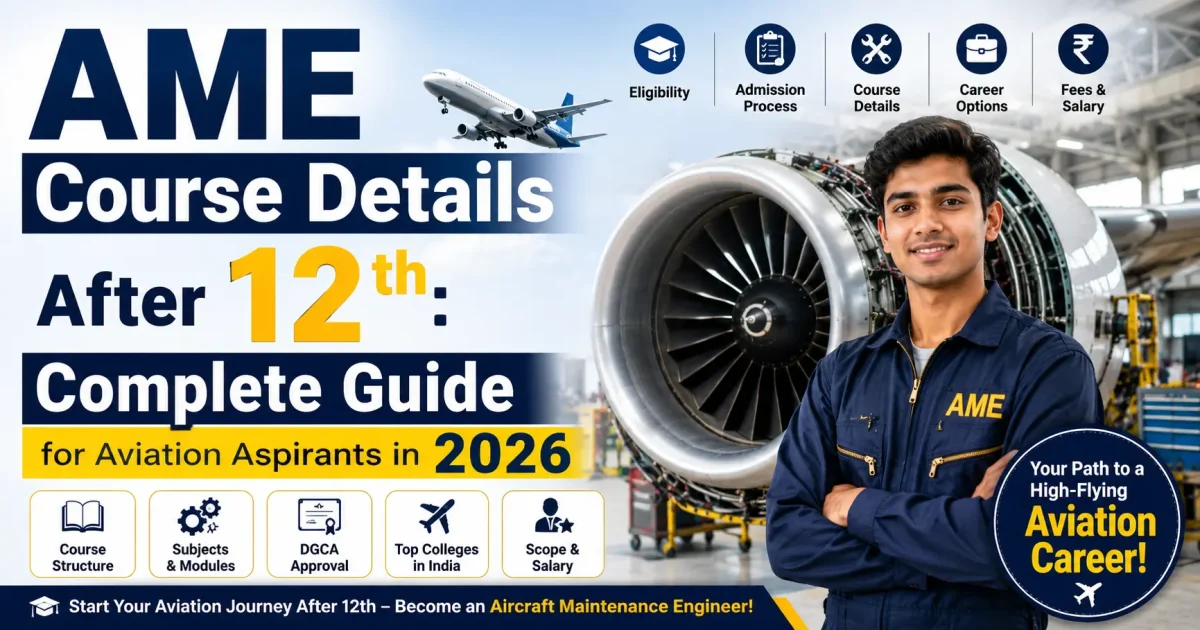
If you are looking to secure a future-proof, high-paying career on the front lines of flight safety, gathering the right AME Course Details After 12th is your most critical immediate step. This comprehensive guide serves as your definitive roadmap, detailing the training phases, academic eligibility criteria, stream specializations, fee structures, and career options available to help you launch your aviation career.
1. What is the AME Course? (Understanding the Core)
Before exploring the individual semester details, it is essential to establish a clear baseline of what the program actually comprises.
Unlike conventional university degrees (such as a B.Sc. or B.Com) which are purely academic, the Aircraft Maintenance Engineering program is a professional, license-oriented technical training course. In India, this program is strictly regulated, audited, and monitored by the Directorate General of Civil Aviation (DGCA), Ministry of Civil Aviation, Government of India.
The entire training is designed to align with the stringent safety standards of CAR 147 (Basic). The primary objective of the program is to equip you with the deep theoretical knowledge and practical mechanical skills required to clear the basic module examinations conducted by the DGCA.
An AME is the ultimate safety authority on the ground. By civil aviation law, no commercial, cargo, or private aircraft is permitted to take off without a signed Certificate of Release to Service (CRS) from a licensed Aircraft Maintenance Engineer. This level of legal accountability is why the training is highly specialized and rigorously structured.
2. Aircraft Maintenance Engineering (AME) Course Details After 12th (The Timeline)
When planning your education, understanding the “time-to-market,” how quickly you can complete your training and start earning, is an important consideration.
To help you visualize your path, let us break down the core Aircraft Maintenance Engineering course details after 12th regarding duration, structure, and specialization streams.
[3-Year AME Course Structure]
┌──────────────────────┴───────┐
▼ ▼
[Academic Training] (1 Year OJT inside MRO)
The Duration and Phased Structure
The complete program is structurally designed as a 3-year course split into two distinct, highly integrated phases:
- Phase 1: Academic & Workshop Training (2 Years): You spend four semesters on campus inside specialized lecture halls, physical science laboratories, and structural workshops. Here, you master the aerodynamics of flight, metallurgy, gas turbine propulsion cycles, and aviation safety legislation.
- Phase 2: On-the-Job Training (OJT) / Internship (1 Year): After completing your on-campus semesters, you transition to an active, DGCA-approved Maintenance, Repair, and Overhaul (MRO) facility or airline hangar. Under the direct supervision of licensed veteran engineers, you gain real-world practical experience working on operational commercial aircraft, logging your maintenance tasks in your official technical logbook.
3. Specialization Streams in AME: Mechanical vs. Avionics
During your admissions counseling, you must declare your preferred stream of training. The aviation maintenance sector is broadly divided into two highly sought-after categories:
Category B1.1 (Mechanical – Aeroplanes Turbine)
This stream is tailored for students who have a deep passion for heavy structural machinery, fluid dynamics, and thermodynamics.
- What You Will Study: The mechanical architecture of modern commercial passenger jets, including heavy turbofan and turboprop jet engines, structural airframe panels, landing gear assemblies, wing flaps, flight control cables, hydraulics, and pneumatic systems.
- The Daily Workspace: Active runways and open hangars. You will perform physical inspections, trace mechanical systems, change structural components, and assist in engine ground runs. This is the primary route for students who love hands-on mechanical troubleshooting.
Category B2 (Avionics)
This stream is ideal for students with a strong interest in electronics, software-heavy systems, and advanced digital technologies.
- What You Will Study: The electronic “brain” of the aircraft, including flight control computers, radar systems, satellite navigation (GPS), autopilot feedback loops, weather tracking sensors, cockpit display screens (glass cockpits), and airborne communication radios.
- The Daily Workspace: Calibrating highly sensitive instruments, diagnosing digital wiring loops, upgrading flight management software, and testing communication channels in clean, controlled workshop environments.
4. Eligibility Criteria for AME Admission After 12th
Aviation is a field of high responsibility, and therefore, the entry requirements for technical training are strict but fair. When planning your application, you must ensure you meet both the academic and medical benchmarks.
Academic Eligibility Benchmarks
To qualify for admission to a premier CAR 147-approved aviation academy, candidates must fulfill one of the following criteria:
- The 10+2 Science Stream: You must have passed your Class 12 board examinations with Physics, Chemistry, and Mathematics (PCM) from a recognized state or central education board.
- Minimum Marks: Most top-tier institutes require a minimum of $50\%$ aggregate marks in PCM subjects combined.
- The Diploma Route: Alternatively, candidates who have completed a 3-year AICTE-approved polytechnic diploma in any engineering branch (such as Mechanical, Electrical, Electronics, or Aeronautical) are highly accepted for direct admission.
Note: Book a FREE counselling session through SOACET to understand the AME admission process clearly.
Physical and Medical Fitness Standards
Aviation safety depends directly on physical precision. Physical fitness is thoroughly verified during admissions:
- Normal Color Vision: This is a non-negotiable rule. Candidates must possess normal color vision. Any form of color blindness is an automatic disqualification, as technical specialists must be able to instantly identify color-coded wiring, digital cockpit warnings, and hydraulic indicators.
- General Fitness: Candidates must possess healthy hearing and general physical agility. A medical fitness certificate signed by a registered MBBS doctor is a mandatory document during the final registration phase.
- Corrected Vision: Wearing glasses is fully acceptable as long as your vision is corrected to the normal standard.
5. Detailed Semester-Wise Syllabus: What You Will Study
The curriculum of a premier AME institute is designed to take you from a curious high school graduate to a highly disciplined technical expert. The three years are divided into six structured semesters.
Semester 1: The Foundations of Flight
- Key Focus: Introduction to the aviation world and the basic science of materials.
- Core Subjects: Mathematics for Engineers, Engineering Drawing, Basic Electricity, and General Workshop Practice. You will spend significant time learning the precise geometric drafting techniques required to read complex aircraft blueprints.
Semester 2: Safety Culture and Material Sciences
- Key Focus: Understanding the physical limits of hardware and the human element in safety.
- Core Subjects: Material Science and Metallurgy (learning about titanium, composites, and aircraft-grade alloys), Physics of Flight, and Human Factors. Human Factors is a unique, critical subject that teaches how fatigue, stress, and communication errors affect engineering safety.
Semester 3: Core Mechanical and Electronic Systems
- Key Focus: Diving deep into the active systems of the aircraft.
- Core Subjects: Basic Aerodynamics (the study of airflow and lift forces), Aviation Legislation (the legal rules of the skies), and Electronic Instrument Systems. You will start working inside physical labs to trace electrical circuits and test basic radio-navigation benches.
Semester 4: Propulsion Cycles and Systems Engineering
- Key Focus: Understanding how aircraft generate thrust and operate control surfaces.
- Core Subjects: Turbine Propulsion (the study of jet engines, compressor stages, and combustion chambers), Aircraft Airframe Systems (hydraulics, pneumatics, and fuel delivery), and Digital Techniques.
Semester 5: Advanced Maintenance and System Integration
- Key Focus: Advanced diagnostics, troubleshooting, and preparing for active hangar work.
- Core Subjects: Advanced Avionics or Mechanical Systems (depending on your chosen stream), Maintenance Practices (such as lock-wiring, torque application, and Non-Destructive Testing), and System Overhauling.
Semester 6: On-the-Job Training (OJT)
- Key Focus: Real-world industrial exposure.
- Core Activity: You spend this final semester working inside an active, approved airline hangar or MRO facility, logging your practical hours on real commercial aircraft under the supervision of licensed certifying engineers.
6. The Licensing Journey: How to Secure Your AME License
Completing your classroom semesters and receiving your course completion certificate is the first major milestone. However, to sign off on an aircraft, you must secure your official license. This is a step-by-step process of accumulation:
[Enroll in AME Course] ➔ [Clear DGCA Module Exams] ➔ [Complete OJT inside MRO] ➔ [Receive BAMEL License] ➔ [Undergo Type-Rating]
Step 1: Clear the DGCA Module Exams
Throughout your 3-year course, you will appear for centralized technical module examinations conducted directly by the DGCA. There are 11 to 13 modules depending on your stream (Mechanical B1.1 vs. Avionics B2). The passing mark is $75\%$, reflecting the high safety standards of the industry.
Step 2: Accumulate Active Practical Experience
You must complete your mandatory practical experience hours inside an approved Maintenance Training Organization (MTO) or airline hangar, recording every task in your official technical logbook.
Step 3: Receive Your BAMEL License
Once the DGCA verifies your academic credentials, module exam results, and logged practical hours, they issue your Basic Aircraft Maintenance Engineer License (BAMEL). You are now officially a junior certifying engineer!
Step 4: Undergo Type-Rating
The true pinnacle of this profession is “Type-Rating.” This involves specialized, fleet-specific technical training on a specific heavy aircraft model, such as the Boeing 787 or Airbus A320. Once you are “Type-Rated” on a specific plane, your signature becomes exceptionally valuable, and your salary potential reaches the top tier.
7. AME Course Fee Structure and Scholarship Options in 2026
Understanding the financial commitment is vital for every family. While specialized technical education requires a higher investment than general academic streams due to the massive cost of keeping real, operational aircraft on campus, the return on investment (ROI) is exceptionally fast.
General Fee Breakdown
- Tuition & Practical Fees: The average fees for a DGCA-approved CAR 147 program range from Rs. 1,20,000 to Rs. 2,20,000 per year (Totaling Rs. 3.6 Lakhs to Rs. 6.6 Lakhs for the 3-year academic phase). This fee covers the utilization of high-end labs, on-campus aircraft, and necessary workshop consumables.
- Hostel & Mess Charges: For residential students, separate hostel and mess facilities typically range between Rs. 60,000 to Rs. 1,00,000 per year, depending on room preferences and dining plans.
Financial Aid & Scholarship Schemes
At premier institutes like the School of Aeronautics, talent is never grounded due to financial constraints:
- Merit-Based Scholarships: Up to a 25% tuition fee waiver is offered to students who perform exceptionally well in their Class 12 board examinations or secure a top rank in national-level aviation entrance tests.
- Diverse Category Concessions: Additional concessions are offered to female candidates and students belonging to reserved categories (SC/ST) to encourage gender and socioeconomic diversity in the aerospace sector.
- Educational Loan Assistance: Because our courses hold all mandatory central approvals, all major nationalized and private banks provide comprehensive educational loans covering tuition, practical training, and hostel charges.
8. Career Scope & Global Job Opportunities in 2026
Choosing this specialized technical path is ultimately about securing a successful professional future. Graduates of an approved AME course enter an incredibly favorable, high-demand job market.
Major Recruitment Sectors
- Commercial Airlines: Join the engineering teams of rapidly expanding carriers like IndiGo, Air India, Akasa Air, and SpiceJet, managing line maintenance and flight dispatch.
- Maintenance, Repair, and Overhaul (MRO) Hubs: Work inside massive heavy-maintenance hubs like AIESL, GMR Aero Technic, and Indamer, where entire aircraft are dismantled, inspected, and rebuilt.
- Aviation Logistics & Cargo Operators: Manage the technical fleets of global cargo giants like Blue Dart, DHL, and FedEx.
- Aerospace Manufacturing & Defense: Work with defense contractors like Hindustan Aeronautics Limited (HAL) or private aerospace manufacturers like Tata Advanced Systems.
- Private Charter & General Aviation: Maintain business jets, helicopter services, and VIP transport fleets.
9. Salary Progression: What is an AME Specialist Worth?
Aviation is one of the highest-paying technical sectors globally. Because the training is highly specialized and strictly regulated, the competition is lower, and the earning potential experiences rapid, exponential growth as you gain licenses.
Let us map out the career progression and earning potential of an AME technical professional:
| Career Level | Experience Range | Average Monthly Salary (INR) | Primary Scope of Responsibilities |
| Aircraft Technician / Trainee | $0 – 2$ Years | ₹35,000 – ₹55,000 | Assisting senior certifying engineers with physical checks, system diagnostics, and routine logbook entries. |
| Licensed AME (Basic) | $3 – 5$ Years | ₹90,000 – ₹1,50,000 | Conducting structural checks, system troubleshooting, and signing routine airworthiness certificates. |
| Type-Rated Senior Engineer | $5 – 10$ Years | ₹2,50,000 – ₹4,50,000 | Legally signing off on major commercial flights (e.g., Boeing 787), managing heavy hangar maintenance shifts. |
| Chief Engineer / Technical Lead | $15+$ Years | ₹6,00,000+ | Leading entire airline engineering departments, managing compliance audits with regulatory bodies like the DGCA. |
Note on Global Portability: Indian-licensed engineers are highly valued in major international aviation hubs like Dubai, Doha, and Singapore, where senior certified engineers often command tax-free salaries exceeding Rs. 5 Lakhs to Rs. 8 Lakhs per month along with complete residential and family benefits.
10. Why Study at the School of Aeronautics (SOACET), Neemrana?
When it comes to specialized aviation training, where you study is the single most critical factor that dictates your career speed. The School of Aeronautics (SOACET), established in 1992, has built a legendary reputation as a pioneer in aviation education in India.
The Live Hangar Advantage
We do not believe in teaching flight safety or turbine diagnostics solely from textbook diagrams or desktop screens. Our Neemrana campus features an active hangar housing actual, heavyweight operational aircraft, including a Fokker F-27 twin-engine turboprop airliner and a Beechcraft. Our students get to touch real turbine blades, trace active hydraulic lines, and operate working flight control surfaces.
AICTE and DGCA Approvals
Our programs are fully recognized. Our B.Tech program is approved by the AICTE and affiliated with Bikaner Technical University (BTU), ensuring your degree is recognized globally for public sector placements, defense commissions, and higher studies abroad. At the same time, our AME wing is approved by the DGCA under CAR 147, providing a direct, legitimate pathway to your license.
Integrated Dual-Track Programs
For students seeking the ultimate balance of academic security and practical certifying power, SOACET is unique in offering integrated programs. You can pursue your DGCA-approved CAR 147 basic AME training while simultaneously working toward an AICTE-approved B.Tech in Aeronautical Engineering. This dual-track gives you a formal university engineering degree and a professional licensing pathway concurrently, doubling your global employment avenues.
Frequently Asked Questions (FAQs)
Q1. What is the difference between Aeronautical Engineering and AME?
Aeronautical Engineering is an academic, 4-year design-focused B.Tech degree (desk-based), whereas AME is a highly practical, 3-year license-oriented program (hangar-based) focused on active maintenance and safety certification. SOACET offers unique integrated programs combining both concurrently.
Q2. Is JEE Main mandatory for AME admission at the School of Aeronautics?
No, JEE Main is not mandatory. While candidates with JEE Main scores are welcome to apply, the primary admission and counseling path is conducted based on the merit ranks of the official SOACET entrance exam 2026.
Q3. Can a candidate apply for admission if their 12th results are awaited?
Yes, absolutely. Candidates currently appearing in their Class 12 board examinations can register online and sit for the SOACET entrance test. Admission is confirmed provisionally, subject to presenting passing mark sheets during the final document verification rounds in July.
Q4. Can girls pursue a career in Aircraft Maintenance Engineering?
Absolutely! The aviation industry is highly inclusive and actively encourages gender diversity. We have many successful female alumni currently working as licensed certifying engineers and technical managers at leading airlines like Air India, IndiGo, and Emirates.
Conclusion: Lead the Future of Flight
Choosing your path in the aviation sector is more than just choosing a college; it is a life-changing step toward a highly prestigious, global career. As the aviation infrastructure in India doubles its capacity, the industry needs young, dedicated, and highly disciplined minds to keep the skies safe.
By starting your journey with an institution of over three decades of educational legacy like the School of Aeronautics (SOACET), you build your career on a foundation of quality training, legal clearances, premium live aircraft hangar facilities, and a global alumni network.
Don’t let limited DGCA batch capacities and competitive counseling cutoffs pass you by. Complete your online registration today, lock in your counseling choices, and prepare to lead the future of flight.
Your countdown to kickoff starts now. We look forward to welcoming you to our Neemrana campus.