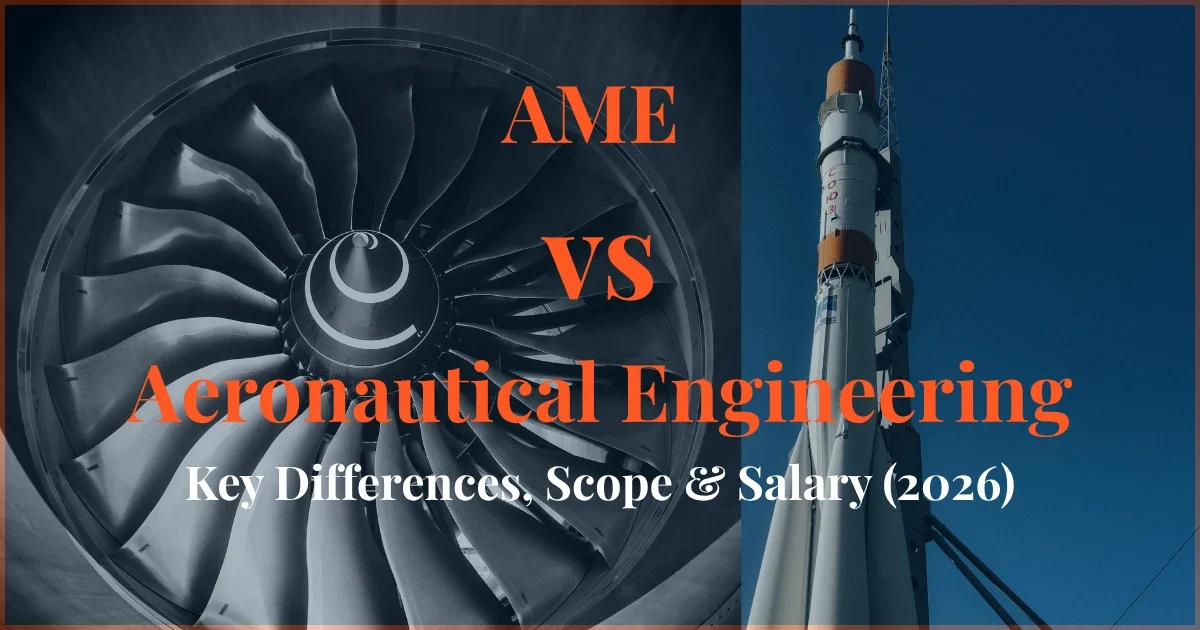
The global aerospace and aviation sector is undergoing an unprecedented boom. With major commercial carriers placing record-breaking aircraft orders and regional airports sprouting up across the country under connectivity schemes, the aviation industry has become one of the most lucrative fields for science students. However, as high school graduates with a background in Physics, Chemistry, and Mathematics (PCM) begin researching their options, they almost always encounter a major point of confusion: AME vs Aeronautical Engineering.
To a beginner, these two terms sound practically identical. Both deal with complex flying machines, require a deep understanding of physics, and offer highly respected professional paths. Yet, their academic structures, day-to-day operations, licensing requirements, and long-term career outcomes are vastly different. Choosing the wrong path could mean the difference between sitting at a high-end workstation designing next-generation wings or working in an active hangar certifying a live passenger jet for takeoff.
Read Before: Aeronautical Engineering vs Aerospace Engineering: What’s the Real Difference? (2026)
1. Defining the Core Fields
To establish a clear baseline of comparison, we must define what each program actually trains you to do. The fundamental difference lies in the lifecycle of the aircraft: one is focused on the birth and design of the machine, while the other is responsible for its safety and longevity.
What is Aeronautical Engineering? (The Creator’s Path)
Aeronautical Engineering is an academic, degree-based discipline that focuses on the design, development, construction, aerodynamics, and structural testing of flight vehicles operating within the Earth’s atmosphere.
- The Core Objective: To innovate and design aircraft, missiles, drones, and helicopters that are lighter, faster, safer, and more fuel-efficient.
- The Qualification: A formal 4-year B.Tech or B.E. degree approved by the All India Council for Technical Education (AICTE) and affiliated with recognized state universities.
- The Nature of Work: Theoretical, analytical, and design-oriented. You will spend your time running mathematical simulations, designing airfoils using CAD/CAM software, testing structural models in wind tunnels, and researching composite materials.
What is Aircraft Maintenance Engineering (AME)? (The Guardian’s Path)
Aircraft Maintenance Engineering (AME) is a highly specialized, license-based vocational training program that focuses on the regular inspection, troubleshooting, repair, overhaul, and safety certification of active aircraft.
- The Core Objective: To ensure that an aircraft is 100% safe and legally “airworthy” before every single takeoff.
- The Qualification: An AME License issued by the regulatory authority, the Directorate General of Civil Aviation (DGCA), Government of India, under CAR 147 (Basic) guidelines.
- The Nature of Work: Practical, hands-on, and heavily safety-critical. You will work on operational aircraft, using precision tools to diagnose engine issues, calibrate avionics systems, inspect structural integrity, and sign off on the critical Certificate of Release to Service (CRS). Without an AME’s signature, no pilot is legally allowed to turn on the engines.
2. AME vs Aeronautical Engineering: Key Comparison Matrix
When analyzing ame vs aeronautical engineering, it is highly helpful to look at a structured head-to-head comparison. This matrix maps out the primary differences that dictate your university years and early career:
| Feature | Aircraft Maintenance Engineering (AME) | Aeronautical Engineering |
| Credential Type | Professional License (CAR 66) | Academic Degree (B.Tech / B.E.) |
| Course Duration | 2 to 3 Years (including practical training) | 4 Years (8 Semesters) |
| Regulatory Body | Directorate General of Civil Aviation (DGCA) | AICTE / University Grants Commission (UGC) |
| Core Philosophy | Practical application, diagnostics, and safety. | Theoretical physics, design, and innovation. |
| Mandatory Exams | DGCA Module Exams (e.g., Mod 11, 12, 13, 15) | Semester-wise university academic exams. |
| Day-to-Day Workspace | Active airport tarmacs, hangars, and MRO hubs. | R&D labs, design offices, and simulation centers. |
| Legal Power | High. Holds the legal authority to ground flights. | None over operational flight dispatch. |
| Stream Divisions | Mechanical (B1.1) or Avionics (B2). | Structures, Propulsion, Aerodynamics, Avionics. |
3. The Academic Blueprint: What You Will Study
The intellectual focus of these two pathways is shaped by their target workspaces. Let us look at the key difference in the syllabus and subjects.
The Aeronautical Engineering Syllabus: Mastering the Math of Flight
An Aeronautical Engineering student dives deep into the classical physical sciences to understand how and why things fly. The curriculum relies heavily on advanced mathematical modeling.
To design an aerodynamic wing profile, students must master the physics of fluid flow. For instance, computing the lift force () generated by a wing requires analyzing the Lift Equation:
Where:
- represents the density of the air.
- represents the flight velocity relative to the air.
- represents the total planform wing surface area.
- represents the dimensionless coefficient of lift.
Core subjects include:
- Computational Fluid Dynamics (CFD): Using supercomputers to simulate airflow around airfoils.
- Aerospace Propulsion: Designing jet engine compressors, combustion chambers, and rocket nozzles.
- Aircraft Structures: Calculating structural stress, shear flows, and fatigue limits of advanced materials.
- Avionics & Control Systems: Developing autopilot algorithms and navigation computers.
The AME Syllabus: Mastering the Mechanics of Maintenance
The AME curriculum is heavily focused on hands-on diagnostics and the practical application of maintenance manuals. While you will study aerodynamics and thermodynamics, the focus is on identifying and fixing wear and tear rather than developing new designs.
Engineers must understand material limits to safely certify components. For example, during structural inspection, the safety factor () of a repair is calculated using the mechanical stress limits:
Where:
- is the maximum stress the material can handle before breaking.
- is the maximum stress expected during high-G flight maneuvers.
Core subjects include:
- Aircraft Maintenance Practices: Learning precision riveting, safety-wiring, torque applications, and non-destructive testing (NDT).
- Aviation Legislation: Mastering the strict regulatory frameworks set by the DGCA and international bodies like the EASA and ICAO.
- Human Factors: Studying how fatigue, stress, and communication errors affect safety in high-pressure environments.
- System Troubleshooting: Actively diagnosing hydraulic, landing gear, fuel delivery, and autopilot systems.
4. Career Scope and Job Roles in 2026
The commercial aviation boom has opened up massive employment pathways for graduates of both disciplines, but they lead to entirely different daily routines.
Your Career in Aeronautical Engineering
As an Aeronautical Engineer, you will primarily find employment with manufacturing giants, space agencies, and defense research organizations. Common roles include:
- Aircraft Design Engineer: Conceptualizing and drawing airframes using CATIA or SolidWorks.
- Structural Analyst: Simulating high-pressure conditions to ensure fuselage frames do not experience structural fatigue.
- Aerodynamicist: Testing wing profiles in wind tunnels and refining aerodynamic coefficients.
- Flight Test Engineer: Analyzing real-time telemetry data collected during experimental test flights of prototype aircraft.
Top Recruiters: Hindustan Aeronautics Limited (HAL), Defence Research and Development Organisation (DRDO), ISRO, Boeing India, Airbus, and Tata Advanced Systems.
Your Career in Aircraft Maintenance Engineering (AME)
As a licensed AME, you will operate on the front lines of airline operations. Your skills are highly valued because airlines lose millions of dollars for every hour a plane is grounded due to a technical snag. Common roles include:
- Licensed Certifying Engineer: Conducting pre-flight, daily, and weekly maintenance checks, troubleshooting snags, and signing off on the release certificate.
- MRO Specialist: Performing heavy maintenance checks (C-Checks and D-Checks) where the aircraft is dismantled, inspected, repaired, and reassembled.
- Quality Assurance Manager: Ensuring that the airline’s maintenance department strictly adheres to civil aviation regulations.
- Technical Officer: Managing the logbooks, flight data recorders, and engine health tracking databases for the airline.
Top Recruiters: Commercial airlines (IndiGo, Air India, Akasa Air, SpiceJet), international carriers (Emirates, Qatar Airways, Etihad), and domestic Maintenance, Repair, and Overhaul (MRO) giants like AIESL, Indamer, and GMR Aero Technic.
5. Salary Trajectory Comparison (AME vs Aeronautical Engineering)
When deciding between ame vs aeronautical engineering, the financial return on your educational investment is a major consideration. The progression paths differ significantly:
Entry-Level Phase (Years 1–2)
- Aeronautical Engineering: Usually commands a higher starting salary as a Graduate Engineer Trainee (GET), ranging from ₹4.5 Lakhs to ₹7.5 Lakhs per annum.
- AME (Trainee Technician): Starts with a relatively modest stipend or salary, ranging from ₹2.5 Lakhs to ₹4.5 Lakhs per annum. During this phase, you are gainfully accumulating the practical experience required to obtain your basic license.
Mid-Career Phase (Years 3–7)
- Aeronautical Engineering: Progresses steadily based on corporate appraisals and engineering promotions, reaching ₹10 Lakhs to ₹16 Lakhs per annum.
- AME (Licensed Engineer): Once you clear your DGCA modules and obtain your basic AME license (BAMEL), your salary experiences an exponential jump. Licensed AMEs can easily earn ₹12 Lakhs to ₹20 Lakhs per annum.
Senior Specialist Phase (Years 10+)
- Aeronautical Engineering: Senior design leads or project managers at major aerospace MNCs, can expect ₹25 Lakhs to ₹45 Lakhs per annum.
- AME (Type-Rated Certifying Engineer): The financial peak of this profession is highly lucrative. If you undergo specialized type-rating training for heavily utilized wide-body or narrow-body commercial jets (like the Boeing 787 or Airbus A320neo), your signature becomes incredibly valuable. Type-rated senior certifying engineers in India earn ₹24 Lakhs to ₹50+ Lakhs per annum, while overseas roles in hubs like Dubai or Singapore offer massive, tax-free salaries exceeding ₹1 Crore per annum.
6. How to Choose: Diagnostic Questions for Students
Still feeling torn? Ask yourself these four simple questions to identify your natural technical path:
- Do you prefer abstract design or physical machines? If you love sitting at a computer using 3D modeling tools to design things that don’t exist yet, choose Aeronautical Engineering. If you love physical mechanisms, holding precision tools, and troubleshooting active machines, choose AME.
- Are you ready for DGCA module exams? AME is a highly regulated, license-based career where you must pass tough DGCA modules (passing score is 75%). If you prefer standard university semester grading, Aeronautical Engineering is the standard academic choice.
- What is your tolerance for safety responsibility? As a licensed AME, you carry the legal and psychological responsibility of thousands of passengers’ lives if you sign off on a faulty plane, you are legally accountable. If you prefer to work in a controlled, research-oriented laboratory environment, Aeronautical Engineering is more suitable.
- Do you want direct job readiness or further studies? AME is a focused vocational training program designed to get you on the hangar floor within 3 years. Aeronautical Engineering provides a broader academic degree that opens doors to master’s programs (M.Tech/MS) and diverse technical corporate careers.
7. The Ultimate 2026 Power Move: Integrated B.Tech + AME
In 2026, students no longer have to choose between a university degree and a technical license. Premier aviation institutions, including the School of Aeronautics (SOACET), offer highly optimized Integrated Dual-Track Programs.
Why Choose an Integrated Program?
- A Strong Safety Net: You work toward an AICTE-approved B.Tech in Aeronautical Engineering from a recognized university like Bikaner Technical University (BTU) while simultaneously undergoing DGCA-approved CAR 147 basic AME training.
- Dual Professional Edge: If you face medical restrictions later in life that prevent you from holding a field license, you still hold a robust, globally recognized engineering degree to work in design, manufacturing, or management.
- Maximum Employability: Recruiters in global aerospace hubs actively seek out candidates with this “dual-profile”—professionals who have the analytical, mathematical mind of a design engineer combined with the practical, certifying authority of a licensed maintenance specialist.
Why Study at the School of Aeronautics (SOACET)?
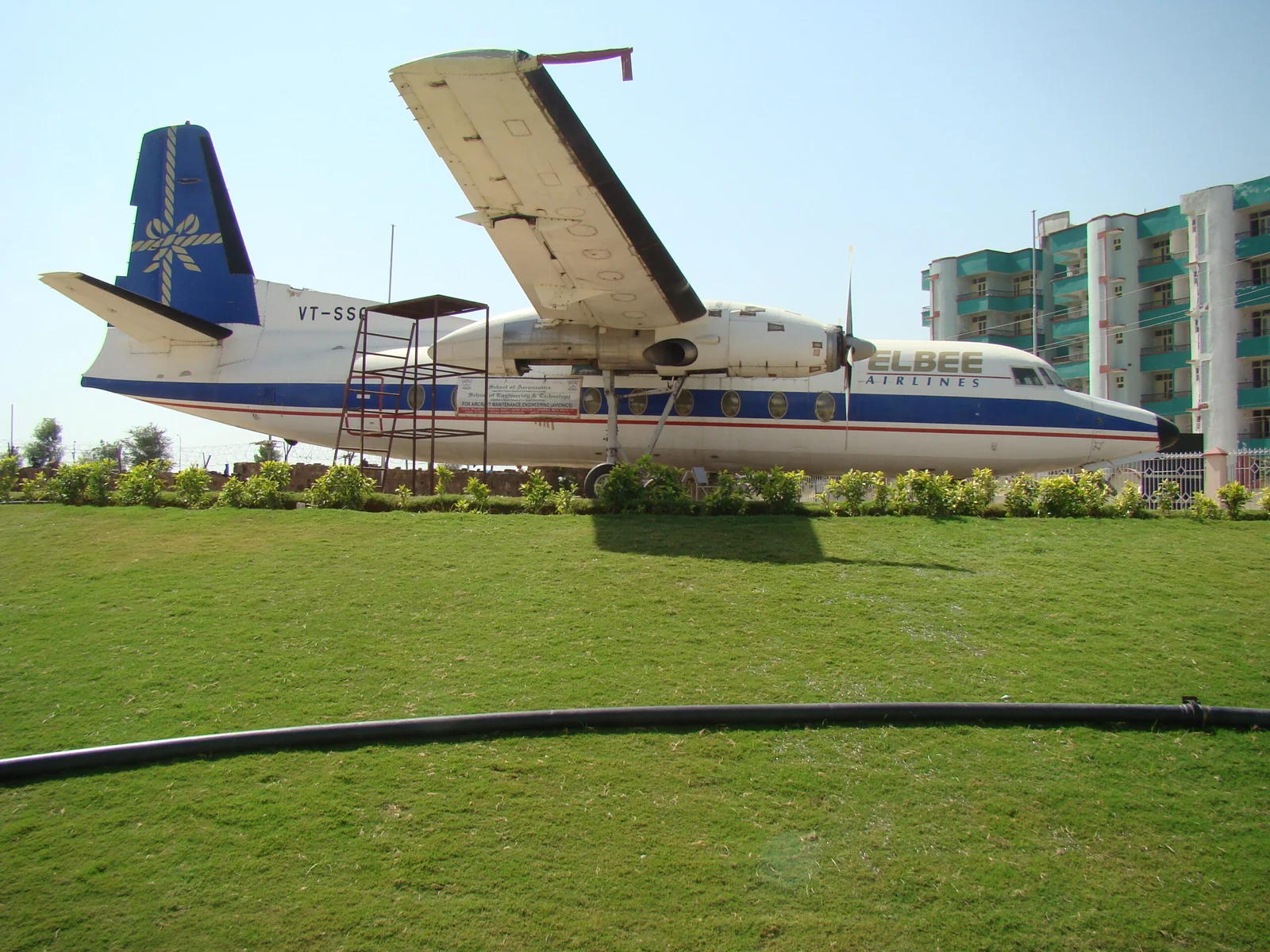
Since 1992, the School of Aeronautics (SOACET) has served as India’s premier launchpad for aviation leaders. Whether you choose AME or Aeronautical Engineering, SOACET provides an educational platform that balances academic depth with unparalleled physical grit.
1. The Neemrana “Live Hangar” Advantage
You cannot learn flight safety or structural mechanics solely from blackboards. Our Neemrana campus features a fully active hangar housing real, heavyweight aircraft, including a Fokker F-27 and a Beechcraft. Our students trace working hydraulic lines, test structural wings, inspect turbofan turbine blades, and conduct live engine runs.
2. Strategic University & Civil Approvals
Our B.Tech courses are fully approved by the AICTE and affiliated with Bikaner Technical University (BTU), ensuring your academic degree is valid globally. At the same time, our AME wing is approved by the DGCA under CAR 147, providing a direct, legitimate pathway to your license.
3. Dedicated Exam Support Cell
Clearing competitive university exams and rigorous DGCA module papers requires expert mentorship. SOACET maintains a dedicated Exam Support Cell providing specialized coaching, module mock tests, and a vast international technical library, resulting in one of the highest clearance rates in the country.
Frequently Asked Questions (FAQs)
Q1. Is Aircraft Maintenance Engineering (AME) equivalent to a B.Tech degree?
No. Standard AME is a professional, license-based vocational course approved by the DGCA, whereas B.Tech in Aeronautical Engineering is a 4-year academic degree. However, you can pursue both concurrently via SOACET’s integrated programs.
Q2. Can an AME work in aerospace design or manufacturing?
While an AME holds deep practical knowledge of aircraft systems, manufacturing firms like Boeing or HAL usually require a formal B.Tech in Aeronautical or Mechanical Engineering for core design and structural analysis roles.
Q3. Can women build a successful career in these fields?
Absolutely! The aviation sector is progressive and actively promotes gender diversity. Many of SOACET’s successful female alumni are currently working as licensed certifying engineers and design analysts globally.
Q4. Are education loans available for both courses?
Yes. Because SOACET is a well-recognized, DGCA-approved, and BTU-affiliated institution, all major public and private banks offer structured educational loans to cover the costs of tuition, practical labs, and residential charges.
When evaluating AME vs Aeronautical Engineering, the debate isn’t about which course is superior; it is about finding the path that matches your natural talents and career expectations.
One path puts you at the innovation drafting board, shaping the aerodynamic forms of future flight. The other puts you on the hangar floor of daily operations, ensuring that the machines
keeping humanity connected remain absolutely safe and airworthy. Both pathways lead to highly respected, intellectually challenging, and financially rewarding aviation careers.
By choosing an institution like the School of Aeronautics (SOACET), which perfectly balances academic depth with unparalleled live hangar experience, you ensure that your career launches with maximum thrust.
The runway is clear, and the skies are waiting. Are you ready for takeoff?