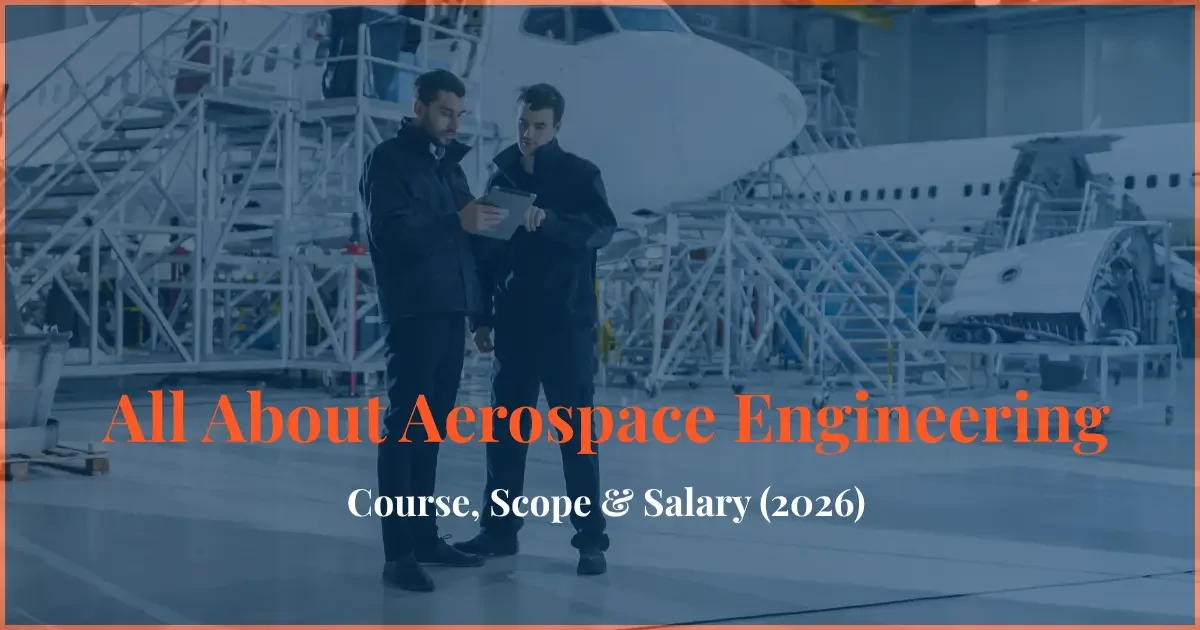
The dream of reaching the stars has always been the ultimate human ambition. While we once looked at the moon with wonder, we are now building the machines that will take us to Mars and beyond. This is the world of aerospace engineering, a field where science fiction meets reality.
If you are a student fascinated by rockets, satellites, and supersonic jets, you have likely asked yourself: Is this the right path for me? This guide covers all about aerospace engineering, from the subjects you’ll study and the skills you’ll need to the impressive salaries you can expect in 2026.
Read Before: The Role of SOACET in Shaping India’s Aviation Engineers
What is Aerospace Engineering?
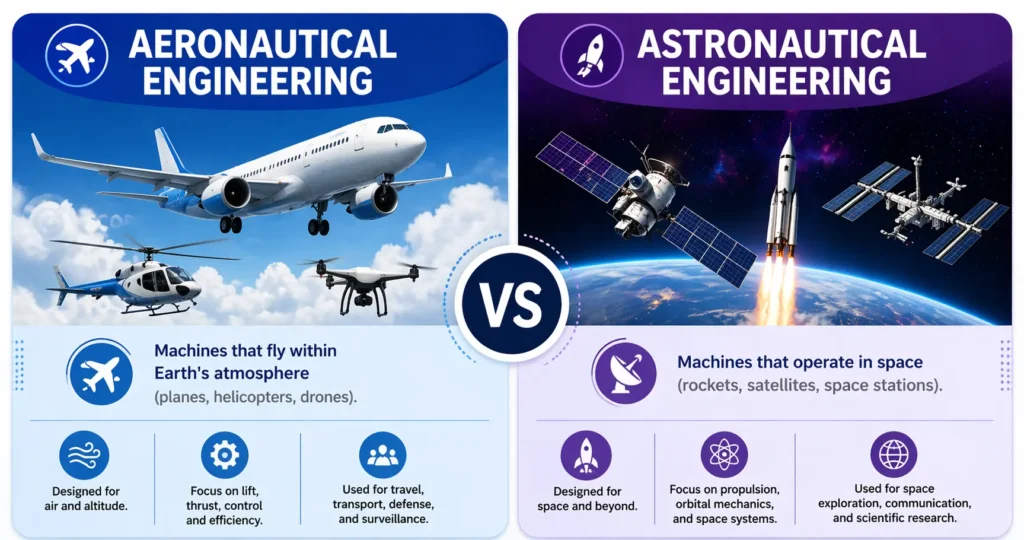
Aerospace engineering is the elite branch of engineering focused on the design, development, testing, and production of aircraft and spacecraft. It is essentially the parent field that contains two major sub-disciplines:
- Aeronautical Engineering: Machines that fly within Earth’s atmosphere (planes, helicopters, drones).
- Astronautical Engineering: Machines that operate in space (rockets, satellites, space stations).
In 2026, this field has evolved beyond traditional flight. Today’s aerospace engineers at SOACET are trained to work on AI-driven navigation systems, reusable launch vehicles (such as those from SpaceX or ISRO), and eco-friendly electric propulsion systems.
Eligibility and Course Details (2026)
To start your journey, you need a solid foundation in STEM (Science, Technology, Engineering, and Mathematics).
1. Educational Requirements
- For Undergraduates (B.Tech): You must complete your 10+2 with Physics, Chemistry, and Mathematics (PCM). Most colleges require a minimum of 60% aggregate.
- For Diploma Holders: Students can pursue a 3-year Diploma after Class 10. Many then choose “Lateral Entry” to join the 2nd year of a B.Tech program.
Note: Book a FREE counselling session through SOACET to understand the AME admission process clearly.
2. Entrance Exams
To get into top-tier institutions, you will typically need to clear:
- JEE Main & Advanced: For IITs and NITs.
- SOACET Entrance Test: For direct admission into one of India’s premier aviation colleges.
The Aerospace Engineering Syllabus: What’s Inside?
The 4-year B.Tech program is rigorous and multi-disciplinary.
- Aerodynamics: Studying how air interacts with solid objects.
- Propulsion: The science of jet engines and rocket motors.
- Flight Mechanics: Analysing the stability and control of vehicles in flight.
- Orbital Mechanics: Calculating trajectories for satellites and interplanetary missions.
- Materials Science: Developing super-alloys that can withstand the heat of re-entry.
- Avionics & Control: The electronic systems used for navigation and communication.
Scope of Aerospace Engineering in 2026
The “scope” of a field is defined by its demand. In 2026, the aerospace sector is experiencing a “Golden Age” for three main reasons:
1. The Private Space Race
With companies like SpaceX, Blue Origin, and Indian startups like Skyroot and Agnikul, space is no longer just for government agencies. Private investment is creating thousands of new jobs for mission specialists and satellite engineers.
2. Defence Modernisation
National security depends on advanced aerospace technology. From stealth fighter jets to hypersonic missiles and surveillance drones, the defence sector is a massive employer for aerospace talent.
3. Sustainable Aviation
Global airlines are racing to reach “Net Zero” by 2050. This requires a complete redesign of aircraft engines to run on hydrogen or electricity, creating a huge demand for “Green Aerospace Engineers.”
Career Paths & Job Roles
Graduating from a specialised institution like SOACET opens doors to various elite roles:
- Aerospace Design Engineer: Designing the next generation of fuselages or satellite structures.
- Data Analyst (Flight Systems): Using AI to predict maintenance needs before a part fails.
- Mission Specialist: Working in mission control for satellite launches.
- Structural Analyst: Ensuring that aircraft can handle extreme G-forces without structural failure.
- UAV Developer: Leading the drone revolution in logistics and agriculture.
Salary Insights (2026 Data)
Aerospace engineering is consistently ranked among the highest-paying engineering disciplines globally.
Salary in India
- Entry-Level (Fresher): ₹5.5 LPA – ₹9 LPA.
- Mid-Career (5-10 Years): ₹15 LPA – ₹28 LPA.
- Senior Level/Lead: ₹35 LPA – ₹60+ LPA.
Salary Abroad
- USA: $95,000 – $140,000 (Entry Level).
- Europe: €60,000 – €85,000 (Entry Level).
Note: Salaries at organisations like ISRO and DRDO follow government pay scales but come with extensive benefits and prestige.
Top Recruiters
Who will hire you? The list includes some of the most influential names in the world:
- Space Agencies: ISRO, NASA, ESA.
- Defence & Research: DRDO, HAL (Hindustan Aeronautics Limited), NAL.
- Commercial Giants: Boeing, Airbus, Lockheed Martin.
- Private Pioneers: SpaceX, Tata Advanced Systems, Mahindra Aerospace.
Why Study at the School of Aeronautics (SOACET)?
When people ask all about aerospace engineering, they often overlook the importance of where they study. SOACET has been a pioneer in aviation education for nearly three decades.
- Industry-First Labs: We offer students the chance to work on actual flight simulators and wind tunnels.
- Integrated Learning: Our courses often combine the theoretical B.Tech curriculum with practical Aircraft Maintenance Engineering (AME) training.
- Placement Hub: Located in the heart of the aviation education sector, we provide unparalleled networking opportunities with industry leaders.
Frequently Asked Questions (FAQs)
Q1. Is Aerospace Engineering more difficult than Mechanical Engineering?
Aerospace is often considered a specialised “cousin” of Mechanical engineering. It is more focused and involves more complex physics (like compressible flow and vacuum conditions), which some find more challenging but much more exciting.
Q2. Can I work in the IT sector with an Aerospace degree?
Yes. Aerospace engineers are highly skilled in coding (MATLAB, Python) and simulation software. Many graduates find high-paying roles in “Computational Engineering” within the tech sector.
Q3. Does 2026 have better prospects than previous years?
Absolutely. With the commercialisation of space and the boom in drone technology, 2026 is arguably the best time in history to enter this field.
Conclusion: Reaching Your Potential
Understanding all about aerospace engineering is the first step toward a career that literally reaches the stars. It is a path reserved for the curious, the brave, and the intellectually driven.
If you want to be more than just a spectator of the future, if you want to be the one who builds it, then it’s time to take flight.
Your countdown starts now. Explore Aerospace Courses at SOACET