Have you ever stood near the tarmac of a busy international airport and watched a massive commercial jetliner lift off into the horizon? It is a spectacle of pure physical power and human engineering. While the pilots in the cockpit command the controls, there is another class of elite professionals on the ground who made that flight possible. These are the Aircraft Maintenance Engineers (AMEs).
The global aviation sector is currently experiencing a historic expansion. Airlines are ordering thousands of next-generation aircraft, and new multi-runway airports are opening in major industrial hubs. For a student planning their professional journey, this rapid expansion translates to an incredible, recession-proof career choice.
If you want a job that combines technical excellence, massive global demand, and an outstanding salary trajectory, understanding how the ame course can serve as your launching pad is the first step.
Read Before: Dual Degree Aviation Course in India: The Complete Guide for 2026
What is an AME Course? (The Gateway to Airworthiness)
Before exploring the financial rewards, it is essential to define what the ame course actually is. The Aircraft Maintenance Engineering course is a highly specialized technical program strictly governed by civil aviation authorities. In India, this program is regulated by the Directorate General of Civil Aviation (DGCA) under the Civil Aviation Requirement (CAR) 147 (Basic) standards.
Unlike a standard, abstract engineering degree that focuses primarily on design or administrative theory, the ame course is a direct professional licensing path. It trains you to troubleshoot, repair, inspect, and certify the structural, mechanical, electrical, and electronic systems of aircraft.
The Flight Release Authority: The Ultimate Responsibility
An AME is not just a technician; they are a legal authority. No aircraft can turn its engines on, taxi onto the runway, or take off without a signed Certificate of Release to Service (CRS) from a licensed Aircraft Maintenance Engineer. Because human lives and multi-million dollar assets rest directly on this signature, the profession is highly respected and heavily compensated.
Specializations Within the AME Course: Aligning Your Skills for Maximum Pay
When you enroll in an ame course at a premier aviation training institute like the School of Aeronautics (SOACET), you will choose a specialized technical stream. Your choice of stream will dictate your daily work environment and your eventual salary trajectory:
1. Category B1.1 (Aeroplanes Turbine – Mechanical)
This is the mechanical stream of the aviation world. It deals with the physical “guts” of the aircraft.
- What you study: Heavy turbofan engines, landing gear systems, hydraulics, pneumatics, fuel delivery structures, and the structural integrity of the fuselage and wings.
- The Career Outlook: B1.1 engineers are always in high demand because every aircraft, regardless of its technological complexity, requires continuous mechanical maintenance and structural inspection.
2. Category B2 (Avionics)
Avionics is the electronic “brain” of the aircraft.
- What you study: Radar systems, satellite navigation (GPS), autopilot feedback loops, digital instrument displays, flight control computers, and complex communication channels.
- The Career Outlook: Modern aircraft are essentially flying supercomputers. Because of this digital transition, avionics engineers who complete their ame course are seeing some of the fastest-growing starting salaries in the global industry.
How the AME Course Translates to a High-Paying Career
Why does the ame course yield such an exceptional return on investment (ROI)? Let’s analyze the mechanics of the aviation career ladder:
A. The Power of the License
In most engineering fields, your salary increases based on your years of service or managerial promotions. In aviation, your earning capacity is tied directly to the licenses and ratings you hold.
Once you complete your training, clear the required DGCA module exams, and accumulate active hangar experience, you receive your Basic Aircraft Maintenance Engineer License (BAMEL). This license immediately shifts you from a regular technician to a legally recognized certifying engineer, leading to a massive jump in base pay.
B. The Type-Rating Salary Booster
The true pinnacle of financial success in aviation comes with “Type-Rating.” A type-rated engineer is someone who has undergone specialized technical training for a specific aircraft model such as the Boeing 787 Dreamliner or the Airbus A321 neo.
When you are type-rated on a highly utilized commercial aircraft, your signature becomes exceptionally valuable to airlines. This specialized expertise is the reason why type-rated senior engineers are among the highest-earning technical professionals globally.
Admissions Contact: For program details, dual specialisation options, fees, and the AME Admission Process 2026 at the SOA School of Aeronautics, Neemrana,
Visit the official website at https://soacet.org/ or contact (+91-9870273846 +91-9314009022) the admissions team directly through the website.
C. Global Portability and Tax-Free Salaries
Because the international aviation standard follows uniform safety frameworks (EASA and CAR 147), a licensed engineer trained in India is highly valued abroad. Many graduates who complete their ame course and gain experience on home soil eventually transition to major international hubs in the Middle East (Dubai, Doha, Abu Dhabi) or Southeast Asia. In these markets, certified engineers command massive, tax-free salaries along with complete housing, medical, and travel benefits for their families.
Calculating the Return on Investment (ROI) of the AME Course
When deciding on a career path, parents and students must analyze the cost of education versus the speed of salary recovery. Because the ame course is a direct 3-year track compared to 4-year traditional degrees, the financial recovery is incredibly rapid.
Let us use a mathematical model to calculate the Return on Investment (ROI) of an AME education over the first five years of active employment:

- Average Total Cost of AME Course (Tuition + Hangar Fees): ~₹6,00,000
- Year 1-2 (Trainee/Technician Salary): ~₹4,50,000 per annum (Total: ₹9,00,000)
- Year 3-4 (Licensed Basic AME Salary): ~₹12,00,000 per annum (Total: ₹24,00,000)
- Year 5 (Type-Rated Certifying Engineer Salary): ~₹24,00,000 per annum (Total: ₹24,00,000)
Using our ROI formula:
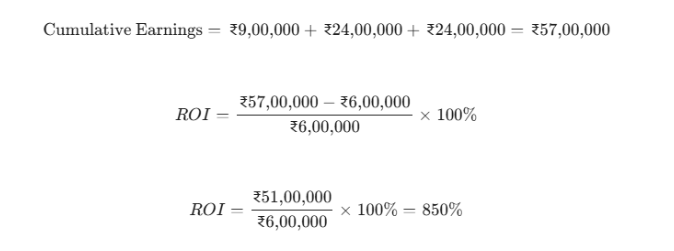
An ROI of 850% over five years of work is virtually unmatched by traditional engineering or general academic degrees, making the ame course one of the most efficient wealth-building pathways for technical students.
Detailed Salary and Career Progression Roadmap
To give you a clear map of your future, let us look at the structured career progression of an AME, from student to senior technical post-holder:
| Career Stage | Expected Role | Average Annual Salary Range (INR) | Primary Responsibilities |
| Stage 1 (Fresh Graduate) | Trainee Technician | ₹3.5 Lakhs – ₹5.5 Lakhs | Assisting senior engineers with physical checks, logbook entries, and routine mechanical services. |
| Stage 2 (Licensed Basic AME) | Junior Certifying Engineer | ₹10 Lakhs – ₹16 Lakhs | Conducting structural inspections, safety clearances, and routine system troubleshooting. |
| Stage 3 (Type-Rated Specialist) | Certifying Engineer (Fleet Specific) | ₹22 Lakhs – ₹36 Lakhs | Signing off on major commercial flights (e.g., Airbus A320), managing hangar maintenance shifts. |
| Stage 4 (Senior Industry Leader) | Chief Engineer / Quality Manager | ₹45 Lakhs – ₹1 Crore+ | Leading entire airline engineering departments, managing airline compliance with regulatory bodies like DGCA. |
Eligibility Criteria for AME Course Admission in 2026
To embark on this highly lucrative career path, candidates must meet specific regulatory and physical benchmarks:
- Academic Background: You must have passed your 10+2 (Higher Secondary) or equivalent exam from a recognized educational board.
- Subject Requirements: Physics, Chemistry, and Mathematics (PCM) are compulsory subjects at the 10+2 level.
- Minimum Academic Standard: Most premium institutes require at least 50% aggregate marks in PCM. Alternatively, candidates holding a 3-year AICTE-approved diploma in Mechanical, Electrical, or Electronics engineering are also eligible for admission.
- Medical Fitness Standard: Candidates must have normal color vision (no color blindness) and undergo a medical fitness examination. This is a critical safety parameter, as engineers must be able to instantly identify color-coded high-voltage wires and hydraulic warning systems.
Why Study the AME Course at the School of Aeronautics (SOACET)?
Aviation is a field where training quality directly dictates your career speed. If you study at an institute with poor facilities, you will struggle to pass the rigorous DGCA module exams. At the School of Aeronautics (SOACET), we provide an educational platform designed to turn beginners into global aviation leaders.
1. The Power of “Live Hangar” Practice
You cannot learn how to troubleshoot a passenger plane by looking at computer screens or small models. Our Neemrana campus features an active hangar housing actual heavyweight aircraft, including a Fokker F-27 and a Beechcraft. Our students get to touch real turbine blades, trace actual hydraulic lines, and operate working flight control surfaces.
2. High Success Rate in DGCA Modules
To obtain your license, you must clear the notoriously difficult DGCA module exams. SOACET maintains a dedicated Exam Support Cell that provides specialized coaching, structured module mock tests, and access to international aviation reference libraries, resulting in one of the highest module clearance rates in India.
3. Integrated Global Degrees
For those who want a strong academic safety net, SOACET offers unique integrated programs. You can pursue your DGCA-approved ame course alongside an AICTE-approved B.Tech in Aeronautical Engineering. This dual-track gives you a professional engineering degree and a licensing pathway simultaneously, making your profile incredibly attractive to global employers.
Frequently Asked Questions (FAQs)
Q1. Is the AME course harder than a B.Tech degree?
It is more practical and highly focused. While a B.Tech involves abstract mathematical theories and conceptual design, the AME course is heavily focused on hands-on diagnostics, physical systems, and aviation safety legislation. If you love mechanics and real machines, you will find it highly engaging.
Q2. Can women build a successful career as an AME?
Absolutely! The aviation sector is highly progressive and actively promotes gender diversity. Many of our most successful alumnae are currently working as licensed engineers and technical managers at leading airlines like Air India and Indigo.
Q3. Do airlines recruit directly from AME colleges?
Yes. Top colleges like SOACET have strong placement tie-ups with commercial airlines and domestic MRO (Maintenance, Repair, and Overhaul) hubs. Recruiters visit our campus during the final semesters to hire trainees and technicians directly.
Q4. Are education loans available for the AME course?
Yes, because SOACET is a DGCA-approved CAR 147 training organization, major public and private banks provide structured educational loans to cover the cost of tuition and hostel fees.
Conclusion: Take the First Step Toward Your Takeoff
The aviation market of 2026 and beyond belongs to those who combine technical intelligence with hands-on precision. The ame course is not just an educational credential; it is a direct license to travel, lead, and earn at the very top of the engineering sector.
By choosing an institution like the School of Aeronautics (SOACET), which balances academic depth with unparalleled hangar experience on real aircraft, you ensure that your investment in education translates directly into a high-paying, global career.
The runway is clear, and the skies are waiting. Are you ready for takeoff?