The civil aviation industry in 2026 is moving through an era of unprecedented, historical expansion. With major commercial carriers placing record-breaking aircraft orders and domestic Maintenance, Repair, and Overhaul (MRO) facilities expanding rapidly under localized manufacturing policies, the demand for highly specialized technical experts has never been more pressing. While pilots command the aircraft controls, the immense responsibility of ensuring their safe airworthiness falls upon the shoulders of licensed Aircraft Maintenance Engineers (AME).
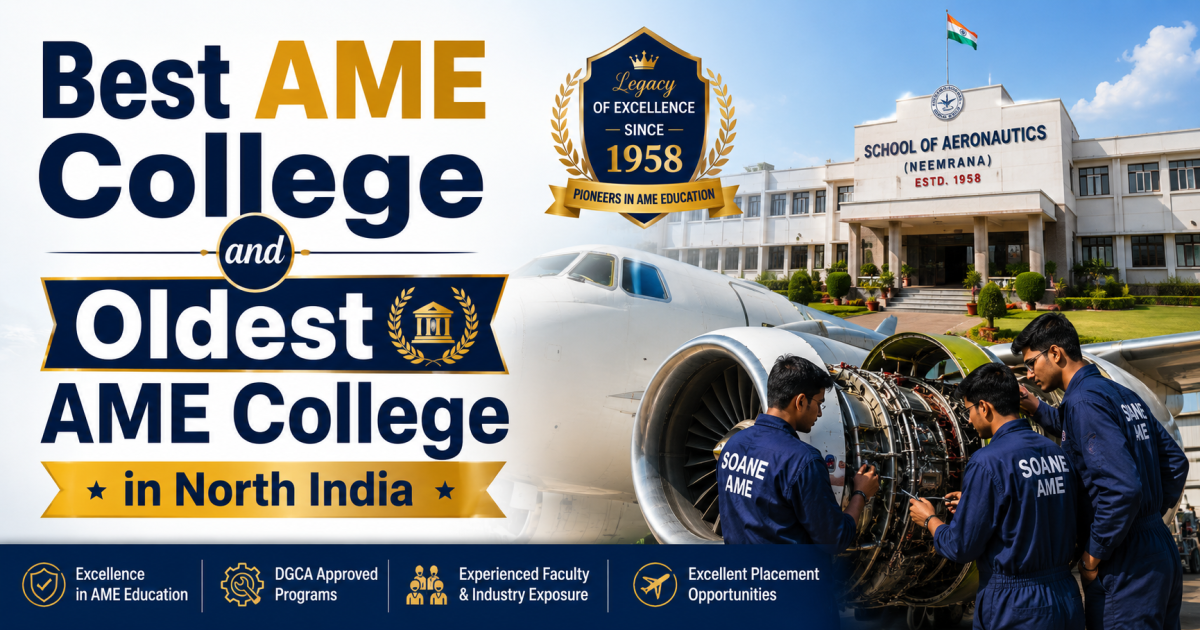
When planning to step into this high-responsibility profession, finding the absolute Best AME College and Oldest AME College in North India is your most critical immediate milestone. In North India’s competitive academic landscape, the pedigree of your educational institution acts as your ultimate career launchpad.
Read Before: How to Choose the Best AME College in India: A Complete Student Guide
1. The Historical Significance: Why Legacy Matters in Aviation Training
In aviation, safety is the absolute priority, and there is no room for error. Consequently, when airlines and MRO facilities recruit technical personnel, they heavily prioritize candidates who have been trained under a legacy of absolute technical discipline. This is why enrolling in the Best AME College and Oldest AME College in North India is an invaluable advantage.
The Foundation of Excellence (Since 1992)
Established in 1992, the School of Aeronautics (SOACET) has built a legendary reputation as a pioneer in aviation education in India. Starting as a highly focused training center in New Delhi, the institution spent fourteen years delivering world-class technical education before establishing its sprawling, state-of-the-art campus in Neemrana, Rajasthan, located strategically within the Delhi-National Capital Region (NCR).
Managed under the visionary guidance of the Laxmi Narain Verma Memorial (LMVM) Society, the institute has provided thirty-four years of glorious service to the aerospace sector. This deep-rooted history translates into a level of industrial trust and institutional experience that newly established training centers simply cannot replicate.
The Value of a 34-Year Legacy
Why does “oldest” mean “best” in aviation maintenance?
- Deep Institutional Trust: Over more than three decades, the college has developed structured training methodologies, refined its practical workshops, and aligned its curriculum with the continuous updates of civil aviation safety regulations.
- Veteran Faculty Base: The instructors at the oldest institutions are not merely career academics; they are veteran aircraft engineers who have spent decades serving in commercial airlines, global MROs, and the Indian Air Force.
- An Elite Global Alumni Network: With over 5,000 alumni working in key technical positions across almost every major airline globally, graduating from an established institution means you enter the hangar with an active professional network waiting to mentor you.
2. Answering the Big Question: Which is the best AME college in North India?
For high school science graduates and parents evaluating technical programs, finding clear direction is essential. When you ask yourself, Which is the best AME college in North India?, the answer lies in looking past glossy brochures and evaluating the physical and regulatory infrastructure of the campus.
[Evaluating the Best AME College]
│
┌────────────────────────┼────────────────────────┐
▼ ▼ ▼
[Regulatory Clearances] [The Live Hangar] [Strategic Tie-Ups]
(CAR 147 Basic Approval) (Fokker F-27 & Beech)
Air India Partnership)
The School of Aeronautics (SOACET) stands at the pinnacle of North Indian aviation academies due to several critical operational parameters:
The Live Hangar Advantage
Aircraft maintenance cannot be learned from textbooks, computer screens, or cut-section models inside a generic laboratory. The presence of an active, on-campus hangar housing actual, heavyweight operational aircraft is what defines elite academies.
At our Neemrana campus, students perform practical exercises on a heavy-weight Fokker F-27 twin-engine turboprop airliner and a Beechcraft. Tracing functional hydraulic landing gears, inspecting real turbine blades, and conducting live engine runs under the guidance of licensed engineers is the only way to build true troubleshooting competence.
Strategic Civil Approvals
Your technical qualifications carry zero professional legitimacy without the proper government clearances. At the School of Aeronautics, our technical training is fully approved by the Directorate General of Civil Aviation (DGCA), Ministry of Civil Aviation, Government of India, under the strict safety standards of CAR 147 (Basic). This ensures that every hour you spend in our workshops is legally recognized toward your licensing experience requirements.
The Air India OJT Partnership
A major highlight of our program is our strategic training partnership with Air India, the country’s largest MRO organization. To provide students with real-world, commercial-line maintenance exposure, our structured training includes planned on-the-job training (OJT) hours at active, high-volume Air India maintenance bases, bridging the gap between student life and corporate engineering.
3. Specialized AME Streams: B1.1 Mechanical vs. B2 Avionics
When completing your admissions counseling, candidates must select their preferred stream of training based on their personal talents and long-term career goals. The AME program at the School of Aeronautics is divided into two broad, highly sought-after categories:
Category B1.1 (Mechanical – Aeroplanes Turbine)
This stream is tailored for students who have a deep passion for heavy structural machinery, propulsion, and fluid dynamics.
- What You Will Study: The mechanical architecture of modern commercial passenger jets, including turbofan and turboprop engines, heavy structural airframes, flight landing gear assemblies, wing flaps, hydraulics, and pneumatics.
- The Workspace: Active hangars and runways, performing physical inspections, disassembling turbine stages, and tracing fuel delivery lines. This is the primary route for students who love hands-on mechanical troubleshooting.
Category B2 (Avionics)
This stream is ideal for students with a strong interest in electronics, software-heavy systems, and advanced digital technologies.
- What You Will Study: The electronic “brain” of the aircraft, including airborne communication radios, weather radar systems, satellite navigation (GPS), autopilot feedback loops, flight control computers, and glass cockpits.
- The Workspace: Calibrating highly sensitive instruments, diagnosing digital wiring loops, and upgrading flight management software. With modern aircraft becoming increasingly computerized, Avionics specialists are seeing rapid, exceptional salary growth.
4. Admission Process 2026: Your Step-by-Step Enrollment Guide
Securing a seat in a premier, DGCA-approved institute requires a methodical and timely approach. Because batch capacities are strictly capped by safety regulators to maintain optimal student-to-instructor ratios, registering early is vital to ensure you do not miss your seat.
[Online Application] ➔ [Appear for SOACET] ➔ [Admissions Counselling] ➔ [Document Verification] ➔ [Final Seat Locking]
To initiate your AME Admission Process 2026, follow this structured application blueprint:
Step 1: Verify Your Academic and Medical Eligibility
Before registering, ensure you meet the strict baseline criteria:
- Academic Criteria: You must have passed your Class 12 board examinations with Physics, Chemistry, and Mathematics (PCM) from a recognized state or central education board, securing a minimum of 50% aggregate marks. Alternatively, a 3-year AICTE-approved polytechnic diploma in any engineering branch is highly accepted.
- Medical Fitness Standards: Normal color vision is mandatory. Candidates must submit a physical fitness certificate signed by a registered MBBS doctor. Any form of color blindness is an automatic disqualification, as engineers must be able to instantly identify color-coded wiring and technical indicators. Corrected vision of up to $6/6$ with glasses is fully acceptable.
Step 2: Register Online for the Entrance Examination
- Visit the official admissions portals at www.soaneemrana.org or www.ameadmission.org.
- Navigate to the online application form and fill in your personal contact details, school scores, and email address.
- Upload clear scanned copies of your passport-sized photograph and signature.
- Submit the nominal registration processing fee via the secure online payment gateway.
Step 3: Appear for the SOACET Entrance Exam 2026
- Download your official hall ticket from your candidate dashboard.
- Appear for the computer-based SOACET entrance exam 2026. The test is designed to evaluate your fundamental aptitude in Physics, Mathematics, English communication, and general logical reasoning.
Step 4: Participate in Admissions Counseling
- Once results are declared, successful candidates are invited to participate in the virtual or physical counseling sessions.
- During counseling, experienced advisors help you select your preferred stream (Mechanical B1.1 vs. B2 Avionics) based on your merit rank.
Step 5: Complete Document Verification & Seat Locking
- Report to the campus with your original documents for verification.
- Submit your token deposit to lock your allocated seat, securing your spot in the upcoming academic batch.
5. Transparent Fee Structure & Aviation Scholarship 2026
At the School of Aeronautics, we believe that exceptional technical talent should never be grounded due to financial constraints. We offer a highly transparent fee structure, coupled with extensive financial aid programs.
Standard Tuition & Hangar Fees
The tuition and practical training fees for our DGCA-approved AME course typically range from Rs. 1,20,000 to Rs. 2,20,000 per year. This represents an exceptional return on investment (ROI) given the high starting salaries of certified technical engineers compared to general academic streams. This fee covers:
- Full utilization of on-campus operational aircraft and advanced laboratories.
- Practical training modules and Air India MRO exposure.
- Access to our rich technical library, containing all international EASA and DGCA reference volumes.
Comprehensive Scholarship Schemes
Administered under the Laxmi Narain Verma Memorial (LMVM) Society, we offer extensive financial concessions:
- Merit-Based Scholarships: Up to a 25% tuition fee waiver for students based on exceptional performance in their Class 12 board exams or high merit ranks in the SOACET entrance test.
- Reserved Category Concessions: An additional 5% concession is offered to female candidates and students belonging to reserved categories (SC/ST) to encourage diverse technical participation in the aerospace sector.
- Educational Loan Assistance: Because our courses hold all mandatory civil and technical approvals, all major nationalized and private banks provide comprehensive educational loans covering tuition, training, and residential hostel fees.
6. AME Placement 2026: Your Direct Launchpad to Global Airlines
Choosing your training ground is ultimately about securing a successful professional future. Our dedicated placement cell works in continuous coordination with leading global airlines, major cargo operators, and prominent MRO organizations.
Our Elite Recruiter Network
│
▼ ▼
[Commercial Airlines] [Global MRO Hubs] [Defense Contractors]
(IndiGo, Air India, etc) (AIESL, Indamer) (HAL, Tata Aerospace)
The Legacy of 34 Years of Placements
Our alumni are currently working in key technical positions across the aviation world. Major hiring partners include:
- Commercial Carriers: IndiGo, Air India, SpiceJet, Akasa Air, Vistara, and GoFirst.
- International Giants: Emirates, Qatar Airways, Etihad, and Singapore Airlines.
- MRO & General Aviation: Air India Engineering Services Limited (AIESL), GMR Aero Technic, Indamer, and Shaurya Aeronautics.
- Aerospace Manufacturing: Tata Advanced Systems, Mahindra Aerospace, and Hindustan Aeronautics Limited (HAL).
Integrated Soft Skills and Interview Prep
We recognize that technical competence must be balanced with professional communication. During your training semesters, SOACET provides dedicated classes in English communication, aviation ethics, French language basics, and mock interviews, ensuring our students stand out as disciplined, highly articulate professionals during campus placement drives.
7. Comparative Analysis: Why North India’s Oldest College Leads the Way
To give you a clear perspective on how the School of Aeronautics stands compared to other aviation training options in India, let us analyze its key technical offerings:
| College Parameter | School of Aeronautics (SOACET) | Stand-Alone Regional Academies | Standard Academic B.Sc. colleges |
| Year of Establishment | 1992 (NCR Pioneer) | 2012 – 2018 (Recent) | Various |
| DGCA Approval Status | Approved under CAR 147 (Basic) | Approved under CAR 147 | Non-approved (No licensing) |
| Live On-Campus Aircraft | Fokker F-27 & Beechcraft (Heavy Fleet) | Small single-engine trainer mockups | None (Purely theoretical) |
| Practical Tie-Ups | Air India MRO (Largest MRO in India) | Small local flying clubs | None |
| Integrated Degree Option | Yes (Integrated B.Tech + AME) | No (Purely standalone AME) | B.Sc. Only (No license) |
| Alumni Placement Base | 5000+ graduates globally | Limited regional footprint | General corporate entry-level |
8. Frequently Asked Questions (FAQs)
Q1. Is JEE Main mandatory for AME admission at the School of Aeronautics?
No, JEE Main is not mandatory. While candidates with valid JEE Main scores are welcome to apply, the primary admission and counseling path is conducted based on the merit ranks of the official SOACET entrance exam 2026.
Q2. What is the difference between an AME License and an Aeronautical B.Tech?
Aeronautical Engineering is an academic, 4-year design-focused B.Tech degree (desk-based), whereas AME is a highly practical, 3-year license-oriented program (hangar-based) focused on active maintenance. SOACET is unique in offering an integrated program where you can pursue both concurrently, maximizing your career scope.
Q3. Can a candidate apply for admission if their 12th results are awaited?
Yes, absolutely. Candidates currently appearing in their Class 12 board examinations can register online and sit for the SOACET entrance test. Admission is confirmed provisionally, subject to presenting passing mark sheets during the final document verification rounds in July.
Q4. Are separate hostel facilities available for outstation students?
Yes, our sprawling campus in Neemrana features separate residential hostels for boys and girls. The hostels are equipped with 24/7 security, high-speed Wi-Fi, hygienic mess halls, recreational sports arenas, and medical facilities to accommodate students from all corners of India.
Conclusion: Take Action Before the Runway Clears
Choosing your training institute is the single most critical decision you will make for your aviation career. In an industry where precision, safety, and regulatory discipline are absolute, the quality of your foundation is your only insurance.
By starting your journey with an institution of over three decades of educational legacy like the School of Aeronautics (SOACET), you build your career on a foundation of quality training, legal clearances, premium live aircraft hangar facilities, and a global alumni network.
Don’t let limited DGCA batch capacities and competitive counseling cutoffs pass you by. Complete your online registration today, lock in your counseling choices, and prepare to lead the future of flight.
Your countdown starts now. We look forward to welcoming you to our Neemrana campus.