Completing your high school board examinations is a monumental milestone, but it also marks the beginning of a high-stakes decision-making phase. If you spent your school years fascinated by mechanical systems, solving physics problems, and looking up at the sky, wondering how massive objects conquer gravity, a standard desk job is not for you. You belong in the dynamic, high-prestige, and rapidly expanding world of aerospace.
The aviation industry in 2026 is experiencing an era of unprecedented expansion. With airlines placing record-breaking aircraft orders, state-of-the-art airports going operational across major hubs, and domestic maintenance facilities expanding rapidly under localization policies, the demand for highly specialized technical experts has never been more urgent.
However, because the training pathways are highly technical and heavily regulated, understanding where to invest your academic efforts can be challenging. Many students find themselves asking: Which aviation course is best after 12th? How do you navigate the complex approvals, and what is the actual career scope of these programs?
To make this high-stakes decision easier, seeking professional Free Aviation Career Counselling India is the most critical first step. Having access to structured Free Aviation Career Guidance ensures you understand the entry rules, choose the right specialization, and select the optimal training ground to launch your career into the stratosphere.
Read Before: How to Become an Aeronautical Engineer After 12th: A Complete Beginner’s Roadmap
1. Why You Need Professional Free Aviation Career Guidance After 12th
A common mistake made by high school science graduates is assuming that a career in the skies is limited to flying as a pilot or working as cabin crew. The reality is that the aerospace sector is a vast, highly integrated technical ecosystem. It is divided into core design, structural manufacturing, regulatory safety, operational dispatch, and airport terminal management.
Without structured Aviation Career Counselling, students often struggle to identify the path that matches their personal talents, financial boundaries, and stream eligibility. For example, some students enroll in general mechanical engineering believing it is the fastest route to aircraft design, only to realize later that they lack the specialized aeronautical credentials required by major aerospace firms.
By engaging in early Aviation Counselling India and seeking the advice of an experienced Aviation Career Consultant, you gain absolute clarity on:
- The real-world difference between a theoretical design degree and a practical certifying license.
- The physical and medical prerequisites mandated by civil aviation authorities.
- The actual return on investment (ROI) of various training programs.
- How to complete the registration and counseling process for limited admission seats.
Professional Aviation Career Advice helps you look past glossy college brochures and focus on the parameters that actually matter: civil approvals, live aircraft availability, and industry placement networks.
2. Deciphering Career Options in Aviation: Which Path is Your Calling?
When planning your professional path, you will find several different aviation courses after 12th that cater to distinct interests, career goals, and practical skills. To identify the best aviation career after 12th, let us break down and evaluate the top four technical programs.
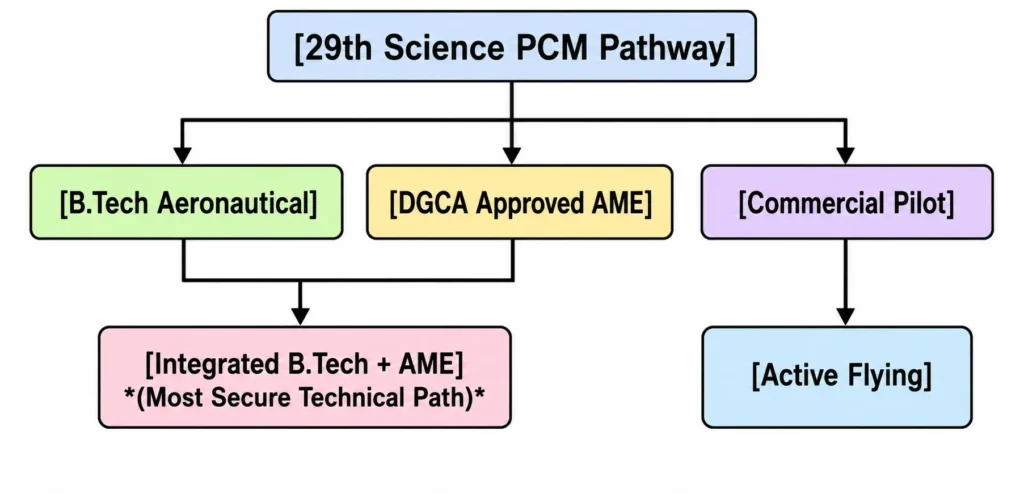
Path 1: The Design & Innovation Track (Aeronautical & Aerospace Engineering)
If you are fascinated by the physics of flight, wing shapes, engine thermodynamics, and structural stress points, pursuing a university-level engineering degree is a natural fit.
- Aeronautical Engineering After 12th PCM: A traditional four-year B.Tech program focused on the design, wind tunnel analysis, simulation, and manufacturing of aircraft operating within the Earth’s atmosphere.
- Aerospace Engineering Course: This program broadens your focus beyond our atmosphere, covering orbital mechanics, satellite systems, launch-vehicle propulsion, and outer-space environments.
- The Job Profile: Graduates work primarily as design engineers, systems analysts, structural engineers, and research specialists. They spend their work hours using computer-aided design (CAD) software, computational fluid dynamics (CFD) modeling tools, and advanced simulation suites.
Path 2: The Hands-On Certification Track (AME Course After 12th PCM)
If your passion lies in getting hands-on with real aircraft, troubleshooting complex mechanical systems, and taking on direct responsibility for passenger safety, the Aircraft Maintenance Engineering (AME) license program is your ideal route.
- The Core Concept: An AME is not a conventional academic designer. Instead, they are highly specialized safety certifying officers. By law, no commercial aircraft can take off without a certified AME inspecting its systems and signing the Flight Release Certificate.
- The Legal Framework: This is a highly regulated technical program aligned with the rigorous safety standards of CAR 147 (Basic) and monitored by the Directorate General of Civil Aviation (DGCA), Ministry of Civil Aviation, Government of India.
- The Job Profile: AMEs inspect, repair, troubleshoot, overhaul, and maintain turbine engines, active landing gears, flight control instruments, and digital cockpits inside active hangars and on airport runways.
Path 3: The Flight Operations Track (Commercial Pilot Course)
For students whose primary goal is to operate the flight deck controls of heavy commercial jets, undergoing structured flight school training is the main route.
- The Core Concept: You join a flight training academy to obtain your Commercial Pilot License (CPL). The training involves flight simulators, ground school examinations, and completing at least 200 hours of actual flying time.
- The Reality Check: While flying is a highly prestigious career, it requires a major, upfront financial investment. Additionally, a pilot’s career is highly dependent on continuous, strict medical clearances. It does not provide an academic fallback degree if health issues arise later in life.
Path 4: The Ultimate Combination (B.Tech Aeronautics + AME)
For students seeking a balanced approach, premier Aviation Training Institutes have designed a powerful integrated pathway: the B.Tech Aeronautics + AME program.
This five-year dual program allows you to complete an AICTE-approved B.Tech university degree while simultaneously completing your CAR 147-approved AME practical licensing training. By combining the design principles of an engineer with the legal certifying authority of a licensed maintenance specialist, you qualify for twice as many career opportunities and enjoy complete professional flexibility.
3. Free Aviation Career Counselling in India for 2026 Admissions: Navigating Capped Seats
As we progress through the 2026 academic enrollment cycle, a critical operational reality is shaping the admission landscape. Unlike general engineering or standard corporate management programs, where universities can easily increase classroom capacity to accommodate more students, aviation technical training is subject to strict regulatory limits.
Under the DGCA’s safety guidelines, an approved Maintenance Training Organization (MTO) is bound to a strict student-to-instructor ratio (typically 28:1 or 30:1) for practical hangar workshops. This means that once an institute reaches its approved intake limit for the year, it cannot admit a single additional student.
The Timeline of AME & Aeronautical Admission 2026
Our experienced counselors emphasize that the seat-allotment process is conducted in highly time-sensitive phases:
- Aviation Entrance Guidance Phase: Students who register early for national-level aptitude tests or institute-specific entrance exams are placed in the primary merit cycles.
- Aviation Admission Counselling Phase: Once results are declared, qualified candidates are invited to participate in the physical or virtual counselling rounds.
- Choice Locking Phase: During this critical window, students select their preferred specializations (such as Category B1.1 Mechanical vs. Category B2 Avionics).
- Seat Allotment & Verification: Provisional seats must be secured within a tight time-frame by submitting the token deposit and verifying original academic documents.
By utilizing Free Aviation Career Counselling in India for 2026 Admissions, you ensure that you don’t miss these critical registration deadlines. Our counselors provide personalized Aviation admission guidance in India, tracking your application status to ensure your seat is locked before the batch capacities are reached.
Note: Book a FREE counselling session through SOACET to understand the AME admission process clearly.
4. Understanding Aviation Courses Eligibility and Stream Criteria
A major area where students require professional counseling is verifying stream eligibility. While the aviation sector has excellent administrative tracks open to all students, the core technical pathways require a solid science foundation.
Academic Eligibility (12th Class Criteria)
- Aviation Courses for Science Students: To apply for premier technical courses like B.Tech Aeronautical Engineering, B.Tech Aerospace, and Aircraft Maintenance Engineering (AME), you must have completed your 10+2 board exams with Physics, Chemistry, and Mathematics (PCM). Most top-tier Aviation Colleges in India require a minimum aggregate of 50% in these core subjects.
- Diploma Holders: If you hold a 3-year AICTE-approved polytechnic diploma in Mechanical, Electrical, Electronics, or Aeronautical engineering, you are highly eligible for lateral admission routes, jumping directly into the second year of the B.Tech program.
- Aviation Courses eligibility for Commerce & Arts: Students from non-science backgrounds are eligible to apply for business-oriented programs like the BBA in Aviation Management. These programs lead to excellent career options in aviation, such as cargo management, fleet scheduling, and airport terminal logistics.
Physical and Medical Fitness Standards
Aviation is a safety-critical field. Consequently, physical fitness is an essential eligibility gatekeeper that is thoroughly verified during Aviation Admission Counselling:
- Normal Color Vision: For AME and pilot training, candidates must possess normal color vision. Color blindness is a strict disqualification because technical specialists must be able to instantly identify color-coded wiring, digital warnings, and hydraulic indicators.
- General Fitness: Candidates must possess healthy hearing and general physical agility. A medical fitness certificate signed by a registered MBBS doctor is a mandatory document during the final registration phase.
5. Evaluating Aviation Colleges in India: The Expert Checklist
Once you have defined your career goals, selecting your academic institution is the single most critical decision of your life. During an Aviation College Counselling session, experienced advisors help you look past basic marketing and focus on three essential parameters:
Parameter 1: Verifying Regulatory Approvals
A college without proper government clearances cannot provide you with professional legitimacy. For technical courses, the institute must hold:
- A valid CAR 147 (Basic) approval from the DGCA for its AME programs.
- AICTE approval and recognized technical university affiliation for its B.Tech programs.
Parameter 2: Inspecting Hangar & Practical Facilities
Aviation cannot be learned solely from textbooks or computer screens. The presence of an active, on-campus hangar housing actual operational aircraft is what separates elite academies from average colleges. During Aviation College Counselling, we help students evaluate whether the college has real, heavyweight aircraft for practical training.
Parameter 3: Module Exam & Placement Success
The license in AME is granted based on your success in the central DGCA module exams. A top-tier college provides the academic focus, structured test cell coaching, and library resources needed to help students clear these difficult papers. Professional Aviation Admission Counselling helps you check the college’s placement history: Are their alumni actively working at major airlines like IndiGo, Air India, or global hubs in the Middle East?
6. High-Salary Comparison: Finding the Best Career Fit
When planning your career, understanding your potential return on investment (ROI) is a key consideration. You want to choose an academic path that offers excellent long-term security and financial rewards.
Below is an analytical comparison of the different technical streams, outlining their academic weight, licensing authority, starting salary, and career growth potential:
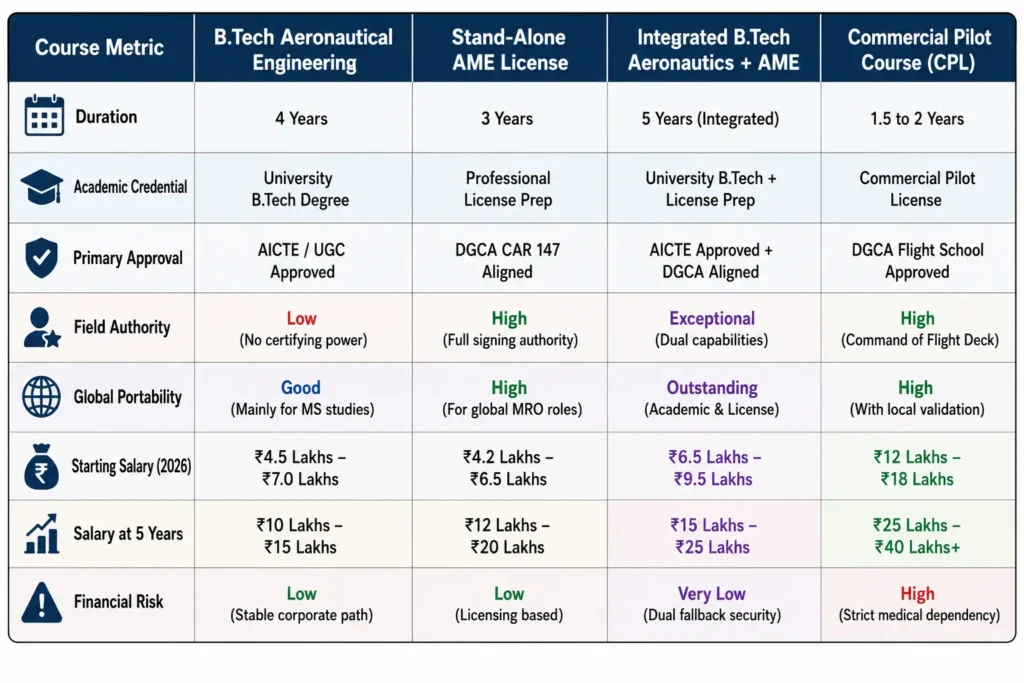
Note: The salaries listed above represent realistic industry ranges for 2026. Actual compensation varies based on individual merit, academic results, and the hiring organization.
7. Why the School of Aeronautics (SOACET) is the Premier Choice
For over three decades, the School of Aeronautics (SOACET), established in 1992, has been widely recognized as a leader in aviation education in India.
Located on a state-of-the-art campus in Neemrana, SOACET has built a reputation for producing highly skilled aviation professionals who lead the industry today.
The Live Hangar Advantage
SOACET’s technical facilities feature entire operational heavy aircraft. Our students perform practical hangar work on a Fokker F-27 twin-engine airliner and a Beechcraft. Under the guidance of experienced, licensed instructors, you will gain hands-on experience running active turbine systems, diagnosing mechanical architectures, and analyzing aircraft instruments.
Strategic Approvals & Affiliations
Our programs are fully approved. Our B.Tech program is approved by the AICTE and affiliated with Bikaner Technical University (BTU), ensuring your degree is recognized globally for higher studies and government engineering commissions. At the same time, our AME wing is approved by the DGCA under CAR 147, providing a direct, legitimate pathway to your license.
Dedicated Training and Active Placements
Our dedicated placement cell works closely with top domestic airlines, international cargo companies, and major defense manufacturers. Our alumni are currently working in key roles at Emirates, IndiGo, Air India, Tata Advanced Systems, and Hindustan Aeronautics Limited (HAL), reflecting the industry’s trust in our graduates.
8. Frequently Asked Questions (FAQs)
Q1. How can I register for AME Career Counselling or Aeronautical Engineering Counselling?
You can secure professional counselling by contacting the admissions desk at the School of Aeronautics (SOACET). We offer comprehensive, free counselling sessions online and on-campus to help students understand their career options.
Q2. Is there any fee for Free counselling for aviation students?
No. At SOACET, our counseling sessions are completely free of cost. Our goal is to provide honest, transparent career direction to help students make informed decisions.
Q3. Can a science student apply for both B.Tech and AME?
Absolutely! SOACET specializes in integrated dual-track programs where you can complete your B.Tech in Aeronautical Engineering while simultaneously completing your CAR 147-approved AME practical licensing training. This is widely considered the most secure technical pathway in the country.
Q4. Are education loans available for these specialized courses?
Yes. Because the School of Aeronautics is a recognized, AICTE-approved, and state university-affiliated institution, all major nationalized and private banks provide comprehensive educational loans covering tuition, training, and hostel fees.
Conclusion: Take Action Before the Runway Clears
Choosing your path in the aviation sector is more than just choosing a college; it is a life-changing step toward a highly prestigious, global career. As the aviation infrastructure in India doubles its capacity, the industry needs young, dedicated, and highly disciplined minds to keep the skies safe.
By engaging in professional Aviation Career Counselling after 12th and starting your journey with an institution of over three decades of educational legacy like the School of Aeronautics (SOACET), you build your career on a foundation of quality training and proven success.
Don’t let limited admission seats pass you by. Begin your registration today, complete your eligibility checks, and secure your place on the launchpad.
Book Your Free Aviation Career Counselling Session at SOACET Today!