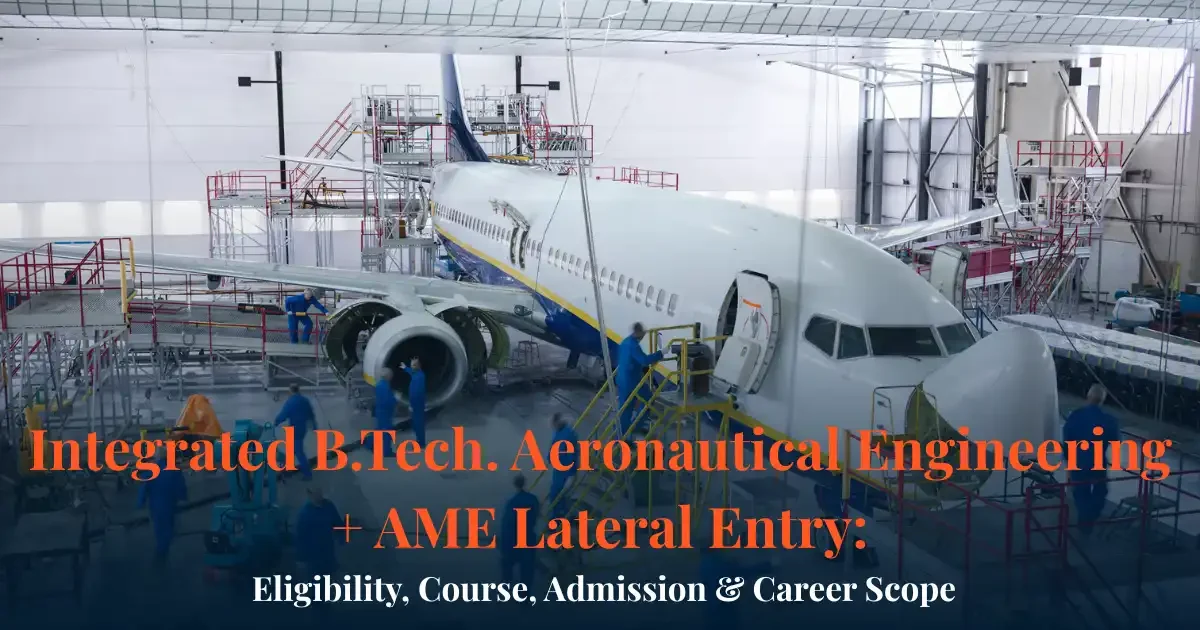
Students holding an engineering diploma or an eligible B.Sc. degree often face a critical academic decision: whether to pursue a traditional engineering degree focused on design and analysis or to specialize in practical aircraft maintenance. The Integrated B.Tech. Aeronautical Engineering + AME Lateral Entry program bridges this gap by combining academic engineering coursework with practical aircraft maintenance training into a single, direct second-year admission pathway.
Bypassing introductory first-year basic science modules already completed during diploma or science studies, this lateral entry pathway enables eligible candidates to earn an undergraduate B.Tech degree in three academic years while gaining direct exposure to aircraft systems, maintenance practices, and hangar workflows. For technical graduates aiming to work across airline technical support, Maintenance, Repair, and Overhaul (MRO) facilities, and aerospace manufacturing, this dual-oriented pathway offers a versatile academic foundation.
This comprehensive course guide details the eligibility criteria, academic structure, comparison against standalone pathways, career outcomes, and admission steps for the Integrated B.Tech. Aeronautical Engineering + AME Lateral Entry program at the School of Aeronautics (SOACET).
Read Before: SOACET Counselling 2026: Admission Process, Eligibility & Registration Guide
Course Highlights
| Program Parameter | Program Details |
|---|---|
| Full Program Title | Integrated B.Tech. Aeronautical Engineering + AME (Lateral Entry) |
| Admission Level | Direct Admission into Second Year (3rd Semester) |
| Program Duration | 3 Academic Years (6 Semesters) |
| Primary Academic Focus | Aeronautical Engineering Theory + Practical Aircraft Maintenance Exposure |
| Eligible Qualification | 3-Year Engineering Diploma OR 3-Year B.Sc. Degree (with Mathematics) |
| Academic Degree Output | B.Tech. Degree in Aeronautical Engineering |
| Practical Training Exposure | Hands-on hangar exposure, active aircraft components, avionics rigs, engine systems |
| Regulatory Framework | University B.Tech curriculum aligned with AICTE guidelines combined with practical maintenance exposure |
| Target Career Sectors | Airline Technical Operations, MRO Facilities, Aerospace Component Manufacturing, Defense Technical Support |
Key Benefits of the Integrated Pathway
- Direct Second-Year Entry: Bypasses foundational first-year subjects, saving one full academic year for diploma holders and B.Sc. graduates.
- Dual Engineering & Maintenance Exposure: Combines theoretical aeronautical design principles with hands-on aircraft maintenance training.
- Practical Hangar Training: Provides access to operational aircraft, gas turbine engines, avionics test rigs, and workshop tools.
- Broader Technical Career Scope: Prepares graduates for roles in both engineering design support and operational airline/MRO technical environments.
- Enhanced Problem-Solving Skills: Integrates mathematical modeling and computational design tools with physical troubleshooting and maintenance procedures.
- Seamless Educational Progression: Upgrades a three-year technical diploma or pure science B.Sc. into a recognized four-year equivalent professional engineering degree.
What Is Integrated B.Tech. Aeronautical Engineering + AME?
The Integrated B.Tech. Aeronautical Engineering + AME program is an interdisciplinary academic pathway that merges the theoretical fundamentals of aeronautical engineering with the practical methodologies of Aircraft Maintenance Engineering (AME).
In traditional technical education, students choose either a pure engineering degree (B.Tech) focused on aerodynamics, structural analysis, CAD design, and flight dynamics, or a vocational/technical maintenance track (AME) focused on airworthiness regulations, system inspections, hangar safety, and component repair. The integrated framework combines both disciplines, allowing students to understand how an aircraft is engineered on paper and how it is inspected, serviced, and maintained on the flight line.
It is important to understand the academic distinction between these two components:
- Aeronautical Engineering: Focuses on the mathematical, physical, and computational design of airframes, propulsion units, control surfaces, and fluid dynamics.
- Aircraft Maintenance Engineering (AME): Focuses on operational safety, system diagnostics, airworthiness compliance, component overhaul, and hangar repair protocols.
By combining these two technical tracks, the integrated program equips students with a comprehensive understanding of an aircraft’s complete lifecycle from initial engineering design to operational field maintenance.
What Is Integrated B.Tech. + AME Lateral Entry?
Integrated B.Tech. Aeronautical Engineering + AME Lateral Entry is an expedited admission mechanism designed specifically for students who have already completed foundational technical or scientific education.
Under standard university guidelines, a B.Tech degree takes four academic years (eight semesters). However, because engineering diploma holders and B.Sc. graduates have already covered basic engineering mathematics, physics, technical drawing, and workshop practices, regulatory bodies like the All India Council for Technical Education (AICTE) permit direct admission into the third semester (second year) of the B.Tech program.
Through lateral entry, eligible candidates complete the full integrated curriculum encompassing advanced B.Tech coursework and practical maintenance modules in three academic years (six semesters), earning their professional degree without repeating redundant introductory coursework.
Who Is Eligible for Integrated B.Tech. + AME Lateral Entry?
Eligibility for direct second-year entry into the integrated program is governed by academic background, subject prerequisites, and institutional standards. The table below outlines the general eligibility parameters evaluated during admissions:
| Eligibility Factor | Requirement Parameter |
|---|---|
| Primary Academic Background | 3-Year Recognized Engineering Diploma OR 3-Year B.Sc. Degree |
| Eligible Diploma Branches | Mechanical, Electrical, Electronics, Aeronautical, Automobile, Mechatronics, or Civil Engineering |
| B.Sc. Subject Prerequisite | B.Sc. degree from a recognized university with Mathematics as a core subject at 10+2 or degree level |
| Minimum Qualifying Marks | Candidates must meet the minimum percentage criteria set by the university for the current academic session |
| Entry Level | Direct admission into the 3rd Semester (2nd Year) of the B.Tech program |
| Document Verification | Submission of valid marksheets, provisional certificates, transfer certificates, and identity proof |
Note: Prospective students should review the official SOACET admission notification for the current academic cycle to confirm specific percentage thresholds and subject equivalence rules.
Integrated B.Tech. + AME Lateral Entry After Diploma
For engineering diploma graduates in branches such as Mechanical, Automobile, Electrical, or Electronics, pursuing the Integrated B.Tech + AME after diploma pathway represents a logical technical progression.
During diploma studies, students build strong practical skills in benchwork, machining, basic electrical circuits, and mechanical drawing. Entering the integrated program in the second year leverages this practical base while introducing advanced engineering mathematics, aerodynamics, gas dynamics, and specialized aircraft maintenance workflows.
Diploma holders benefit significantly from this dual exposure: their familiarity with hands-on mechanical tools simplifies their transition into hangar maintenance labs, while the B.Tech academic framework upgrades their credential to a full engineering degree suitable for high-level technical roles.
Integrated B.Tech. + AME Lateral Entry After B.Sc.
B.Sc. graduates majoring in Physics, Mathematics, or Electronics possess a solid grounding in theoretical sciences. Pursuing Integrated B.Tech. Aeronautical Engineering + AME Lateral Entry after B.Sc. allows these students to apply theoretical physics and mathematical analysis to real-world aerospace systems.
To qualify for lateral entry, B.Sc. candidates must have studied Mathematics at the high school (10+2) or undergraduate degree level. Depending on university guidelines, B.Sc. entrants may be required to clear introductory engineering drawing or basic mechanics subjects alongside their standard third-semester coursework to satisfy technical equivalence requirements. This pathway allows pure science graduates to pivot effectively into applied aviation engineering and maintenance technology.
B.Tech. Aeronautical Engineering + AME: How Does the Integrated Program Work?
The integrated curriculum blends academic classroom lectures, computer laboratory modeling, practical workshop exercises, and live aircraft hangar exposure.
| INTEGRATED B.TECH. AERONAUTICAL ENGINEERING + AME CURRICULUM | |
|---|---|
| Part 1: B.Tech Aeronautical Science | Part 2: Practical AME Modules |
|
|
| Result: Graduate with Academic Engineering Degree + Practical Hangar Expertise | |
Part 1: B.Tech. Aeronautical Engineering Academic Component
- Aerodynamics & Fluid Dynamics: Airfoil theory, boundary layer flow, subsonic and supersonic wind tunnel testing, lift/drag optimization.
- Aircraft Structures & Materials: Mechanics of solids, stress analysis of wings and fuselages, finite element analysis (FEA), composite material repair.
- Propulsion Systems: Thermodynamics, jet engines, turboprops, rocket propulsion cycles, combustion analysis.
- Flight Dynamics & Control: Longitudinal, directional, and lateral stability, performance dynamics, flight control surface mechanics.
- CAD/CAM & Aerospace Manufacturing: Computer-aided drafting, 3D component modeling, automated assembly systems.
Part 2: Aircraft Maintenance Engineering (AME) Practical Component
- Aircraft Maintenance Practices: Hangar safety routines, safety wiring, precision measuring tools, aircraft hardware, fasteners.
- Aircraft Systems & Maintenance: Inspection routines for hydraulic, pneumatic, fuel, landing gear, and environmental control systems.
- Avionics & Instrumentation: Cockpit displays, navigation units, radar principles, electrical wiring interconnect systems (EWIS).
- Aviation Regulations & Safety: Civil aviation airworthiness standards, maintenance documentation, safety management systems (SMS).
- Troubleshooting Protocols: Fault identification, non-destructive testing (NDT), engine maintenance procedures.
Integrated B.Tech. + AME vs B.Tech. Aeronautical Engineering
Choosing between the integrated pathway and a standalone B.Tech in Aeronautical Engineering depends on your career goals and learning preferences.
| Factor | Integrated B.Tech. Aeronautical Engineering + AME Lateral Entry | B.Tech. Aeronautical Engineering Lateral Entry |
|---|---|---|
| Primary Focus | Dual emphasis on theoretical aeronautical engineering and practical aircraft maintenance | Pure academic focus on aeronautical design, computational mechanics, and aerodynamics |
| Degree Awarded | B.Tech Degree in Aeronautical Engineering | B.Tech Degree in Aeronautical Engineering |
| Practical Hangar Exposure | Extensive hands-on exposure to active aircraft systems, engine inspection, and hangar tools | Focuses primarily on software modeling, wind tunnel testing, and structural lab testing |
| Maintenance Systems Knowledge | Comprehensive coverage of airframe, engine, and avionics operational procedures | General overview of aircraft systems integrated into broader engineering design modules |
| Ideal Career Pathways | Airline technical support, MRO operations, line/base maintenance planning, quality auditing | Aerospace design, CAD modeling, structural stress analysis, defense R&D, graduate research |
| Target Student Profile | Candidates who want engineering credentials combined with hands-on aircraft maintenance training | Candidates who prefer pure engineering design, mathematical simulations, and manufacturing tech |
Integrated B.Tech. + AME vs AME
It is important to understand how the integrated degree differs from a standalone Aircraft Maintenance Engineering (AME) program:
| Factor | Integrated B.Tech. Aeronautical Engineering + AME | Standalone AME Program |
|---|---|---|
| Academic Credential | Full 4-Year Equivalent University Engineering Degree (B.Tech) | Vocational / Technical Training Certificate |
| Engineering Science Scope | Includes advanced engineering mathematics, fluid dynamics, stress analysis, CAD | Focuses strictly on maintenance procedures, civil aviation rules, and component repair |
| Higher Education Eligibility | Qualifies graduates for postgraduate degrees (M.Tech, M.S., MBA, Ph.D.) | Requires additional academic degrees to qualify for postgraduate university admission |
| Licensing Considerations | Provides degree education + maintenance training. Licensing requires passing regulatory exams. | Focuses directly on preparing candidates for regulatory licensing exams and practical logbook hours |
| Career Flexibility | Enables entry into engineering design, technical operations, MROs, and manufacturing | Primarily focused on aircraft maintenance technician and licensed engineer tracks |
Regulatory Licensing Clarification: Enrolling in or completing an integrated degree program provides academic knowledge and practical maintenance exposure, but does not automatically grant a licensed Aircraft Maintenance Engineer (AME) license. Regulatory licensing is governed separately by civil aviation authorities (such as the DGCA) and requires passing prescribed modular examinations and fulfilling mandatory practical experience requirements.
Career Scope After Integrated B.Tech. + AME Lateral Entry
Graduates of the integrated lateral entry track possess a dual perspective: they understand the theoretical mathematics behind aircraft design and the practical realities of keeping an aircraft airworthy on the ground.
| CAREER PATHWAYS FOR INTEGRATED B.TECH. + AME GRADUATES | ||
|---|---|---|
| Airline Technical Ops | MRO Facilities | Aerospace Manufacturing |
|
|
|
| Aviation Logistics | Technical Services | Higher Education |
|
|
|
Key Career Sectors:
- Airline Technical Operations: Assisting fleet management teams in maintenance scheduling, technical log monitoring, engine reliability tracking, and aircraft troubleshooting support.
- Maintenance, Repair, and Overhaul (MRO): Working within certified MRO hangars on airframe heavy maintenance preparation, component repair tracking, and quality assurance auditing.
- Aerospace Manufacturing & Quality: Supporting manufacturing plants with component assembly, structural non-destructive testing (NDT), and quality compliance documentation.
- Technical Services & Engineering Support: Working for leasing companies, airline engineering departments, and aviation technical consultancies analyzing airworthiness directives (ADs) and service bulletins (SBs).
Potential Job Roles
Graduates of the integrated program can explore a variety of technical job roles:
- Technical Support Engineer: Providing engineering guidance to line maintenance crews and resolving operational aircraft defects.
- Maintenance Planning Engineer: Developing preventative maintenance schedules, tracking engine life-cycles, and coordinating hangar maintenance visits.
- Quality Assurance Inspector (Trainee): Auditing maintenance practices, safety management protocols, and workshop compliance against aviation standards.
- Aircraft Systems Engineer: Analyzing avionics, hydraulic, or propulsion system performance telematics across active fleets.
- Aviation Spares & Logistics Analyst: Managing inventory compliance, certified aircraft parts tracking, and supply chain logistics for MROs.
- CAD / Manufacturing Assistant Engineer: Supporting design teams in developing component modifications, repair schemes, and tooling fixtures.
Career Growth and Higher Studies
Completing the Integrated B.Tech program provides a solid foundation for both professional career growth and advanced academic study.
Postgraduate Academic Pathways:
- M.Tech / M.S. in Aerospace Engineering: Specializing in aerodynamics, space propulsion, composite structures, or autonomous flight systems.
- MBA in Aviation Management / Supply Chain: Preparing for executive roles in airline operations, airport management, or aviation logistics.
- Specialized Technical Certifications: Pursuing certifications in Non-Destructive Testing (NDT Level II/III), CAD/CAM software platforms, or Lean Six Sigma for aerospace manufacturing.
Professional Maintenance Progression:
For graduates pursuing licensed maintenance roles, the practical exposure gained during the integrated course provides a strong foundation for taking DGCA / EASA modular examinations and completing mandatory practical experience hours at certified MRO facilities.
Is Integrated B.Tech. + AME a Good Choice for You?
Use this decision matrix to evaluate whether the integrated lateral entry pathway aligns with your goals:
This Program Is Suitable For You If:
- You hold an eligible 3-year Engineering Diploma or B.Sc. degree with Mathematics.
- You want to earn a recognized B.Tech engineering degree in three years.
- You are interested in both theoretical engineering design and practical aircraft maintenance.
- You want career flexibility across airlines, MRO facilities, and aerospace manufacturing.
- You prefer hands-on training on active aircraft components alongside classroom engineering analysis.
This Program May NOT Be Ideal If:
- You want a program focused strictly on software development or general non-aviation engineering.
- You have no interest in working with physical machinery, aircraft hardware, or hangar environments.
- You expect an automatic regulatory AME license without passing separate civil aviation authority examinations.
Why Choose SOACET for Integrated B.Tech. + AME Lateral Entry?
The School of Aeronautics (SOACET) provides a dedicated aviation-focused learning environment designed to deliver both academic rigor and practical industry exposure.
| THE SOACET ADVANTAGE AT A GLANCE |
|---|
|
- Dedicated Aviation Infrastructure: SOACET features specialized laboratories, including wind tunnels, material testing equipment, avionics test benches, and live aircraft facilities for hands-on learning.
- Integrated Curriculum Design: The academic structure seamlessly weaves theoretical engineering lectures with practical maintenance routines, ensuring students develop a well-rounded technical skill set.
- Experienced Technical Faculty: Courses are taught by academic engineering professors and seasoned aviation professionals with real-world maintenance experience.
- Focused Academic Environment: Unlike generic multi-disciplinary colleges, SOACET focuses specifically on aviation, aerospace, and maintenance engineering, fostering an immersive learning environment.
Admissions Contact: For program details, dual specialisation options, fees, and the AME Admission Process 2026 at the SOA School of Aeronautics, Neemrana,
Visit the official website at https://soacet.org/ or contact (+91-9870273846 +91-9314009022) the admissions team directly through the website.
Admission Process for Integrated B.Tech. + AME Lateral Entry
Joining the integrated program via lateral entry follows a clear, structured application journey:
| ADMISSION WORKFLOW (SOACET) | |
|---|---|
| Step | Action / Milestone |
| Step 1 | Verify Eligibility (Engineering Diploma or B.Sc. PCM) |
| Step 2 | Visit SOACET Admissions Portal & Fill Online Application |
| Step 3 | Submit Academic Transcripts & Qualification Certificates |
| Step 4 | Fulfill Institutional Merit / Assessment Requirements |
| Step 5 | Attend Counseling & Document Verification Session |
| Step 6 | Receive Seat Allotment & Submit Prescribed Admission Fees |
| Step 7 | Complete Enrolment & Join Second Year (3rd Semester) Classes |
- Step 1 – Eligibility Verification: Check your diploma branch or B.Sc. subject combination against current SOACET entry guidelines.
- Step 2 – Online Application: Complete the official application form on the SOACET admissions portal.
- Step 3 – Document Submission: Upload prior marksheets, certificates, and identity proof for academic evaluation.
- Step 4 – Merit Evaluation: Complete any institutional assessments or counseling evaluations required for the current session.
- Step 5 – Document Verification: Present original academic credentials for verification of credit equivalence and eligibility.
- Step 6 – Admission Confirmation: Complete fee payment formalities to secure your seat in the second year (3rd semester).
Documents Required for Admission
Candidates applying for lateral entry should prepare an organized set of official documents:
- Official 10th Class Marksheet and Passing Certificate (Proof of Date of Birth)
- Official 12th Class Marksheet (if applicable)
- Semester-wise Marksheets of 3-Year Engineering Diploma / B.Sc. Degree
- Provisional Diploma Certificate / Final B.Sc. Degree Certificate
- Migration Certificate / Transfer Certificate from the previous institution/board
- Character Certificate from the head of the last attended institution
- Category / Caste Certificate (if claiming reservation under applicable rules)
- Valid Government-issued Photo Identity Proof (Aadhaar Card, Passport, Voter ID)
- Recent Passport-size Photographs
Note: Specific document requirements may vary based on prior academic background and current admission cycle guidelines.
How to Choose an Integrated B.Tech. + AME College
When evaluating institutions offering integrated aviation programs, students and parents should consider the following factors:
- Academic Approvals & Affiliations: Ensure the B.Tech degree is awarded by a recognized university meeting UGC/AICTE guidelines.
- Practical Hangar & Aircraft Facilities: Verify that the institution owns physical aircraft, operational engines, and modern workshop tools for practical training.
- Laboratory Infrastructure: Check for dedicated aerodynamics, avionics, strength of materials, and CAD/CAM software labs.
- Faculty Experience: Confirm that faculty members possess appropriate academic engineering qualifications and practical industry experience.
- Separate Regulatory Understanding: Ensure the institution clearly distinguishes between university degree approvals and civil aviation maintenance regulatory frameworks.
- Career Support & Counseling: Evaluate student guidance facilities, industry interaction opportunities, and placement support services.
Frequently Asked Questions
1. What is Integrated B.Tech. Aeronautical Engineering + AME?
It is a dual-oriented academic program that combines theoretical undergraduate aeronautical engineering coursework with practical aircraft maintenance engineering training, providing comprehensive exposure to aircraft design and hangar maintenance operations.
2. What is Integrated B.Tech. + AME lateral entry?
Integrated B.Tech. + AME lateral entry is an expedited admission pathway enabling eligible engineering diploma holders and B.Sc. graduates to enter directly into the second year (3rd semester) of the program, completing the degree in three years.
3. Who is eligible for Integrated B.Tech. + AME lateral entry?
Eligibility generally requires a recognized 3-year technical diploma in a relevant engineering branch (such as Mechanical, Electrical, or Aeronautical) or a 3-year B.Sc. degree with Mathematics, fulfilling the university’s minimum marks criteria.
4. Can diploma students join Integrated B.Tech. + AME?
Yes. Diploma holders in Mechanical, Automobile, Electrical, Electronics, or Aeronautical Engineering can apply for direct second-year entry into the integrated program via lateral entry.
5. Can B.Sc. students apply for Integrated B.Tech. + AME lateral entry?
Yes. B.Sc. graduates with Mathematics at the 10+2 or degree level are eligible. Some universities may require B.Sc. students to complete additional foundational engineering drawing subjects alongside regular coursework.
6. What is the difference between B.Tech. Aeronautical Engineering and Integrated B.Tech. + AME?
Standalone B.Tech Aeronautical Engineering focuses purely on academic engineering design, aerodynamics, and aerospace manufacturing. The integrated pathway combines this academic foundation with practical aircraft maintenance procedures and hangar exposure.
7. What is the difference between Integrated B.Tech. + AME and standalone AME?
An integrated program awards a full university B.Tech engineering degree alongside maintenance exposure. Standalone AME is a vocational training program focused specifically on civil aviation regulatory licensing preparation.
8. What are the career opportunities after Integrated B.Tech. + AME?
Graduates can explore technical roles across airline engineering support, MRO base maintenance planning, quality control inspection, aerospace component manufacturing, technical logistics, and graduate engineering studies.
9. Does the Integrated program automatically provide an AME licence?
No. Completing the degree provides academic qualifications and practical maintenance knowledge. Obtaining a licensed AME status requires passing separate modular examinations and satisfying practical experience requirements set by civil aviation authorities (such as the DGCA).
10. What is the admission process for Integrated B.Tech. + AME at SOACET?
The process involves verifying eligibility, submitting an online application on the SOACET portal, uploading academic transcripts for credit verification, attending counseling, and completing fee payment formalities.
11. What documents are required for lateral entry admission?
Required documents include 10th/12th marksheets, semester-wise diploma or B.Sc. transcripts, provisional/degree certificates, transfer/migration certificates, photo identity proof, and passport-sized photographs.
12. How can I apply for the Integrated B.Tech. + AME program at SOACET?
You can apply online by visiting the official SOACET Admissions Portal, selecting the Integrated B.Tech. + AME Lateral Entry track, and uploading your academic documents for evaluation.
Take the Next Step in Your Aviation Career
If you hold an engineering diploma or a B.Sc. degree with Mathematics, the Integrated B.Tech. Aeronautical Engineering + AME Lateral Entry program at SOACET offers an efficient, three-year pathway to upgrade your qualification into a professional engineering degree while building practical aircraft maintenance skills.
Explore Your Options at SOACET:
- Apply Online: Visit the official SOACET Admissions Portal to start your application.
- Explore Pure Engineering: Learn about our standalone B.Tech. Aeronautical Engineering Lateral Entry program.
- Explore Integrated Track: Discover detailed course modules for the Integrated B.Tech. Aeronautical Engineering + AME Lateral Entry track.
Connect with an admissions counselor today to evaluate your credit transfer eligibility and plan your academic journey.