Have you ever wondered how a massive Boeing 747, weighing over 400,000 kilograms, manages to lift off the ground and glide through the sky with such grace? Or how a supersonic jet breaks the sound barrier without falling apart? The answer lies within one of the most prestigious and challenging branches of science: aeronautical engineering.
As we step into 2026, the aviation industry is undergoing a massive transformation. From hydrogen-powered planes to autonomous drones and air taxis, the field of aeronautical engineering is no longer just about traditional aircraft it is the heartbeat of future mobility. If you are a student with a passion for physics, mathematics, and innovation, this complete guide will help you navigate the heights of this career.
Read Before: What Is Aeronautical Engineering? Course Meaning, Scope & Career Path
What is Aeronautical Engineering?
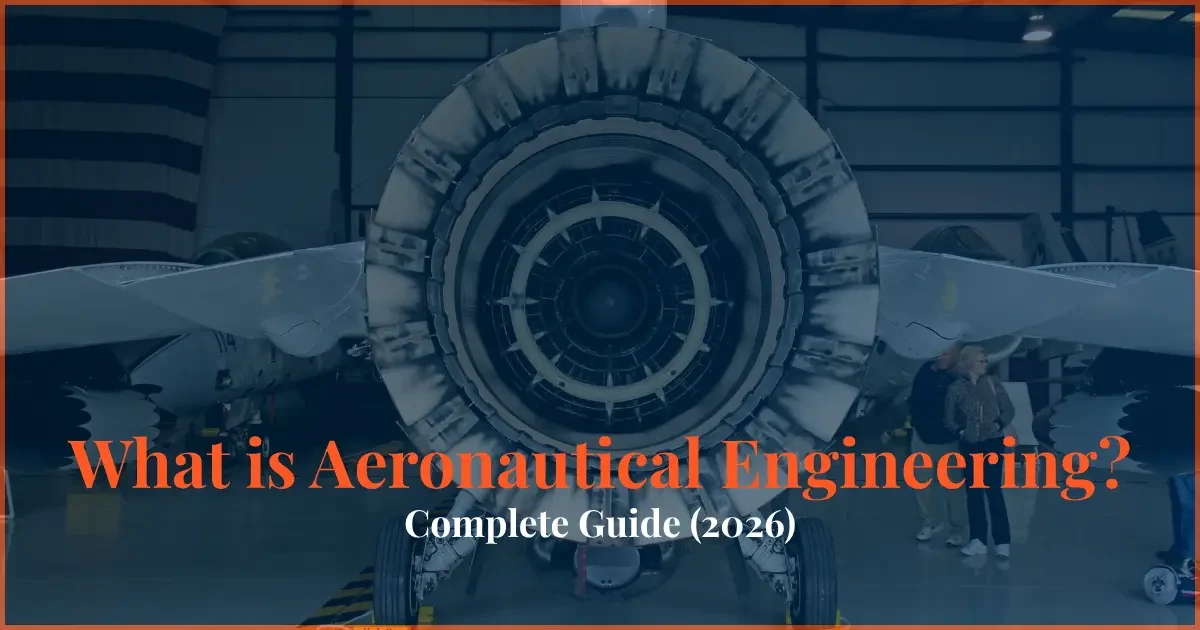
At its core, aeronautical engineering is the primary branch of engineering concerned with the design, development, construction, testing, and maintenance of aircraft that operate within the Earth’s atmosphere.
While the term is often used interchangeably with aerospace engineering, there is a technical distinction. Aeronautical engineering focuses specifically on machines that fly within our atmosphere (like commercial planes, helicopters, and drones), whereas aerospace engineering is a broader umbrella that also includes astronautical engineering (spacecraft and satellites).
The Evolution of Flight in 2026
In 2026, the definition has expanded. Today’s aeronautical engineers are working on:
- Electric Vertical Take-off and Landing (eVTOL): The “flying cars” of the future.
- Sustainable Aviation Fuel (SAF): Reducing the carbon footprint of global travel.
- Unmanned Aerial Vehicles (UAVs): Transforming logistics, agriculture, and defence.
Aeronautical Engineering vs. Aerospace Engineering: The Difference
If you are looking to apply for courses at SOACET, it is vital to understand which path suits your interests.
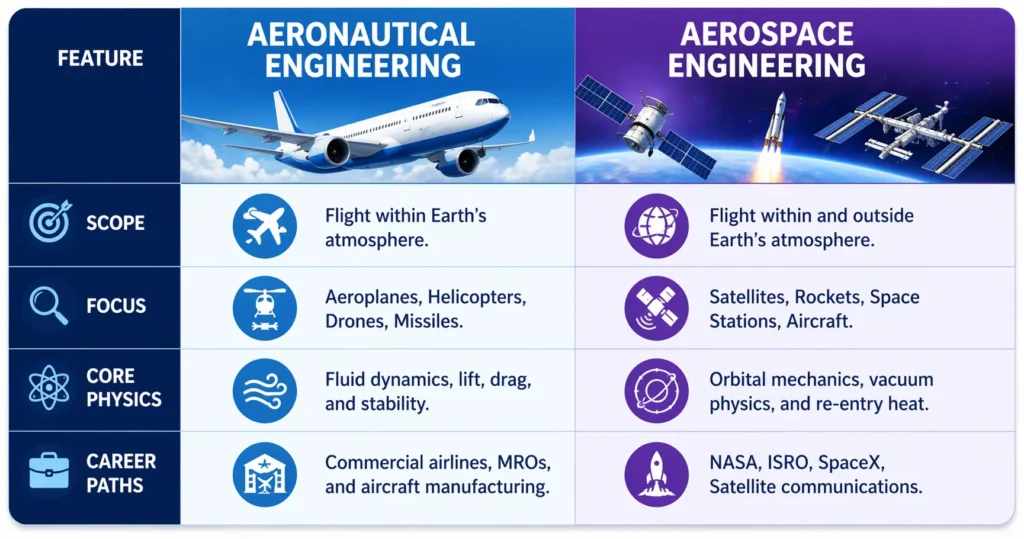
| Feature | Aeronautical Engineering | Aerospace Engineering |
| Scope | Flight within Earth’s atmosphere. | Flight within and outside Earth’s atmosphere. |
| Focus | Aeroplanes, Helicopters, Drones, Missiles. | Satellites, Rockets, Space Stations, Aircraft. |
| Core Physics | Fluid dynamics, lift, drag, and stability. | Orbital mechanics, vacuum physics, and re-entry heat. |
| Career Paths | Commercial airlines, MROs, and aircraft manufacturing. | NASA, ISRO, SpaceX, Satellite communications. |
Why Choose Aeronautical Engineering in 2026?
The global aviation market is projected to reach record highs by the end of the decade. Here is why this is a “future-proof” career choice:
1. Massive Industry Growth
With the “Make in India” initiative and global fleet expansions by giants like Indigo and Air India, the demand for skilled engineers in design and maintenance is at an all-time high.
Note: Book a FREE counselling session through SOACET to understand the AME admission process clearly.
2. Intellectual Challenge
This isn’t a “desk job.” It involves solving complex puzzles related to material science, thermodynamics, and aerodynamics. You are literally building the future.
3. Global Mobility
An aeronautical engineering degree is a global passport. Skills learned in India are applicable in the USA, UK, Germany, and the UAE, allowing for incredible international career growth.
Eligibility Criteria for Admission (2026 Update)
To embark on this journey, students must meet specific academic benchmarks. Most premier institutions, including the School of Aeronautics, follow these requirements:
For B.Tech (4 Years)
- Educational Background: Must have passed 10+2 (Higher Secondary) with Physics, Chemistry, and Mathematics (PCM).
- Minimum Marks: At least 45% to 55% aggregate (varies by university).
- Entrance Exams: You may need to clear exams like JEE Main or the SOACET Entrance Test.
For Diploma (3 Years)
- Educational Background: Completion of Class 10 with strong marks in Science and Math.
- Lateral Entry: If you have completed a 3-year diploma, you can join the B.Tech program directly in the 2nd year.
The 2026 Syllabus: What You’ll Study
The curriculum for aeronautical engineering is designed to take you from a curious student to a technical expert. In 2026, the syllabus will have been modernised to include digital twins and AI.
Core Subjects:
- Aerodynamics: The study of how air moves around objects. This is the “science of lift.”
- Aircraft Structures: Learning how to build airframes that are light yet strong enough to withstand extreme pressure.
- Propulsion: The study of jet engines, gas turbines, and the future of electric propulsion.
- Avionics: The electronic “brain” of the aircraft, including navigation, radar, and communication systems.
- Flight Mechanics: Analysing the stability and control of the aircraft during different phases of flight.
- Computational Fluid Dynamics (CFD): Using software like ANSYS and CATIA to simulate flight before a prototype is even built.
High-Paying Career Paths and Job Roles
An aeronautical engineering graduate doesn’t just work in hangars. The roles are diverse:
- Aircraft Design Engineer: Creating the blueprints for next-gen wings or fuselages.
- Flight Test Engineer: The “detectives” who analyse data from test flights to ensure safety.
- Systems Engineer: Ensuring the mechanical, electrical, and hydraulic systems work in harmony.
- Maintenance Engineer (AME): Overseeing the health and airworthiness of existing fleets.
- Drone Developer: Designing UAVs for delivery services like Amazon or for defence surveillance.
Salary Expectations in 2026 (India & Abroad)
One of the biggest draws to this field is the financial reward.
| Region | Experience Level | Average Salary (Per Annum) |
| India | Fresher (Entry Level) | ₹4.5 LPA – ₹8 LPA |
| India | Mid-Level (5-10 Years) | ₹12 LPA – ₹25 LPA |
| USA | Entry Level | $85,000 – $110,000 |
| Europe | Entry Level | €55,000 – €75,000 |
Top Recruiters: ISRO, DRDO, HAL, Airbus, Boeing, Rolls-Royce, Lockheed Martin, and Tata Advanced Systems.
Why Study at SOACET (School of Aeronautics)?
Choosing the right college is the most critical decision in your aeronautical engineering journey. SOACET has established itself as a leader in aviation education since 1996.
Why we stand out:
- Practical First Approach: We don’t just teach from books. Our students get hands-on exposure to real aircraft and engines.
- Modern Infrastructure: 30+ specialised labs equipped with the latest technology.
- Industry Placement: A 90%+ placement record with top airlines and manufacturing firms.
- Comprehensive Programs: From B.Tech to Integrated B.Tech+AME courses, we provide a 360-degree education.
Frequently Asked Questions (FAQs)
Q1. Is Aeronautical Engineering harder than Computer Science?
It involves more specialised physics and mathematics. However, for those who love machines and mechanics, it is often considered more rewarding and “tangible” than coding.
Q2. Can I become a pilot with an Aeronautical Engineering degree?
While the degree doesn’t make you a pilot, it gives you a massive advantage in ground school and technical knowledge. Many engineers later pursue a Commercial Pilot License (CPL).
Q3. Does this field have a future with climate change concerns?
Yes! The industry is pivoting toward “Green Aviation.” Engineers are needed now more than ever to design electric planes and hydrogen-fueled engines to save the planet.
Q4. Are there jobs for aeronautical engineers in the government sector?
Absolutely. In India, organisations like ISRO (Space), DRDO (Defence), and HAL (Manufacturing) are the largest employers of aeronautical talent.
Conclusion: Elevate Your Career
Aeronautical engineering is more than just a degree; it’s a commitment to pushing the boundaries of what is possible. Whether you want to design the next supersonic airliner or manage the maintenance of a global airline’s fleet, the sky is no longer the limit it is your workplace.
The first step toward your dream career starts with the right education. Start your journey today with the pioneers in aviation.
Explore our courses and take flight: Visit the SOACET Official Website