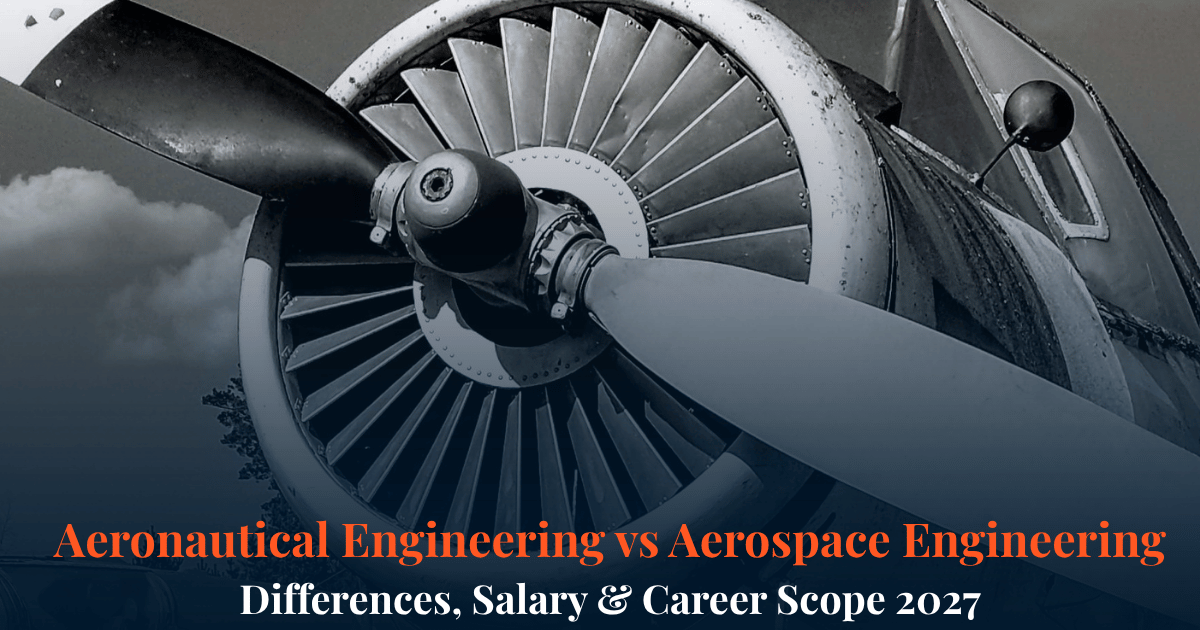
Aeronautical Engineering vs Aerospace Engineering: The main difference is that Aeronautical Engineering primarily focuses on aircraft operating within Earth’s atmosphere, while Aerospace Engineering covers both atmospheric flight and space vehicles. Both disciplines share subjects such as aerodynamics, propulsion, structures and flight mechanics, but aerospace programmes may also include spacecraft design, orbital mechanics and rocket technology.
For students planning an engineering career after Class 12, understanding these differences can help them select the right degree, college and career pathway.
Aeronautical Engineering vs Aerospace Engineering: Quick Comparison
| Feature | Aeronautical Engineering | Aerospace Engineering |
|---|---|---|
| Primary focus | Aircraft and atmospheric flight | Aircraft and spacecraft |
| Main applications | Aeroplanes, helicopters, drones | Aircraft, rockets, satellites, spacecraft |
| Typical degree | B.Tech/B.E. Aeronautical Engineering | B.Tech/B.E. Aerospace Engineering |
| Course duration | Usually 4 years | Usually 4 years |
| Common subjects | Aerodynamics, propulsion, aircraft structures | Aerodynamics, propulsion, structures, flight dynamics |
| Additional specialisation | Aircraft design, systems and performance | Spacecraft systems, orbital mechanics, space propulsion |
| Typical industries | Aviation, aircraft manufacturing, UAVs | Aviation, aerospace, defence and space technology |
| Career opportunities | Aircraft design, manufacturing, testing and research | Aircraft and spacecraft engineering, testing and research |
| Best suited for | Students particularly interested in aircraft | Students interested in aircraft and/or space technology |
Key takeaway: Aerospace Engineering is broader in scope, but this does not automatically make it better. A well-designed Aeronautical Engineering programme can be more suitable for students interested specifically in aircraft technology.
What Is Aeronautical Engineering?
Aeronautical Engineering is a branch of engineering concerned with the design, development, analysis, testing and performance of aircraft that operate within Earth’s atmosphere.
It combines principles of physics, mathematics, mechanical engineering and fluid dynamics to understand how aircraft fly and how their systems perform.
Aeronautical engineers may work on commercial aircraft, helicopters, military aircraft, unmanned aerial vehicles and other atmospheric flight systems.
What Does an Aeronautical Engineer Do?
Typical responsibilities may include:
- Designing and analysing aircraft components.
- Studying lift, drag and aerodynamic performance.
- Evaluating aircraft structures and materials.
- Supporting propulsion and flight-control system development.
- Conducting simulations and engineering tests.
- Improving aircraft efficiency, reliability and performance.
- Working with manufacturing and quality-assurance teams.
For example, an aeronautical engineer might analyse an aircraft wing to determine whether it meets structural and aerodynamic requirements.
Students seeking a detailed introduction can explore the Aeronautical Engineering course guide.
What Is Aerospace Engineering?
Aerospace Engineering is a broader engineering discipline covering the development, testing and operation of vehicles that fly within the atmosphere or travel through space.
It includes two closely related areas:
Aeronautics
Aeronautics deals primarily with aircraft and atmospheric flight, including aeroplanes, helicopters and drones.
Astronautics
Astronautics focuses on space-related engineering, including satellites, launch vehicles, spacecraft, orbital motion and space missions.
However, not every Aerospace Engineering degree gives equal emphasis to both areas. Individual universities may offer different electives, laboratories and specialisations.
IIT Bombay’s Department of Aerospace Engineering, for example, identifies aerodynamics, dynamics and control, propulsion, structures and systems design as important specialisation areas.
Key Differences Between Aeronautical and Aerospace Engineering
Although both disciplines share a strong engineering foundation, they differ in the types of systems students may study and the projects they may pursue.
1. Aircraft vs Spacecraft
Aeronautical Engineering mainly deals with aircraft operating within the atmosphere.
Aerospace Engineering covers aircraft as well as systems such as launch vehicles, satellites and spacecraft.
An aircraft wing design project is closely associated with aeronautics, while a satellite orbital analysis project belongs more directly to astronautics.
2. Technical Knowledge
Both fields require knowledge of mathematics, fluid mechanics, thermodynamics, structures, materials and engineering design.
Space-oriented aerospace work may additionally require knowledge of orbital mechanics, spacecraft thermal systems, rocket propulsion and space mission design.
AME Exam 2027 Registration Started! Apply now for SOACET 2027 before 31 March 2027. Register Now and take the first step towards your aviation career.
3. Engineering Applications
Aeronautical engineers commonly work on aircraft performance, aerodynamic analysis, structures, manufacturing and flight systems.
Aerospace engineers may work in these same areas or pursue space-related projects.
4. Career Flexibility
The two fields have substantial overlap.
An Aeronautical Engineering graduate may qualify for certain aerospace-sector roles, while an Aerospace Engineering graduate may work in aircraft-focused positions.
Actual eligibility depends on the employer, technical skills, experience and job requirementsnot simply the degree title.
Aeronautical Engineering vs Aerospace Engineering Subjects
Students often assume that the two degrees have completely different syllabuses. In reality, they share many core engineering subjects.
Common Subjects
| Subject | What Students Learn |
|---|---|
| Engineering Mathematics | Calculus, differential equations and numerical methods |
| Engineering Mechanics | Forces, motion and mechanical systems |
| Fluid Mechanics | Behaviour of liquids and gases |
| Aerodynamics | Airflow, lift, drag and aircraft performance |
| Thermodynamics | Heat, energy and engineering processes |
| Propulsion | Principles of thrust generation |
| Engineering Materials | Material properties and applications |
| Structural Analysis | Loads, stresses and structural behaviour |
| Flight Mechanics | Stability, motion and flight performance |
| Control Systems | Modelling and controlling dynamic systems |
These subjects are consistent with areas represented in IIT Kanpur’s Aerospace Engineering curriculum.
Aeronautical Engineering-Focused Subjects
Depending on the institution, students may study aircraft structures, aircraft design, aircraft performance, gas turbine engines, avionics, computational fluid dynamics and flight testing.
These subjects prepare students to analyse and solve problems involving atmospheric flight vehicles.
Aerospace Engineering-Focused Subjects
Aerospace programmes may additionally offer rocket propulsion, orbital mechanics, satellite technology, spacecraft systems, space mission analysis and launch vehicle design.
For example, the Indian Institute of Space Science and Technology includes aircraft-related fundamentals alongside introductory rocket propulsion and orbital mechanics in its Aerospace Engineering curriculum.
Important: Course names alone do not establish the complete syllabus. Students should compare the official semester-wise curriculum, laboratory facilities and electives of each university.
Eligibility for Aeronautical and Aerospace Engineering After 12th
Students interested in either discipline generally begin by completing Class 12 or an equivalent qualification.
Educational Qualification
For many B.Tech programmes, Physics, Chemistry and Mathematics (PCM) provide the standard academic preparation.
However, eligibility rules vary across institutions and admission routes.
The AICTE Approval Process Handbook 2024–2027 specifies broader engineering eligibility provisions, while individual universities may impose additional subject combinations, minimum marks or entrance-exam requirements.
Therefore, students should always verify the latest admission brochure before applying.
Entrance Exams
Depending on the institution, admission routes may include:
- JEE Main
- JEE Advanced
- State-level engineering entrance examinations
- University-specific entrance examinations
- Institution-specific admission or selection processes
For example, IIT Bombay’s undergraduate Aerospace Engineering admissions follow the JEE-based admission route.
Other institutions may use different admission systems.
Course Duration
A standard B.Tech or B.E. programme in either field generally takes four academic years.
Integrated and dual-degree programmes may have different durations.
For students exploring Aeronautical Engineering programmes at the School of Aeronautics, the SOACET 2027 entrance examination is a relevant institution-specific admission pathway. Students should review the current eligibility and programme details before applying.
Aeronautical vs Aerospace Engineering Salary in India
Salary is one of the most common factors students consider when comparing these engineering disciplines.
However, there is no universal salary difference between Aeronautical Engineering and Aerospace Engineering graduates.
Actual earnings depend on the job role, employer, location, technical expertise, experience and responsibilities.
Factors That Affect Salary
| Factor | Impact on Career Earnings |
|---|---|
| Technical skills | Specialist knowledge may improve suitability for certain roles |
| Work experience | Experienced engineers may qualify for more advanced positions |
| Employer | Compensation structures differ across organisations |
| Job role | Design, research, manufacturing and testing roles may pay differently |
| Location | Regional labour markets and employer requirements vary |
| Qualifications | Advanced study or specialised training may support certain career paths |
Which Field Offers a Higher Salary?
Neither degree guarantees a higher salary.
An Aeronautical Engineering graduate working in aircraft design may earn more than an Aerospace Engineering graduate in another role, or vice versa.
Students should compare salaries for specific positions, such as Design Engineer, Structural Analysis Engineer, Propulsion Engineer or Aerospace Systems Engineer, rather than comparing degree names alone.
For detailed experience-wise salary information, explore the Aeronautical Engineering Salary in India guide.
Career Opportunities in Aeronautical and Aerospace Engineering
Both disciplines can lead to engineering roles in aviation, aerospace manufacturing, research, defence-related technology and specialised engineering services.
Aeronautical Engineering Career Options
| Job Role | Typical Responsibilities |
|---|---|
| Aircraft Design Engineer | Supports aircraft and component design |
| Aerodynamics Engineer | Analyses airflow and aerodynamic performance |
| Aircraft Structural Engineer | Evaluates loads, stresses and structural integrity |
| Propulsion Engineer | Works on engine and propulsion-related systems |
| Flight Test Engineer | Supports aircraft testing and performance evaluation |
| Manufacturing Engineer | Works on aircraft production processes |
| UAV Engineer | Supports drone design, development and testing |
Aerospace Engineering Career Options
| Job Role | Typical Responsibilities |
|---|---|
| Aerospace Design Engineer | Develops aircraft or spacecraft components |
| Spacecraft Systems Engineer | Works on integrated spacecraft systems |
| Satellite Engineer | Supports satellite design and subsystem development |
| Rocket Propulsion Engineer | Analyses propulsion systems for launch vehicles |
| Guidance and Control Engineer | Develops modelling and control solutions |
| Aerospace Research Engineer | Works on advanced aerospace technologies |
| Structural Analysis Engineer | Evaluates aerospace components and structures |
These roles represent possible career pathways, not guaranteed placements or job titles available to every graduate.
Can Aeronautical Engineers Work in ISRO or DRDO?
Yes, Aeronautical Engineering graduates may be eligible for certain roles in Indian space and defence research organisations, provided they meet the requirements of the specific recruitment notification.
For example, ISRO has previously included Aeronautical Engineering and Aerospace Engineering among accepted specialisations for certain Scientist/Engineer recruitment categories.
However, eligibility is notification-specific. Not every ISRO or DRDO vacancy accepts both degrees.
Students interested in these organisations should develop strong foundations in mathematics, mechanics, structures, propulsion, programming and relevant engineering applications.
They should also monitor official recruitment announcements rather than assuming that a particular degree guarantees selection.
Which Is Better: Aeronautical or Aerospace Engineering?
The better choice depends on your interests, career goals, preferred curriculum and available institutions.
Choose Aeronautical Engineering If You:
- Are particularly interested in aeroplanes, helicopters and drones.
- Want to study aircraft design and performance.
- Prefer projects involving aerodynamic analysis and aircraft structures.
- Are interested in aviation manufacturing and aircraft engineering.
- Find an institution offering strong aircraft-focused laboratories and projects.
Choose Aerospace Engineering If You:
- Are interested in both aircraft and space technology.
- Want to explore satellites, rockets or spacecraft systems.
- Prefer a programme offering space-related electives.
- Are considering higher studies in aerospace or space engineering.
- Find an institution with suitable research facilities and academic specialisations.
Student Decision Checklist
Before choosing either programme, ask yourself:
- Am I more interested in aircraft, spacecraft or both?
- Does the college offer relevant laboratories and practical projects?
- What subjects and electives are included in the official syllabus?
- Are internships and industry exposure available?
- Does the programme meet the applicable recognition and approval requirements?
- What are the total fees and likely financial commitments?
- Which employers and job roles match the skills taught?
- Will the degree support my future higher-study plans?
Recommendation: Choose the programme that offers the strongest combination of curriculum quality, practical learning, affordability and relevance to your career goals.
Aeronautical Engineering vs Aircraft Maintenance Engineering
Students should also understand that Aeronautical Engineering and Aircraft Maintenance Engineering (AME) are different educational and professional pathways.
Aeronautical Engineering is primarily an engineering discipline focused on aircraft design, analysis, development and related technical activities.
Aircraft Maintenance Engineering focuses on aircraft inspection, maintenance and airworthiness-related responsibilities.
| Feature | Aeronautical Engineering | Aircraft Maintenance Engineering |
|---|---|---|
| Main focus | Aircraft design and engineering | Aircraft maintenance and airworthiness |
| Typical pathway | Engineering degree | Approved training, examinations and required experience |
| Technical activities | Analysis, development, design and testing | Inspection, maintenance and troubleshooting |
| Professional regulation | Applicable academic and engineering requirements | DGCA licensing requirements for licensed privileges |
| Career objective | Engineering and development roles | Aircraft maintenance and certification-related roles |
In India, DGCA regulates Aircraft Maintenance Engineer licensing through CAR-66 and related requirements.
Completing an AME training programme alone does not automatically grant an AME licence.
Students interested in maintenance careers should explore the Aircraft Maintenance Engineering course guide and review DGCA’s official licensing requirements.
Future Scope of Aeronautical and Aerospace Engineering in India
India’s aviation and aerospace ecosystem includes commercial aviation, aircraft manufacturing, maintenance services, unmanned aircraft systems, research and space technology.
These sectors involve technical disciplines such as aerodynamics, propulsion, structures, materials, manufacturing, electronics and systems engineering.
Potential long-term areas of interest include:
Aircraft Manufacturing and Engineering
Aircraft manufacturing and component development require engineers with expertise in design, materials, production, testing and quality assurance.
Unmanned Aerial Vehicles
Drones and other unmanned aircraft create applications for aerodynamics, flight controls, embedded systems and engineering design.
Space Technology
Satellite systems, launch vehicles and space research provide specialised opportunities for graduates with relevant technical knowledge.
Advanced Simulation and Digital Engineering
Computational fluid dynamics, structural simulation, computer-aided design and numerical modelling are valuable skills across both disciplines.
Research and Higher Education
Graduates may pursue postgraduate study or research in aerodynamics, propulsion, structures, flight mechanics, control systems or space technology.
The growth of an industry does not automatically guarantee employment. Students should build demonstrable technical skills, practical experience and a strong academic foundation.
Frequently Asked Questions
1. What is the main difference between Aeronautical Engineering and Aerospace Engineering?
Aeronautical Engineering mainly focuses on aircraft operating within Earth’s atmosphere. Aerospace Engineering covers both atmospheric aircraft and space vehicles, including satellites, rockets and spacecraft.
2. Is Aerospace Engineering better than Aeronautical Engineering?
Not necessarily. Aerospace Engineering offers a broader academic scope, while Aeronautical Engineering may provide a more focused aircraft-oriented pathway. The better option depends on the institution, curriculum and student’s career goals.
3. Which has a higher salary in India?
Neither degree automatically provides a higher salary. Earnings depend on the role, employer, experience, location and specialised skills.
4. Can Aeronautical Engineering graduates work in ISRO?
They may qualify for certain ISRO recruitment categories when Aeronautical Engineering is listed as an accepted qualification. Eligibility must be checked against each official recruitment notification.
5. Can Aerospace Engineering graduates work in airlines?
Yes, some graduates may work in airline-related engineering, technical, planning or support roles, depending on the position and required qualifications. A degree alone does not provide the privileges of a licensed Aircraft Maintenance Engineer.
6. Is Aeronautical Engineering difficult?
It can be academically demanding because it involves mathematics, physics, fluid mechanics, thermodynamics and structural analysis. Consistent study and practical problem-solving can help students manage the coursework.
7. Can I study Aerospace Engineering after Class 12 PCM?
Yes. Class 12 PCM is a common preparation route for Aerospace Engineering degrees in India. Students must also satisfy the chosen institution’s admission and entrance-examination requirements.
8. Can an Aeronautical Engineer work on spacecraft projects?
Potentially, yes. Skills in structures, propulsion, control systems and computational analysis may transfer to certain space-related roles. Additional knowledge or qualifications may be required.
9. Which course is better for aircraft design?
Both degrees can support aircraft design careers. Compare the institution’s aircraft design courses, laboratories, projects and faculty expertise rather than relying only on the degree name.
10. Is Aeronautical Engineering the same as AME?
No. Aeronautical Engineering focuses on aircraft engineering and development, while AME is associated with aircraft maintenance and airworthiness. Licensed AME responsibilities are subject to DGCA requirements.
Conclusion
Aeronautical Engineering and Aerospace Engineering are closely related disciplines that share many technical subjects and career opportunities.
The primary difference lies in their scope: Aeronautical Engineering concentrates on aircraft and atmospheric flight, while Aerospace Engineering also includes spacecraft and space-related systems.
For students interested specifically in aircraft design, performance and aviation technology, Aeronautical Engineering can be a suitable choice. Those who want to explore aircraft alongside rockets, satellites and space systems may prefer Aerospace Engineering.
Before selecting a course, compare the official syllabus, institutional facilities, eligibility requirements, fees and career pathways.
Explore Aeronautical Engineering Admission 2027
Students interested in pursuing Aeronautical Engineering at the School of Aeronautics, Neemrana, can explore the SOACET 2027 entrance examination, programme eligibility and admission process.
References and Official Sources
- IIT Bombay: Department of Aerospace Engineering, Academics and Curriculum.
- IIT Kanpur: Aerospace Engineering Department, Academic Courses.
- AICTE: Approval Process Handbook 2024–2027.
- Directorate General of Civil Aviation: AME Licensing and Examination Information.
- Indian Space Research Organisation: Official Recruitment Notices and Eligibility Requirements.