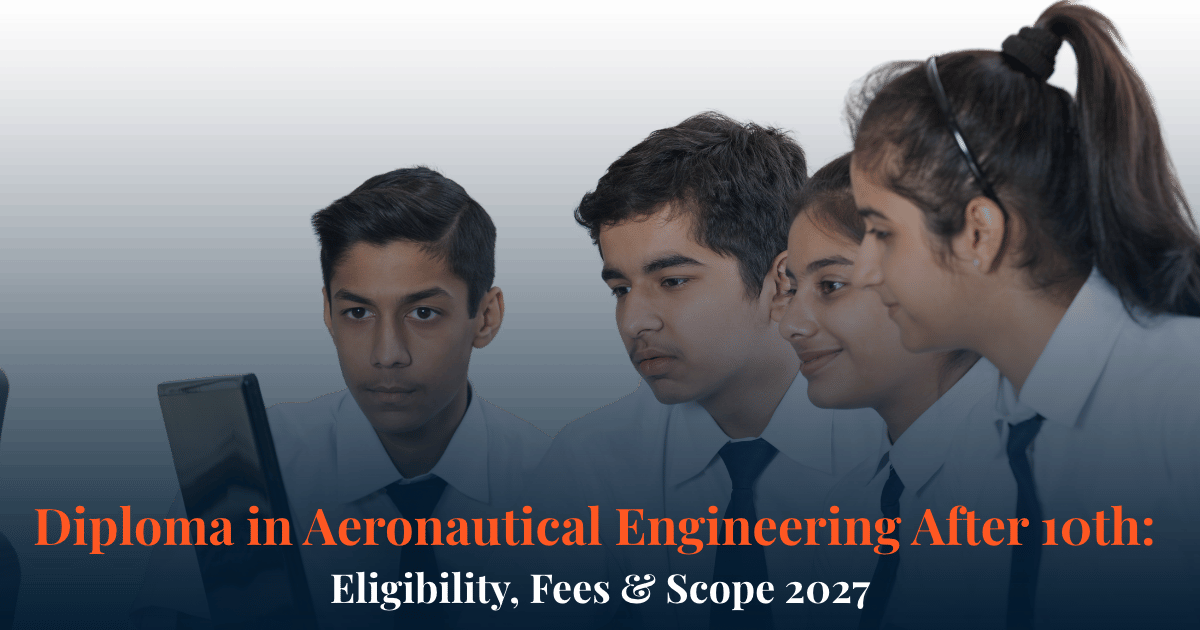
Students can pursue a Diploma in Aeronautical Engineering after 10th at institutions offering recognised diploma programmes, subject to their admission requirements. It is generally a three-year technical course covering aircraft systems, aerodynamics, engineering materials, propulsion and manufacturing fundamentals.
After completing the diploma, eligible students can explore technical employment opportunities or pursue B.Tech Aeronautical Engineering through lateral entry.
For students interested in aircraft technology from an early age, this diploma can provide a foundation for higher education and a future career in the aviation industry.
Diploma in Aeronautical Engineering: Course Highlights
| Particulars | Details |
|---|---|
| Course Name | Diploma in Aeronautical Engineering |
| Course Level | Engineering Diploma |
| Course Duration | Generally 3 years |
| Educational Qualification | Class 10 or equivalent |
| Minimum Marks | As per institutional requirements |
| Admission Process | Merit-based or entrance examination |
| Course Mode | Full-time |
| Main Subjects | Aerodynamics, aircraft structures, propulsion and engineering fundamentals |
| Course Fees | Vary by institution and location |
| Further Education | B.Tech/B.E. through eligible admission routes |
| Career Opportunities | Technical, manufacturing and engineering support roles |
What Is a Diploma in Aeronautical Engineering?
A Diploma in Aeronautical Engineering is a technical education programme that introduces students to aircraft technology, engineering principles and practical applications in the aviation sector.
The programme combines mechanical, electrical and electronics engineering fundamentals with aircraft-related subjects.
Students may learn about aircraft construction, flight principles, engineering drawings, aircraft systems, manufacturing techniques and maintenance fundamentals.
Unlike a four-year B.Tech Aeronautical Engineering degree, a diploma generally places greater emphasis on foundational technical knowledge and applied engineering skills.
It can serve as an academic pathway for students who want to enter technical education after Class 10 instead of completing the conventional Class 12 route.
Can You Study Aeronautical Engineering After 10th?
Yes, students can begin studying aeronautical engineering through a diploma programme after completing Class 10 from a recognised educational board.
The AICTE Approval Process Handbook 2024–2027 identifies a three-year engineering diploma as an educational pathway after Class 10 or SSC.
However, students cannot ordinarily enter a regular four-year B.Tech Aeronautical Engineering programme directly after Class 10.
They can consider two educational routes:
- Complete Class 10, pursue an engineering diploma and subsequently apply for B.Tech lateral entry.
- Complete Class 12 with Physics, Chemistry and Mathematics, followed by a regular B.Tech programme.
Both routes can lead towards an engineering degree, provided students meet the applicable admission requirements.
Diploma in Aeronautical Engineering Eligibility 2027
Admission requirements for diploma programmes vary across institutions and state technical education authorities.
Educational Qualification
Students should generally have completed Class 10 or an equivalent examination from a recognised board.
Mathematics, Science and English are commonly relevant subjects for admission and subsequent technical studies.
Minimum Marks Required
The minimum percentage required depends on the institution and applicable admission regulations.
For example, Acharya Polytechnic specifies Class 10 completion with English, Science and Mathematics and a minimum aggregate of 35%.
This requirement should not be interpreted as a universal eligibility criterion for every diploma college in India.
Age Requirements
Age-related conditions, where applicable, are determined by the institution or state admission authority.
Students and parents should review the official 2027 admission brochure before submitting an application.
Entrance Examination
Admission may be based on Class 10 marks, state-level polytechnic entrance examinations or institution-specific selection procedures.
JEE Main and JEE Advanced are not generally required for first-year engineering diploma admission.
Diploma in Aeronautical Engineering Course Duration
The standard Diploma in Aeronautical Engineering programme generally takes three academic years, often divided into six semesters.
The course normally progresses from basic engineering principles to aircraft-related technical subjects and practical projects.
| Academic Year | Indicative Learning Focus |
|---|---|
| First Year | Mathematics, physics, engineering drawing and workshop fundamentals |
| Second Year | Engineering mechanics, materials, thermodynamics and aircraft fundamentals |
| Third Year | Aerodynamics, aircraft systems, propulsion and technical projects |
The exact semester structure depends on the curriculum prescribed by the institution and its affiliating technical education authority.
Students should download the official syllabus before selecting a college.
Looking for AME Admission 2027? Book your FREE counselling session through SOACET 2027 and get step-by-step guidance on eligibility, application, entrance exam and counselling.
Diploma in Aeronautical Engineering Fees in India 2027
Diploma in Aeronautical Engineering fees vary depending on the institution, location, infrastructure, accommodation requirements and available scholarships.
Government polytechnics may have different fee structures from private aviation and engineering institutions.
Students should consider the complete cost of education rather than comparing tuition fees alone.
Diploma Course Fee Components
| Fee Component | Description |
|---|---|
| Tuition Fees | Academic instruction and coursework |
| Admission Fees | Registration and enrolment charges |
| Laboratory Fees | Technical laboratories and practical training |
| Examination Fees | Semester and board examination charges |
| Hostel Fees | Accommodation, where required |
| Mess Charges | Food and residential expenses |
| Uniform and Equipment | Workshop clothing, stationery and technical materials |
| Transportation | Daily travel and commuting expenses |
How to Calculate the Total Diploma Course Fees
For financial planning, students can estimate the total three-year cost using the following illustrative examples.
| Example Annual Tuition Fee | Total Tuition for 3 Years |
|---|---|
| ₹25,000 | ₹75,000 |
| ₹50,000 | ₹1,50,000 |
| ₹75,000 | ₹2,25,000 |
| ₹1,00,000 | ₹3,00,000 |
These figures are calculation examples, not verified college fee quotations or national average fees. Hostel, examination and other charges are excluded.
Students should request a written fee structure from their shortlisted institutions for the 2027 academic session.
Diploma in Aeronautical Engineering Subjects and Syllabus
The curriculum introduces engineering concepts that help students understand aircraft construction, performance and technical systems.
The subjects may include the following:
| Subject | Learning Area |
|---|---|
| Engineering Mathematics | Mathematical calculations and problem-solving |
| Engineering Physics | Motion, forces, energy and physical principles |
| Engineering Drawing | Technical drawings and component interpretation |
| Engineering Mechanics | Forces and mechanical systems |
| Aerodynamics | Aircraft lift, drag and airflow |
| Aircraft Structures | Aircraft construction and structural fundamentals |
| Aircraft Propulsion | Engine and thrust generation principles |
| Aircraft Materials | Properties and uses of aviation materials |
| Electrical and Electronics Engineering | Electrical circuits and electronic systems |
| Avionics Fundamentals | Introduction to aircraft electronic systems |
| Manufacturing Technology | Production methods and workshop processes |
| Aircraft Maintenance Fundamentals | Introduction to inspection and maintenance concepts |
Practical Training
Depending on the institution, practical learning may involve engineering workshops, computer-aided drawing, laboratory experiments, component studies and technical projects.
Students should prioritise colleges that offer meaningful practical exposure alongside classroom teaching.
Practical training within a diploma course should not be confused with the experience and licensing requirements prescribed for Aircraft Maintenance Engineers.
For a broader understanding of engineering degree subjects, students can also explore Aeronautical Engineering courses and syllabus.
Diploma in Aeronautical Engineering Admission Process 2027
The admission process depends on the institution and applicable state-level technical education regulations.
Students can generally follow these steps:
Step 1: Complete Class 10
Pass the required school examination and satisfy the minimum eligibility criteria.
Step 2: Shortlist Diploma Colleges
Compare available programmes, institutional approvals, academic facilities, practical training and fees.
Step 3: Check Admission Requirements
Determine whether admission requires an entrance examination, merit-based selection or counselling.
Step 4: Submit the Application
Complete the application form and provide the required academic and personal documents.
Step 5: Attend Counselling or Selection
Participate in the applicable admission and seat-allocation process.
Step 6: Confirm Admission
Complete document verification and pay the prescribed fees after reviewing the admission terms.
Commonly requested documents include Class 10 mark sheets, school-leaving certificates, identity documents, photographs and category certificates, where applicable.
Diploma in Aeronautical Engineering Colleges in India
Students should choose a diploma college based on programme recognition, curriculum, infrastructure and educational quality rather than advertisements alone.
Acharya Polytechnic in Bengaluru is one example of an institution that publicly lists a three-year Diploma in Aeronautical Engineering programme.
Students can also explore state technical education admission portals to identify other available programmes.
How to Choose the Right Diploma College
Before applying, verify the following:
- Applicable AICTE approval and affiliation for the specific programme.
- Current availability of the Aeronautical Engineering diploma.
- Engineering laboratories and workshop facilities.
- Faculty qualifications and technical experience.
- Complete course fees and refund policies.
- Internship and practical training opportunities.
- Documented placement outcomes.
- Eligibility for further engineering education.
Students should verify approvals for the relevant academic year instead of relying on outdated approval certificates.
Career Opportunities After a Diploma in Aeronautical Engineering
Diploma holders can explore entry-level technical and engineering support positions in aviation, aerospace manufacturing and related industries.
The availability of jobs depends on individual qualifications, technical skills, employer requirements and industry demand.
Job Roles After an Aeronautical Engineering Diploma
| Job Role | Typical Responsibilities |
|---|---|
| Aircraft Manufacturing Technician | Supports aircraft component production and assembly |
| Aerospace Technician | Assists with aerospace-related technical activities |
| CAD Technician | Prepares technical drawings and computer-aided models |
| Quality Control Assistant | Supports component inspection and quality checks |
| Production Technician | Assists manufacturing and production processes |
| Aircraft Maintenance Assistant | Supports permitted maintenance-related tasks under appropriate supervision |
| Technical Support Assistant | Assists engineering documentation and technical activities |
| Engineering Laboratory Technician | Supports laboratory experiments and equipment operation |
A diploma does not automatically qualify a graduate for every engineering position or licensed aircraft maintenance responsibility.
Students interested in aircraft design, advanced analysis and engineering development may benefit from pursuing a suitable B.Tech or B.E. degree.
Diploma in Aeronautical Engineering Salary in India
Salary after a Diploma in Aeronautical Engineering depends on the job profile, employer, technical skills, location and work experience.
Entry-level diploma holders generally compete for technician, production and technical support positions rather than graduate-level engineering roles.
Factors Affecting Diploma Salary
- Practical engineering knowledge and workshop skills.
- Computer-aided design and technical software proficiency.
- Internship and industrial training experience.
- Employer and employment location.
- Additional qualifications and specialised technical training.
Students should compare current job advertisements and actual institutional placement records to understand realistic salary expectations.
There is no fixed nationwide starting salary for Aeronautical Engineering diploma holders.
Those planning to complete an engineering degree can explore the Aeronautical Engineering Salary in India guide to understand graduate-level career prospects.
Can You Pursue B.Tech Aeronautical Engineering After Diploma?
Yes, eligible diploma holders can apply for B.Tech Aeronautical Engineering through lateral entry at institutions offering this admission pathway.
Lateral entry generally allows students to enter the second year of a four-year engineering degree, subject to the applicable academic and admission requirements.
B.Tech Lateral Entry Eligibility
The AICTE Approval Process Handbook 2024–2027 specifies a general qualifying diploma threshold of at least 45%, with 40% for eligible reserved-category candidates, for the second-year engineering degree lateral entry pathway.
However, universities and institutions may have additional eligibility requirements, accepted diploma branches and selection procedures.
Applicants should check the specific institution’s latest admission criteria.
B.Tech Lateral Entry Course Duration
A standard second-year lateral entry pathway generally requires three additional academic years to complete the engineering degree.
| Educational Stage | Typical Duration |
|---|---|
| Diploma after Class 10 | 3 years |
| B.Tech through second-year lateral entry | 3 years |
| Total academic duration after Class 10 | 6 years |
Eligible diploma holders interested in studying at the School of Aeronautics can explore the B.Tech Aeronautical Engineering Lateral Entry admission pathway.
Students interested in combining engineering education with aircraft maintenance training can also review the Integrated B.Tech and AME Lateral Entry programme and its separate eligibility requirements.
Diploma vs Class 12 PCM: Which Is Better for Aeronautical Engineering?
Students interested in Aeronautical Engineering after Class 10 can choose between a diploma pathway and conventional higher secondary education.
| Comparison | Diploma Route | Class 12 PCM Route |
|---|---|---|
| Starting Point | After Class 10 | After Class 10 |
| Initial Duration | 3 years | 2 years |
| Learning Focus | Applied technical education | Academic preparation in science and mathematics |
| B.Tech Entry | Second-year lateral entry, if eligible | Regular first-year admission |
| B.Tech Duration | Generally 3 additional years | Generally 4 additional years |
| Total Time After Class 10 | Approximately 6 years | Approximately 6 years |
| Intermediate Qualification | Engineering Diploma | Class 12 Certificate |
| Suitable For | Students seeking early technical education | Students seeking broader academic and degree options |
Which Route Should You Choose?
A diploma may be suitable for students who prefer practical engineering education and have a clear interest in technical subjects.
Class 12 PCM may be more suitable for students who want to keep a wider range of university and academic options open.
Not every engineering institution accepts lateral entry. Students targeting a particular university should check its admission policy before deciding.
Diploma in Aeronautical Engineering vs Aircraft Maintenance Engineering
A Diploma in Aeronautical Engineering and Aircraft Maintenance Engineering (AME) are different educational and professional pathways.
| Feature | Aeronautical Engineering Diploma | Aircraft Maintenance Engineering |
|---|---|---|
| Main Focus | Aircraft technology and engineering fundamentals | Aircraft maintenance and airworthiness |
| Educational Pathway | Technical diploma | Applicable maintenance training and licensing pathway |
| Main Activities | Engineering support, manufacturing and technical work | Inspection, maintenance and troubleshooting |
| Professional Outcome | Diploma qualification | Licensing eligibility subject to DGCA requirements |
| Aircraft Certification Privileges | Not automatically granted | Subject to valid licence and applicable authorisations |
| Higher Education | Eligible engineering degree pathways | Depends on qualifications and admission requirements |
In India, aircraft maintenance licensing is regulated by the Directorate General of Civil Aviation (DGCA).
An Aeronautical Engineering diploma alone does not grant an Aircraft Maintenance Engineer licence or aircraft maintenance certification privileges.
Students interested specifically in aircraft maintenance should explore the Aircraft Maintenance Engineering course and its regulatory requirements.
Future Scope of Diploma in Aeronautical Engineering in India
India’s aviation and aerospace ecosystem offers applications for technical knowledge across aircraft manufacturing, maintenance services, unmanned aircraft systems and engineering support.
Diploma holders may explore the following areas:
Aircraft Manufacturing
Aircraft component production, assembly, engineering drawings and industrial quality control.
Maintenance, Repair and Overhaul (MRO)
Technical support and permitted aircraft-related activities, subject to employer and regulatory requirements.
Drone Technology
Mechanical systems, component integration, manufacturing and technical support for unmanned aircraft.
Higher Engineering Education
B.Tech or B.E. programmes and subsequent specialisation in aircraft design, propulsion, structures or aerospace technology.
Industry growth can create opportunities, but employment depends on individual qualifications, practical capabilities and recruitment conditions.
Frequently Asked Questions
Can I pursue Aeronautical Engineering after 10th?
Yes. Students can pursue a recognised Diploma in Aeronautical Engineering after Class 10, subject to institutional eligibility and admission requirements.
Is a Diploma in Aeronautical Engineering a three-year course?
Generally, yes. The standard engineering diploma pathway after Class 10 takes three academic years.
What percentage is required for an Aeronautical Engineering diploma?
Minimum marks vary across institutions. Students should check the applicable college or state technical education admission requirements.
What are the fees for a Diploma in Aeronautical Engineering?
Fees vary depending on the institution, location, accommodation and training facilities. Students should obtain the official fee structure before applying.
Is JEE compulsory for diploma admission?
No. JEE is not generally required for first-year diploma admission. Applicable state-level or institution-specific admission requirements may apply.
Can I pursue B.Tech after a Diploma in Aeronautical Engineering?
Yes. Eligible diploma holders can apply for B.Tech Aeronautical Engineering through lateral entry at institutions offering this pathway.
Can diploma holders work in airlines?
Diploma holders may qualify for certain technical support positions, depending on employer requirements. Licensed aircraft maintenance responsibilities require additional qualifications and authorisations.
What is the salary after a Diploma in Aeronautical Engineering?
Salary depends on the job role, employer, skills, experience and location. There is no guaranteed starting salary applicable to every diploma graduate.
Is a Diploma in Aeronautical Engineering equivalent to AME?
No. An engineering diploma is an academic qualification, while licensed Aircraft Maintenance Engineering involves separate regulatory requirements.
Which is better after 10th: Diploma or Class 12 PCM?
The better option depends on the student’s interests and academic objectives. A diploma provides early technical education, while Class 12 PCM generally offers broader university admission options.
Conclusion
A Diploma in Aeronautical Engineering after 10th can provide a technical foundation for students interested in aircraft technology, engineering and aviation.
The three-year programme introduces fundamental engineering concepts, aircraft systems and practical technical skills.
After completing the diploma, students may explore suitable technical employment or continue their education through B.Tech Aeronautical Engineering lateral entry.
Before selecting a programme, students should carefully compare institutional recognition, eligibility, course fees, curriculum, practical training and higher education opportunities.
Explore B.Tech Aeronautical Engineering Admission After Diploma
Students who have completed an eligible engineering diploma can explore B.Tech Aeronautical Engineering and integrated aviation education pathways at the School of Aeronautics, Neemrana.
Explore B.Tech Aeronautical Engineering Lateral Entry
SOA Admission Portal: www.ameadmission.org
College Portal: www.soaneemrana.org