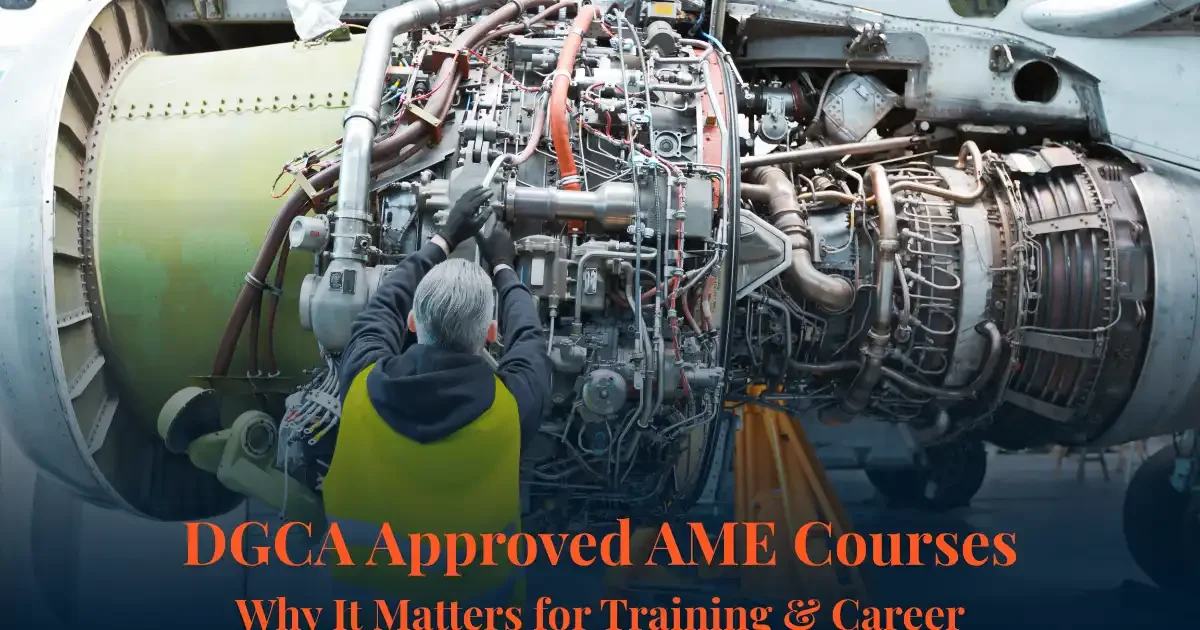
If you’re planning to pursue Aircraft Maintenance Engineering, choosing an institute is not just about fees, campus facilities, or placement advertisements. One of the first things you should understand is the regulatory status of the AME training organisation itself. Searching for a DGCA-approved AME Course is the right instinct, but most students stop at the phrase itself without understanding what that approval actually covers, what it doesn’t, and how it connects to the much longer path toward actually becoming a licensed Aircraft Maintenance Engineer.
This guide goes past the marketing phrase. It explains what DGCA approval means in practical, regulatory terms, why it matters, what it does not automatically guarantee, and exactly how to verify it yourself before you commit fees to any institute.
Read Before: AME Course Guide 2026: Eligibility, Fees, Scope & Career Opportunities
Quick Answer: Is DGCA Approval Important for an AME Course?
Yes, DGCA approval (specifically, CAR-147 Maintenance Training Organisation approval) is a legal requirement, not a marketing preference. Only training received from a CAR-147-approved organisation counts toward eligibility for DGCA’s module examinations, which are themselves a required step toward AME licensing. That said, approval alone doesn’t guarantee training quality, job placement, or automatic licensing. Students should verify an institute’s current approval status directly, understand exactly what it covers, and evaluate the actual training environment separately.
What Is DGCA?
DGCA stands for the Directorate General of Civil Aviation, India’s civil aviation safety and regulatory authority, operating under the Ministry of Civil Aviation. DGCA is responsible for regulating civil aviation activities across the country this includes aircraft airworthiness, pilot and maintenance personnel licensing, and the approval of organisations involved in aviation training, including aircraft maintenance training.
For Aircraft Maintenance Engineering specifically, DGCA’s role is central: it sets the training standards, approves the organisations permitted to deliver that training, conducts the licensing examinations, and ultimately issues the individual licenses that authorize someone to certify aircraft as airworthy. Aviation safety in India depends directly on this regulatory chain functioning correctly, which is exactly why “DGCA approved” isn’t a phrase to skim past.
What Does “DGCA Approved AME Course” Actually Mean?
When students search for a DGCA Approved AME Course, what they’re generally trying to find is a training organisation holding valid CAR-147 (Basic) approval, the specific regulatory approval that authorizes an organisation to legally conduct aircraft maintenance training in India.
CAR-147 approval is governed under Rule 133B of the Aircraft Rules, 1937, and is modeled on international standards (broadly aligned with EASA’s Part 147 framework used in Europe). It covers the training organisation itself, its curriculum, facilities, instructor qualifications, and quality processes, not an individual student’s qualification.
This distinction matters enormously: CAR-147 approval applies to the training organisation. It is not the same as an individual AME license, which is governed by a separate framework (commonly referenced as CAR-66) covering module examinations, practical experience requirements, and individual licensing. Students should verify an organisation’s current CAR-147 approval status directly through official DGCA information rather than relying solely on an institute’s own marketing claim of being “DGCA approved,” “DGCA affiliated,” or “DGCA recognised,” since these phrases get used loosely and don’t always mean the same thing.
Why DGCA Approval Matters 10 Key Reasons
1. Regulatory Compliance
Aircraft maintenance training in India is a regulated activity, not a general vocational course. Any organisation conducting AME training is legally required to hold CAR-147 approval to do so. Training received from a non-approved organisation doesn’t count as valid, regulation-compliant AME training regardless of how well-run the institute otherwise appears.
Student implication: Enrolling at a non-approved institute isn’t just a quality risk it can mean your training doesn’t count toward your actual licensing pathway at all.
2. Structured AME Training
CAR-147 approval requires the training organisation’s curriculum and delivery structure to align with DGCA’s syllabus and training requirements the same structure that DGCA’s own module examinations are built around.
Student implication: Training at an approved organisation means your coursework is actually structured to prepare you for the examinations you’ll eventually need to pass, rather than a loosely related general curriculum.
3. Access to Relevant Training and Examination Pathways
Completing training at a CAR-147-approved organisation is generally what makes a candidate eligible to register for DGCA’s module examinations in the first place a required step toward licensing.
Student implication: This is about eligibility to attempt the required examinations, not automatic passage or automatic licensing the exams themselves still have to be passed independently.
4. Proper Practical Training Environment
CAR-147 approval involves DGCA auditing the training organisation’s facilities, workshops, aircraft or system access, and general practical training infrastructure against required standards.
Student implication: This provides a regulatory baseline for practical training infrastructure, though it doesn’t automatically mean every approved institute offers equally strong facilities students should still evaluate the actual training environment directly, not assume approval alone guarantees superior facilities.
5. Understanding the AME Licensing Pathway
Approval relates to training eligibility, not licensing itself. Students need to understand the full sequence: approved training → module examinations → documented practical/maintenance experience → formal licensing requirements each a distinct step.
Student implication: Don’t assume that finishing an approved course means you’re licensed. It means you’ve completed one part of a multi-step regulatory pathway.
6. Better Transparency Before Admission
Verifying an institute’s actual, current approval status rather than trusting an advertisement gives you concrete, checkable information before committing significant fees.
Student implication: This verification takes a few minutes and protects a financial and career decision that takes years to unwind if it goes wrong.
Note: Book a FREE counselling session through SOACET to understand the AME admission process clearly.
7. Greater Confidence in the Training Pathway
Regulatory oversight provides a meaningful baseline when evaluating a training organisation it means the institute has been through an official assessment process rather than simply asserting its own quality.
Student implication: Approval is a useful, necessary signal but not a complete guarantee of educational quality in every respect. Combine it with your own direct evaluation of faculty, facilities, and outcomes.
8. Helps Students Avoid Misleading Claims
Phrases like “DGCA affiliated,” “DGCA recognised,” “DGCA approved,” and “internationally approved” get used inconsistently across institute marketing, and don’t always mean the same specific thing.
Student implication: Ask exactly what an institute means by these phrases, and verify it independently rather than accepting the phrase at face value.
9. Supports a More Informed Career Decision
Regulatory status should be one input among several alongside curriculum quality, faculty, facilities, and genuine outcomes data in choosing where to train.
Student implication: Don’t let “DGCA approved” alone be the entire decision. It’s a necessary filter, not a complete evaluation.
10. Helps Students Plan Their AME Career Properly
Understanding the real relationship between training, examinations, practical experience, and licensing helps students set realistic expectations and timelines for their own career path.
Student implication: Approval alone does not guarantee employment or licensing your own exam performance, practical experience, and career effort remain central to the outcome.
DGCA Approval vs AME Licence
| Factor | DGCA Training Organisation Approval (CAR-147) | AME Licence |
|---|---|---|
| What it relates to | The training organisation itself | The individual professional |
| Applies to | An approved/authorised training institute | An eligible individual candidate |
| Purpose | Regulates who can legally deliver AME training | Grants individual professional licensing privileges |
| Automatically granted after course completion? | N/A (this is the organisation’s status, not the student’s) | No; requires passing module examinations and fulfilling practical experience requirements |
| Job guarantee? | No | No |
| Verification | Check the training organisation’s current official approval status | Check applicable current DGCA licensing requirements for the individual |
DGCA Approval vs College/University Recognition
It’s a common and understandable mistake to assume that a college being generally “recognised” through a university affiliation or general educational registration automatically means its AME training is DGCA-approved. These are separate things entirely.
- University/general educational recognition relates to an institution’s standing as an educational body broadly, and may apply to unrelated degree programs the same institute offers.
- AICTE-related approval, where applicable, generally concerns engineering degree programs like B.Tech., not aircraft maintenance training specifically.
- DGCA CAR-147 approval is the specific regulatory approval relevant to AME training itself, entirely separate from these other forms of recognition.
Not every AME programme or affiliated activity requires every type of approval what matters is that students verify the specific programme and training organisation’s status relevant to the exact qualification they’re pursuing, rather than assuming that general institutional recognition automatically extends to cover AME training specifically.
How to Verify a DGCA Approved AME Training Organisation
Step 1: Visit official DGCA sources directly, rather than relying solely on an institute’s own claims.
Step 2: Locate current information on approved Maintenance Training Organisations.
Step 3: Verify the exact organisation name matches what the institute is advertising some groups operate multiple similarly-named entities, so precision matters.
Step 4: Check the specific approval status currently listed for that organisation.
Step 5: Check which specific course/category/scope the approval covers where this information is available approval for one category (say, B1.1) doesn’t automatically extend to another (say, B2).
Step 6: Confirm the information reflects current status, not an outdated or historical approval that may have since changed.
Step 7: Compare what you find officially against what the institute advertises note any discrepancies.
Step 8: If something doesn’t match, ask the institute directly for clarification and documentation before proceeding with admission.
What Students Should Check Before Joining an AME Course
☐ Current DGCA CAR-147 approval/status
☐ Exact AME category/programme covered by that approval (B1.1, B2, etc.)
☐ Training scope specifically covered
☐ Practical training facilities
☐ Aircraft/system exposure
☐ Workshops
☐ Laboratories
☐ Faculty/instructor qualifications
☐ Course curriculum
☐ Examination support and preparation
☐ Total fees
☐ Hostel/other charges
☐ Training schedule
☐ Documentation requirements
☐ Placement assistance specifics
☐ Genuine alumni outcomes
Never choose an AME institute solely because its advertisement says “DGCA Approved.” Verify the claim and understand exactly what it covers.
B1.1 and B2 Why the Category Matters
B1.1 is broadly associated with mechanical and airframe/engine systems training aligned toward turbine-powered aeroplane maintenance from a mechanical perspective.
B2 is broadly associated with avionics, electrical, and electronic aircraft systems.
An institute’s CAR-147 approval typically specifies which category or categories it’s approved to train for approval for B1.1 doesn’t automatically mean the same institute is approved for B2, or vice versa. Students should understand precisely which category they’re enrolling in, what that training pathway actually involves, and confirm the institute’s approval specifically covers that category. This is not about overstating what licensing privileges either category eventually grants it’s about making sure your training matches the career direction you actually want.
Does DGCA Approval Guarantee a Job?
No.
Employment after AME training depends on multiple factors: your specific qualification and category, the quality and depth of your training, practical experience gained, the applicable license/authorization you eventually hold, individual employer requirements, your technical skill level, which aircraft types you’re trained on, broader industry hiring conditions at the time, and your own performance throughout training and interviews. DGCA approval of your training organisation is a necessary regulatory foundation it is not, by itself, an employment outcome.
Does DGCA Approval Guarantee an AME Licence?
No.
Completing training at a CAR-147-approved organisation is one step in a longer sequence. After training, candidates still need to complete the applicable DGCA module examinations, obtain and document required practical/maintenance experience, and formally meet all current licensing requirements before an actual AME licence and the certification authority that comes with it is granted. Training organisation approval and individual licensing are governed by related but distinct parts of DGCA’s regulatory framework, and completing one does not automatically confer the other.
Career Benefits of Choosing the Right AME Training Pathway
Choosing a properly approved, genuinely well-run training pathway matters because it directly affects your eligibility for the examinations and career environments ahead, including:
- Airlines
- MRO (Maintenance, Repair, and Overhaul) organisations
- Aircraft maintenance organisations
- Aviation technical services
- Aircraft manufacturing/support organisations
- Other aviation maintenance environments
None of these outcomes are guaranteed by training or approval alone they depend on the full combination of your training quality, licensing achieved, and individual career effort.
DGCA-Approved AME Training at School of Aeronautics
School of Aeronautics (SOACET), Neemrana, offers AME training as part of its broader aviation education programs. Students specifically evaluating SOACET’s current CAR-147 approval status, exact approved categories, eligibility criteria, course details, facilities, and admission process should confirm these directly through SOACET’s official AME programme page, since specific institutional facts should always be verified at the source rather than assumed from general guidance like this article.
What can be said generally and factually: SOACET is an institute specifically focused on aviation and aerospace education, meaning its AME training sits within a broader institutional context genuinely centered on this field, rather than as one unrelated department among many. Beyond that, students should independently verify current approval status, specific facilities, and outcomes before making an admission decision. This article deliberately avoids unverified claims about rankings, placement percentages, or superlatives, since those should only be stated when independently confirmed.
Frequently Asked Questions
What is a DGCA Approved AME Course?
It’s an Aircraft Maintenance Engineering training program delivered by an organisation holding valid DGCA CAR-147 (Basic) approval, the regulatory authorization required to conduct AME training in India legally.
Why is DGCA approval important for AME training?
Because training from a non-approved organisation generally doesn’t count toward eligibility for DGCA’s required module examinations, a core step toward AME licensing, regardless of the training’s actual quality.
How can I verify a DGCA-approved AME training organisation?
Check official DGCA sources directly for current approval status, confirm the exact organisation name and approved category, and compare this against what the institute advertises, following up directly with the institute if anything doesn’t match.
Does DGCA approval guarantee an AME licence?
No. Approval relates to the training organisation, not individual licensing. Candidates must separately complete module examinations and practical experience requirements to obtain an actual licence.
Does DGCA approval guarantee a job?
No. Employment depends on your qualification, training quality, practical experience, applicable licensing, employer requirements, and industry conditions, not on training organisation approval alone.
Is DGCA approval the same as university or college recognition?
No. General university or educational recognition is separate from DGCA’s specific CAR-147 approval for AME training one doesn’t automatically confirm the other, so verify both independently if relevant.
What should I check before joining an AME institute?
Current CAR-147 approval status, the exact category covered, practical training facilities, faculty qualifications, curriculum, fees, and genuine outcomes data, not just an advertised “DGCA Approved” label.
What is the difference between B1.1 and B2 AME?
B1.1 broadly covers mechanical and airframe/engine systems on turbine aeroplanes; B2 broadly covers avionics, electrical, and electronic aircraft systems. Institute approval typically specifies which category it covers.
Is practical training important in an AME course?
Yes, significantly hands-on exposure to real aircraft systems, workshops, and maintenance procedures is central to building genuine technical competence, alongside theoretical coursework.
What happens after completing AME training?
Graduates typically move toward DGCA module examinations, then documented practical/maintenance experience, before becoming eligible for actual licensing training completion alone doesn’t constitute becoming a licensed AME.
Can I choose any institute that advertises a DGCA-approved AME course?
Not without verification. Advertising claims should always be independently checked against official DGCA information before enrolling or paying fees, since marketing language doesn’t always precisely reflect current regulatory status.
Why should students verify approval status before paying admission fees?
Because AME training is a significant financial and multi-year time commitment tied directly to a regulated licensing pathway, verifying approval status protects you from training that may not count toward your actual career goal.
Conclusion
DGCA approval, specifically CAR-147 approval for the training organisation, matters because it’s the regulatory foundation that makes your AME training count toward the licensing pathway you’re actually working toward. It’s not a marketing badge to take at face value, and it doesn’t by itself guarantee a job, automatic licensing, or superior training quality in every respect. Understanding the real sequence of approved training, module examinations, practical experience, and formal licensing helps you make a genuinely informed decision rather than choosing based on an advertisement alone. Before committing to any AME institute, including SOACET, verify current approval status directly and ask specific questions about what that approval actually covers.