The global aerospace sector in 2026 is moving at a breakneck speed. Aviation is no longer just about operating flights between major metropolitan cities; it has transformed into a highly integrated ecosystem of advanced commercial airliners, massive domestic maintenance facilities, complex digital avionics, and clean aviation initiatives. For students who have completed their high school studies with a solid foundation in Physics, Chemistry, and Mathematics (PCM), this industry represents a gateway to an extraordinary career.
However, when exploring your educational routes, you are met with a dizzying array of options. The sheer volume of aviation courses after 12th can overwhelm even the most focused students. Should you pursue a purely academic engineering degree, opt for a hands-on technical license, or step into the business and management side of the airlines?
To make this decision easier, a highly innovative program has emerged as the gold standard: the integrated dual-pathway of B.Tech Aeronautics + AME.
1. What is the B.Tech Aeronautics + AME Integrated Program?
To understand why this dual-qualification is gaining immense popularity, you must first understand what it actually comprises. Historically, students interested in the technical side of aviation had to choose between two completely different paths:
- The Academic Path (B.Tech in Aeronautical Engineering): A four-year university undergraduate degree focusing on the design, analysis, research, and manufacturing of aircraft structures and propulsion systems.
- The Licensing Path (Aircraft Maintenance Engineering): A three-year professional training program approved by the Directorate General of Civil Aviation (DGCA) under CAR 147, focusing on structural inspection, troubleshooting, repair, and final airworthiness certification of active aircraft.
The integrated B.Tech Aeronautics + AME program bridges this historical divide. It is a strategically engineered, five-year dual program that allows students to work toward a university degree approved by the All India Council for Technical Education (AICTE) while simultaneously undergoing the rigorous practical and theoretical training required to clear the DGCA basic module licensing examinations.
Instead of spending seven to eight years completing these two programs separately, students under this integrated model master both the scientific “why” of design and the regulatory “how” of active maintenance in a consolidated timeline. It is designed to produce a “hybrid professional” who can transition seamlessly between a designer’s desk and a active maintenance hangar.
2. A Panoramic View of Other Aviation Courses After 12th
To establish a clear comparison, let us examine the other primary aviation career options available to high school science graduates.
A. B.Sc. in Aviation (3 Years)
This is a three-year undergraduate science degree that covers the general science of flight, meteorological studies, air regulations, and basic airport ground operations.
- The Target Audience: Often chosen by students who wish to gain a basic academic degree while undergoing commercial pilot training, or those looking for general entry-level ground staff jobs.
- The Limitation: It lacks both the heavy engineering depth of a B.Tech program and the regulatory engineering licensing authority of an AME course.
B. BBA in Aviation Management (3 Years)
This is a business administration degree with a concentration on the administrative, financial, and logistical aspects of airlines and airport hubs.
- The Target Audience: Ideal for students who do not have a PCM background but want to enter the aviation sector in customer relations, cargo management, terminal operations, or marketing.
- The Limitation: It is completely non-technical. You will have no involvement with aircraft engines, systems, design, or maintenance.
C. Stand-Alone AME Course (3 Years)
This is a focused, three-year training program approved by the DGCA under CAR 147 regulations.
- The Target Audience: Suited for students who are purely interested in the active maintenance, repair, and certification of aircraft.
- The Limitation: It is a professional licensing track, not an academic university degree. If a student wishes to pursue higher education (like an MS in the United States or Europe) or apply for general engineering civil services, they may face administrative hurdles due to the lack of a formal B.Tech degree.
D. Stand-Alone B.Tech in Aeronautical or Aerospace Engineering (4 Years)
This is a standard four-year engineering program affiliated with a technical university.
- The Target Audience: Perfect for those who want to work exclusively in research, computational fluid dynamics (CFD), computer-aided design (CAD), or initial structural manufacturing.
- The Limitation: Lacks the hands-on practical training and regulatory licensing clearances required to certify commercial aircraft for takeoff in active airline hangars.
Note: Book a FREE counselling session through SOACET to understand the AME admission process clearly.
E. Commercial Pilot License (CPL) Training (1.5 to 2 Years)
This is a highly specialized flight training program conducted at approved flying clubs, leading to a pilot’s license.
- The Target Audience: For those whose primary goal is to fly commercial aircraft.
- The Limitation: It requires a massive, upfront financial investment and is highly dependent on flawless physical and medical fitness throughout one’s entire career. It does not provide an academic fallback degree.
3. Head-to-Head Comparison: B.Tech Aeronautics + AME vs Other Aviation Courses
When planning your career, you must evaluate educational paths across several key parameters: academic weight, legal certifying authority, financial return, global mobility, and long-term career security.
Below is a detailed comparison matrix outlining how the dual program stands against standard alternative courses:
| Career & Training Parameter | Integrated B.Tech Aeronautics + AME | Stand-Alone AME Course | Stand-Alone B.Tech Aeronautical | BBA in Aviation Management |
| Duration of Program | 5 Years (Integrated) | 3 Years | 4 Years | 3 Years |
| Academic Credential | University B.Tech Degree | Professional License Prep | University B.Tech Degree | University BBA Degree |
| Regulatory Authority | AICTE Approved + DGCA Aligned | DGCA Approved (CAR 147) | AICTE / UGC Approved | UGC Approved |
| Hangar & Field Authority | High (Eligible for certifying license) | High (Eligible for certifying license) | None (Cannot certify aircraft) | None (Purely administrative) |
| Corporate Scope | Design, Manufacturing & MRO | Purely MRO & Line Maintenance | Purely Design & Manufacturing | Terminal Ops, Logistics & Sales |
| Global Educational Portability | Outstanding (Easy entry to MS/PhD) | Limited (Needs lateral degrees) | High (For academic tracks) | Moderate (For business tracks) |
| Average Starting Salary (2026) | ₹6.5 Lakhs – ₹9.5 Lakhs | ₹4.2 Lakhs – ₹6.5 Lakhs | ₹4.5 Lakhs – ₹7.0 Lakhs | ₹3.5 Lakhs – ₹5.0 Lakhs |
4. Why the Integrated B.Tech Aeronautics + AME is the Ultimate Career Move
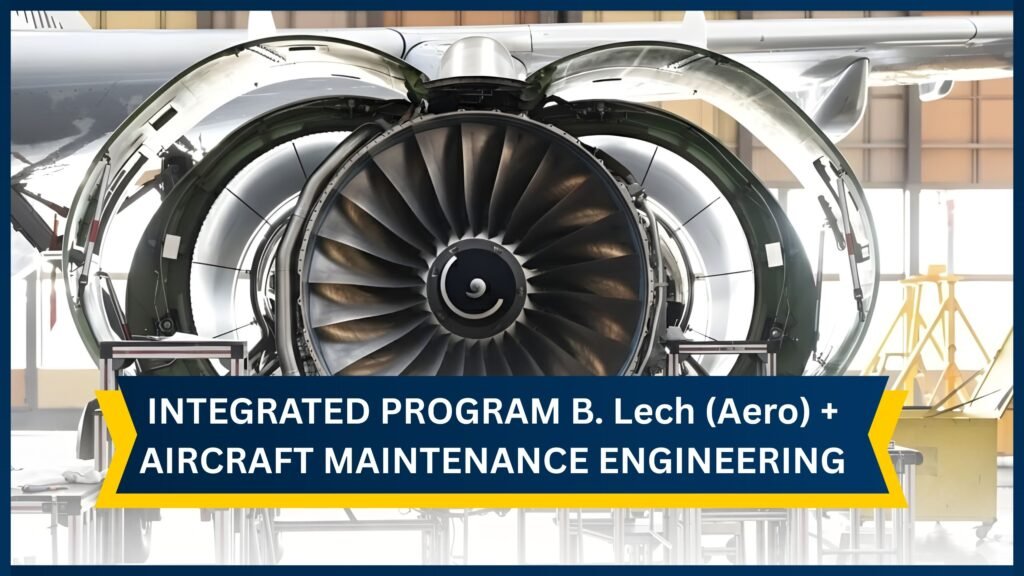
If you compare B.Tech Aeronautics + AME vs Other Aviation Courses, the dual program consistently emerges as the most structurally robust option for modern technical careers. Let us explore the core reasons behind this dominance.
Reason 1: Complete Career De-Risking
The biggest risk of choosing a stand-alone licensing path is the lack of a formal degree. If, for any medical or personal reason, a licensed engineer wishes to transition into a corporate executive desk job, a research institute, or a teaching role later in life, having a formal B.Tech degree is extremely valuable. The integrated program guarantees that you have a prestigious engineering degree from an approved university, ensuring you never face a professional bottleneck.
Reason 2: Double the Employment Opportunities
By completing this program, you qualify for two distinct job markets simultaneously:
- The Design & Tech Market: You can apply for design engineering roles at aerospace giants like Boeing, Airbus, Airbus, Tata Advanced Systems, and Hindustan Aeronautics Limited (HAL).
- The Maintenance & Operations Market: You are fully prepared to enter the Maintenance, Repair, and Overhaul (MRO) sector, working directly on active runways and in major hangars for airlines like IndiGo, Air India, and SpiceJet.
Reason 3: Superior Global Mobility
International civil aviation authorities (such as the FAA in the United States or EASA in Europe) require technical personnel to have a solid base of formal academic study alongside practical work experience. A stand-alone Indian license might require complex equivalency tests abroad. However, when you present an AICTE-approved B.Tech degree alongside a rigorous portfolio of practical aircraft maintenance hours, your profile becomes highly competitive globally.
5. Navigating the 2026 Technical Syllabus: What You Will Study
To give you a clear understanding of the educational path, let us examine how the curriculum is structured. This program is highly comprehensive, ensuring students master both the science of design and the details of structural maintenance.
The Engineering Design Modules
- Aerodynamics: The study of fluid flow around lifting bodies, wing geometry, and boundary layer behavior.
- Propulsion Systems: Understanding the thermodynamics of gas turbines, combustion chambers, compressor stalls, and fuel injection architectures.
- Space Dynamics & Structures: Analyzing the high-strength composite materials (like carbon-fiber-reinforced polymers) that allow aircraft to withstand massive stress.
The Licensing and Maintenance Modules
- Aviation Legislation: Memorizing the complex safety rules, civil aviation requirements, and airworthiness directives set by the DGCA and international bodies.
- Maintenance Practices: Hands-on training in sheet metal work, precision welding, cable tensioning, non-destructive testing (NDT), and composite repair.
- Digital Avionics: Studying autopilot logic, flight management computers (FMC), weather radar systems, and complex radio-navigation instruments.
6. Real-World Career Progression: The Journey to High Salaries
Many students ask, “What does my life look like after I complete this program?” Let us chart the actual career trajectory and financial benchmarks of a graduate from this integrated path in 2026.
Stage 1: The Technical Associate (Years 1 to 2)
Upon graduation, you enter an airline, MRO, or design firm as a Graduate Engineer Trainee or Junior Technician. Your focus is on gaining active hangar hours and logging your work in your official logbook.
- Average Salary Range: ₹4.5 Lakhs to ₹7.0 Lakhs per annum.
Stage 2: The Licensed AME / System Engineer (Years 3 to 5)
Once you pass the required basic DGCA modules and accumulate your practical hours, you obtain your Basic Aircraft Maintenance License (BAMEL) or transition into a senior design engineering role.
- Average Salary Range: ₹10 Lakhs to ₹18 Lakhs per annum.
Stage 3: The Type-Rated Senior Specialist (Years 5 and beyond)
After gaining specialized training on a specific heavy aircraft type (like the Boeing 777 or Airbus A320) or leading complex aerospace design projects, you reach the peak of your technical profession.
- Average Salary Range: ₹24 Lakhs to ₹45 Lakhs per annum (with tax-free international opportunities pushing this much higher).
7. Admissions Checklist: Key Eligibility and Registration Guidelines
If you have decided that the integrated B.Tech Aeronautics + AME program is the right launchpad for you, here are the core requirements to keep in mind for the 2026 admissions cycle:
- Academic Foundation: You must have completed your board exams with a minimum aggregate of in Physics, Chemistry, and Mathematics (PCM).
- Entrance Exam Participation: Most premier institutes conduct a dedicated aptitude test to assess your mathematical logic, physics principles, and English communication skills.
- Physical Fitness Clearance: You must obtain a medical certificate from a registered medical officer stating that you have normal hearing, normal color vision, and are physically fit to work in active workshop and hangar environments.
8. Why School of Aeronautics (SOACET) is the Best Choice for Your Training
An integrated program of this caliber cannot be run in standard classrooms. It requires heavy investments in physical infrastructure, operational aircraft, and highly qualified industry experts.
The School of Aeronautics (SOACET), established in 1992, is widely regarded as the premier destination for integrated aviation studies in India.
The Live Hangar Advantage
While many institutions teach aircraft systems using computer screens, our state-of-the-art campus in Neemrana features entire, heavy-weight operational aircraft. Our hangar houses a Fokker F-27 turboprop airliner and a Beechcraft. This means you will learn to run actual jet engines, troubleshoot real hydraulic gear retractions, and operate avionics suites on real aircraft.
Affiliation and Approvals
Our integrated programs are fully approved. Our B.Tech program is affiliated with Bikaner Technical University (BTU) and approved by the AICTE, while our practical maintenance modules are aligned with the highest regulatory standards. This dual validation ensures that your educational investment is fully recognized both in India and abroad.
Comprehensive Placement Infrastructure
We do not just train you for a degree; we build your pathway into the industry. Our dedicated training and placement cell works in continuous coordination with leading global airlines, major defense production facilities, and top MRO organizations to secure premier internship and job opportunities for our students.
9. Frequently Asked Questions (FAQs)
Q1. Is the integrated B.Tech Aeronautics + AME program too difficult?
It is intellectually demanding because it combines academic engineering with practical licensing modules. However, with the structured semester schedules, mock exams, and personalized coaching provided at SOACET, dedicated students complete the program highly successfully.
Q2. Can I apply for government jobs after this course?
Yes. Since the B.Tech degree is awarded by an approved state university (BTU) and cleared by the AICTE, you are fully eligible to apply for technical roles in the Indian Air Force, HAL, ISRO, DRDO, and general civil services exams.
Q3. How does this course compare to a pilot training course in terms of cost?
Pilot training courses are highly expensive and must be completed in a very short period with no fallback degree. The integrated B.Tech + AME program offers a far more stable, cost-effective, and academically secure investment with a wider range of technical career opportunities.
Q4. Are education loans available for the dual program?
Yes. Because SOACET holds all the necessary university affiliations and central approvals, all major nationalized and private banks provide comprehensive educational loans to cover the training, hostel, and academic charges.
Conclusion: Elevate Your Future
When analyzing B.Tech Aeronautics + AME vs Other Aviation Courses, the conclusion is clear. If you are looking for a career that offers absolute academic safety, direct regulatory authority in active hangars, double the employment avenues, and unparalleled global mobility, the integrated dual path is your best choice.
The global aviation industry in 2026 does not just need people who can manage terminals or analyze spreadsheets; it needs highly skilled technical minds who can design the next generation of flight and guarantee its airworthiness on the ground.
By embarking on your journey with an institution of over three decades of legacy like the School of Aeronautics, SOACET you ensure your career is built on solid, elite ground.
Your future in the skies is waiting. Take the first step toward your destination today.