
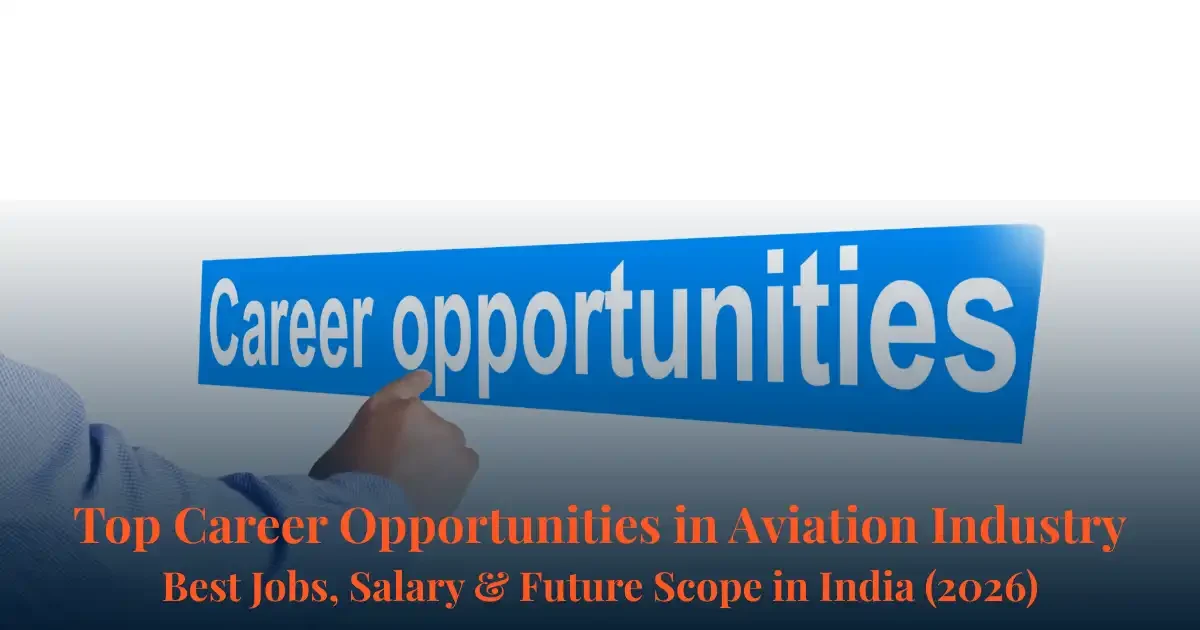
Ask most students what aviation careers look like, and they’ll usually name two: pilot or cabin crew. That’s a narrow slice of a much bigger picture. The real career opportunities in aviation industry span engineering, maintenance, avionics, airport operations, safety management, drone technology, and research, each requiring a distinct skill set and academic pathway. Understanding this breadth matters before you pick a course, not after, because “aviation” as a career category covers people who design aircraft, people who keep them flying safely, people who manage the airports they land at, and increasingly, people who never touch a manned aircraft at all.
This guide walks through the major aviation career paths available in India today, what each one requires, realistic salary expectations, and how to choose among them based on your interests rather than just following the most talked-about option.
Read Before: Best Aviation Course After 12th PCM in India: Top Career Options & Scope 2026
What Are the Career Opportunities in Aviation Industry?
Aviation careers generally fall into a handful of broad categories, each with its own entry points and progression:
- Aircraft Maintenance: keeping aircraft airworthy through licensed technical work.
- Aeronautical Engineering: aircraft design, structures, and systems.
- Aerospace Engineering: a broader category spanning aircraft and spacecraft.
- Avionics: aircraft electronics, navigation, and communication systems.
- Airline Operations: the operational backbone that keeps flights running.
- Airport Management: running the infrastructure aircraft and passengers depend on.
- Ground Handling: the physical operations supporting aircraft turnaround.
- Aviation Safety: risk management and regulatory compliance.
- Aviation Security: protecting passengers, crew, and infrastructure.
- Air Traffic Management: coordinating aircraft movement safely.
- Drone/UAV Technology: one of the newest, fastest-growing categories.
- Aviation Business and Management: the commercial and administrative side of the industry.
- Research and Development: advancing aviation technology itself.
The career opportunities in aviation industry roles listed above don’t all require the same starting point some need a specific engineering degree, others need licensing exams, and some are open to graduates from almost any academic background. That’s exactly why understanding the categories first matters more than picking a course based on its name alone.
Top Career Opportunities in Aviation Industry
1. Aircraft Maintenance Engineer (AME)
AMEs inspect, maintain, and certify aircraft as airworthy no DGCA-registered aircraft can legally fly without a licensed AME’s sign-off. Licensing splits into B1 (Mechanical), covering airframe and engine systems, and B2 (Avionics), covering electrical systems, both regulated under DGCA’s CAR-66 framework. Becoming an AME requires DGCA-approved training and passing module examinations, a licensing pathway distinct from a general engineering degree, not something a B.Tech. automatically confers. AMEs typically work with airlines and MRO organizations.
2. Aeronautical Engineer
Aeronautical engineers work on aircraft design, aerodynamics, structures, propulsion, testing, and manufacturing. This path typically runs through a B.Tech. in Aeronautical Engineering, an AICTE-approved four-year degree, sometimes followed by an M.Tech. for design or research-focused roles. It suits students drawn to the engineering “why” behind aircraft function more than hands-on maintenance.
3. Aerospace Engineer
Aerospace engineering broadens the aeronautical scope to include spacecraft alongside aircraft propulsion, materials science, and space systems. In India, this often overlaps substantially with aeronautical engineering programs, though dedicated research opportunities (particularly through ISRO) exist for students specifically drawn to space systems.
4. Avionics Engineer
Avionics engineers focus on the electronic systems that make modern aircraft function navigation, communication, flight control, and instrumentation. This sits closer to electronics and embedded systems engineering than mechanical work, and has grown in importance as aircraft systems become increasingly software-driven. It exists both within the AME B2 licensing framework and broader engineering roles at OEMs and defence contractors.
5. Aircraft Production / Manufacturing Engineer
Production engineers oversee manufacturing component fabrication, assembly, production planning, and quality control during build. Aerospace manufacturing tolerances leave far less room for error than most other manufacturing sectors. Aircraft OEMs and component manufacturers are the primary employers here.
Note: Book a FREE counselling session through SOACET to understand the AME admission process clearly.
6. Airline Technical Operations
This role sits within an airline, covering maintenance planning, technical services, fleet management support, and reliability tracking. It’s less hands-on than direct maintenance but requires solid technical grounding to make sound operational decisions under the tight turnaround schedules airlines run on.
7. Airport Operations Professional
Airport operations roles cover passenger movement coordination, ground operations, safety procedures, and general administration. This is one of the more accessible aviation categories for non-technical academic backgrounds, drawing more on coordination and administrative skill than engineering knowledge.
8. Aviation Safety Professional
Safety professionals handle risk assessment, safety audits, incident prevention, and Safety Management System (SMS) implementation an increasingly formalized function as airlines, airports, and MROs strengthen safety governance. This suits candidates drawn to compliance and risk-focused work over technical or customer-facing roles.
9. UAV / Drone Professional
The drone/UAV space covers operations, maintenance, engineering, and specialized applications such as surveying, mapping, infrastructure inspection, agriculture, and defence. This is one of the newest categories here; commercial drone operation has only become a structured, licensed activity in India in recent years under DGCA’s drone regulations, and it’s also one of the more accessible entry points given lower prerequisite requirements than traditional engineering paths. Specific long-term employment volume in this sector isn’t reliably projectable here treat it as genuinely growing, not one with guaranteed numbers.
10. Aviation Management Professional
Aviation management spans airline management, airport management, and broader aviation business roles the commercial and strategic side of an industry built on complex operations and significant capital investment. This typically suits candidates with a business or commerce background, sometimes combined with an aviation-specific management degree, rather than requiring an engineering foundation.
11. Aviation Research & Development
R&D roles advance aviation technology itself new materials, propulsion, unmanned systems, and sustainable aviation research. These exist within public research organizations (ISRO, DRDO, academic institutions) and private aerospace R&D divisions, typically rewarding candidates with postgraduate qualifications and genuine research orientation.
Aviation Career Comparison
| Career | Typical Qualification | Key Skills | Work Area | Career Scope |
|---|---|---|---|---|
| AME | DGCA-approved training + CAR-66 licensing | Technical troubleshooting, regulatory compliance | Airlines, MRO | Type-rated specialist, maintenance lead |
| Aeronautical Engineer | B.Tech. Aeronautical Engineering | CAD/CAE, structural analysis | Manufacturers, design firms | Design lead, R&D |
| Aerospace Engineer | B.Tech./M.Tech. Aerospace or Aeronautical | Systems engineering, simulation | ISRO, aerospace firms | Senior/principal engineer |
| Avionics Engineer | B.Tech. + avionics specialization, or B2 AME license | Electronics, embedded systems | Manufacturers, MRO, defence | Senior avionics specialist |
| Production Engineer | B.Tech. (Mechanical/Aeronautical) | Manufacturing processes, quality control | Aircraft OEMs | Production manager |
| Airline Technical Ops | Engineering degree + industry experience | Planning, reliability tracking | Airlines | Technical operations manager |
| Airport Operations | Bachelor’s degree (any relevant stream) | Coordination, safety procedures | Airports | Operations manager |
| Aviation Safety | Aviation/engineering background + SMS training | Risk assessment, auditing | Airlines, airports, MRO | Safety/compliance manager |
| UAV/Drone Professional | DGCA Remote Pilot Certificate or engineering degree | Drone operation, data analysis | Agri-tech, infrastructure, defence | Specialist, RPTO instructor |
| Aviation Management | Business/management degree, aviation specialization helpful | Strategic planning, commercial acumen | Airlines, airports | Senior management |
| Aviation R&D | Postgraduate degree (M.Tech./Ph.D.) | Research methodology, simulation | ISRO, DRDO, private R&D | Senior scientist/researcher |
Aviation Jobs After 12th
For PCM Students
Class 12 PCM (Physics, Chemistry, Mathematics) opens the widest range of technical aviation pathways: AME (via DGCA-approved institutes), B.Tech. Aeronautical or Aerospace Engineering, and with additional certification, UAV/drone technology programs. These are the pathways requiring the strongest core science and math foundation.
For Students from Other Streams
Students from commerce, humanities, or other streams aren’t excluded from aviation careers, but their pathways look different. Aviation management, airport operations, ground handling, and aviation business roles are generally accessible without a PCM background, often through dedicated diploma or degree programs in aviation management or airport operations. It’s worth being clear here: not every aviation career is open to every academic stream, and technical engineering or licensed maintenance roles specifically do require the PCM foundation.
Aviation Jobs After Graduation
Graduates entering aviation careers typically specialize further based on their degree: engineering graduates move into design, maintenance, or production roles; those from management backgrounds move into operations or aviation business roles; and graduates from safety, quality, or technical backgrounds often move into compliance-focused functions. Across all these paths, practical experience, internships, hands-on lab exposure, or entry-level operational roles tend to matter as much as the degree itself when it comes to actual employability, since aviation employers consistently value demonstrated, applied competence alongside academic qualification.
Aviation Salary in India
| Career | Approximate Entry-Level Salary | Experience-Based Growth |
|---|---|---|
| AME / Maintenance Roles | Roughly ₹28,000–₹55,000/month for licensed freshers without a type endorsement | Rises substantially with type endorsements and experience; senior/lead roles considerably higher |
| Aeronautical/Aerospace Engineer | Broadly comparable to other core engineering entry-level bands | Grows with specialization, postgraduate study, and seniority |
| Avionics Engineer | Broadly comparable to core engineering entry-level bands | Strong growth potential with specialized avionics/systems expertise |
| Airport Operations | Varies significantly by role and employer | Growth tied to seniority and scope of operational responsibility |
| UAV/Drone Professional | Roughly ₹20,000–₹45,000/month for entry-level certified operators | Specialized skills (mapping, data analytics) and senior roles command notably higher pay. |
Important note on these figures: these are broad, approximate ranges only, not guarantees. Actual salary depends heavily on employer, location, specific licensing/certifications, experience, and individual negotiation. Roles like aviation management, safety, and R&D aren’t included in table form here because reliable, India-specific salary benchmarking for these more specialized or senior-track categories wasn’t readily verifiable treat any figures you encounter for these roles with appropriate skepticism unless tied to a current, credible source.
Best Aviation Courses for Building a Career
There’s no single “best” aviation course the right one depends entirely on which career category from above actually interests you:
- Aircraft Maintenance Engineering (AME): for hands-on, licensed technical work
- B.Tech. Aeronautical Engineering: for design, structures, and broader engineering careers
- Aerospace-related engineering programs: for students drawn toward spacecraft/space systems alongside aircraft
- Aviation Management / Airport Management programs for business and operations-focused careers
- Aviation safety programs and SMS certifications for risk and compliance-focused roles
- Drone/UAV certification programs for the fastest-entry technical pathway into aviation
- Relevant professional certifications: software tools, specialized technical modules, or management certifications that supplement a base degree
Choosing based on your interest in the underlying work hands-on technical, design/research, electronics, operations, or business will serve you better than choosing based on which course sounds most prestigious.
How to Choose the Right Aviation Career
If you enjoy hands-on technical work: Consider AME or other maintenance-related pathways you’ll be working directly with aircraft systems and carrying real certification responsibility.
If you enjoy engineering and aircraft design: Consider Aeronautical or Aerospace Engineering this suits students drawn to the “why” behind how aircraft work.
If you enjoy electronics: Consider Avionics a good fit if embedded systems and instrumentation interest you more than mechanical systems.
If you enjoy airport and business operations: Consider Aviation Management or Airport Operations these roles reward coordination, administrative, and strategic thinking skills.
If you enjoy emerging technology: Consider UAV/Drone or broader aviation technology pathways this is the newest, fastest-evolving category on this list.
How to Build a Successful Aviation Career
- Choose the right course based on genuine interest, not just popularity.
- Understand eligibility requirements thoroughly before committing.
- Select a credible, appropriately accredited institution (DGCA/AICTE as relevant).
- Develop technical skills deliberately, not just to the minimum syllabus requirement.
- Gain practical exposure through labs, workshops, and hands-on projects.
- Complete internships where relevant to your chosen path.
- Build communication skills consistently undervalued relative to their actual career impact.
- Learn industry-relevant software and technology tools.
- Follow aviation regulations and safety standards as a discipline, not an afterthought.
- Continue learning throughout your career, since aviation technology and regulation both evolve continuously.
Frequently Asked Questions
What are the best career opportunities in the aviation industry?
There’s no single “best” option. AME, aeronautical/aerospace engineering, avionics, airport operations, aviation management, and UAV technology each suit different interests and skill sets. The right choice depends on whether you’re drawn to hands-on technical work, design, electronics, operations, or business.
Which aviation job has the highest salary?
This varies significantly by role, seniority, and employer rather than being fixed by job title. Licensed AMEs with strong type endorsements, senior engineers, and specialized technical roles can all reach strong compensation with experience, but there’s no single category that universally pays the most.
What aviation jobs are available after 12th?
For PCM students: AME, B.Tech. Aeronautical/Aerospace Engineering, and drone/UAV certification programs. For students from other streams: aviation management, airport operations, and ground handling pathways are generally more accessible.
Is aviation a good career in India?
Yes, given the sector’s sustained growth in airports, fleet expansion, and MRO capacity though outcomes for individual candidates depend significantly on choosing the right pathway and building genuine, demonstrated skill within it.
Which aviation course is best after 12th PCM?
It depends on your interests: AME for hands-on licensed maintenance work, B.Tech. Aeronautical/Aerospace Engineering for design and research-oriented careers. Neither is universally “better” they lead to genuinely different types of work.
Can B.Tech. Aeronautical Engineering graduates work in airlines?
Yes, in engineering, technical operations, and design-support roles, though becoming a licensed AME specifically requires additional DGCA CAR-66 certification beyond the B.Tech. degree itself.
What is the salary of aviation professionals in India?
It varies considerably by role, licensing, employer, and experience see the salary table above for approximate entry-level ranges in a few key categories. Treat any figures as indicative, not guaranteed.
Is AME a good career option?
Yes, for students with strong PCM fundamentals who want a hands-on, safety-critical technical career with a clear, licensed progression path though it requires DGCA-approved training and passing module examinations, not just academic study alone.
What skills are required for an aviation career?
A combination of technical skills (specific to your chosen path) and professional skills like communication, attention to detail, teamwork, and adaptability employers consistently value both together.
What is the future scope of the aviation industry in India?
Strong, driven by airport expansion, fleet growth, MRO development, indigenous manufacturing investment, and emerging areas like drones, AI-driven maintenance, and sustainable aviation though the pace and shape of that growth will keep evolving.
Conclusion
The career opportunities in aviation industry roles genuinely extend far beyond pilots and cabin crew, spanning engineering, licensed maintenance, avionics, airport operations, safety management, drone technology, and research, each with its own pathway and skill requirements. Choosing the right direction starts with understanding what kind of work actually interests you, not just which course sounds impressive, and building real technical and professional skills alongside your formal qualification. As India’s aviation ecosystem continues to expand across airports, fleets, manufacturing, and emerging technologies, students who choose deliberately and build genuine competence in their chosen path will be well positioned for a long, adaptable career in this industry.