
The Indian aviation industry is undergoing a historical transformation. Propelled by rapid economic expansion, middle-class income growth, and aggressive infrastructure modernization, India has emerged as the third-largest domestic aviation market in the world. As passenger traffic surges toward unprecedented peaks, the traditional framework of point-to-point regional flights is evolving into a highly structured, internationally competitive network architecture.
Central to this structural evolution is Indias Hub & Spoke Model. Designed to consolidate passenger traffic from tier-2 and tier-3 cities into major gateway hubs, this model allows Indian airlines to optimize aircraft utilization, improve load factors, and offer wide-reaching global flight itineraries.
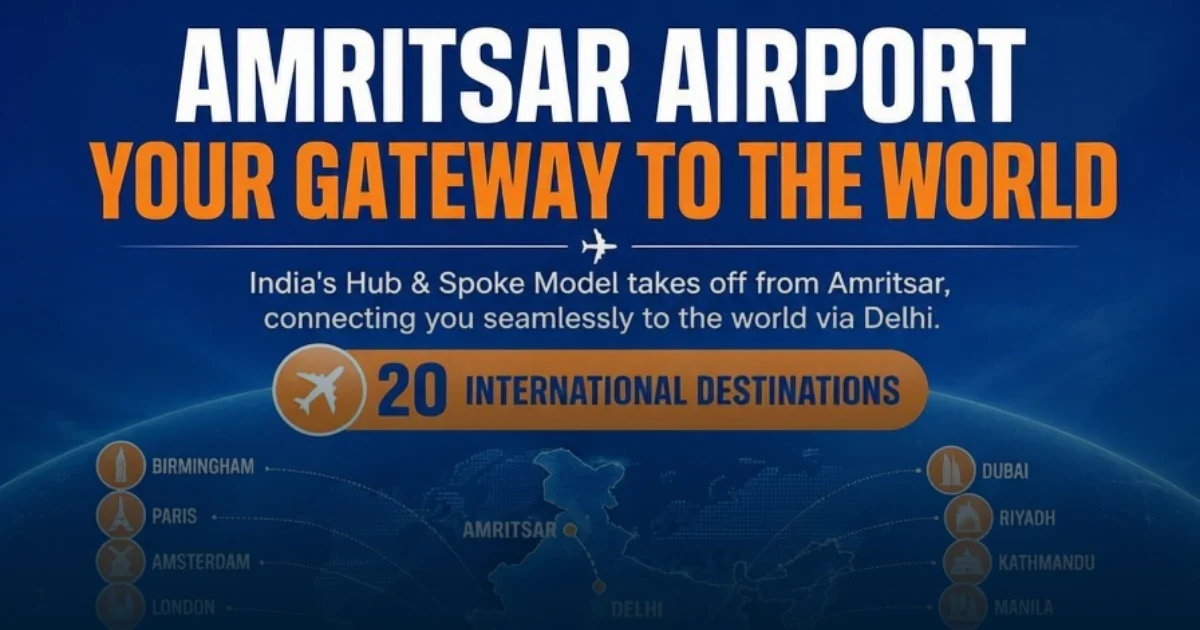
A flagship example of this strategic transformation is Sri Guru Ram Dass Jee International Airport (ATQ) in Amritsar. Long recognized as the cultural and spiritual heart of Punjab, Amritsar is taking center stage as a vital regional spoke feeding international travel corridors. Through groundbreaking initiatives like Air India’s Easy Connect program, passengers departing from Amritsar can now access more than 20 major international destinations across Europe, North America, Australia, Southeast Asia, and the Middle East through a single, hassle-free transit via New Delhi.
This article examines how Indias Hub & Spoke Model works, why Amritsar Airport has emerged as an international gateway, the systemic benefits for travelers and the economy, and how this rapid industry growth is opening up high-value career opportunities for students trained at specialized institutions like the School of Aeronautics (SOACET).
Definition and Operational Mechanics
In commercial aviation, an airline route system generally follows one of two primary architectural structures: the Point-to-Point Model or the Hub & Spoke Model.
In Indias Hub & Spoke Model, a central airport acts as the primary “hub” a major operational node where long-haul international flights originate and terminate. Surrounding regional airports function as “spokes,” collecting passengers from smaller catchments and flying them into the central hub on high-frequency domestic feeder flights.
At the hub airport, passenger streams from multiple spoke routes are aggregated onto large, wide-body aircraft destined for global long-haul markets. Conversely, inbound international travelers arrive at the central hub and disperse across domestic spoke destinations.
Global Precedents
The Hub & Spoke framework is the foundation of world-leading international aviation ecosystems:
- Dubai International (DXB): Operates as Emirates’ mega-hub, funneling passengers from Asia, Africa, and Europe across the globe.
- Hartsfield-Jackson Atlanta (ATL): Serves as Delta Air Lines’ primary hub, linking hundreds of regional American cities to transatlantic and Latin American destinations.
- London Heathrow (LHR) & Frankfurt (FRA): Act as primary European connection centers for British Airways and Lufthansa.
Hub & Spoke vs. Point-to-Point Model
| Operational Parameter | Hub & Spoke Model | Point-to-Point Model |
|---|---|---|
| Network Structure | Centralized through major hub airports | Direct non-stop connections between individual city pairs |
| Fleet Utilization | Mixed fleet (narrow-body for spokes, wide-body for hubs) | Uniform narrow-body or regional aircraft fleets |
| Passenger Volume Consolidation | High (pools demand from multiple feeder regions) | Dependent strictly on local origin-and-destination (O&D) demand |
| Global Destination Reach | Expansive (access to 100+ cities with one connection) | Restricted to commercially viable direct point-to-point routes |
| Operational Efficiency | High passenger load factors on long-haul routes | Risks low seat-factor on secondary international routes |
Advantages and Challenges
While the Hub & Spoke system offers undeniable network density, higher load factors, and lower per-seat operating costs on long-haul sectors, it requires sophisticated baggage handling systems, coordinated flight banks, and tight operational sync between feeder flights and long-haul departures.
Why Amritsar Airport?
Sri Guru Ram Dass Jee International Airport (ATQ), situated in Amritsar, holds a unique geopolitical and economic position in Northern India. Serving as the primary aviation portal for Punjab, Himachal Pradesh, and Jammu & Kashmir, the airport caters to a vast catchment area characterized by distinct passenger segments:
- Vast Global Punjabi Diaspora: Millions of Non-Resident Indians (NRIs) residing in the United Kingdom, Canada, the United States, Australia, Europe, and the Gulf region maintain deep personal and business ties with Punjab.
- Religious and Cultural Tourism: Home to the Golden Temple (Sri Harmandir Sahib), Amritsar draws millions of global pilgrims annually, generating steady year-round international inbound demand.
- Overseas Student Migration: Punjab is one of India’s largest exporters of higher-education students to universities in Canada, the UK, Western Europe, and Australia.
- Air Cargo Potential: The fertile agricultural hinterland produces high-value perishable goods, fresh produce, and textiles destined for international markets in the Middle East and Europe.
By integrating Amritsar into Indias Hub & Spoke Model, civil aviation planners leverage this immense latent demand, connecting Northern India directly into the global air transport framework.
Government & Airline Initiatives: The Air India Easy Connect Revolution
To realize the full strategic benefit of Indias Hub & Spoke Model, the Ministry of Civil Aviation (MoCA) launched a coordinated initiative to streamline domestic-to-international transfers. Frontlining this transition is Air India with its flagship Easy Connect program.
Under traditional travel arrangements, a passenger flying from Amritsar to an international destination via Delhi had to retrieve checked luggage at Indira Gandhi International Airport (DEL), transfer between domestic and international terminals, go through immigration clearance, re-check baggage, and undergo duplicate security screenings.
Key Highlights of Air India’s Easy Connect at Amritsar Airport:
- Single-Ticket Reservation: Passengers book a single, integrated itinerary from Amritsar to their ultimate global destination.
- Origin Immigration Clearance: Eligible international travelers complete primary immigration and customs clearance directly at Amritsar’s Sri Guru Ram Dass Jee International Airport.
- Through-Baggage Tagging: Checked baggage is tagged straight to the final destination, eliminating the need to collect or re-check luggage during transit in Delhi.
- Dedicated Transit Corridors: Upon landing at Delhi Airport, passengers follow designated international transfer corridors directly to their onward departure gates without exiting the airside environment.
- Optimized Flight Schedules: Air India operates designated daily feeder flights such as morning flight AI1113 and late-evening flight AI1115 precisely timed to connect with major onward international departure banks within four hours of landing in Delhi.
Unlocking Worldwide Connectivity: 20+ International Destinations
Through the operationalization of Indias Hub & Spoke Model at Amritsar Airport, travelers from Northern India gain seamless single-connection access to more than 20 premier international destinations across five continents:
- Europe & The United Kingdom: Direct morning connections via Delhi to London Heathrow, Birmingham, Paris (CDG), Frankfurt, Milan, Zurich, Rome, Vienna, Amsterdam, and Copenhagen.
- North America: Late-evening departures linking smoothly to ultra-long-haul services bound for New York (JFK), Newark, Chicago O’Hare, San Francisco, Toronto Pearson, and Vancouver.
- Australia: Streamlined transfers connecting directly to Melbourne and Sydney flights.
- Southeast Asia & The Middle East: Fast onward connections to Singapore, Phuket, Bali, and Dubai.
This network expansion effectively turns Amritsar into a high-capacity global portal, keeping long-haul traffic on domestic carriers while significantly reducing total journey times.
Benefits for Passengers
The practical roll-out of Indias Hub & Spoke Model delivers major benefits for travelers across Northern India:
- Elimination of Multi-Airport Bureaucracy: Passengers avoid repeating immigration checks, security queues, and terminal transfers at intermediate airports.
- Reduced Stress for Elderly and First-Time Travelers: Overseas Punjabi families, seniors visiting relatives abroad, and students traveling internationally experience a straightforward, single-ticket journey.
- Protection Against Missed Connections: Booking on a single ticket guarantees that in the event of domestic weather delays, the airline is responsible for rebooking passengers onto alternative onward flights.
- Enhanced Cost Efficiency: Single-ticket hub bookings are often significantly more economical than purchasing separate domestic and international sector tickets.
- No Foreign Language Barriers: Transit through an Indian hub like Delhi allows travelers to complete connection formalities in familiar languages before boarding long-haul international flights.
Macroeconomic Impact: Fueling Trade, Tourism, and Logistics
The structural rollout of Indias Hub & Spoke Model serves as a powerful engine for broader economic growth across Northern India:
- Air Cargo & Agriculture: The integration of Amritsar into global airline belly-hold networks enables local agricultural producers to export perishable goods such as fresh fruits, vegetables, and flowers directly to international markets within 24 to 36 hours.
- Spiritual & Heritage Tourism: Enhanced transit options encourage foreign tour operators to market multi-day pilgrimage and cultural itineraries in Amritsar, boosting local hotel occupancies, transport providers, and retail trade.
- Regional Employment: Expanding airport throughput generates direct and indirect employment across airport operations, airline station management, aircraft maintenance, ground handling, customs brokerage, and aviation security.
Impact on Punjab and Northern India
For decades, international travelers from Punjab were forced to make long, costly road journeys to New Delhi or endure complex multi-stop transit through foreign airports in the Gulf.
The implementation of Indias Hub & Spoke Model restores regional pride and accessibility:
- Strengthening Diaspora Links: Makes home visits easier for the global Punjabi community, driving capital investment into real estate, healthcare, and rural infrastructure.
- Empowering Overseas Students: Provides safe, direct, and structured travel routes for students departing for academic programs in North America, Europe, and Australia.
- Unlocking Medical Tourism: Positioned as a healthcare destination for eye care, joint replacements, and specialized surgeries, Amritsar can attract medical tourists from neighboring South Asian and Middle Eastern nations.
Challenges & Future Opportunities
While Indias Hub & Spoke Model offers immediate structural advantages, long-term success requires addressing operational and infrastructure challenges:
- Balancing Hub Transit with Direct Long-Haul Demand: Local trade associations often advocate for direct non-stop long-haul flights from Amritsar. Airlines must carefully balance point-to-point commercial viability with hub-consolidation efficiency.
- Infrastructure Upgrades: Domestic spoke airports like Amritsar require expanded international departure lounges, dedicated transit gates, enhanced baggage sorting equipment, and expanded cold-storage cargo facilities.
- Multi-Hub Expansion: As Delhi’s Indira Gandhi International Airport and the upcoming Noida International Airport (Jewar) scale up, Indian carriers plan to expand spoke connectivity from Amritsar to secondary hubs in Mumbai, Bengaluru, and Hyderabad.
Career Opportunities Created by India’s Aviation Growth
The nationwide expansion of Indias Hub & Spoke Model combined with record-breaking aircraft orders placed by Indian carriers is creating an unprecedented hiring boom across the entire aviation value chain.
As fleet sizes double over the next decade, airlines, airport operators, ground handling agencies, and maintenance and repair organizations (MROs) urgently require certified, highly trained personnel across key specializations:
- Aircraft Maintenance Engineering (AME): With hundreds of advanced narrow-body and wide-body aircraft entering Indian airspace, the demand for DGCA-licensed Aircraft Maintenance Engineers to oversee airworthiness, jet engine maintenance, and avionics systems is at an all-time high.
- Airport Management & Terminal Operations: Managing complex hub-and-spoke passenger flows requires professionals skilled in passenger terminal management, gate allocation, security protocols, customer experience, and emergency response planning.
- Ramp Handling & Ground Operations: Turnaround times are critical for hub operations. Qualified professionals are needed to supervise aircraft towing, pushback procedures, fueling, baggage handling, and weight-and-balance calculations.
- Air Cargo & Aviation Logistics: The surge in belly-hold freight requires specialists in dangerous goods regulations (DGR), cold-chain management, customs clearance documentation, and air cargo terminal planning.
- Aviation Safety, Security & Quality Assurance: Ensuring strict compliance with DGCA, ICAO, and IATA safety guidelines requires safety auditors, quality managers, and aviation security officers.
The Role of Aviation Education & School of Aeronautics (SOACET)
To turn this unprecedented aviation growth into sustainable career success, aspiring professionals must possess rigorous technical training, hands-on practical experience, and industry-aligned certifications. Traditional academic degrees often lack the specialized practical exposure required by modern civil aviation standards.
This is where specialized aviation education plays a pivotal role.
The Educational Mandate
Modern aviation education bridges the gap between academic theory and real-world operational execution. Key training pillars include:
- Applied Technical Skills: Practical instruction conducted on real aircraft components, turbine engines, and operational avionics test benches.
- Regulatory Mastery: Deep knowledge of DGCA Civil Aviation Requirements (CAR), ICAO standards, and international air transport protocols.
- Industry Simulation: Training in modern airport terminal management software, flight operations tracking systems, and emergency simulation protocols.
School of Aeronautics (SOACET): Nurturing Future Aviation Leaders
Established as a pioneer in technical aviation education, the School of Aeronautics (SOACET) has played a fundamental role in supplying job-ready technical talent to the Indian aviation ecosystem. Located strategically in the Delhi-NCR educational corridor, SOACET provides an ideal learning environment for students aspiring to build rewarding careers in aviation.
- World-Class Infrastructure: Unlike institutions that rely solely on textbook theory, SOACET features an on-campus operational aircraft hangar housing real aircraft including Hawker, Learjet, and Cessna models giving Aircraft Maintenance Engineering (AME) students real-world practical experience.
- Comprehensive Academic Programs: Offering specialized courses in Aircraft Maintenance Engineering (AME), Aeronautical Engineering, and Airport Management, the institute combines academic learning with practical skill acquisition.
- Industry Exposure and Placement Support: Through structured internships, expert-led workshops, and corporate partnerships with leading airlines, ground handling agencies, and MRO facilities, SOACET ensures that its graduates step directly into high-demand roles across the growing aviation industry.
Future Outlook: India as a Global Aviation Hub
The integration of regional hubs like Amritsar into Indias Hub & Spoke Model is just the beginning of a larger national vision. Over the next decade, India is positioned to become a central global transit hub connecting Western Europe and the Middle East with Southeast Asia and Australasia.
Key Drivers Shaping the Future:
- Mega Fleet Expansions: Indian carriers have over 1,500 aircraft on order, including wide-body Boeing 777X, 787 Dreamliners, and Airbus A350s designed specifically for long-haul hub connectivity.
- Airport Modernization & Greenfield Expansions: Projects like the second phase expansion of Delhi IGIA, Jewar International Airport, and regional upgrades under the UDAN scheme will double airport capacity nationwide.
- Digital Passenger Processing (DigiYatra): Biometric processing and automated baggage routing will make transit through Indian hubs faster and more seamless than foreign transit hubs.
- Commitment to Sustainable Aviation: Adoption of Sustainable Aviation Fuel (SAF), solar-powered airport terminals, and energy-efficient fleet operations will position India as a leader in green aviation infrastructure.
Achieving this national vision requires a steady pipeline of highly trained technical professionals, highlighting the vital importance of quality aviation education.
Conclusion
Indias Hub & Spoke Model marks a major step forward in the evolution of Indian civil aviation. By integrating regional spoke airports like Sri Guru Ram Dass Jee International Airport in Amritsar into centralized global hub networks like Delhi, the nation is making international travel more seamless, efficient, and accessible for millions of citizens.
For passengers across Punjab and Northern India, initiatives like Air India’s Easy Connect provide effortless, single-ticket access to over 20 top destinations worldwide. Beyond passenger convenience, this connectivity drives economic development, boosts air cargo exports, stimulates tourism, and strengthens ties with the global Indian diaspora.
Crucially, this structural expansion is creating thousands of rewarding career opportunities across Aircraft Maintenance Engineering, Airport Management, Aviation Logistics, and Ground Operations. Institutions like the School of Aeronautics (SOACET) stand ready to
Frequently Asked Questions (FAQs)
Q1: What is India’s Hub & Spoke Model in aviation?
Answer: India’s Hub & Spoke Model is an aviation network structure where regional “spoke” airports (such as Amritsar, Varanasi, or Ahmedabad) collect passenger traffic and feed it via domestic flights into a central “hub” airport (such as Delhi or Mumbai). At the central hub, passenger traffic is consolidated onto long-haul international flights departing worldwide.
Q2: How does Air India’s Easy Connect work at Amritsar Airport?
Answer: Under the Easy Connect program at Amritsar Airport, passengers traveling overseas complete check-in, collect physical boarding passes for all flight legs, and clear international immigration directly at Amritsar. Checked baggage is tagged straight to their final global destination, allowing seamless transit through Delhi without re-checking luggage or exiting the airside transfer area.
Q3: Which international destinations can passengers reach from Amritsar via Delhi?
Answer: Passengers flying from Amritsar can seamlessly connect via Delhi to over 20 major international destinations, including London, Birmingham, Paris, Frankfurt, Milan, New York (JFK), Newark, Chicago, San Francisco, Toronto, Vancouver, Melbourne, Sydney, Singapore, Bali, Phuket, and Dubai.
Q4: Do passengers transferring through Delhi under the Hub & Spoke system need to collect their baggage?
Answer: No. Under the Easy Connect hub-and-spoke framework, checked luggage is tagged directly to the final destination at Amritsar Airport. Passengers do not need to retrieve or re-check baggage during their transit at Delhi Airport.
Q5: Why is Amritsar Airport strategically important for international aviation?
Answer: Amritsar’s Sri Guru Ram Dass Jee International Airport serves a vast catchment region including Punjab, Jammu & Kashmir, and Himachal Pradesh. It caters to a large global NRI diaspora, international religious tourism to the Golden Temple, overseas student travel, and high-value agricultural air cargo exports.
Q6: What are the main benefits of the Hub & Spoke model for passengers?
Answer: Key benefits include single-ticket convenience, reduced transit times, elimination of duplicate immigration and baggage re-check procedures, protected onward flight connections, lower total travel costs, and single-airline customer support.
Q7: How does airport network expansion create jobs in India?
Answer: Network expansion increases flight frequencies, passenger numbers, and aircraft fleets. This creates high demand for DGCA-licensed Aircraft Maintenance Engineers (AME), airport terminal managers, ground handling crews, air cargo specialists, flight operations officers, and aviation security personnel.
Q8: What career courses are offered by the School of Aeronautics (SOACET)?
Answer: The School of Aeronautics (SOACET) offers specialized industry-aligned programs, including Aircraft Maintenance Engineering (AME), Aeronautical Engineering, and Airport Management, designed to prepare students for professional technical and managerial careers in civil aviation.
Q9: Is a Ph.D. or engineering degree mandatory to work in airport management or ground operations?
Answer: No. While Aircraft Maintenance Engineers require specialized DGCA-approved AME training and licenses, roles in Airport Management, Ground Operations, Customer Service, and Cargo Management are accessible to graduates and postgraduates with specialized diplomas or degrees in Aviation Management and Airport Operations.
Q10: How can aspiring students join the aviation industry through SOACET?
Answer: Aspiring students can apply for admission to SOACET’s specialized AME, Aeronautical Engineering, or Airport Management courses after completing their 10+2 education. Students receive practical hands-on training in real on-campus aircraft hangars and modern labs, supported by comprehensive internship and placement guidance.