
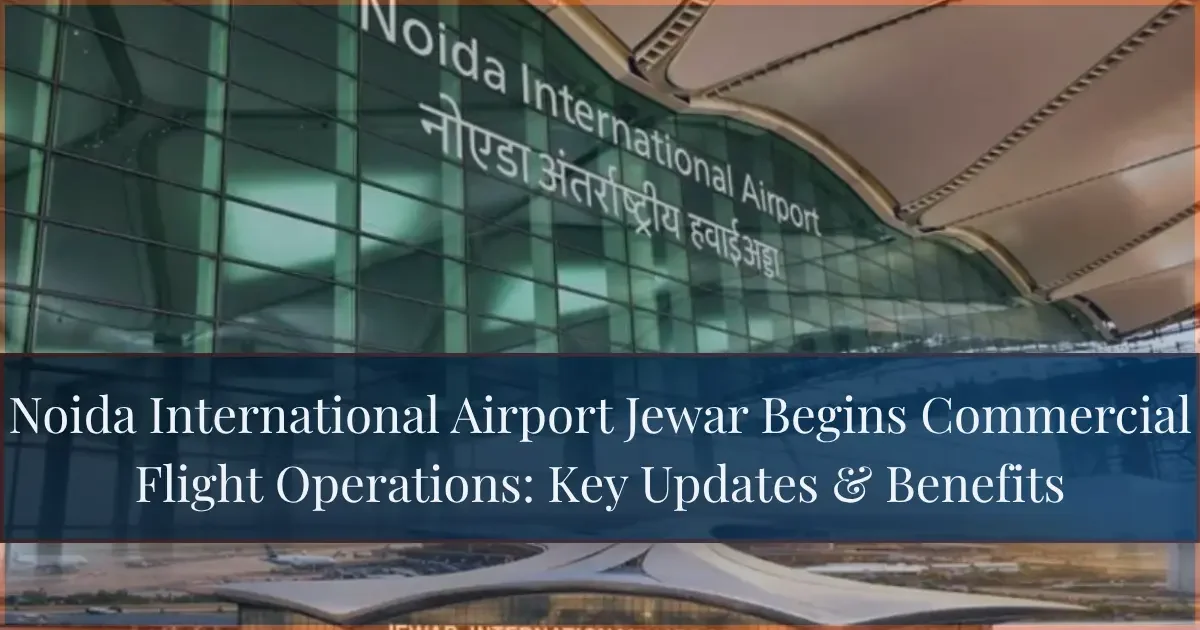
An iconic transformation has permanently altered the geography of global transport and infrastructure in northern India. On Monday, June 15, 2026, the newly built runway of Noida International Airport, located in the strategic belt of Jewar, successfully transitioned from a multi-year construction project into a live, bustling aviation gateway. The arrival of the inaugural scheduled commercial flight marked the dawn of a “dual-airport system” for the National Capital Region (NCR), aligning Delhi-NCR with premier global metropolises like London, New York, and Tokyo that utilize multiple high-capacity airports to handle massive civilian traffic.
With the IATA code DXN and ICAO code VIND officially active on global aviation boards, this massive greenfield project is poised to relieve the intense traffic congestion at Delhi’s Indira Gandhi International Airport. For residents, leisure travelers, businesses, and logistics networks across western Uttar Pradesh, Delhi, Haryana, and Rajasthan, the official operational launch of this facility is not just a travel convenience. It represents the birth of a major economic engine, a massive international cargo transit center, and a technological showcase of eco-friendly airport architecture.
Here is a comprehensive, highly detailed analysis of the launch, including flight schedules, infrastructural features, connectivity plans, and regional economic benefits.
Read Before: Gati Shakti Vishwavidyalaya Signs MoU with DGCA to Boost Aviation Workforce in India
1. The Historic Takeoff: Monday, June 15, 2026
Video source: DD Newz
The long-awaited moment arrived in the early morning hours of June 15, 2026, when the first scheduled commercial aircraft descended gracefully over the Gautam Buddha Nagar district. IndiGo flight 6E-2278, departing from Chaudhary Charan Singh International Airport in Lucknow at 7:55 AM, touched down smoothly on the 3,900-meter runway of the Noida International Airport Jewar at exactly 8:45 AM.
The landing of the Airbus A320 was celebrated with a traditional water cannon salute, a time-honored aviation ritual welcoming a new runway to the global network. In a symbolic gesture that highlighted the cooperative spirit of the mega-project, the first group of passengers to board the aircraft for its return flight were local farmers and agricultural landowners from Jewar whose land had been acquired for the airport’s development. This return flight took off at 10:30 AM for Bengaluru, completing the airport’s first commercial departure.
DXN Launch Milestone Grid
│
┌──────────────────────────────┼──────────────────────────────┐
▼ ▼ ▼
[The Inaugural Flight] [The Symbolic Boarding] [The First Departure]
IndiGo 6E-2278 from Lucknow 170 local landowners as VT-IOM flight to Bengaluru
touched down at 8:45 AM. ceremonial first fliers. took off at 10:30 AM.
The inauguration of commercial service was attended by Union Civil Aviation Minister Kinjarapu Ram Mohan Naidu, alongside state administrators and representatives from Yamuna International Airport Private Limited (YIAPL) a fully owned subsidiary of Zurich Airport International AG, which holds the 40-year concession to design, build, and operate the greenfield facility.
2. Noida International Airport commercial flights update: Schedules & Route Networks
For travelers across northern India planning their itineraries, staying updated with the latest Noida International Airport commercial flights updates is essential. The airport operator is executing a carefully planned, multi-stage domestic and international flight rollout designed to test and stabilize systems, teams, and passenger flow.
Phase 1 Domestic Flight Densities
The domestic flight schedule for June and July is designed to rapidly build high-frequency connections on high-density domestic routes:
- The June Baseline: For the initial launch phase in June, the airport will manage 12 daily domestic arrivals and departures.
- The July Expansion: Starting July 1, 2026, the flight density will scale up to over 40 daily domestic flights. This expansion phase will significantly increase route availability, allowing travelers to connect across multiple Indian states.
- Carrier Alliances: IndiGo stands as the primary launch partner, operating 8 daily flights in June and scaling to 28 daily departures in July. Following IndiGo’s lead, Akasa Air and Air India Express are scheduled to launch their respective commercial schedules, offering a wide array of options for travelers.
Initial Domestic Routes & Destinations
The flight paths currently active and scheduled for expansion during the July cycle cover major business and tourism hubs across India:
Initial Domestic Flight Grid
│
┌─────────────────────────┴─────────────────────────┐
▼ ▼
[Active June Routes] [July Expansion Routes]
- Lucknow (Daily link) • Chandigarh & Dehradun
- Bengaluru (Daily link) • Jaipur & Jodhpur
- Hyderabad (Daily link) • Bhopal & Bareilly
- Jammu & Amritsar (High Frequency) • Dharamshala & Pantnagar
International Flight Timelines
While the current focus is on domestic connectivity, global travelers will not have to wait long. The airport operator has scheduled international passenger flights to commence by the end of the third quarter of 2026 (targeting September–October).
Zurich, Dubai, and Singapore have been identified as the high-priority “Phase 1” international destinations. This setup is designed to serve both high-value corporate travel and labor migration traffic to the Gulf and Southeast Asian regions.
3. World-Class Greenfield Infrastructure: Inside Phase 1
The Noida International Airport at Jewar is planned as one of Asia’s largest greenfield airports, ultimately designed to house five runways and handle up to 225 million passengers annually when all four development phases are completed by 2061.
The first phase represents an initial capital investment of approximately $₹11,000 \text{ crore}$, turning roughly 1,334 hectares of land into a modern aviation facility.
Infrastructural Scope of DXN
│
┌─────────────────────────┴─────────────────────────┐
▼ ▼
[Phase 1] [Phase 4 Vision]
- 1 Runway (3,900 meters) • 5 Runways
- 100,000 sq. meter Terminal • 4 Passenger Terminals
- 12 Million Passengers/Annum • 225 Million Passengers/Annum
- 200,000 Tonne Cargo Facility • 1.5 Million Tonne Cargo Hub
Smart Passenger Processing Systems
DXN is designed to provide a completely paperless, seamless transit experience by utilizing digital-first solutions:
- DigiYatra Biometric Boarding: Facial recognition cameras are installed at all entry points, security checks, and boarding gates, eliminating the need for physical tickets or physical identification cards.
- Self-Service Baggage Drop: Automated luggage drop counters allow passengers to print tags, weigh their bags, and send them directly to the sorting belts in under 90 seconds.
- Net-Zero Carbon Commitment: The passenger terminal utilizes a high-performance translucent canopy inspired by the flowing waters of the holy River Ganga. This design maximizes natural daylight inside the terminal, drastically reducing energy requirements. Additionally, the airport operates on-site solar power farms, utilizes electric vehicle transport fleets, and implements advanced water recycling systems, aiming to achieve carbon neutrality from its launch.
4. The “Aerotropolis” Vision: Transforming Gautam Buddha Nagar
The impact of the airport stretches far beyond travel convenience. Speaking at the inaugural flight launch, Union Civil Aviation Minister K. Ram Mohan Naidu highlighted the state’s vision to develop the region as an aerotropolis, an integrated urban and industrial ecosystem that grows around a high-capacity airport.
The Yamuna Expressway Industrial Development Authority (YEIDA) is actively building dedicated industrial manufacturing and business parks immediately bordering the airport boundaries.
The Jewar Aerotropolis Grid
│
┌─────────────────────────┼─────────────────────────┐
▼ ▼ ▼
[The Toy Park] [Medical Device Park] [The Apparel Park]
Dedicated manufacturing, High-tech laboratory & research centers. Positioning Western UP as
zones for localized medical manufacturing, a premier exporter of
toy design. garment textiles.
This integrated development is attracting billions in private investment and is projected to generate over 1 lakh direct and indirect employment opportunities across the region over the next decade. The logistics and warehousing demand along the Yamuna Expressway corridor is seeing an unprecedented surge, with developers building modern, cold-storage warehouses to store agricultural produce from western Uttar Pradesh and transport it globally via DXN’s cargo networks.
5. Multi-Modal Connectivity: Linking NCR and Beyond
To ensure that passengers from across northern India can access the facility smoothly, the airport is planned as a master multi-modal transport hub.
- Yamuna Expressway Integration: A dedicated, elevated flyover connects the Yamuna Expressway directly to the main terminal gates. This allows travelers from Agra, Mathura, Aligarh, and Noida to bypass local highway traffic and enter the airport directly.
- Integrated Rail & Metro Linkages: Plans have been approved to extend the Noida Metro’s Aqua Line directly into the airport’s underground passenger hub. Additionally, a dedicated corridor is being planned to connect the airport with the upcoming Regional Rapid Transit System (RRTS), providing high-speed rail access from Delhi and Ghaziabad.
- The High-Speed Underground Transit Study: To facilitate seamless transfers for passengers with connecting flights across different airports, feasibility studies have commenced for an underground high-speed transit tunnel connecting Indira Gandhi International Airport (IGI) in Delhi directly to Jewar (DXN). This setup is aimed at allowing passengers to transfer between the two major hubs in under 40 minutes.
6. Global Cargo Hub: Boosting Trade & Logistics
A key factor driving the economic growth around the Noida International Airport Jewar is its cargo facility. Developed in partnership with Air India SATS (AISATS), the airport’s cargo terminal is set to become a major transit gateway for international trade.
- Initial Cargo Handling Capacity: Phase 1 features a fully computerized cargo facility with an initial handling capacity of 2,00,000 metric tonnes of cargo annually, with expansion layouts designed to scale up to 1.5 million tonnes.
- IATA E-Freight Systems: The terminal utilizes fully digital, paperless documentation networks that enable end-to-end live tracking of cargo containers. This setup allows exporters of agricultural produce, MSME electronics, and high-value textiles from western Uttar Pradesh and Haryana to ship their goods globally with minimal transit delays.
7. The Aviation Boom: Spurring a Rise in Technical Careers
The operational launch of Noida International Airport is a transformative event for students and young science graduates, analyzing the professional job market. Building a massive, 12-million-passenger aviation hub doesn’t just create administrative roles; it places an immense demand on the highly specialized, technical core of the aviation industry.
The Rise of the North India Maintenance, Repair, and Overhaul (MRO) Hub
A major highlight of the Jewar Airport master plan is the development of one of the largest Maintenance, Repair, and Overhaul (MRO) complexes in South Asia. Historically, Indian airlines had to fly their aircraft to facilities in Singapore, Sri Lanka, or Europe for heavy structural maintenance checks due to a lack of specialized domestic infrastructure.
Every single aircraft arriving at or departing from DXN requires continuous pre-flight checks, weekly safety audits, and deep-level structural overhauls. This operational reality is creating a massive deficit in safety-certified technical specialists.
If you are an aspiring engineer looking to ride this historic aviation wave, choosing a specialized, license-oriented technical path like the School of Aeronautics (SOACET) is the ultimate way to secure a future-proof, high-paying career.
Technical Aviation Career Matrix
│
┌───────────────────────────┴───────────────────────────┐
▼ ▼
[Avionics & Cockpit Tech] [Line Maintenance]
Calibrating digital radars, Troubleshooting turbine blades,
flight computers, and communications. landing gears, and hydraulics.
8. Why Choose the School of Aeronautics (SOACET) to Launch Your Career?
When it comes to specialized aviation and engineering training, the quality of your educational foundation is everything. The School of Aeronautics (SOACET), established in 1992, has built a legendary reputation as a pioneer in aviation education in India.
The Live Hangar Advantage
We do not believe in teaching flight safety or turbine diagnostics solely from textbook diagrams or digital screens. Our state-of-the-art campus in Neemrana features an active hangar housing actual, heavyweight operational aircraft, including a Fokker F-27 turboprop airliner and a Beechcraft. Our students get to touch real turbine blades, trace active hydraulic lines, and operate working flight control surfaces.
Note: Book a FREE counselling session through SOACET to understand the AME admission process clearly.
AICTE and DGCA Approvals
Our programs are fully recognized. Our B.Tech program is approved by the AICTE and affiliated with Bikaner Technical University (BTU), ensuring your degree is recognized globally for public sector placements, defense commissions, and higher studies abroad. At the same time, our Aircraft Maintenance Engineering (AME) wing is approved by the DGCA under CAR 147, providing a direct, legitimate pathway to your professional license.
Integrated Dual-Track Programs
For students seeking the ultimate balance of academic security and practical certifying power, SOACET is unique in offering integrated programs. You can pursue your DGCA-approved CAR 147 basic AME training while simultaneously working toward an AICTE-approved B.Tech in Aeronautical Engineering. This dual-track gives you a formal university engineering degree and a professional licensing pathway concurrently, doubling your global employment avenues.
Frequently Asked Questions (FAQs)
Q1. What is the IATA code for Noida International Airport?
The International Air Transport Association (IATA) has officially assigned the three-letter code DXN to the Noida International Airport at Jewar. This code is now integrated across global flight schedules, booking portals, baggage tracking systems, and cargo networks.
Q2. How many flights are operating daily from Jewar Airport?
As of June 15, 2026, Noida International Airport operates 12 daily domestic arrivals and departures. According to the latest Noida International Airport commercial flights update, this number will scale up to over 40 daily domestic flights starting July 1, 2026, offering direct connectivity to major Indian cities.
Q3. When will international flights start from Jewar?
International flight operations at Noida International Airport are scheduled to commence by the end of the third quarter of 2026 (targeting September–October). The primary international routes will connect Jewar directly with Zurich, Dubai, and Singapore.
Q4. Are there public transport facilities to access Jewar Airport?
Yes, absolutely. The airport management has tied up with regional transport authorities to provide a wide range of transit options, including airport taxis, app-based cab services, and dedicated bus routes connecting the airport directly with Delhi, Noida, Greater Noida, and major cities across Western Uttar Pradesh.
Conclusion: Take Flight Into the Future of Infrastructure
The commencement of scheduled commercial flight operations at Noida International Airport Jewar is a defining moment in India’s modern history. It represents the opening of a massive gateway for global cargo, trade, logistics, and regional connectivity, turning Noida and Greater Noida into a premier aerotropolis.
As the aviation infrastructure in northern India expands rapidly to support this new giant, the industry needs young, dedicated, and highly disciplined technical minds to maintain and certify the future of flight.
By starting your technical journey with an institution of over three decades of educational legacy like the School of Aeronautics (SOACET), you build your career on a foundation of quality training, legal clearances, premium live aircraft hangar facilities, and a global alumni network.
The runway is clear, the airport is active, and the future is waiting. Are you ready for takeoff?
Explore Admissions 2026 at SOACET – The Leader in Aviation Education