
The global civil aviation landscape in 2026 stands at a transformative juncture where rapid passenger demand recovery intersects with unprecedented technological integration. Airlines and airport operators worldwide are transitioning from reactive post-pandemic rebuilding to strategic structural modernization. Driven by high-efficiency fleet acquisitions, artificial intelligence in flight operations, and rigorous sustainability mandates, commercial and tactical aviation are evolving faster than ever before. Simultaneously, India’s aviation ecosystem has emerged as a key engine of global market growth, catalyzed by record-breaking commercial aircraft orders, aggressive greenfield airport development, and regional air connectivity schemes. Understanding the trajectory of the Aviation Industry Outlook 2026 is essential for students, engineering aspirants, and industry professionals preparing to navigate this technology-intensive, highly regulated sector.
Read Before: How the AME Course Can Help You Build a High-Paying Aviation Career (2026)
Aviation Industry Outlook 2026: What Is Changing?
The global aviation sector in 2026 is defined by two primary dynamics: an urgent focus on operational resilience and a steady push toward digital transformation. Airline capacity management has shifted from sheer volume expansion to precision deployment, driven by volatile fuel prices, engine maintenance turnarounds, and global supply chain realignments.
Key macro forces shaping the industry include:
- Fleet Modernization & Delivery Backlogs: Major airframe OEMs (Boeing and Airbus) continue working through historic order books, pushing airlines to optimize existing assets using advanced data analytics and predictive engineering.
- Infrastructure & Smart Expansion: Major international hubs are integrating biometric processing, IoT-enabled baggage systems, and AI-driven tarmac management to relieve terminal congestion without requiring massive physical footprints.
- Sustainability & Regulatory Targets: With global zero-emission roadmaps tightening, the adoption of Sustainable Aviation Fuel (SAF) and airport decarbonization technologies has moved from speculative pilots to core regulatory compliance.
- Divergence Between Global & Indian Markets: While mature European and North American markets focus heavily on fleet replacement and carbon efficiency, India’s aviation ecosystem is experiencing simultaneous expansion in all directions passenger traffic, airport network size, domestic Maintenance, Repair, and Overhaul (MRO) facilities, and indigenous aerospace manufacturing under Atmanirbhar Bharat.
Top 10 Aviation Industry Trends in 2026
1. Artificial Intelligence and Machine Learning in Aviation
Artificial intelligence (AI) and machine learning (ML) have transitioned from back-office analytical software into mission-critical operational tools across flight planning, customer management, and air traffic flow optimization.
- What it is: AI systems ingest multi-variable datasets including real-time weather, high-altitude wind currents, air traffic congestion, and aircraft weight distribution to generate optimized flight trajectories and resource allocations.
- Why it matters: Fuel represents 30% to 40% of an airline’s operating expenses. AI-driven flight path adjustments reduce unnecessary fuel burn, cut carbon emissions, and reduce flight delays.
- Technology in action: Machine learning algorithms continuously analyze historical flight data, passenger booking velocity, and seasonal yield variations to automate dynamic ticket pricing and gate management.
- Current developments: Flight planning software platforms like SITA OptiFlight and Boeing’s digital solutions are actively used by major carriers to recommend real-time altitude and speed adjustments during flight.
- Future impact: AI will form the backbone of next-generation Autonomous Traffic Management (ATM) and single-pilot monitoring safety frameworks.
- Career implications: Demand is surging for software engineers, data analysts, and avionics specialists who understand machine learning algorithms alongside aerospace domain logic.
2. Predictive Aircraft Maintenance
Unplanned maintenance downtime costs the airline industry billions annually. In 2026, predictive maintenance powered by IoT sensors and big data analytics is replacing traditional reactive and strictly calendar-based maintenance cycles.
- What it is: Modern aircraft produce gigabytes of telemetry data per flight through thousands of integrated sensors monitoring engine temperature, vibration levels, hydraulic pressure, and structural stress.
- Why it matters: Predictive analytics allow Aircraft Maintenance Engineers (AMEs) to detect component fatigue and subtle mechanical anomalies days before a part fails, preventing costly gate cancellations and enhancing flight safety.
- Technology in action: Systems such as Airbus Skywise and GE Aerospace’s digital twin models ingest sensor data in real time during flight, automatically alerting ground crews to prepare replacement parts before the aircraft arrives.
- Current developments: MRO facilities across Asia and Europe are integrating predictive diagnostic software directly into work-order management systems, significantly reducing aircraft-on-ground (AOG) time.
- Future impact: Fully automated component health scoring will streamline regulatory airworthiness audits and lower total life-cycle costs for commercial fleets.
- Career implications: Aircraft Maintenance Engineers (AMEs) and Aeronautical Engineers must master digital diagnostic tools, data interpretation, and automated testing equipment alongside core mechanical and avionics skills.
3. Sustainable Aviation and SAF Integration
Decarbonization is no longer optional. Driven by ICAO’s CORSIA framework and national net-zero targets, the aviation industry’s shift toward Sustainable Aviation Fuel (SAF) and green operational practices is accelerating in 2026.
- What it is: SAF is a drop-in biofuel derived from renewable waste materials (such as used cooking oil, municipal waste, and agricultural residue) that reduces lifecycle carbon emissions by up to 80% compared to conventional jet fuel.
- Why it matters: Aviation contributes roughly 2% to 2.5% of global human-induced carbon emissions. SAF provides an immediate pathway to decarbonize medium- and long-haul flights where battery-electric solutions remain physically unfeasible due to weight constraints.
- Technology in action: Refineries are scaling Hydroprocessed Esters and Fatty Acids (HEFA) and Power-to-Liquid (PtL) synthetic fuel processes to meet mandated blending ratios at major international airports.
- Current developments: Major carriers are executing off-take agreements, and regional hubs are establishing dedicated SAF supply pipelines, while research continues into hydrogen combustion and hybrid-electric powertrains.
- Future impact: Blending mandates will increase globally through 2030, spurring investments in green hydrogen, synthetic fuels, and ultra-efficient wing designs like the Transonic Truss-Braced Wing.
- Career implications: Emerging job roles include Sustainable Aviation Specialists, Environmental Compliance Engineers, Chemical/Fuel Engineers, and Airport Energy Analysts.
4. Growth of Airports and Smart Airport Technology
Modern airports are evolving into automated, data-driven transit hubs that process passengers with minimal physical friction while maximizing operational throughput.
| SMART AIRPORT ECOSYSTEM IN 2026 | |
|---|---|
| Passenger Processing | Airside & Terminal Operations |
|
|
- What it is: Smart airports use Internet of Things (IoT) sensors, facial recognition, automated bag-drop systems, and unified digital platforms to process passengers and manage airside ground operations.
- Why it matters: Air travel volume is outstripping terminal space. Digital efficiency allows airports to handle 20% to 30% more passengers without needing massive physical terminal expansions.
- Technology in action: Biometric initiatives such as India’s DigiYatra enable contactless, paperless travel from check-in to boarding gates using facial recognition.
- Current developments: Greenfield airports such as Navi Mumbai International Airport (NMIA) and Noida International Airport (Jewar) are integrating smart infrastructure directly into their core layouts, featuring digital twin control centers and automated ramp coordination.
- Future impact: Gate-to-gate touchless passenger journeys, fully autonomous ground handling equipment, and AI-managed tarmac operations will become standard worldwide.
- Career implications: Strong opportunities exist for Airport Operations Managers, Systems Engineers, Cybersecurity Analysts, and IoT Infrastructure Technicians.
5. Aircraft Manufacturing and Indigenous Aerospace Development
Global supply chain adjustments and national self-reliance initiatives are reshaping aerospace manufacturing. India, in particular, is transitioning from an importer of aviation components into an emerging manufacturing and defense aerospace exporter.
- What it is: The expansion of localized aerospace manufacturing ecosystems, encompassing structural airframes, precision engine components, composites, and defense platforms.
- Why it matters: Diversifying manufacturing hubs reduces reliance on singular global supply chains while fostering domestic technological capabilities and engineering employment.
- Technology in action: Advanced additive manufacturing (3D printing), automated fiber placement for composite structures, and digital factory twins are reducing production cycles for aircraft components.
- Current developments: Defense acquisitions, such as the Ministry of Defence’s multi-billion rupee contracts with Hindustan Aeronautics Limited (HAL) for Tejas Light Combat Aircraft (LCA) Mark-1A variants, alongside private sector aerospace parks in Karnataka, Telangana, and Gujarat, are driving domestic manufacturing growth.
- Future impact: Increased private-public partnerships will make India a key supplier of structural sub-assemblies and avionics for major global OEMs.
- Career implications: Growing career pathways for Aerospace Engineers, Manufacturing/Quality Control Engineers, CAD/CAM Designers, and Composite Materials Specialists.
Admissions Contact: For program details, dual specialisation options, fees, and the AME Admission Process 2026 at the SOA School of Aeronautics, Neemrana,
Visit the official website at https://soacet.org/ or contact (+91-9870273846 +91-9314009022) the admissions team directly through the website.
6. Drone and UAV Technology Integration
Unmanned Aerial Vehicles (UAVs) and drone systems have grown far beyond hobbyist tools into scalable enterprise solutions for logistics, infrastructure inspection, agriculture, defense, and geospatial mapping.
- What it is: Autonomous and Beyond Visual Line of Sight (BVLOS) drone platforms equipped with advanced sensor payloads, lidar, and real-time data links.
- Why it matters: Drones perform critical, hazardous inspection tasks such as evaluating high-voltage transmission lines, pipeline networks, and aircraft structural exteriors faster, cheaper, and safer than manual methods.
- Technology in action: AI-driven computer vision onboard inspection drones detects micro-cracks on aircraft wings and fuselages during routine hangar checks, drastically reducing inspection times.
- Current developments: Regulatory bodies like India’s DGCA have established clear digital sky frameworks and drone pilot certification rules, spurring commercial BVLOS trials for medical and cargo delivery.
- Future impact: Drone swarms, autonomous delivery networks, and defense UAVs will require dedicated Unmanned Traffic Management (UTM) networks integrated into mainstream airspace.
- Career implications: Expanding demand for UAV Design Engineers, Drone Maintenance Technicians, UTM Systems Software Developers, and Certified Remote Pilots.
7. Advanced Avionics and Connected Aircraft
The modern cockpit has evolved into a high-speed digital node. Advanced avionics integrate navigation, communication, flight control, and diagnostics into unified touch-screen interfaces and cloud-connected software architectures.
- What it is: High-bandwidth satellite connectivity (Ka/Ku band) linking aircraft cockpits and cabin systems directly to airline operational centers and OEM databases in real time.
- Why it matters: Real-time data connectivity enables continuous flight surveillance, dynamic graphical weather overlays, electronic flight bag (EFB) synchronization, and in-flight passenger Wi-Fi.
- Technology in action: Integrated Modular Avionics (IMA) replaces bulky, dedicated hardware boxes with shared computing modules, reducing aircraft weight and wiring complexity.
- Current developments: Next-generation cockpits feature Synthetic Vision Systems (SVS), heads-up displays (HUD), and automated flight guidance systems designed to safely operate in degraded visibility.
- Future impact: Cloud-connected cockpits will enable real-time collaborative flight planning across multiple aircraft sharing the same corridor, optimizing airspace capacity.
- Career implications: Avionics Engineers, Embedded Systems Software Developers, and Hardware Testing Technicians are critical for developing and maintaining these complex systems.
8. Digital Transformation and Aviation Data Systems
Aviation is fundamentally a data business. Every flight, passenger ticket, MRO procedure, and fueling event generates structured data that airlines and airport authorities use to drive operational efficiency.
- What it is: The convergence of Big Data analytics, cloud computing, enterprise software integration, and digital twin technology across the aviation lifecycle.
- Why it matters: Siloed operational data leads to delays, inefficient asset utilization, and higher costs. Integrated data architecture enables clear, actionable insights across all departments.
- Technology in action: Digital Twins virtual replicas of physical assets like jet engines or entire airport terminals allow operators to simulate scenarios, test stress points, and optimize schedules before implementation.
- Current developments: Cloud platforms are replacing legacy passenger service systems (PSS) and flight operations software with modular, API-first software architectures.
- Future impact: Real-time cross-industry data sharing between air traffic control, ground handling, airlines, and MRO vendors will minimize turnaround times at major hubs.
- Career implications: High demand for Aviation Data Analysts, Cloud Software Architects, Cybersecurity Engineers, and Database Administrators with aerospace background knowledge.
9. Advanced Air Mobility (AAM) and Emerging Aircraft Concepts
Advanced Air Mobility (AAM), including electric Vertical Takeoff and Landing (eVTOL) aircraft, represents a radical transformation in short-haul regional and urban transportation.
- What it is: Zero-direct-emission aircraft that utilize distributed electric propulsion (DEP) and are designed for low-noise, short-distance urban passenger and cargo transport.
- Why it matters: Urban congestion severely hampers the efficiency of ground transport. eVTOL aircraft offer rapid, point-to-point aerial transit across metropolitan regions.
- Technology in action: Companies like Joby Aviation, Archer Aviation, and Volocopter are advancing flight testing and working closely with safety regulators like the FAA and EASA toward commercial type certification.
- Current developments: Infrastructure operators are designing “vertiports” equipped with high-power charging grids and urban airspace management systems.
- Future impact: Commercial urban air taxi routes will begin limited operations in select global cities before 2030, eventually expanding into regional air mobility feeders.
- Career implications: Opportunities for Flight Controls Engineers, Battery System Specialists, Vertiport Designers, and eVTOL Certification Engineers.
10. Changing Aviation Workforce and Skill Requirements
As technological complexity increases, the skill set required for aviation professionals is shifting rapidly from pure mechanical mechanics to interdisciplinary engineering and digital literacy.
- What it is: The evolution of aviation training standards to blend traditional aerodynamics, mechanical systems, and airframe repair with software tools, data diagnostics, and safety culture.
- Why it matters: Modern aircraft and smart airports cannot be maintained or managed using legacy methods; technicians and engineers require continuous upskilling.
- Technology in action: Virtual Reality (VR) and Augmented Reality (AR) flight and maintenance simulators allow students to practice complex engine teardowns and cockpit procedures safely in realistic digital environments.
- Current developments: Educational institutes are updating curricula to meet new regulatory mandates emphasizing composite repair, avionics software, and human factors safety management.
- Future impact: Licensed professionals with multi-disciplinary qualifications (e.g., AME with avionics + data skills) will command premium roles in global MROs and airlines.
- Career implications: Success requires committing to continuous learning, acquiring internationally recognized certifications (DGCA / EASA), and developing strong analytical problem-solving abilities.
Indian Aviation Industry Outlook 2026
India’s civil aviation sector in 2026 represents one of the world’s most dynamic growth markets. Anchored by strong domestic demand, expanding regional infrastructure, and supportive government policy, the Indian market is expanding across all segments.
| INDIAN AVIATION ECOSYSTEM LANDSCAPE 2026 | |
|---|---|
| Commercial Airlines | Fleet expansion, low-cost dominance (IndiGo, Air India Group, Akasa Air) |
| Airport Infrastructure | Expansion from 74 airports (2014) to 150+ operational airports; major greenfield hubs |
| MRO Facilities | Policy incentives tax rationalization to shift maintenance from overseas to domestic |
| Defense & Manufacturing | Atmanirbhar Bharat push, HAL combat programs, private aerospace component manufacturing |
Key Pillars of Growth in India:
- Commercial Fleet Expansion: Major Indian carriers led by IndiGo, the integrated Air India Group, and Akasa Air are actively integrating hundreds of narrow-body and wide-body aircraft ordered from Airbus and Boeing. This expanding fleet drives immediate demand for qualified Aircraft Maintenance Engineers, licensed pilots, and cabin safety personnel.
- Airport Infrastructure Boom: India’s operational airport network has expanded significantly under the Ministry of Civil Aviation’s UDAN (Ude Desh ka Aam Nagrik) regional connectivity scheme. Key greenfield mega-projects such as Navi Mumbai International Airport (NMIA) in the West and Noida International Airport (Jewar) in the North are entering operational phases to relieve severe congestion at existing metro hubs.
- Indigenous MRO Hub Creation: Historically, a major portion of heavy airframe and engine MRO work for Indian carriers was outsourced to hubs in the Middle East and Southeast Asia. Regulatory support, GST rationalization on MRO services, and land allocation policies at major airports are transforming domestic facilities into regional MRO centers.
- Defense Aerospace & Drone Push: Under the Government of India’s Atmanirbhar Bharat vision, domestic procurement for fighter aircraft, transport planes, and tactical UAVs has created a robust ecosystem for private aerospace suppliers and government defense entities like HAL and DRDO.
Aviation Industry Growth Opportunities
The structural expansion of the global and Indian aviation markets is opening career pathways across six key sub-sectors:
- Commercial Airlines: Opportunities in flight operations management, route network planning, safety management systems (SMS), revenue management, and flight crew operations.
- Airport Development & Management: Demand for specialists in terminal management, airside ground safety, baggage system automation, sustainability auditing, and airport security infrastructure.
- Maintenance, Repair & Overhaul (MRO): Substantial hiring for licensed Aircraft Maintenance Engineers (Category A, B1, and B2), quality assurance managers, non-destructive testing (NDT) technicians, and MRO logistics planners.
- Aerospace & Defense Manufacturing: Roles for Aeronautical and Aerospace Engineers in structural design, CAD/CAM drafting, composite material testing, component machining, and quality compliance.
- Unmanned Aerial Systems (UAS/Drones): Rapidly expanding roles in drone hardware assembly, software development, flight control testing, BVLOS operations management, and sensor data analysis.
- Aviation IT & Technology: Opportunities for software specialists, cybersecurity experts, and data engineers developing cloud-based aviation operations platforms and AI predictive tools.
Future Career Opportunities in Aviation
As technology reshapes the industry, career opportunities are expanding for technical graduates and licensed professionals:
1. Aircraft Maintenance Engineer (AME)
- Role & Value: Licensed AMEs hold the sole legal authority to inspect, repair, maintain, and certify aircraft as airworthy prior to flight under DGCA / EASA regulations.
- Future Focus: Today’s AMEs combine traditional mechanical expertise (mechanical stream – B1) or electronics/instrumentation skills (avionics stream – B2) with digital diagnostic equipment and predictive software analytics.
2. Aeronautical Engineer
- Role & Value: Focuses on the physical design, aerodynamic performance, structural integrity, and manufacturing systems of aircraft within Earth’s atmosphere.
- Future Focus: Designing fuel-efficient airframes, working with lightweight carbon-composite materials, and integrating noise-reduction technologies.
3. Aerospace Engineer
- Role & Value: Encompasses the broader science of systems operating both within Earth’s atmosphere and in space environments, including rockets, satellites, and advanced missiles.
- Future Focus: Developing defense platforms, satellite technology, advanced propulsion architectures, and emerging eVTOL airframes.
4. Avionics Engineer
- Role & Value: Specializes in electronic systems installed on aircraft and satellites, including navigation, radar, digital flight controls, radio communications, and flight recorders.
- Future Focus: Next-generation digital cockpits, satellite navigation systems, cybersecurity defenses for flight networks, and autonomous flight guidance.
5. MRO Operations & Quality Professional
- Role & Value: Ensures that aircraft maintenance processes comply strictly with civil aviation safety guidelines and international quality standards.
- Future Focus: Managing supply chain timelines for aircraft spares, implementing lean MRO workflows, and overseeing regulatory compliance audits.
6. UAV / Drone Systems Engineer
- Role & Value: Designs, builds, tests, and maintains unmanned aerial vehicles, flight control software, and ground support equipment.
- Future Focus: Autonomous navigation algorithms, heavy-payload delivery drones, long-range battery systems, and UTM network compatibility.
7. Aviation Data Analyst & Flight Operations Specialist
- Role & Value: Analyzes operational datasets such as fuel consumption logs, flight delays, engine maintenance metrics, and ticket sales to optimize efficiency.
- Future Focus: Leveraging predictive AI models to improve turnaround times, streamline flight paths, and minimize operational costs.
Skills Aviation Professionals Will Need in the Future
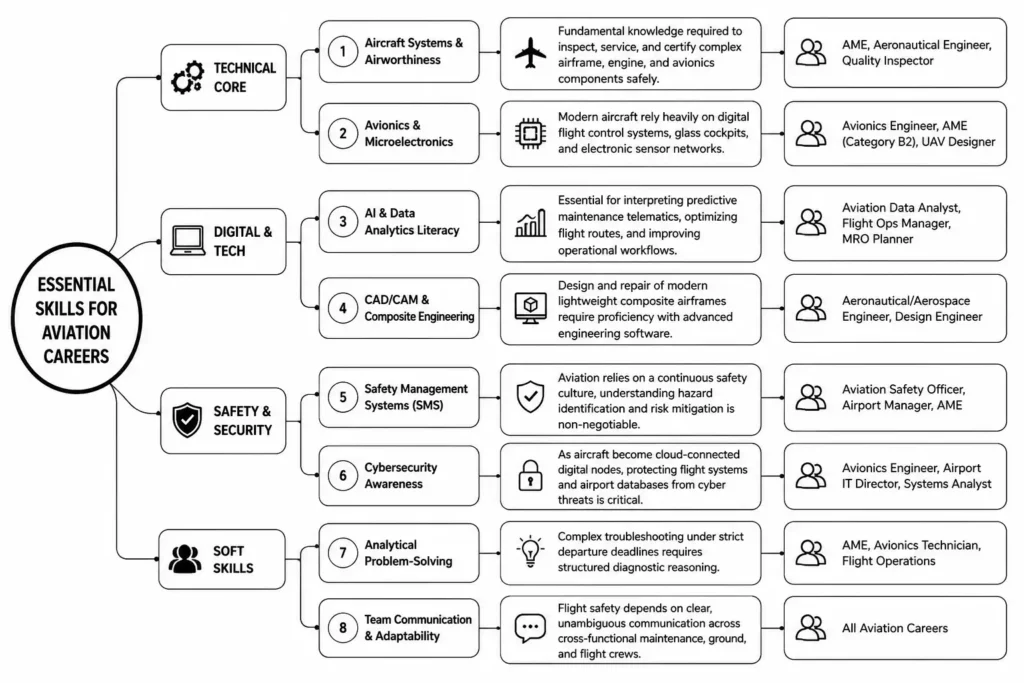
To succeed in the technology-driven aviation ecosystem, prospective professionals must combine technical domain mastery with key soft skills and digital capabilities:
Best Aviation Courses for the Future
Choosing the right educational pathway depends on a student’s career interests, whether in technical aircraft maintenance, engineering design, airport management, or software integration.
| EDUCATIONAL PATHWAYS IN AVIATION | ||
|---|---|---|
| Goal | Course Pathway | Regulatory / Focus |
| Maintenance & Certification | AME (Aircraft Maintenance Engineering) | DGCA / EASA CAR 147 Licensed Certification |
| Aircraft Design & Manufacturing | B.Tech. Aeronautical / Aerospace Engineering | AICTE / University Degree Program |
| Dual Technical Advantage | Integrated B.Tech + AME | Combined Degree + License Preparation |
| Airport & Airline Operations | BBA / MBA Aviation Management | Business Operations & Logistics |
1. Aircraft Maintenance Engineering (AME)
- Overview: A specialized training program structured under DGCA (Directorate General of Civil Aviation) or EASA guidelines.
- Key Focus: Airframe structures, jet engine systems, avionics, electrical instruments, maintenance safety practices, and practical hangar experience.
- Best Suited For: Students (10+2 PCM) who want a practical hands-on career inspecting, servicing, and issuing certificates of release to service for commercial aircraft.
2. B.Tech in Aeronautical Engineering
- Overview: A four-year academic degree program focusing on the design, analysis, and testing of atmospheric aircraft.
- Key Focus: Aerodynamics, fluid mechanics, propulsion, flight mechanics, structural dynamics, and aircraft materials.
- Best Suited For: Students interested in aircraft manufacturing, structural testing, R&D, and engineering design roles.
3. B.Tech in Aerospace Engineering
- Overview: A comprehensive four-year degree covering atmospheric flight as well as space systems.
- Key Focus: Orbital mechanics, rocket propulsion, satellite systems, advanced composites, and computational fluid dynamics (CFD).
- Best Suited For: Aspirants aiming for careers across commercial aviation, space research, missile defense, and satellite manufacturing.
4. Integrated B.Tech + AME
- Overview: A combined academic and vocational training model designed to provide both a university engineering degree and DGCA AME license preparation.
- Key Focus: Offers students a strong theoretical foundation in aeronautical science alongside practical aircraft maintenance training.
- Best Suited For: Students seeking a multi-faceted skill set that expands their employment opportunities across both aircraft maintenance and engineering design.
5. Aviation Management & Unmanned Aerial Systems (UAS) Programs
- Overview: Specialized degree or diploma programs focusing on airport management, airline business models, or commercial drone technologies.
- Key Focus: Terminal planning, air traffic logistics, drone assembly, BVLOS flight rules, and geospatial mapping.
- Best Suited For: Candidates aiming for operational management, airport logistics, or emerging careers in the commercial drone industry.
Aviation Industry Outlook 2026–2030
Looking beyond 2026, the global aviation industry will progress through two distinct phases of growth and technological evolution:
Near-Term Outlook (2026–2027)
- Rapid Fleet Integration: Airlines will focus on taking delivery of fuel-efficient narrowbody models (A320neo family, Boeing 737 MAX) to meet strong domestic travel demand.
- Expansion of Domestic MROs: In India, new hangar infrastructure and engine overhaul lines will open, keeping a larger share of maintenance work within domestic borders.
- Smart Airport Operations: Widespread adoption of biometric boarding systems, automated baggage sorting, and digital ramp management across major hubs.
- Drone Logistics Scaling: Initial expansion of commercial BVLOS drone deliveries for medical supplies and priority cargo along designated aerial corridors.
Medium-Term Outlook (2028–2030)
- SAF Production Scaling: Sustainable aviation fuel production will expand globally, driven by regulatory mandates and lower production costs.
- Initial Commercial AAM Operations: Certified eVTOL air taxis will launch initial commercial routes in select metropolitan hubs under controlled air traffic management frameworks.
- Advanced Digital Twins: Widespread deployment of full-airport and fleet-level digital twins, enabling real-time automated resource allocation and predictive maintenance tracking.
- Indigenous Manufacturing Maturity: Expanded domestic production of aerospace components and assembly lines in emerging hubs, increasing local defense and civil aerospace output.
Key Challenges Facing the Aviation Industry
A complete analysis of the Aviation Industry Outlook 2026 must acknowledge the structural challenges and operational bottlenecks facing the sector:
| KEY AVIATION INDUSTRY CHALLENGES | |
|---|---|
| Fuel & Cost Volatility | Jet fuel (ATF) represents 30-40% of costs; foreign exchange fluctuations impact margins |
| Supply Chain & Parts | Global delays in engine spares and structural components extend maintenance downtime |
| Skilled Labor Shortages | Rising global demand for certified AMEs, avionics specialists, and experienced pilots |
| Infrastructure Pressure | Metro airside congestion requires greenfield airport completions to keep pace with demand |
| Cyber & Data Security | Increasing network connectivity exposes smart airports and fleet software to cyber security risks |
- Fuel Price Volatility & Operating Margins: Aviation Turbine Fuel (ATF) remains one of the largest cost components for airlines. Fluctuations in crude oil prices directly impact profitability and ticket prices.
- Global Supply Chain Bottlenecks: Aircraft manufacturing and MRO turnarounds continue to experience delays due to shortages in engine components, specialized raw materials, and precision micro-electronics.
- Skilled Workforce Shortages: The rapid growth of global aircraft fleets has created strong demand for qualified Aircraft Maintenance Engineers, avionics technicians, and aeronautical engineers, underscoring the need for quality aviation training institutes.
- Airspace & Terminal Congestion: Popular air travel corridors and major metropolitan terminals face capacity limits, making greenfield airport developments and modernized air traffic management essential.
- Cybersecurity Risks: As flight control systems, smart airport terminals, and airline networks become fully interconnected, robust cybersecurity infrastructure is critical to protect sensitive aviation data and operations.
Frequently Asked Questions
What is the aviation industry outlook for 2026?
The aviation industry outlook for 2026 is positive, marked by strong passenger growth, major fleet deliveries, and digital modernization. Airlines and airport operators are focusing heavily on operational efficiency, predictive aircraft maintenance, smart terminal automation, and sustainable fuels to handle expanding global demand while keeping operating costs under control.
What are the biggest aviation trends in 2026?
The top aviation trends in 2026 include AI-driven flight operations, predictive aircraft maintenance, expanded Sustainable Aviation Fuel (SAF) integration, smart airport biometrics, indigenous aerospace manufacturing, commercial drone applications, advanced avionics, and the development of Advanced Air Mobility (AAM) aircraft concepts like eVTOLs.
How is AI changing the aviation industry?
AI is transforming aviation by optimizing flight paths to save fuel, analyzing real-time engine telemetry for predictive maintenance, automating passenger handling at smart airports, predicting maintenance schedules before failures occur, and delivering dynamic pricing models for airlines all while supporting high standards of operational safety.
What is the future of aviation in India?
India’s aviation sector is growing rapidly, driven by expanded airline fleets, greenfield airport developments under Gati Shakti and UDAN, supportive government MRO policies, and an increasing emphasis on domestic defense aerospace manufacturing under Atmanirbhar Bharat, creating steady demand for skilled aviation professionals.
What are the future career opportunities in aviation?
Future career opportunities in aviation include licensed Aircraft Maintenance Engineers (AMEs), Aeronautical Engineers, Aerospace Engineers, Avionics Technicians, Smart Airport Managers, UAV/Drone Engineers, Aviation Data Analysts, and MRO Quality Assurance Specialists, spanning both technical maintenance and digital technology management.
Is aviation a good career choice in India?
Yes, aviation offers diverse career opportunities in India due to expanding airline fleets, new regional airports, and domestic MRO hubs. Qualified technical professionals especially licensed AMEs and specialized aeronautical engineers benefit from clear career progression and global job mobility across civil and defense aviation.
Which aviation technologies are growing fastest?
The fastest-growing aviation technologies in 2026 include AI predictive maintenance platforms, contactless biometric processing systems, integrated modular avionics, commercial long-range UAVs, cloud-based flight management architectures, and emerging hybrid-electric propulsion technologies.
What skills will aviation professionals need in the future?
Aviation professionals will need a mix of core mechanical/electrical engineering skills, digital literacy, AI diagnostic tool proficiency, avionics expertise, CAD software mastery, knowledge of Safety Management Systems (SMS), clear communication, and analytical problem-solving abilities.
What is the role of drones in the aviation industry?
Drones perform structural aircraft inspections, infrastructure surveys, parcel delivery, agricultural monitoring, and defense reconnaissance. Their growth is spurring new technical sectors in unmanned aircraft systems (UAS) design, BVLOS flight management, software maintenance, and Unmanned Traffic Management (UTM).
What is the future scope of aircraft maintenance and MRO?
The future scope of MRO is expanding rapidly due to fleet growth and policies encouraging domestic maintenance facilities. Modern MRO relies heavily on predictive data diagnostics, composite repair techniques, digital twin tracking, and automated component testing, driving strong long-term demand for licensed AMEs.
Conclusion
The Aviation Industry Outlook 2026 highlights a sector undergoing significant structural modernization. Driven by advancements in artificial intelligence, predictive maintenance, sustainable aviation fuels, and smart airport technologies, the global civil aviation ecosystem is becoming more efficient, interconnected, and technologically advanced. India’s aviation sector, with its expanding commercial fleets, greenfield airport developments, and growing MRO footprint, stands as a central pillar of this global expansion.
For aspiring engineering students, PCM graduates, and career seekers, this evolving landscape offers exciting pathways. Whether qualifying as a licensed Aircraft Maintenance Engineer, designing next-generation airframes as an Aeronautical Engineer, or managing digital systems at a smart airport, success relies on acquiring quality, industry-aligned education. Building strong technical fundamentals and embracing lifelong learning will empower the next generation of aviation leaders to soar in this dynamic industry.
Build Your Future in Aviation with School of Aeronautics (SOACET)
The Aviation Industry Outlook 2026 highlights a clear reality: the future belongs to highly trained, technically skilled aviation professionals. As airlines expand their fleets and advanced aircraft maintenance technologies transform the global sky, certified expertise has never been more valuable.
At School of Aeronautics (SOACET), we provide industry-aligned educational programs designed to launch your career in this high-growth sector. Explore our recognized programs in Aircraft Maintenance Engineering (AME), B.Tech in Aeronautical Engineering, and specialized dual pathways. Train in modern labs and practical hangar facilities guided by experienced faculty.
Take the first step toward turning your passion for aviation into a rewarding professional career.
- Visit: www.soacet.org
- Explore Programs & Admissions: www.soacet.org/admissions-2026